

Ask any experienced India guide when to do the Golden Triangle and the answer is almost always the same: October to March. But within that six-month window, October holds a specific and underrated position that most first-time visitors overlook in favour of December or January.
October is the month when everything aligns simultaneously — weather, light, crowds, landscape, and the unique cultural energy of India’s greatest festivals — in a way that no other month fully replicates.
This is the complete guide to doing the Golden Triangle tour in October 2026. City by city, week by week, festival by festival — everything you need to understand why October may be the finest month to visit Delhi, Agra, and Jaipur.
Why October Is Different from Every Other Month
The Golden Triangle is best in winter. But “winter” in this context means the entire October–March window, and within that window October is distinct in three specific ways.
It follows the monsoon. Four months of rain have washed the cities clean. The air quality — which deteriorates progressively through the dry months from pollution accumulation — is at its annual best in October. The Taj Mahal’s white marble is at its cleanest and most luminous. The gardens at Fatehpur Sikri, Amber Fort, and the Taj itself are lush and green in a way that bare winter never produces. Delhi’s trees are full-leafed. Jaipur’s sandstone forts glow against a saturated blue sky.
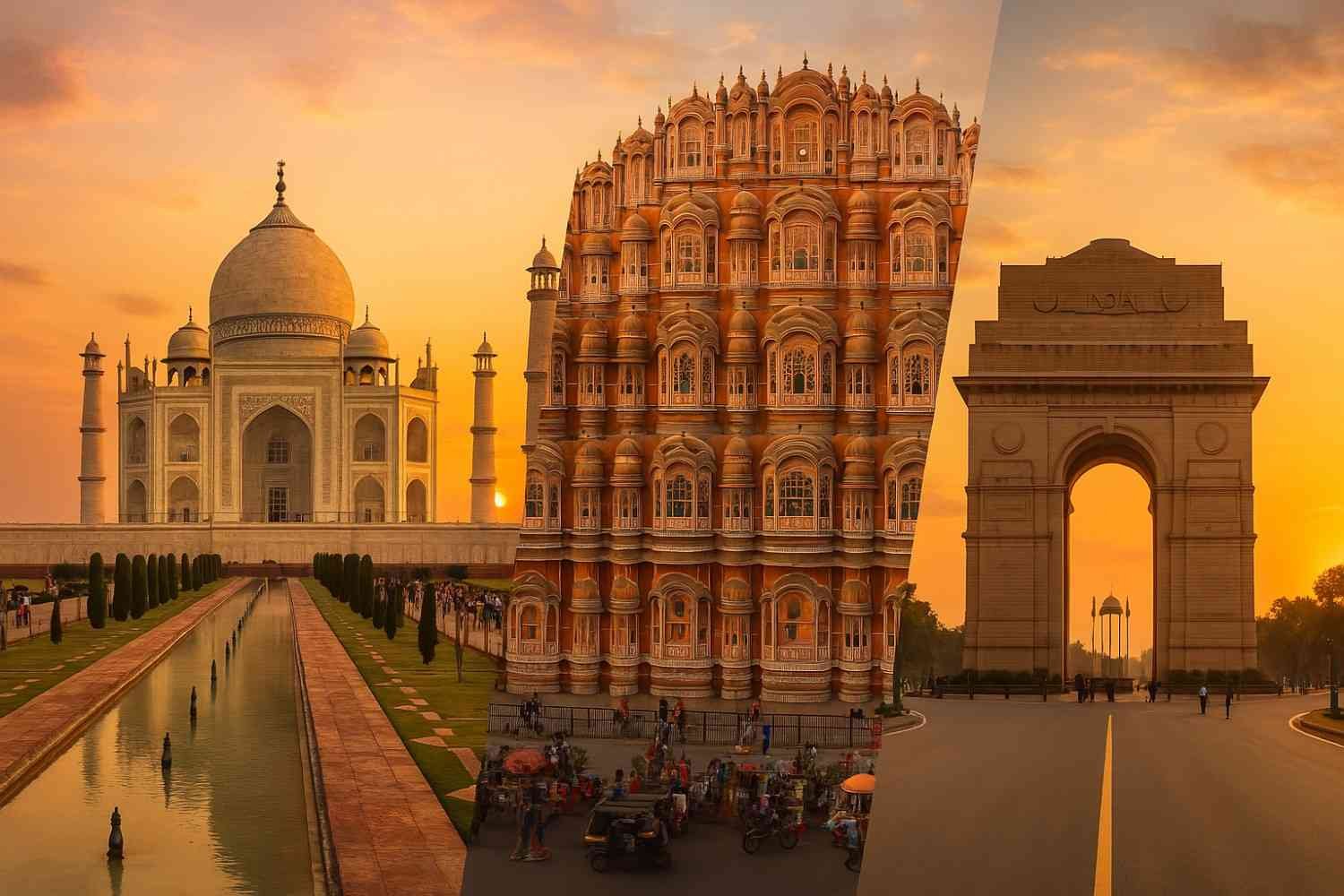
It carries the festivals. Dussehra falls on October 2, 2026 — the very beginning of the month. Diwali falls on November 8, 2026 — just beyond October’s edge but whose build-up transforms every Golden Triangle city through the entire final fortnight of the month. October is when India’s greatest festival season happens, and the Golden Triangle cities celebrate with particular intensity.
It precedes the crowds. December and January bring the highest tourist numbers of the year. November is building toward that peak. October sits just before the surge — offering weather that is already excellent while crowds are still at manageable levels. The Taj Mahal sunrise queue in October is a fraction of what it will be by Christmas week.
October Weather Across the Golden Triangle
Delhi
Delhi in October transforms from the oppressive, humid city of August and September into something genuinely pleasant. Daytime temperatures sit between 28°C and 34°C in the first two weeks — still warm enough to feel summery but without the heat stress of the preceding months. By late October, highs drop to 24–29°C and evenings fall to a cool 16–20°C that requires a light jacket.
The post-monsoon air clarity in Delhi is remarkable. October skies are a deep, saturated blue — the kind that satellite photographs of Delhi show only for this brief window before November pollution begins to build. This matters for photography at Humayun’s Tomb, Qutub Minar, and India Gate, where the monuments against a sharp October sky look their best of the year.
Rain is essentially finished. A brief shower occasionally passes through in the first week of October, but by mid-month Delhi is dry, clear, and settled into the pattern it will hold through the winter.
Agra
Agra in October is the Taj Mahal at its annual best.
The post-monsoon marble clarity effect is significant and specific: four months of rainfall clean the white marble of accumulated pollution and dust, leaving it bright and sharp in a way that the pre-monsoon marble in March or April never quite achieves. Combined with the post-monsoon gardens — which are lush and fully green in October, unlike the dry, yellowing grass of December — the visual experience of the Taj Mahal in October produces the photographs that define most people’s idea of this monument.
Daytime temperatures in Agra follow Delhi’s pattern: 28–33°C early October, dropping to 24–29°C by month’s end. Morning temperatures at the 6:15 AM gate opening sit around 18–22°C — cool enough for a light layer, comfortable for two hours of walking the gardens and mausoleum.
The Taj Mahal in October sees lower crowds than November or December while the weather is already excellent. For everything about visiting the Taj Mahal in October — the best times, photography conditions, and what to expect inside — read our dedicated Taj Mahal in October 2026 guide.
For a complete picture of Agra’s best time to visit across all months, that guide covers every season honestly.
Jaipur
Jaipur in October is exceptional. The Pink City — built in warm, rose-toned sandstone — responds to October’s clear light in a way that makes every fort, palace, and haveli look exactly as they do in the best travel photography.
Amber Fort at sunrise in October, with the fort walls lit in golden light against the blue sky and the surrounding hills still green from the monsoon, is one of the most visually striking experiences on the entire Golden Triangle circuit. The Hawa Mahal in the late afternoon October sun. The City Palace courtyards under a sharp October sky. Jaipur earns every superlative in October.
Temperatures: 26–32°C daytime in early October, 22–28°C by month’s end. Evenings in late October cool noticeably — a shawl is useful at outdoor restaurants after 8 PM.
The pre-Diwali decorations begin appearing on Jaipur’s bazaars from around October 15 onward. By the last week of October, the old city’s markets — Johari Bazaar, Bapu Bazaar, Nehru Bazaar — are strung with lights and alive with shopping energy that is completely unique to this season.
The October Festivals — What They Mean for Your Trip
Dussehra — October 2, 2026
Dussehra marks the victory of Lord Rama over the demon king Ravana — the culmination of the nine-night Navratri festival that precedes it. On Dussehra evening, enormous effigies of Ravana, Kumbhakarna, and Meghnath stuffed with fireworks are burned in parks and grounds across every Golden Triangle city. The burning is dramatic, loud, and genuinely extraordinary to witness.
In Delhi, the Ramlila Maidan hosts one of India’s largest Dussehra celebrations — effigy heights reaching 70–80 feet, crowds of hundreds of thousands, fireworks that turn the night sky orange. The Connaught Place and India Gate areas are particularly vibrant.
In Jaipur, the Dussehra celebrations at the Ram Niwas Bagh and various city grounds attract enormous local crowds. The festive energy in Jaipur’s streets on October 2 is extraordinary — the old city is alive in a way that has nothing to do with tourism and everything to do with genuine celebration.
For your itinerary: If your first day in India falls on October 2, position yourself in either Delhi or Jaipur for the evening. This is one of the great free cultural experiences India offers — no ticket required, just presence.
Navratri (September 25 – October 3, 2026)
The nine nights of Navratri leading up to Dussehra bring Garba and Dandiya dance events to every neighbourhood across the Golden Triangle cities. These traditional circular dances — performed in communal grounds to live music — are among India’s most joyful and participatory festivals. Visitors are invariably welcomed.
Jaipur’s Navratri celebrations are particularly vibrant — the Pink City’s temples are decorated, the evening events run until midnight, and the energy of the old city during this period has a quality that no other time of year produces.
The Diwali Build-Up — Last Two Weeks of October
Diwali 2026 falls on November 8 — just beyond October. But the build-up, which begins in earnest from around October 20, transforms every Golden Triangle city progressively.
Sweet shops in every city start producing and displaying Diwali mithai. Clay diya makers set up stalls throughout bazaars. Markets begin their competitive illumination displays. The festive shopping energy — Indians buying gold, textiles, and gifts — creates a street life intensity that is unlike any other time of year.
In Delhi: Chandni Chowk and Connaught Place begin their illumination displays. The energy of the markets is electric.
In Jaipur: Johari Bazaar — the jewellery market — competes annually to produce the most spectacular light display. By the last week of October, walking through Johari Bazaar after dark is one of India’s great market experiences.
In Agra: The city and the areas surrounding the Taj Mahal begin decorating with diyas and lights. While the Taj itself is not lit for Diwali, the surrounding city in late October has a warm, festive quality that adds an extra layer to an Agra visit.
If your October trip extends into November 8 — or if you want to plan specifically around Diwali — read our complete Diwali 2026 travel guide for everything about celebrating in Jaipur, Delhi, and Agra.
City by City — What to Do in October
Delhi in October
Humayun’s Tomb — the Mughal monument that directly inspired the Taj Mahal and remains one of the most architecturally perfect buildings in India — is exceptional in October’s clear light. The Persian garden surroundings are lush from the monsoon. Go early morning for the best light and fewest crowds.
Qutub Minar — the 12th-century minaret and surrounding archaeological complex are best visited in October’s comfortable temperatures. The complex is largely outdoors and exposed; summer heat makes extended exploration difficult. In October it’s completely comfortable.
Old Delhi — the lanes, markets, and mosque courtyards of the old city are at their most atmospheric in October. The pre-Diwali shopping energy adds an extra dimension to Chandni Chowk that the post-peak-season January visit doesn’t carry.
Lodhi Garden — Delhi’s most beautiful park, with Mughal-era tombs scattered through manicured gardens. October’s green lawns and clear light make this one of Delhi’s finest October experiences. Best at sunrise or the golden hour before sunset.
India Gate — the war memorial on Rajpath is best visited at dusk in any season, but October’s cool evenings make the post-sunset stroll genuinely pleasant.
For a first-time visitor’s complete Delhi guide, read our Delhi travel guide for first-time visitors.
Agra in October
The full Agra circuit in October is one of the Golden Triangle’s finest days:
Taj Mahal at sunrise — arrive at the East Gate by 6:15 AM. October’s golden hour light on the post-monsoon marble, the lush green gardens, the still reflecting pool — this is the Taj Mahal at its annual best. Read the complete Taj Mahal tickets and entry fee guide for everything you need before arriving.
Agra Fort — the UNESCO-listed fort that predates the Taj Mahal by nearly 60 years. October is an excellent time to explore it — comfortable walking temperatures throughout, the red sandstone glowing in the clear October light, and the elevated Yamuna-view terrace giving you the famous view of the Taj across the river in October’s sharp post-monsoon air.
Mehtab Bagh — the Moonlight Garden directly across the Yamuna from the Taj. In October, the river is still running full from the monsoon, making the Taj-across-the-Yamuna view more dramatic than the thin winter trickle. The late afternoon light at Mehtab Bagh in October produces extraordinary Taj photographs. Read more about this and all of Agra’s best stops in our 3 Days in Agra itinerary.
Fatehpur Sikri — the abandoned Mughal capital 37 km from Agra, built by Akbar in 1569 and abandoned within 14 years. October is ideal for exploring this largely outdoor site — comfortable temperatures throughout and the post-monsoon greenery on the surrounding plains makes the drive and the setting particularly beautiful.
From Delhi, the one day Agra tour from Delhi is one of Squid Travel India’s most popular October formats — departing at 5 AM from Delhi, Taj Mahal at sunrise, Agra Fort mid-morning, Mehtab Bagh at sunset, back to Delhi by 9–10 PM.
Jaipur in October
Amber Fort — the hilltop Rajput fort 11 km outside Jaipur is at its most dramatic in October. Sunrise at Amber, with the fort’s walls lit in early morning gold against the blue sky and the Maota Lake below reflecting the complex, is genuinely extraordinary. Climb to the top ramparts for the full view of the surrounding hills — green from the monsoon, sharp and clear in October air.
City Palace — the Maharaja of Jaipur’s palace, partially open as a museum. The Diwan-i-Khas (Hall of Private Audience), with its two enormous silver urns that hold Ganges water for the Maharaja’s travels, is the highlight. October’s comfortable temperatures make the multi-courtyard complex pleasant to explore without rushing.
Hawa Mahal — Jaipur’s iconic “Palace of Winds” facade, built to allow royal women to watch street life without being seen. Best photographed from the street opposite in the morning light (facing east), when October’s directional sun catches the pink sandstone perfectly.
Nahargarh Fort — the hilltop fort overlooking Jaipur from the ridge above the old city. October evenings at Nahargarh, watching the city below begin to light up as dusk falls, are among Jaipur’s best experiences. In the final week of October, as the pre-Diwali illuminations begin in earnest, this view becomes extraordinary.
Jaipur Markets — Johari Bazaar for jewellery and gems, Bapu Bazaar for textiles and handicrafts, and the lanes around the old city’s bazaar for block-print fabrics and blue pottery. October’s pre-Diwali shopping energy makes the markets more alive than at any other time of year.
For a full guide to Jaipur’s attractions, read our top things to do in Jaipur.
October vs December vs November — The Honest Comparison
| October | November | December | |
|---|---|---|---|
| Temperature | 18–33°C (warm to perfect) | 12–28°C (ideal) | 8–22°C (cold mornings) |
| Taj Mahal crowds | Moderate — lower than Nov/Dec | High | Very high |
| Fog at Taj Mahal | None | Rare | Possible from mid-Dec |
| Gardens condition | Lush green — post-monsoon peak | Transitioning | Drying and yellowing |
| Marble clarity | Post-monsoon best | Excellent | Excellent |
| Air quality | Best of the year | Good (declining) | Good (some pollution) |
| Hotel prices | Shoulder (good value) | Peak | Peak + premium |
| Festivals | Dussehra Oct 2, Diwali build-up | Diwali Nov 8, Dev Deepawali | Christmas, New Year |
| Advance booking needed | 6–8 weeks | 3–4 months | 4–6 months |
The table makes October’s position clear: comparable visual quality to November and December, meaningfully lower crowds, better landscape condition, and significantly more affordable accommodation — with the bonus of India’s most spectacular festival season built in.
The one genuine advantage December has: cooler temperatures for those who prefer cold weather. October mornings at 18°C are comfortable; December mornings at 8°C are cold, which some visitors specifically enjoy. If you’re temperature-sensitive, late November to early December edges ahead. For everyone else, October is the answer.
October Golden Triangle — Week by Week Guide
Week 1 (October 1–7) — Dussehra Opening
The first week of October is one of the most exciting times to be in the Golden Triangle. Dussehra falls on October 2, bringing the effigy-burning celebrations to every city. Navratri wraps up with the festival climax. The post-monsoon freshness is at its most vivid — the greenest landscape of the year, the cleanest air, the most luminous Taj marble.
Temperature: 28–34°C days, 20–24°C nights. Warm — particularly in the afternoon — but fully manageable. Heat is not a concern for sightseeing.
Crowds: Lower than any subsequent week of the tourist season. The international tour groups that dominate December and January are mostly still planning their trips. Early October is genuinely uncrowded.
Best for: Travellers who want the best landscape and festival experience with the lowest crowds. Ideally position yourself in Jaipur or Delhi on October 2 for Dussehra night.
Week 2 (October 8–15) — The Sweet Spot
Week 2 is arguably the finest week of the entire October–March season.
The Dussehra energy has settled into a post-festival contentment that fills Indian cities with a warm, relaxed atmosphere. Temperatures are slightly cooler than Week 1 (25–32°C). The landscape is still fully green. Crowds are building slightly from Week 1 but still well below peak season. Ranthambore National Park has been open for a week and tigers are moving freely through the post-monsoon forest — if adding a Ranthambore safari to your itinerary, the second week of October is excellent.
Best for: First-time visitors who want the ideal balance of weather, landscape, and crowds. The single best week of the year for the full Golden Triangle circuit.
Week 3 (October 16–22) — Pre-Diwali Energy Builds
Week 3 brings a new dimension to the Golden Triangle: the pre-Diwali atmosphere. Diwali 2026 falls on November 8 — three weeks away from October 16 — and its build-up is already visible and palpable in every city.
Jaipur’s Johari Bazaar begins its competitive illumination display. Delhi’s markets fill with festive shopping crowds. Sweet shops overflow. Clay diya makers set up stalls throughout the old city lanes of Agra. The evening energy of all three cities shifts into a festive register that is unique to this period.
Temperatures continue to drop comfortably: 23–30°C days, 17–21°C nights. Late evenings cool noticeably — a light jacket is useful after 9 PM.
Best for: Travellers who want the Diwali atmosphere without the Diwali crowds and prices. The pre-festival energy in Week 3 is in many ways richer and more accessible than the main festival itself.
Week 4 (October 23–31) — Late October Perfection
Late October is the closest the Golden Triangle gets to perfection. Temperatures have settled into their most comfortable range (20–28°C days, 14–18°C nights). The pre-Diwali illuminations are now fully established across all three cities — evening walks through Jaipur’s old city and Delhi’s markets are extraordinary. Amber Fort at sunrise in late October conditions is one of the Golden Triangle’s finest visual experiences.
October half-term for UK families typically falls in this week — it’s worth noting that late October combines the best weather with the most festival atmosphere and is one of our most popular booking windows for British families.
Best for: Late October is ideal for everyone — families on October half-term, couples wanting the festival atmosphere, first-timers who want genuinely comfortable walking temperatures.
What Makes October Special at Each Monument
The Taj Mahal in October
The Taj Mahal in October has a specific and identifiable character that differs from every other month. The post-monsoon marble is its most luminous — clean, bright, and white against a deep blue sky. The gardens are at their annual green peak. The reflecting pool is full and still in the early morning.
Morning light in October — golden angle, clear air, no haze — catches the carved marble reliefs in directional shadow that reveals the monument’s depth and detail more clearly than the flat overhead light of summer or the diffused light of monsoon. Photographers consistently rate October’s light at the Taj as among the finest of the year.
The moonlight viewing tour (open on the full moon and two nights before and after) falls on October 6, 2026. The October full moon viewed from the Taj Mahal complex — in clear post-monsoon air, with the marble glowing in pure moonlight — is one of India’s extraordinary experiences. Book in advance through the ASI office. Read our Taj Mahal tickets and entry fee guide for all booking details.
Amber Fort in October
Amber Fort responds to October light like no other month. The warm rose-gold sandstone catches the low-angle morning sun with a richness that high-summer overhead light suppresses entirely. The hillside gardens that have been lush and green since the monsoon — visible from the fort’s terraces — give the fortress a setting that the bare-hill winter photographs never show.
The fort’s upper ramparts, overlooking the Maota Lake below and the Aravalli hills beyond, provide one of Jaipur’s great October panoramas: green hills, blue sky, warm stone, and the formal garden of the palace complex below.
Humayun’s Tomb in October
Often called the “draft of the Taj Mahal” — the Mughal architectural experiment that directly prefigured Agra’s great monument — Humayun’s Tomb in October benefits from the same post-monsoon clarity as the Taj. The Persian char-bagh garden that surrounds the tomb is lush and green, the sandstone and marble glows against the blue sky, and the surrounding Nizamuddin neighbourhood has the calm, contemplative quality that made it a spiritual centre for centuries.
This is one of Delhi’s most undervisited major monuments. In October, with comfortable temperatures and manageable crowds, take the time to explore it fully rather than rushing through.
The October Golden Triangle + Ranthambore — The Perfect Circuit
October has one additional advantage over November and December that makes it uniquely compelling for wildlife enthusiasts: Ranthambore National Park reopens on October 1 after the monsoon closure.
The park opens fresh from four months of complete rest. Its 80+ tigers have been undisturbed since June 30 — no safari vehicles, no tourists, no human presence. The post-monsoon forest is at its most lush and beautiful. And tigers in early October, according to every experienced naturalist, are more relaxed and visible than at any point in the preceding winter season.
The Golden Triangle + Ranthambore circuit — Delhi (2 nights), Agra (1 night), Ranthambore (2 nights), Jaipur (2 nights) — is Squid Travel India’s most popular October itinerary. It covers three UNESCO World Heritage Sites, the world’s most famous monument, and a Bengal tiger safari in a single 8-day circuit.
For the full October safari guide, read our Ranthambore in October 2026 guide — covering zones, permits, what to expect, and how to book.
Practical Tips for the Golden Triangle in October
Book in Advance — But Not as Far as December
Unlike December, which requires 4–6 months of advance booking, October is manageable with 6–8 weeks of planning. That said:
- Taj Mahal sunrise tickets for weekends can sell out 48–72 hours in advance in October — book online through the ASI portal
- Ranthambore safari permits for zones 1–3 in October fill quickly after the October 1 opening — book these as far ahead as possible
- Heritage hotels in Jaipur (Samode Haveli, Alsisar Haveli) book out for Dussehra week specifically — if you want that experience, book early
- October half-term week (typically last week of October) is busy at popular family hotels
What to Pack
Early October (1st–15th): Lightweight breathable clothing for the warm days. A light jacket or fleece for evenings. Sunscreen and sunglasses are still essential — October sun is strong.
Late October (16th–31st): Same daywear but add a proper light jacket for evenings and early mornings. The 6 AM Taj Mahal visit in late October at 16–18°C requires a layer at the start. By 8 AM you’ll be shedding it.
For Ranthambore: Earth tones only — khaki, olive, tan. No bright colours. Layers for the 6:30 AM jeep departure. Binoculars are strongly recommended.
Air Quality Awareness
October air quality across the Golden Triangle is the best of the entire year — the post-monsoon atmosphere is clear and clean. However, from the final week of October, as Diwali approaches and crop-burning begins in surrounding agricultural areas, air quality begins to deteriorate in Delhi specifically. This usually remains manageable through October but worsens significantly around the Diwali main night (November 8) and for several days afterward.
If respiratory sensitivity is a concern, the first three weeks of October are the safest window. For a guide to the one time of year when visiting the Taj Mahal should genuinely be avoided, read our worst time to visit Agra and the Taj Mahal guide.
Getting Around
The three Golden Triangle cities are connected by excellent road and rail. A private car on the Yamuna Expressway (Delhi to Agra, 3.5 hours) is the most flexible option and the standard choice for Squid Travel India’s October tours. Agra to Jaipur by road (4–4.5 hours via NH-21 through Fatehpur Sikri and Bharatpur) is a natural route that adds the Fatehpur Sikri stop organically.
Alternatively, the Golden Triangle by car guide covers all the transport options in detail.
October Golden Triangle Itineraries
5 Days — The Classic Circuit
The most popular format for first-time visitors.
Day 1: Arrive Delhi. Lodhi Garden afternoon. Old Delhi dinner. Day 2: Delhi — Humayun’s Tomb, Qutub Minar, India Gate. Dussehra (if October 2) or pre-Diwali market evening. Day 3: Drive to Agra (5 AM departure). Taj Mahal at sunrise. Agra Fort. Mehtab Bagh sunset. Day 4: Drive to Jaipur via Fatehpur Sikri. Arrive afternoon. Nahargarh Fort sunset view. Day 5: Amber Fort sunrise. City Palace. Hawa Mahal. Johari Bazaar evening. Return Delhi.
See our 4-day Golden Triangle package for the standard itinerary format.
8 Days — Golden Triangle + Ranthambore
Days 1–2: Delhi Day 3: Agra — Taj Mahal at sunrise, Agra Fort Days 4–5: Ranthambore — two safari sessions Days 6–7: Jaipur Day 8: Return Delhi
This is Squid Travel India’s most-booked October itinerary. See our how to plan a Golden Triangle tour guide for planning details.
10 Days — Grand October Circuit
Days 1–2: Delhi Day 3: Agra Days 4–5: Ranthambore Days 6–7: Jaipur Days 8–9: Udaipur (fly or drive) Day 10: Return Delhi
For couples, this extended circuit adds Udaipur’s Lake Palace and romantic lakeside setting — particularly atmospheric in the pre-Diwali season. For more on the Golden Triangle for couples, that guide covers the best romantic additions to the classic circuit.
Who Should Come in October
First-time international visitors who want the best single-month experience of India without peak-season prices or December’s fog risk. October gives you everything the Golden Triangle offers, optimised.
Families — particularly those with UK school-age children on October half-term. The weather is comfortable for children, the festivals are engaging and accessible, and Ranthambore’s tiger safari is one of the finest children’s wildlife experiences on earth.
Photographers who want the best light conditions. The post-monsoon clarity, lush gardens, and absence of fog make October’s photography conditions superior to any other month.
Wildlife enthusiasts who want to combine the Taj Mahal with Ranthambore. October 1 is the park’s opening day — the first opportunity of the season to see India’s tigers in their natural habitat.
Festival travellers who want India’s greatest cultural events without the main Diwali crowds and prices. October carries Dussehra and the Diwali build-up in a form that is fully accessible without the specific logistical challenges of the main festival weekend.
Book Your October Golden Triangle Tour
Squid Travel India has been running Golden Triangle tours in October for over a decade. It’s consistently our most rewarding month — the combination of post-monsoon landscape beauty, festival energy, manageable crowds, and the natural tie-in with Ranthambore’s season opening makes October Golden Triangle tours some of the finest experiences we deliver all year.
Every booking includes private AC transport, a licensed English-speaking guide for each city, advance Taj Mahal and fort entry bookings, accommodation at carefully selected hotels, and 24/7 support throughout your trip.
We’ve completed over 1,800 tours with a 98% satisfaction rate and TripAdvisor Travelers’ Choice recognition for 2024–25.
Plan your October Golden Triangle tour with Squid Travel India → Call us: +91 9990812499
Quick Reference — October Golden Triangle
| Details | |
|---|---|
| Temperature range | 18–34°C (early Oct); 14–28°C (late Oct) |
| Rain days | 0–2 (early Oct only) |
| Taj Mahal gate opening | ~6:15 AM (30 min before sunrise) |
| Taj Mahal closed | Every Friday |
| October Fridays 2026 | Oct 2, 9, 16, 23, 30 |
| Dussehra 2026 | October 2 |
| Navratri | September 25 – October 3 |
| Diwali 2026 | November 8 (build-up from Oct 20) |
| Full moon moonlight tour | October 6 |
| Ranthambore opens | October 1 |
| Crowd level | Moderate — lower than Nov/Dec |
| Hotel pricing | Shoulder — below peak season |
| Advance booking needed | 6–8 weeks |
| Best week | October 8–15 |
Squid Travel India is a New Delhi-based, award-winning tour operator specialising in Golden Triangle tours, Rajasthan packages, wildlife safaris, South India and Kerala tours. We’ve run Golden Triangle tours in October every year since 2013.
Comment (0)