

The Honest Answer First
October is one of the two finest months to visit the Taj Mahal.
The other is February. Both months deliver near-perfect conditions — clear sky, vivid marble, comfortable temperatures, and manageable crowds. But October has something February cannot offer in 2026: Navratri runs October 11 to 19, Dussehra falls on October 20, and Diwali is just eighteen days away on November 8. Visiting the Taj Mahal in October means doing so within India’s most concentrated festival season.
The monument itself is extraordinary year-round. But October is the month when the post-monsoon atmosphere clears completely, the sky turns a deep and saturated blue, and the Taj Mahal’s white Makrana marble appears against that sky in the sharpest and most vivid form available in any month except the brief clarity window of February.
This guide covers everything you need for a Taj Mahal visit in October 2026 — weather, crowds, timings, entry fees, what the monument looks like in this month, and how to build your Agra visit into a Golden Triangle itinerary.
Is the Taj Mahal Open in October?
Yes. Fully open.
The Taj Mahal is open 365 days a year — with one weekly exception. The Taj Mahal closes every Friday for prayers at the mosque within the complex. In October 2026, Fridays fall on October 2, 9, 16, 23, and 30. Schedule your Agra visit on any other day of the week.
October 20 is Dussehra — a national public holiday. The Taj Mahal is open on Dussehra. It is also a popular day for domestic visitors, so October 20 will be busier than a typical weekday. If your itinerary is flexible, visiting October 21 or 22 gives you better conditions.
Gates open 30 minutes before sunrise — approximately 5:30 AM in early October, shifting to around 5:45 AM by late October as the sunrise moves later. The monument closes 30 minutes before sunset.
Complete entry information: Taj Mahal Tickets, Timings & Entry Fee 2026 — exact prices, how to book online, and what the mausoleum add-on includes.
October Weather at the Taj Mahal
October is the month when Agra’s weather makes the turn from hot and humid to cool and perfect. Understanding the difference between early and late October helps you set the right expectations.
Early October (October 1 to 15): The monsoon has only just ended. The air is mostly clear but early October can carry residual warmth and occasional humidity from the late monsoon tail. Daytime temperatures sit around 28°C to 34°C. Dawn temperatures for the sunrise visit are around 18°C to 22°C — warm enough to be comfortable in light clothing. The gardens are at their most vivid green from the monsoon rains.
Mid October (October 16 to 20): The transition is complete. Temperatures drop noticeably toward 24°C to 32°C during the day. The humidity is gone. The sky is clear and a deep, vivid blue. This is Agra entering its finest season. The evenings cool toward 14°C to 18°C — pleasant for walking the bazaars or sitting at Mehtab Bagh at sunset.
Late October (October 21 to 31): October’s finest stretch for the Taj Mahal. Daytime temperatures 22°C to 28°C. Dawn temperatures 10°C to 16°C — bring a light layer for the sunrise visit. The sky is consistently clear and blue. The marble is at its most vivid. The air quality in Agra is excellent. This is the opening edge of peak season and many experienced India travellers consider late October their preferred window.
One practical note: Agra’s air quality begins to deteriorate in late October due to crop stubble burning in neighbouring states. On some late October days, a haze in the early morning can soften the Taj Mahal’s distant views — particularly the approach shot from the main gateway. This is nothing like the severe fog of December and January, but it is worth knowing. On most days it clears by mid-morning. The vast majority of October visits are completely unaffected.
What the Taj Mahal Looks Like in October
This is the detail most guides miss.
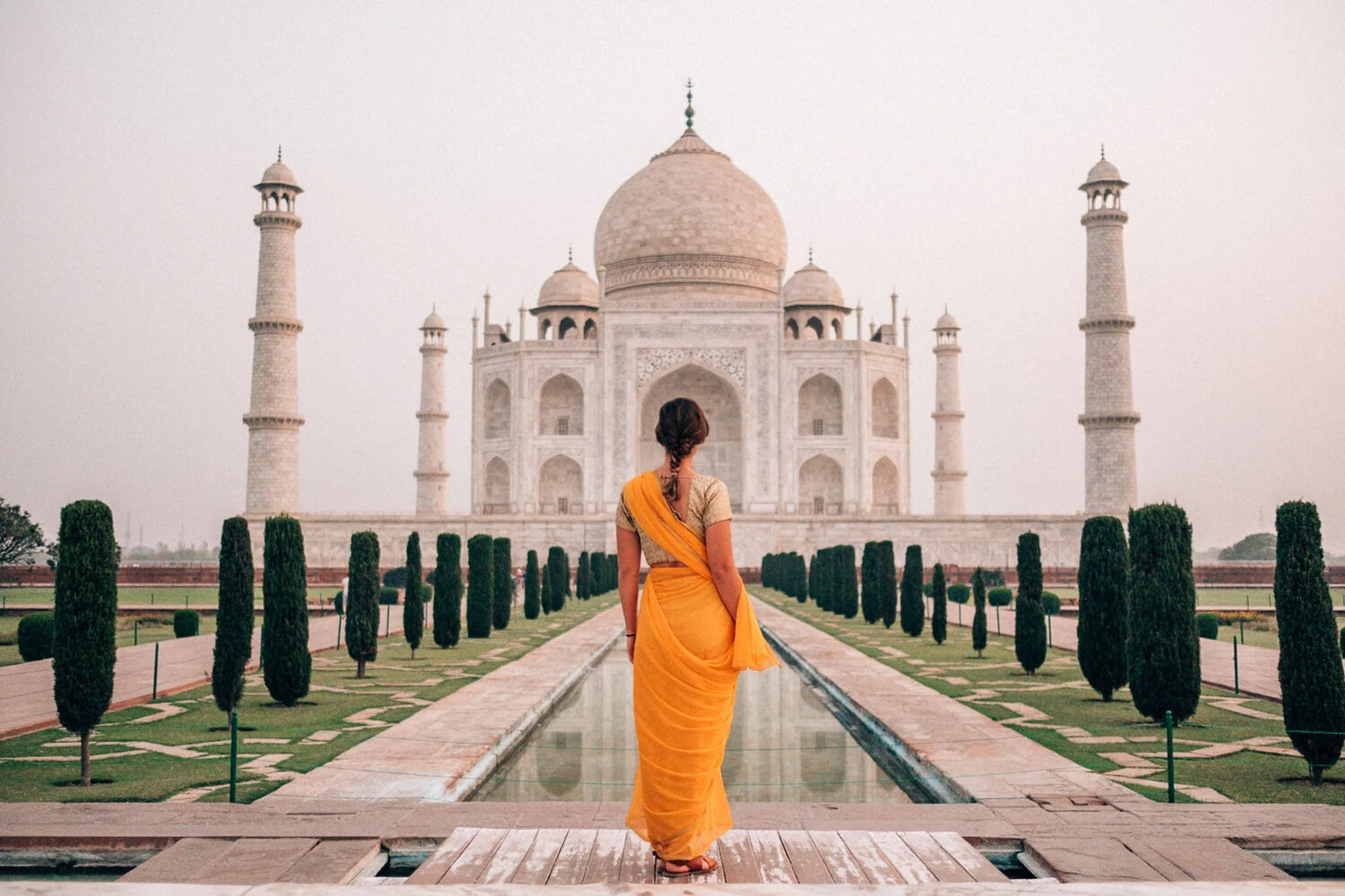
October delivers the blue sky version of the Taj Mahal — the one that looks closest to the most famous photographs ever taken of the monument. After August’s atmospheric monsoon light and September’s soft, diffused sky, October is when the Taj Mahal appears in the sharp, high-contrast form that its white marble was designed to create.
The sky in October over Agra is a vivid, saturated blue. Against it, the white Makrana marble of the Taj Mahal appears with an intensity that is simply not available in the softer skies of August and September. The carved pietra dura inlay — the intricate floral patterns and Quranic calligraphy on every surface — casts clean, defined shadows in October’s direct but not-yet-harsh light.
The gardens in early and mid October are still carrying their monsoon green — lush lawns, full flower beds, cypress trees at their most vigorous. By late October, the green begins to dry and fade toward the golden tones of the cool season. Early to mid October catches this at its peak: vivid green lawns beneath white marble beneath a deep blue sky is one of the finest visual combinations the monument offers.
The reflecting pool in October is full — still carrying the monsoon water through October into November. The pool reflection of the Taj Mahal at sunrise — with the morning sky and white marble perfectly mirrored in still water — is at its most photogenic in the clear October light.
The Yamuna River behind the mausoleum is still running relatively high in early October, providing a fuller river view from the back terrace. By late October it has begun its seasonal drop toward the lower winter level.
How Crowded Is the Taj Mahal in October?
This is the honest answer: building, but not yet intense.
October is the beginning of peak season. Crowds increase throughout the month — early October is quieter than late October, and late October is quieter than November or December. Here is a more specific breakdown.
Early October: Still transitional. International tourists are arriving but domestic holiday season hasn’t fully begun. Weekday mornings at the Taj Mahal in early October are genuinely quiet — you may have the main platform with very few people for the first 30 to 60 minutes after gate opening.
Mid October — Navratri week (October 11 to 19): Navratri is primarily a celebration in Delhi, Jaipur, and Gujarat rather than Agra. The Taj Mahal in Navratri week sees slightly elevated traffic from domestic visitors on holiday, but nothing dramatic. Gate opening visits are still very comfortable.
Dussehra (October 20): National public holiday. The Taj Mahal will be busier than a typical weekday — a meaningful increase in domestic visitors. Still well below December peak levels.
Late October (October 21 to 31): Peak season is clearly established. Weekend visits are noticeably busier than weekdays. The sunrise slot remains the most effective way to beat the crowd — you gain 60 to 90 minutes of relatively uncrowded access before the 8 AM to 3 PM peak.
The overall October picture: manageable and rewarding, particularly for morning visitors. Nothing like the queue-heavy conditions of Christmas week or the Republic Day weekend in late January.
The Best Time of Day to Visit in October
Sunrise — always. But in October it matters slightly less urgently than in August.
In August, the hot-humid-heat window meant you absolutely had to be done by 9 AM. In October, you have more flexibility — the temperature remains comfortable until 11 AM or later by mid-month, and by late October the entire morning is genuinely pleasant.
But the light argument for sunrise remains completely valid year-round.
5:30 to 7:30 AM — The Golden Window. Arrive at gate opening. The sun rises behind the mausoleum and lights the marble from the east as you approach from the south. The reflecting pool is glassy and still. The light is soft, warm, and directional. The first 90 minutes after gate opening deliver the finest photography conditions of the day — the perfect combination of light quality, empty platform, and still reflections.
8:00 to 11:00 AM — Good but building. The marble is well-lit, crowds are growing but still manageable, and the temperature is comfortable throughout October. The reflecting pool photograph becomes harder to compose without visitors in the frame by 9 AM.
11:00 AM to 3:00 PM — Peak heat and crowds. Even in October, the midday sun on the marble platform can be intense and the crowd at its fullest. Use this window for a hotel rest or lunch.
4:00 to 5:30 PM — Second recommended window. The late afternoon light falls from the west, lighting the Taj Mahal’s main facade directly. The soft, golden late-October afternoon light on white marble is genuinely beautiful — a different quality from sunrise but equally worth experiencing. The crowd thins significantly after 3:30 PM as day visitors head back to Delhi. Go to Mehtab Bagh across the Yamuna by 5 PM for the finest external sunset view of the monument.
Entry Fees for October 2026
Entry fees at the Taj Mahal are the same year-round regardless of season.
Foreign nationals pay ₹1,100 for garden access — this covers entry to the complex, the gardens, the mosque, the guest house, and the outer sandstone buildings. To enter the main mausoleum — the central marble chamber where the tombs of Shah Jahan and Mumtaz Mahal are kept — an additional ₹200 mausoleum ticket is required at the mausoleum entrance. Do not skip this. Entering the mausoleum is the heart of the entire visit and the experience inside — the carved marble screens, the inlaid tombs, the soft light filtering through the marble lattice — is what the monument is actually about.
Indian nationals pay ₹50 for garden access plus ₹200 for the mausoleum. Children under 15 enter free regardless of nationality.
Book online in advance. Walk-in tickets are available at the gate — but the online booking system saves time, guarantees your ticket, and provides a QR code for direct gate entry. In October, particularly around Dussehra week, the walk-in queue can be long. Online tickets eliminate the queue entirely.
The single-entry policy applies year-round — once your QR code has been scanned and you exit the turnstiles, your ticket is void. Plan your entire visit before you go in.
What Else to Do in Agra in October
Agra Fort
India’s second UNESCO World Heritage Site in Agra — just 2.5 km from the Taj Mahal. The massive red sandstone fortress was the primary Mughal seat of power before Shahjahanabad (Old Delhi) was built. October is one of the finest months to visit — the sandstone glows amber in the October afternoon light, and the ramparts looking toward the Taj Mahal across the Yamuna are extraordinary at this time of year.
The fort is typically visited after the morning Taj Mahal session — arriving around 9 to 10 AM before the midday heat and spending two hours exploring the Diwan-i-Am, Diwan-i-Khas, Khas Mahal, and the famous viewpoint looking toward the distant Taj Mahal.
Mehtab Bagh at Sunset
The garden on the opposite bank of the Yamuna river from the Taj Mahal. This is the finest external viewpoint for the monument at sunset — and in October, the Yamuna is still relatively full from the monsoon, providing the most reflective foreground to the Taj Mahal in the evening light.
Arrive at Mehtab Bagh at 4:30 PM. Walk to the central viewing platform. As the sun drops behind you, the Taj Mahal ahead turns from white to gold to pale pink. By 5:30 PM the light is extraordinary. Stay until after dark if the mood takes you — the Taj Mahal in the first stars of an October night, lit from within by its own white marble, is genuinely beautiful.
Fatehpur Sikri
The abandoned Mughal capital 40 km from Agra — built by Emperor Akbar in 1571 and deserted 14 years later, leaving a perfectly preserved red sandstone ghost city. October light on the red sandstone of Fatehpur Sikri is outstanding — warm, directional, and casting clean shadows across the carved detail of the Diwan-i-Am, the Panch Mahal, and the Buland Darwaza (the largest gateway in Asia). Allow 2 to 2.5 hours.
Itmad-ud-Daulah — The Baby Taj
The small, exquisitely carved white marble tomb across the Yamuna — predating the Taj Mahal and considered its architectural predecessor. Almost always overlooked. Almost always near-empty. In October, the garden surrounding it is still carrying its monsoon green. Allow 30 to 45 minutes and combine with a Mehtab Bagh visit in the same afternoon session.
Agra in October as Part of the Golden Triangle
October is the finest month for the Golden Triangle overall — and Agra is its centrepiece.
The route most commonly taken is Delhi → Agra → Jaipur, spending one night in Agra for the Taj Mahal sunrise and one afternoon at Agra Fort. For those who want more depth, a two-night Agra stay allows the following structure: arrival afternoon with Mehtab Bagh sunset, Taj Mahal at sunrise on day two, Agra Fort mid-morning, and Fatehpur Sikri on the drive toward Jaipur.
October’s festival calendar enhances the Golden Triangle significantly. Navratri Ramlila performances in Delhi from October 11 to 19 add evening cultural depth to the Delhi leg. Dussehra in Delhi or Jaipur on October 20 is extraordinary. And Diwali on November 8 — eighteen days after Dussehra — means extending the trip to November gives you the complete festival arc.
Full planning resources:
Same-Day Agra from Delhi in October
A same-day trip from Delhi to Agra is entirely manageable in October — and October is one of the best months for it. The weather is cool enough that a full morning at the Taj Mahal and afternoon at Agra Fort is comfortable rather than draining.
The Gatimaan Express from Delhi Hazrat Nizamuddin to Agra Cantonment covers the distance in 1 hour 40 minutes and is the finest option — clean, comfortable, reliable, and fast. Trains depart Delhi at 8:10 AM and arrive Agra at 9:50 AM. This timing does not allow a sunrise Taj Mahal visit — but it does give you a full morning at the monument before the worst of the midday crowds.
A private car from Delhi takes 3 to 3.5 hours on the Yamuna Expressway. For a sunrise visit, departure from Delhi at 4:30 AM or 5:00 AM allows gate opening arrival. For a morning visit rather than sunrise, departure at 6:00 to 6:30 AM gives you arrival in time for the 9:30 AM to 11:30 AM window.
Arrange your Agra day trip: Same Day Agra Tour from Delhi — early morning pickup, pre-booked tickets, licensed guide, and comfortable private transport.
October vs November at the Taj Mahal
This is the most practical comparison for travellers choosing between the two months.
October advantages: the post-monsoon gardens are still at their most vivid green. Early and mid October has slightly lower crowd levels than November. If Dussehra is a priority, October 20 places you in the right month.
November advantages: cooler temperatures throughout — ideal for all-day outdoor sightseeing without the midday warmth of early October. Diwali on November 8 is the finest single night in the India festival calendar, and being in Jaipur on November 8 while visiting the Taj Mahal the morning before is the most memorable Golden Triangle sequence available in 2026.
The honest verdict: late October (after October 20) and early November are essentially the same quality of experience at the Taj Mahal — excellent weather, excellent marble clarity, growing but manageable crowds. October costs 15 to 25% less than November in hotels. November has Diwali. Choose based on which festival — Dussehra or Diwali — you want to build your trip around.
November in full detail: India in November 2026 — Diwali, Dev Deepawali & Complete Guide
Practical Tips for October at the Taj Mahal
Dress in layers for the sunrise visit. Early October dawn temperatures are 18°C to 22°C — comfortable in light clothing. Late October dawns drop to 10°C to 15°C — a light jacket or fleece is needed for the open platform at 6 AM. By 9 AM it is warm and you will be removing it.
Shoes off at the plinth. Shoes must be removed before stepping onto the white marble platform surrounding the main mausoleum. Shoe covers are provided free of charge. Wear footwear that is easy to slip off.
No photography inside the mausoleum. Photography anywhere in the complex grounds and on the marble platform is freely permitted. Photography inside the mausoleum chamber — at the actual tombs — is not. Security will politely but firmly ask you to put your camera away before entering.
Book tickets online. The official ASI portal is the only authorised booking site. Tickets must be bought in advance for specific dates. In October, particularly around Dussehra week, online advance booking avoids long gate queues.
The single-entry rule. Once your ticket has been scanned and you exit, it is void. Plan your full visit before entering — including the mausoleum, the mosque, the guest house, and the back terrace overlooking the Yamuna.
Water and sunscreen. Even in October, the Taj Mahal’s marble platform reflects the sun significantly. Carry at least one litre of water and sunscreen SPF 50+ — UV radiation in October on a reflective white marble surface is more intense than it appears.
Frequently Asked Questions
Is October a good time to visit the Taj Mahal?
October is one of the two finest months to visit the Taj Mahal. The post-monsoon sky is clear and vivid blue. The white marble appears at its most brilliant. Temperatures are comfortable throughout the day. Crowds are building but well below December to January peak.
What is the weather like at the Taj Mahal in October?
Early October: 28°C to 34°C days, 18°C to 22°C at dawn. Late October: 22°C to 28°C days, 10°C to 15°C at dawn. Skies are clear and dry throughout. No rain risk. Excellent outdoor conditions from sunrise through mid-morning, cooling again from 4 PM onwards.
How crowded is the Taj Mahal in October?
Busier than September but well below December to February peak. Early October mornings at gate opening are genuinely quiet. Dussehra (October 20) brings higher domestic traffic. Sunrise visits across October remain the most reliably uncrowded window.
Is the Taj Mahal more beautiful in October than other months?
October and February are the two months that deliver the most vivid version of the Taj Mahal — the clear, saturated blue sky against white marble at its sharpest. August and September have their own atmospheric beauty but a different quality of light. November and December are also excellent. October is genuinely one of the finest months.
Can I visit the Taj Mahal on Dussehra (October 20)?
Yes. Dussehra is a national public holiday but the Taj Mahal is open. It will be busier than a typical weekday due to domestic visitors on holiday. Arriving at gate opening on October 20 morning still gives you excellent conditions.
What time does the Taj Mahal open in October?
Approximately 5:30 AM in early October (30 minutes before sunrise). This moves to approximately 5:45 AM by late October as sunrise shifts later. Check the exact gate opening time against sunrise for your specific visit date.
How much does it cost to visit the Taj Mahal in October 2026?
Entry fees are the same year-round. Foreign nationals pay ₹1,100 for garden access plus ₹200 for the mausoleum add-on (essential — do not skip). Indian nationals pay ₹50 plus ₹200 for the mausoleum. Children under 15 enter free. Book online at the official ASI portal.
Plan Your October Agra Visit with Squid Travel India
October is one of our busiest months at Squid Travel India — and with good reason. The Taj Mahal in October conditions, combined with Navratri, Dussehra, and the approaching Diwali, makes this one of the richest India travel periods available.
We pre-book Taj Mahal tickets months in advance so our clients never queue at the gate. We build Golden Triangle itineraries timed around festival dates — so your Delhi days fall during Navratri Ramlila performances and your Jaipur days include Dussehra or Diwali. Every detail is handled from the first pickup to the final drop.
Tell us your travel dates and we will build your October Agra and Golden Triangle itinerary within 24 hours.
Also worth reading:
- Best Time to Visit Agra & Taj Mahal 2026
- Taj Mahal Tickets, Timings & Entry Fee 2026
- Golden Triangle Tour from Delhi
- India in October 2026
- Dussehra 2026 — Where to Celebrate
- India in November 2026
📞 Call / WhatsApp: +91 9990812499 📧 Email: Squidtravelindia@gmail.com 🌐 Visit: squidtravelindia.com
1,800+ trips completed | 98% happy clients | TripAdvisor Travelers’ Choice 2024–2025
Last updated: September 2026. Taj Mahal entry fees and timings are subject to change. Always verify at the official ASI portal before your visit.

Comment (1)