

The Question Everyone Asks — And the Honest Answer
Every August, thousands of travellers land in India with a tight schedule and the same question: should I go to Agra in the monsoon?
Most travel guides tell you to avoid it. They say August is too hot, too wet, too humid. They say wait for October or November when the weather is perfect and the sky is blue.
Here is the honest answer: they are not entirely wrong — but they are missing the point.
Agra in August is not the most comfortable version of Agra. But it is one of the most beautiful, most affordable, and least crowded versions. The white marble of the Taj Mahal glistens after rain. The gardens inside the complex are at their most vivid and green. The dramatic monsoon sky — deep grey clouds rolling behind the white dome — produces photographs that look nothing like the typical postcard. And you share the monument with a fraction of the December or January crowd.
If you are visiting India in August and wondering whether to include Agra — the answer is yes. But you need to plan it right. This guide tells you exactly how.
Agra Weather in August 2026: What to Actually Expect
August is the heart of monsoon season in Agra. Here is what that means in practice.
Temperatures in August typically range from 28°C to 36°C during the day. It sounds hot — and it is. But compare that to the 42°C to 47°C of May and June, and August starts to feel almost manageable. The monsoon rains bring the temperature down significantly from the brutal summer peak.
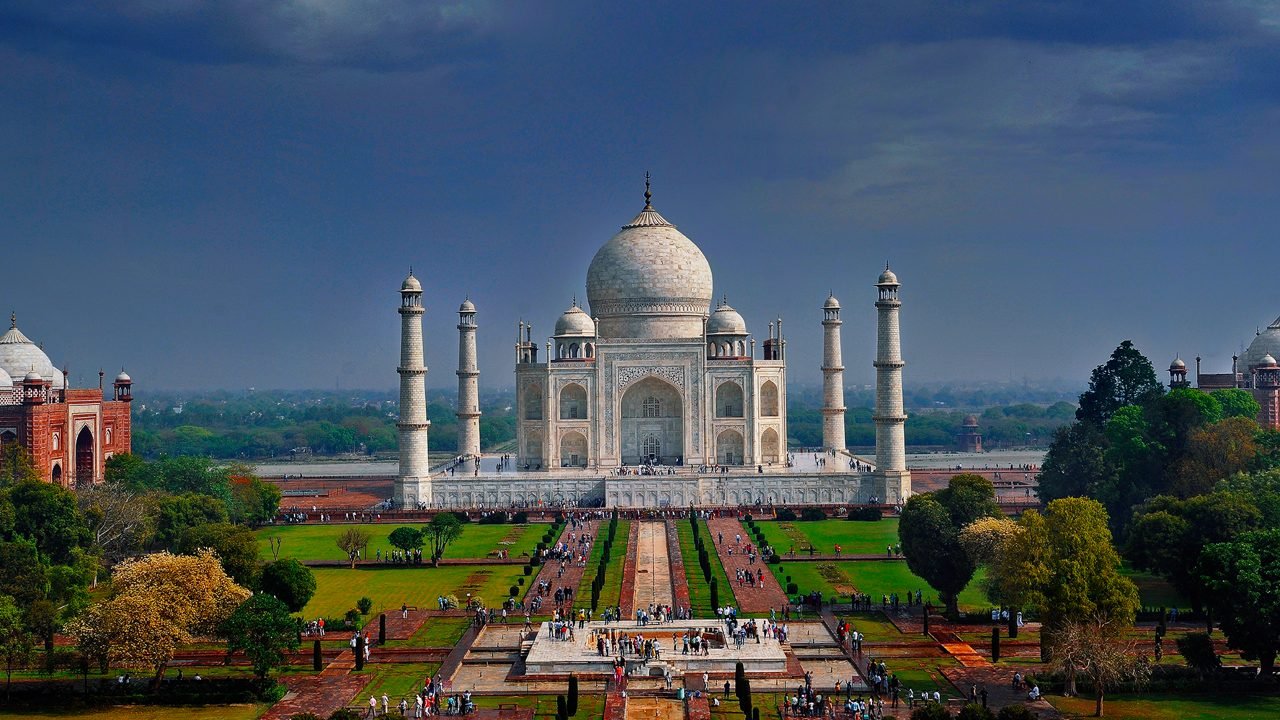
Rain in Agra in August does not mean constant, all-day downpours. The pattern is typically heavy showers — often in the afternoon or evening — followed by clear or partly cloudy periods. Most rain arrives between 2 PM and 5 PM. Mornings are frequently clear, humid, and warm — and this is the most important fact for planning your Taj Mahal visit.
Humidity is the biggest challenge. August mornings at the Taj Mahal are warm and sticky — plan for it. Wear light, quick-dry fabrics. Carry water. Avoid checking the humidity reading if you are sensitive to such things.
The good news: Agra receives most of its annual rainfall (roughly 670 mm) between July and September, with much of it coming at night or in the late afternoon. Travellers who have visited in August consistently report that the rain disrupted their plans far less than they expected. Most mornings are workable. Early risers — the 5:30 AM to 8:30 AM window — almost always get a clear visit.
Is the Taj Mahal Open in August?
Yes. Fully open.
The Taj Mahal operates year-round through every season including monsoon. It is open from 30 minutes before sunrise to 30 minutes before sunset, seven days a week — with one exception. The Taj Mahal is closed every Friday. In August 2026, Fridays fall on August 7, 14, 21, and 28. Plan your Agra visit on any other day of the week.
August 15 (Independence Day) is a national holiday but not a Friday in 2026 — the Taj Mahal will be fully open. Entry may be free for Indian nationals on Independence Day, though this is announced by the ASI closer to the date. Read our dedicated Independence Day guide for full details.
Tickets and timings: See our Taj Mahal Tickets, Timings & Entry Fee 2026 guide for exact entry fees, online booking, and what is included.
The 5 Honest Reasons to Visit Agra in August
1. The Fewest Crowds of the Year
August is peak monsoon season — which means it is the least crowded time to visit the Taj Mahal. While December sees the monument at its busiest with long ticket queues and shoulder-to-shoulder visitors at the reflection pool, August delivers a near-private experience.
Arriving at gate opening on a weekday morning in August, you may have the main platform almost entirely to yourself for the first thirty to sixty minutes. For photographers, solo travellers, and honeymooners who want an intimate experience, this is genuinely extraordinary. The famous reflection pool shot — near-impossible without strangers walking through it on a December morning — is yours to compose in August.
2. Hotel Prices Drop by 40 to 60 Percent
This is the most compelling practical argument for August Agra.
Budget guesthouses in Taj Ganj — the main traveller neighbourhood near the monument — drop from ₹4,000 to ₹5,000 in December to ₹1,500 to ₹2,000 in August. Mid-range hotels that cost ₹8,000 to ₹12,000 per night in peak season can be found for ₹4,000 to ₹6,000. The Oberoi Amarvilas — widely considered the finest hotel in Agra, with Taj Mahal views from every room — offers significantly better rates in August than at any point between October and March.
If budget is a consideration, August delivers the same Taj Mahal for a fraction of the cost.
3. The Monsoon Makes the Marble Gleam
This is the most underrated fact about visiting Agra in August.
After rain — particularly the light showers that clear quickly in the mornings — the Taj Mahal’s white Makrana marble appears freshly washed. It has a luminous quality in the soft, diffused monsoon light that it does not have in the harsh direct sun of March or the dusty haze of early October. The gardens inside the complex are at their greenest and most lush. The fountains in the central pool are full. The lawns are vivid.
The overall effect is of a monument that looks newly built — clean, glowing, and almost impossibly beautiful against the dramatic grey and green monsoon backdrop.
4. Dramatic Sky Photography
Many of the most striking photographs ever taken of the Taj Mahal were shot in monsoon season.
In November and February — the most recommended months — you get a deep blue sky and brilliant white marble. Beautiful, classic, postcard-perfect. In August, you get something entirely different: deep charcoal clouds moving behind the white dome, dramatic lighting that shifts every few minutes, and the possibility of the monument emerging through light rain with the gardens reflecting off wet marble surfaces.
If you visit the Taj Mahal in August and it rains lightly while you are inside — do not run for shelter. Stay. Watch what the rain does to the light and the marble. Some of the most spectacular Taj photographs have been taken in exactly this moment.
5. Mehtab Bagh at Its Best
Mehtab Bagh is the garden on the opposite bank of the Yamuna river from the Taj Mahal — and the finest viewpoint for sunset photography of the monument from the outside. In August, the Yamuna river rises to its fullest level of the year. The river, reflecting the Taj Mahal, with monsoon clouds in the sky above — is genuinely extraordinary.
This view is almost unknown outside serious India photography circles. In August, it is at its most dramatic and most beautiful. Go at 5:00 PM and stay until the gates close at sunset.
The 3 Honest Challenges of August Agra
1. Humidity is Real
There is no softening this. August mornings at the Taj Mahal are hot and sticky. By 8 AM you will be sweating, regardless of how lightly you are dressed. Carry at least two litres of water for your visit. Wear the most breathable clothing you own. Light cotton or linen is ideal. Avoid dark colours that show sweat.
The humidity is manageable — millions of people visit Agra in August every year — but do not underestimate it. Plan your entire Taj Mahal visit before 9 AM and spend the midday hours in your air-conditioned hotel room, eating well, and resting.
2. Afternoon Rain Can Disrupt Plans
While mornings are generally clear, afternoons in August Agra can bring heavy, fast showers. If you are planning a late afternoon visit to Mehtab Bagh or an evening at Agra Fort, carry a compact umbrella or light rain jacket. The rain rarely lasts more than an hour — but that hour can be intense.
Check a weather app the night before your visit and plan your activities around the expected rain windows. Most serious travellers visit the Taj Mahal at sunrise and use the afternoon rain time for hotel rest or an air-conditioned cafe.
3. Wet Marble Steps
The marble platform surrounding the Taj Mahal can become slippery after rain. The ASI provides shoe covers at the plinth entrance, and the surface is generally well-maintained — but exercise care on the steps and sloped walkways, especially if it has rained recently. Wear footwear with some grip that is also easy to remove, since shoes must come off before stepping onto the plinth.
What to Do in Agra in August: A Day-by-Day Plan
Day 1: The Taj Mahal at Sunrise
Wake at 4:30 AM. Eat nothing heavy. Leave your hotel by 5:00 AM at the latest and head to the West Gate (the closest to Taj Ganj hotels and typically the shortest morning queue). The gates open approximately 30 minutes before sunrise — around 5:20 AM in August.
Enter with your pre-booked online ticket and walk straight to the main gateway arch. Take a breath. Walk through. The full view of the Taj Mahal framed by the gateway, reflected in the long central pool — happens here. In August, with mist sometimes hovering low over the gardens and the sky shifting from grey to pink to gold, this moment is extraordinary.
Spend your first hour at the reflection pool before the tour groups arrive around 7 AM. Enter the mausoleum before 8 AM — this is where the tombs of Shah Jahan and Mumtaz Mahal are kept, and a separate mausoleum ticket (₹200 extra) is required. After 9 AM, the heat and humidity build sharply — plan to exit by this point.
By 10 AM, return to your hotel for breakfast and rest through the midday heat. This is not optional in August — it is how experienced India travellers approach the monsoon.
Day 1 Afternoon: Agra Fort
If the afternoon rain holds off, Agra Fort is the ideal second stop — it is entirely covered in sections and offers shade throughout. If it rains, use the afternoon as downtime, then go to Agra Fort in the late afternoon from 4 PM to 6 PM when the temperature drops and the light turns beautiful on the red sandstone.
Agra Fort is a UNESCO World Heritage Site just 2.5 km from the Taj Mahal. From the fort’s upper ramparts, you can see the Taj Mahal shimmering in the distance across the Yamuna — the same view that the imprisoned Emperor Shah Jahan had of his masterpiece in the final years of his life. Allow two hours.
Day 2: Mehtab Bagh at Sunset + Fatehpur Sikri
Spend the morning visiting Itmad-ud-Daulah — the Baby Taj. This smaller, exquisitely carved white marble tomb across the Yamuna predates the Taj Mahal and is architecturally extraordinary. Almost entirely overlooked by tourists, it is usually near-empty and deeply beautiful. In August, the garden surrounding it is at its most vivid green.
In the evening, go to Mehtab Bagh for sunset. Arrive by 5 PM and find a position facing the Taj Mahal across the river. As the sun drops, the Taj changes colour from white to gold to pale pink. With the monsoon-full Yamuna in the foreground and dramatic clouds above, this is some of the finest photography available anywhere in India.
If you have time for a day trip, Fatehpur Sikri is 40 km from Agra — a perfectly preserved abandoned Mughal capital from the 16th century built entirely in red sandstone. It is partially covered and manageable even in August rain. Allow three hours.
Considering a same-day trip from Delhi? Read our Same Day Agra Tour from Delhi guide — and see why early departure is even more critical in August than at any other time of year.
What to Eat in Agra in August
Agra’s food scene is excellent and genuinely affordable, particularly in August when the tourist restaurants drop their prices.
The city is famous for petha — a translucent sweet made from ash gourd, originally from Agra and found everywhere. Try the saffron or angoori (grape-shaped) variety from Panchi Petha near Taj Ganj — one of the most famous petha shops in the city.
For meals, the area around Taj Ganj has a dense cluster of cafes and restaurants catering to all budgets. Joney’s Place is a legendary backpacker institution — cheap, cheerful, and consistently good. Pinch of Spice is the best mid-range restaurant in central Agra. Bon Barbecue near the hotel strip does excellent tandoor food.
For the full Agra street food experience — chaat, samosas, kachori, and chai — the lanes near the Kinari Bazaar in the old city are extraordinary. Best done in the evening after the rain has cleared and the temperature has dropped.
Agra in August: Budget Guide
August is the best month in the year to visit Agra on a budget. Every category of spend is significantly cheaper than the October to March peak.
Budget guesthouses near Taj Ganj: ₹800 to ₹2,000 per night. Mid-range hotels with AC and included breakfast: ₹3,000 to ₹6,000 per night. Taj Mahal entry fee (foreigners): ₹1,300 for garden access plus ₹200 for the mausoleum. Agra Fort entry (foreigners): ₹650. Auto-rickshaw from Taj Ganj to Agra Fort: ₹80 to ₹150. Full day of food at local restaurants: ₹600 to ₹1,200 per person.
A complete two-day Agra experience — flights or train from Delhi, two nights in a mid-range hotel, all entry fees and meals — costs approximately ₹8,000 to ₹14,000 per person in August. The same trip in December costs 50 to 80% more.
Getting to Agra in August 2026
From Delhi by train: The Gatimaan Express covers Delhi Hazrat Nizamuddin to Agra Cantt in approximately 1 hour 40 minutes. The Vande Bharat Express is similarly fast. Both are excellent options — comfortable, punctual, and scenic. Book on IRCTC at least two to three weeks in advance even in August, as seats fill up. In August you will have much better availability than peak season.
From Delhi by road: The Yamuna Expressway connects Delhi and Agra in three to three and a half hours under normal conditions. In August, Monday and Friday mornings can see heavier traffic near Delhi. Depart by 4 AM for a sunrise Taj Mahal visit, or take the train for a more relaxed arrival.
Want a fully arranged Agra trip? Our Same Day Agra Tour from Delhi includes early morning private pickup, pre-booked tickets, and a licensed guide at the Taj Mahal — handling all the August logistics for you.
August Agra vs October Agra: Which Should You Choose?
This is the most honest comparison we can give you.
October in Agra is better for comfort. Temperatures drop to 18°C to 33°C, humidity disappears, skies turn clear and blue, and the Taj Mahal stands against a perfect backdrop. Accommodation costs more. Crowds are building but not yet at peak. If you have a choice of travel dates, October and November are the finest months.
August in Agra is better for budget, for solitude, and for a completely different visual experience. If your India trip is in August — either because of school holidays, work schedules, or because you are already in India — do not skip Agra. The experience is different from October, but it is not lesser. It is vivid, dramatic, atmospheric, and — in the right light, at the right time — genuinely spectacular.
The travellers who visit the Taj Mahal in August and see it emerge from monsoon cloud with rain-washed marble gleaming in the early light often say they prefer it to the blue-sky version. They are not wrong.
Practical Packing List for August Agra
Everything you wear should be lightweight and quick-dry. Cotton or linen tops and trousers. Avoid denim — it becomes unbearable in August humidity. Light colours are more comfortable in the heat.
Carry a compact umbrella or packable rain jacket — a single afternoon shower can be heavy. Sunscreen SPF 50+ is essential despite the cloud cover — UV radiation in August Agra is still intense. Sunglasses. At least two litres of water from the moment you leave the hotel.
Easy-slip footwear for the Taj Mahal visit — shoes must be removed at the marble plinth. Waterproof camera cover or phone case if you are a photographer. Cash — withdraw enough in Delhi or at the Agra ATMs before heading to Taj Ganj, where ATMs can run dry on weekends.
Frequently Asked Questions
Can you visit the Taj Mahal in August?
Yes — fully. The Taj Mahal is open every day except Friday year-round, including through the entire monsoon season.
Is August a bad time to visit Agra?
Not if you plan it correctly. Heat and humidity are genuine challenges, but August delivers the lowest crowds, lowest prices, and some of the most dramatic photography conditions of the year.
Does it rain all day in Agra in August?
No. Rain in Agra in August typically falls in the afternoon or evening in heavy but short bursts. Mornings are usually clear and workable — the sunrise window is reliable most days.
Is the Taj Mahal beautiful in the rain?
Many experienced travellers say yes — emphatically. Rain-washed marble gleams. Dramatic monsoon clouds create extraordinary backdrops. The gardens are at their most vivid. If light rain catches you inside the complex, stay and experience it.
Is August the cheapest month to visit Agra?
Yes — hotel prices in August are 40 to 60% lower than October to March peak season. Agra is very affordable year-round, but August offers the best combination of low prices and reasonable visitability.
What is the best time of day to visit the Taj Mahal in August?
Sunrise to 9 AM — without question. The light is best, the temperature is most manageable, and the crowds are fewest. After 9 AM, both heat and humidity build sharply.
Is the Taj Mahal slippery in the rain?
The marble platform can be slippery when wet. Wear footwear with grip and take care on the steps. The ASI provides shoe covers at the plinth — these actually improve grip on wet marble.
Plan Your August Agra Visit with Squid Travel India
Visiting Agra in August does not need to be complicated. The right timing, a pre-booked ticket, and a knowledgeable guide make the difference between an exhausting mid-monsoon scramble and a genuinely extraordinary experience.
At Squid Travel India, we arrange August Agra trips from Delhi for international and domestic travellers year-round. Early morning pickup, pre-booked tickets, licensed guides, and private AC transport — everything handled so you experience the Taj Mahal at its finest, however the weather behaves.
Also worth reading for your August India trip:
- Taj Mahal Open on 15 August 2026 — Independence Day Guide
- Taj Mahal in August 2026
- India in August 2026 — Complete Travel Guide
- Best Time to Visit Agra & Taj Mahal 2026
- Golden Triangle Tour from Delhi
📞 Call / WhatsApp: +91 9990812499 📧 Email: Squidtravelindia@gmail.com 🌐 Visit: squidtravelindia.com
1,800+ trips completed | 98% happy clients | TripAdvisor Travelers’ Choice 2024–2025
Last updated: August 2026. Taj Mahal timings, entry fees, and closures are subject to change. Always verify at the official ASI portal before your visit.

Comments (2)