Why November Is Varanasi's Finest Month
Varanasi never closes. It is one of the oldest continuously inhabited cities on Earth, and it operates on its own timeless clock regardless of the calendar. But November brings a rare convergence — the monsoon is long gone, the summer heat is a distant memory, and the city has not yet slipped into the low-energy lull of deep winter. For American travelers making the journey from across the Pacific or Atlantic, November is the sweet spot that makes every moment feel earned.
The Ganges runs clearer this time of year. Morning mist sits low over the river at dawn, and the light that breaks through it turns the sandstone ghats a shade of honey gold that no photograph quite captures. Boat rides at 5:30 AM — when Hindu devotees perform their morning rituals along the waterfront — are among the most quietly profound experiences available anywhere in South Asia.
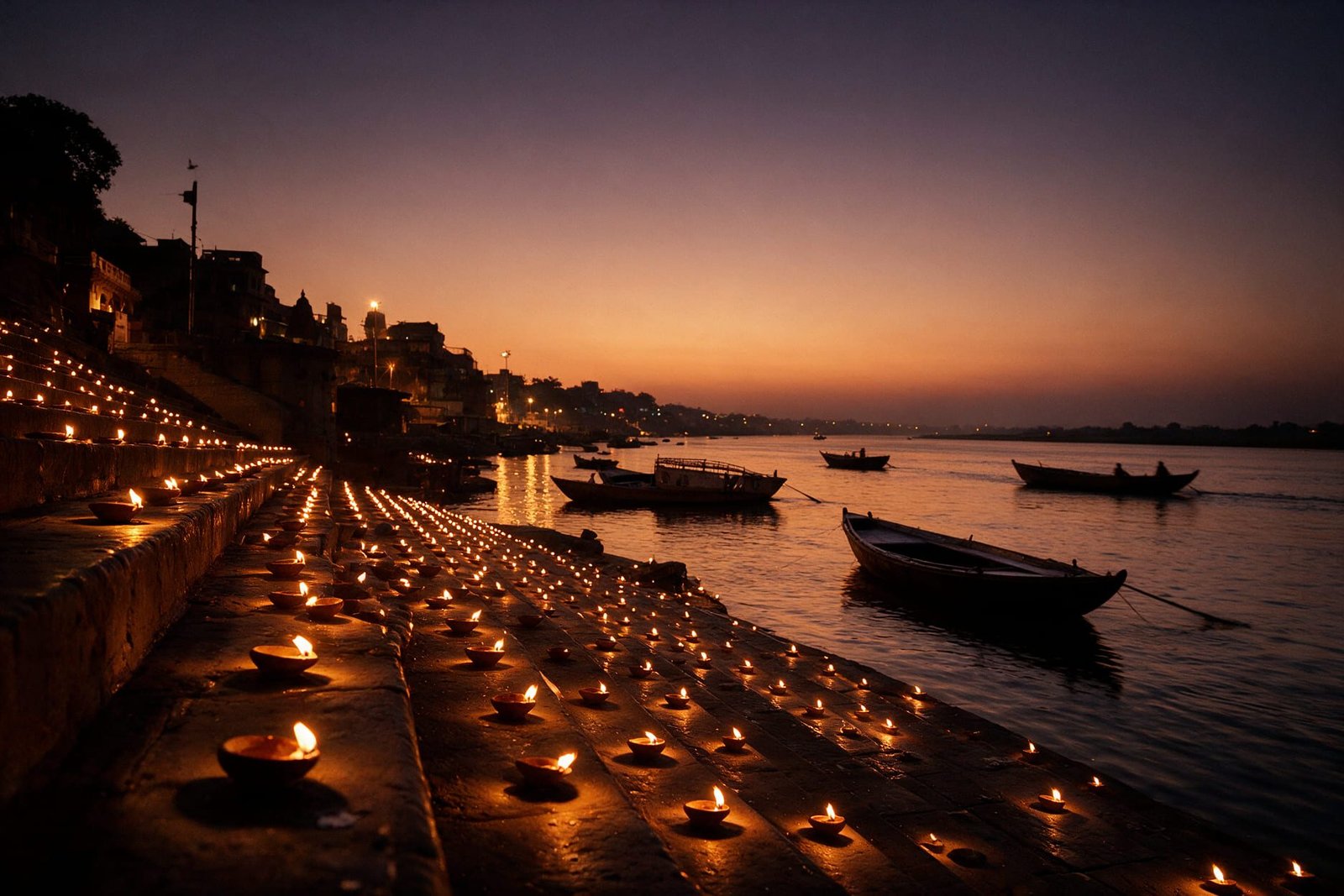
And then there is Dev Deepawali. On the full moon of the Hindu month of Kartik — which falls on 5 November 2026 — the entire 7-kilometer stretch of ghats is illuminated with oil lamps in an act of collective devotion that draws crowds of over a million people. For context: the population of Varanasi is less than 1.5 million. This is not a festival you watch from a distance. It surrounds you.
Traveler's note: Dev Deepawali is not Diwali. Diwali celebrates Lord Ram's return to Ayodhya and falls 15 days earlier. Dev Deepawali celebrates the gods themselves descending to bathe in the Ganges — it is considered the more spiritually potent of the two, and it belongs almost entirely to Varanasi.
November Weather in Varanasi
November weather in Varanasi is the kind that makes you want to stay one more day — and then another. Daytime temperatures sit comfortably in the mid-to-upper 20s Celsius (low 80s Fahrenheit), dropping to the mid-teens at night (upper 50s Fahrenheit). There is no humidity to speak of, no rain, and the air quality — while not pristine by Western standards — is vastly better than in summer or July–August.
Dawn boat rides — which start around 5:00–5:30 AM — can feel genuinely cold in the river breeze. Pack a fleece or a mid-weight jacket specifically for this. By 9 AM you will be back to a t-shirt. Late November evenings, especially near the ghats after sunset, call for a proper layer again. Think of it as layering weather: easy to manage, and the cool nights make sleeping deeply comfortable.
Dev Deepawali 2026 — The Main Event
If there is one night in India in 2026 that every serious traveler should plan around, it is Dev Deepawali in Varanasi on 5 November. The festival marks the kartik purnima (full moon), when according to Hindu tradition, the gods descend from the heavens to take a holy dip in the Ganges — and the city responds by lighting the way for them with oil lamps along every step of every ghat.
More than 300,000 deepas (small earthen oil lamps) are arranged along the ghats from Assi Ghat in the south to Raj Ghat in the north — a continuous river of flame mirrored in the water below. Priests perform a synchronized aarti ceremony on all the major ghats simultaneously. Fireworks rise above the riverline. Devotional music carries across the water. The collective effect is not something that fits into ordinary descriptive language.
Best viewing ghats
Dashashwamedh, Assi, Panchganga, and Prabhu Ghat offer the most concentrated lamp displays and the best river views.
Book a boat early
Watching from a boat mid-river is the single best vantage point. Boats for the evening sell out weeks in advance — book as soon as your dates are confirmed.
Arrive by 5 PM
The lamps are lit from around 6 PM, with the main ceremony peaking around 7–8 PM. Crowds are extraordinary — being in position early is not optional.
Low light + motion
Bring a camera that performs in low light. A tripod is useful but nearly impossible to deploy in the crowds — high ISO and stabilization matter more.
Important: Dev Deepawali draws visitor numbers that genuinely overwhelm the Old City's narrow lanes. Hotels within walking distance of the ghats command a premium and book out months ahead for the 3–5 November window. If you are planning to be in Varanasi for this festival in 2026, accommodation is the first thing to lock in — not the last.
Ganga Aarti — Every Evening, Without Fail
Dev Deepawali happens once a year. Ganga Aarti happens every single evening at dusk, 365 days a year, without cancellation, without variation, and without any drop in its extraordinary quality. At Dashashwamedh Ghat — the principal ghat and the spiritual heart of Varanasi — a team of young Brahmin priests performs a choreographed fire-worship ceremony that has been conducted in an unbroken line for generations.
Seven priests stand on elevated platforms, each holding a multi-tiered brass lamp (some carry up to 51 flames), moving in synchrony to Sanskrit chants that carry across the river. Incense smoke drifts over the water. Flower petals float downstream. The ceremony runs for approximately 45 minutes, and the crowd — a mix of pilgrims, locals, and visitors from every country on earth — watches in total stillness from the ghat steps or from boats on the river.
For first-time visitors to India, Ganga Aarti at Dashashwamedh is often the experience they describe to people back home years later. It is not staged for tourists. It was here before any of us arrived, and it will be here long after.
How to experience it best
Arrive at least 45 minutes before sunset and find a position on the upper ghat steps rather than the crowded lower platform. Alternatively, hire a rowing boat for the evening — being on the water looking back at the illuminated ghat gives a perspective that the crowd on the steps can never replicate. The ceremony typically begins 20–30 minutes after sunset; check the local sunset time for your specific travel dates in November 2026.
A morning boat ride — starting between 5:00 and 5:30 AM — shows you the opposite rhythm: the quiet personal rituals of Hindus beginning their day with a dip in the river, laundry being washed on the stone steps, and the extraordinary quality of dawn light on the ghats. Both experiences are essential. They show you entirely different cities.
Things to Do in Varanasi in November
Walk the Old City at dawn
The lanes of the Old City (also called the Vishwanath Gali area) are impossibly narrow — some are barely wide enough for two people to pass — and are lined with temples, chai stalls, marigold sellers, and silk merchants. A guided walk starting around 6 AM, when the light is low and the morning rituals are fully underway, is entirely different from anything you could experience at midday. The crowds are thinner, the smells are sharper, and the sense of a city operating on its own ancient terms is undeniable.
Visit Kashi Vishwanath Temple
The Kashi Vishwanath Temple — dedicated to Lord Shiva and considered one of the twelve Jyotirlinga shrines — sits in the heart of the Old City. The temple complex was dramatically expanded and renovated in 2021, and the new Vishwanath Dham corridor has made it significantly more accessible to visitors, with better sight lines and a well-organized entry system. Non-Hindus have limited access to the inner sanctum but can visit the outer complex and the surrounding corridor.
Explore the silk weaving district
Varanasi silk — Banarasi silk — is the most prized silk in India, and its production is concentrated in the neighborhoods of Madanpura and Lallapura just behind the ghats. A visit to a working weaving workshop reveals the extraordinary complexity of Banarasi brocade, where a single sari can take two weavers three to four weeks to complete. Many workshops welcome visitors, and buying directly from a weaver rather than a hotel or market shop makes a meaningful difference to the artisan's income.
Take a sunrise boat ride
Already mentioned above, but worth its own entry: the 90-minute early morning boat ride along all the major ghats — starting before the sun fully rises and finishing as the city fully wakes — is the single experience that most US visitors cite as their clearest memory of Varanasi. Book through your hotel or directly with a boatman at Assi Ghat the evening before.
Attend a classical music performance
Varanasi has one of the deepest classical music traditions in India — it is the home city of Ravi Shankar, the sitar master who introduced Indian classical music to the Western world. Several cultural organizations in the city hold evening performances of Hindustani classical music in November, and many are free or nearly free to attend. Ask at your hotel about upcoming performances — this is the kind of experience that tends not to be on travel apps but is remembered for a lifetime.
Sarnath Day Trip — Where Buddhism Began
Twelve kilometers north of central Varanasi lies Sarnath — the place where the Buddha gave his first sermon after achieving enlightenment at Bodh Gaya in 528 BCE. For US visitors with any interest in world history, philosophy, or religion, Sarnath is one of the most significant sites on earth, and November is ideal for exploring it: the heat is manageable, the gardens are green from the monsoon, and the crowds are a fraction of what descend during peak winter.
The Dhamek Stupa — a massive cylindrical tower built on the site where the Buddha preached — stands 43 meters tall and is covered in intricate carvings of the Gupta period (5th century CE). The adjacent Sarnath Archaeological Museum holds some of the finest Buddhist sculpture in Asia, including the Lion Capital of Ashoka, which became the national emblem of India. Plan for at least half a day at Sarnath. Combine it with a morning in Varanasi and an evening Ganga Aarti on the same day for one of India's most complete travel experiences.
Getting there: Sarnath is a 30–45 minute auto-rickshaw or taxi ride from the main Varanasi ghats. The site opens at dawn and is well signposted. A guided visit makes the archaeological context significantly richer — ask your hotel to arrange a local guide for the morning.
Pair Varanasi With the Golden Triangle
Most US visitors to India come for two weeks — sometimes three. Varanasi is so far east of Delhi that many itineraries skip it entirely, which is a significant mistake. The classic solution is to combine Varanasi with the Golden Triangle (Delhi–Agra–Jaipur) into a single two-week journey, and November is the ideal month to do exactly that.
A well-designed itinerary might spend three to four nights in Delhi, two nights in Agra (for the Taj Mahal and Agra Fort), two to three nights in Jaipur (for the City Palace and Amber Fort), and then fly or take the Vande Bharat Express train to Varanasi for a final three to four nights on the ghats. This sequence moves west to east across northern India and finishes at the country's spiritual heart — a structure that tends to give first-time visitors a sense that they have genuinely understood something about India rather than merely visited it.
The Taj Mahal is at its most beautiful in November's clear light. Note that the Taj Mahal is closed every Friday — plan your Agra nights accordingly.
Squid Travel India designs custom itineraries that combine the Golden Triangle with Varanasi for US travelers, handling all logistics, hotels, guides, and transfers. Contact us below to start planning your 2026 India trip.
Practical Tips for US Travelers
Getting to Varanasi
Varanasi has its own international airport — Lal Bahadur Shastri International Airport (VNS) — with direct flights to Dubai and a few other hubs, plus frequent domestic connections to Delhi, Mumbai, and other major Indian cities. From the United States, the most common routing is to fly into Delhi and take a domestic onward connection to Varanasi, or to take the overnight Vande Bharat Express train (approximately 8 hours from Delhi). The train journey itself, arriving in Varanasi at dawn, is memorable for the right reasons.
Where to stay
Varanasi accommodation splits into two distinct worlds. Heritage havelis and boutique guesthouses perched directly on the ghats give you direct river access and the ability to walk to the Ganga Aarti in minutes — but they are reached through narrow lanes inaccessible to vehicles, which means carrying your luggage some distance. Larger hotel properties further from the river (in the Cantonment area or near Lanka) offer standard amenities and easier vehicle access but require a short ride to reach the ghats. For a three-to-four-night stay, a ghat-side property is almost always worth the tradeoff in access — particularly during Dev Deepawali, when the ghats are the entire point of being in the city.
Money, tipping, and bargaining
Varanasi operates almost entirely on cash for anything in the Old City. ATMs are available near the main ghats but can run out during festival periods — withdraw what you need before Dev Deepawali week. For boat rides, negotiate the price before boarding and confirm what is and is not included. Standard tipping for guides is approximately ₹500–700 (roughly $6–8) per person per day; for drivers, ₹300–500 per day is customary.
Health and safety
Drink only bottled or filtered water throughout your trip — this applies to ice as well. Varanasi street food is deeply tempting and mostly safe when eaten from busy stalls with high turnover, but exercise caution with raw vegetables or anything prepared with tap water. Travel insurance is strongly recommended for any India trip; US visitors generally require an e-Visa, which is easy to obtain online well in advance of travel.
What to pack for November
Light clothing (t-shirts, linen or cotton trousers) for daytime, a fleece or mid-weight jacket for early mornings and evenings, comfortable walking shoes that can handle uneven stone surfaces (the ghat steps are beautiful and treacherous in equal measure), and at least one layer that covers arms and legs for temple visits. A small headscarf or shawl is useful for women entering shrines.