

The jeep stops. Your naturalist raises a hand. Everyone in the vehicle holds their breath.
Through the trees, fifty metres away, a Bengal tiger is walking — unhurried, enormous, utterly indifferent to your presence. It steps into a shaft of morning light. Pauses. Looks directly at you with amber eyes. Then continues into the forest and disappears in seconds.
Nothing prepares you for the moment when it actually happens.
India is home to roughly 3,500 wild tigers — nearly three quarters of the entire global wild tiger population. Beyond tigers, the country’s 100+ national parks and 50+ tiger reserves protect Asiatic lions (found nowhere else on earth), one-horned rhinoceroses, Asian elephants, leopards, sloth bears, dholes, snow leopards, and one of the world’s richest collections of bird species. An India wildlife safari is not a consolation prize for travellers who couldn’t get to Africa. It is a completely different experience — shaped by ancient forests, Mughal-era landscapes, Buddhist-influenced conservation philosophy, and wildlife encounters that, at their best, are among the most intimate on the planet.
This is the complete beginner’s guide to planning an India wildlife safari in 2026. Which parks to choose, how the booking system works, what to expect on your first safari morning, and how to combine wildlife with India’s monuments and cultural experiences in a single trip.
Why India for Wildlife?
Before diving into the logistics, it’s worth understanding what makes Indian wildlife safaris different from African ones — and why that difference matters for how you plan.
The forests are dense. Unlike the open savannah of East Africa, most Indian tiger reserves are dry deciduous or sal forest — thick woodland that requires patience and skill to spot animals. This is both the challenge and the reward. When you do see a tiger in Indian forest, the sighting is almost always closer, more sudden, and more emotionally charged than a distant silhouette across a plain.
The tigers are bold. India’s tigers are famously diurnal (active during the day) in places like Ranthambore, and the forests are relatively open compared to central India’s dense sal woodlands. India’s tigers, especially in well-visited reserves, have become habituated to safari vehicles — they often walk directly past jeeps at close range without altering their behaviour.
The diversity is extraordinary. A single India wildlife itinerary can include a tiger safari in Rajasthan, a one-horned rhino encounter in Assam, and an Asiatic lion in Gujarat — three entirely different ecosystems, all within one country.
Wildlife pairs with culture. Unlike most safari destinations, India lets you pair a wildlife trip with the Taj Mahal, Rajasthan’s palaces, or Varanasi’s ghats in the same itinerary — wildlife and heritage, back to back. Ranthambore is three hours from Jaipur. Jim Corbett is six hours from Delhi. Kaziranga is a short flight from Kolkata. No other country combines wildlife and cultural heritage at this scale.
India’s Tiger Population — The Context
India boasts unparalleled biodiversity across over 100 national parks, featuring iconic species like Bengal tigers, Asiatic lions, one-horned rhinos, elephants, sloth bears, and Indian leopards.
The tiger story specifically is one of conservation’s great modern successes. India’s Project Tiger, launched in 1973, pulled the Bengal tiger back from near-extinction. The population has grown from roughly 1,800 in 1973 to over 3,500 today. Out of India’s 50 tiger reserves, you have excellent chances of sighting tigers in at least 15 of them.
For a first-time wildlife visitor, this matters enormously: India’s tiger sighting rates at the best reserves are genuinely high. Ranthambore, Bandhavgarh, and Tadoba regularly report tiger sightings on 70–85% of safari drives during peak season. These are not odds you’re gambling against — they’re odds working strongly in your favour.
The Best National Parks for First-Time Safari Visitors
1. Ranthambore National Park, Rajasthan — Best for Beginners
Ranthambore is India’s single most popular tiger destination — and for good reason. Its tigers are famously diurnal (active during the day), its forests are relatively open compared to central India’s dense sal woodlands, and the ancient Ranthambore Fort rising from the landscape gives every photograph a cinematic backdrop few other parks can match.
Best for first-time international visitors, tiger photography, and combining with the Golden Triangle.
Ranthambore sits in eastern Rajasthan, approximately 160 kilometres from Jaipur and 390 kilometres from Delhi. This proximity to the Golden Triangle circuit makes it the most logical first wildlife destination for visitors combining heritage and safari in a single India trip. A Golden Triangle tour with Ranthambore — Delhi, Agra, Jaipur, Ranthambore — covers India’s most iconic monuments and its most accessible tiger reserve in a single 8–10 day itinerary.
The park’s 10 safari zones vary significantly in tiger sighting probability. Zones 3 and 4, which cover Rajbagh Lake and Padam Talao, are historically the best for tiger sightings. The legendary tigress Machli, featured in National Geographic, ruled these zones. Book zones 1–5 (the core zones) for the best experience.
Wildlife: Royal Bengal tigers, leopards, sloth bears, striped hyenas, marsh crocodiles, sambar deer, nilgai, chital (spotted deer), 300+ bird species Best time: October to June, with March–May offering the highest tiger sighting probability as the forest thins and animals gather near water sources. The park is closed during monsoon (July to September). Safari season opens: October 1, 2026
2. Jim Corbett National Park, Uttarakhand — India’s Oldest, Most Legendary
Jim Corbett is India’s oldest national park, established in 1936 in the Himalayan foothills of Uttarakhand. It carries a particular prestige — this is where Project Tiger was launched in 1973, and where India’s conservation story effectively began. The Ramganga River runs through its core, creating a riverine ecosystem of exceptional richness: grassland, sal forest, river floodplain, and ridges of mixed woodland.
The park is divided into several safari zones including Dhikala, Bijrani, Jhirna, Dhela, and Durgadevi, each offering distinct wildlife experiences.
The Dhikala zone — Corbett’s famous vast grassland — is considered the park’s crown jewel. Dhikala is known for its vast grasslands and high tiger density. However, day jeep safaris are not allowed here unless you are staying in the forest lodge. For day visitors, the canter safari is the only way to access Dhikala. If Dhikala is your priority, book a stay at the Forest Rest House inside the zone — it’s one of India’s great wildlife experiences and sells out a year in advance.
For day visitors and resort-based guests, Bijrani zone is the recommended alternative — historically excellent tiger sightings in more intimate forest terrain.
Wildlife: Royal Bengal tigers, Asian elephants, leopards, gharials, Himalayan black bears, otters, over 600 bird species (Corbett is one of India’s premier birding destinations) Best time: November to June. The park is open from October 15 to June 30. Dhikala, Bijrani, and Durgadevi zones are closed from June 16 to November 15. Jhirna zone stays open year-round. Distance from Delhi: Approximately 250 km (5–6 hours by road)
3. Bandhavgarh National Park, Madhya Pradesh — Highest Tiger Density
Bandhavgarh National Park is small compared to other national parks but has the highest density of Bengal tigers in India.What this means in practice: the highest sighting rates of any tiger reserve in the country. First-time safari visitors who specifically want near-guaranteed tiger encounters consistently rate Bandhavgarh as the top choice.
One thing that rarely appears in travel guides: the Bandhavgarh Fort sits on a rocky hillside at the centre of the reserve, accessible by safari jeep. The ride takes you through active tiger territory and the fort itself is surrounded by carved rock-cut caves and ancient temples dating back over a thousand years. It transforms Bandhavgarh from a great tiger park into something genuinely singular.
Wildlife: Royal Bengal tigers (highest density in India), leopards, sloth bears, wild boar, sambar, gaur, 250+ bird species Best time: November to June. For the highest chances of tiger sightings, travel between late March and June. Distance from Delhi: ~800 km (fly to Jabalpur, then 2 hours by road)
4. Kanha National Park, Madhya Pradesh — The Jungle Book Park
Kanha is where Rudyard Kipling set The Jungle Book — and the landscape makes this immediately believable. Vast meadows (called maidans) open between dense sal and mixed forest, creating the kind of sweeping wildlife vistas rare in India’s typically dense parks. Kanha is where the barasingha (swamp deer) was saved from extinction through targeted conservation — seeing a herd of barasingha in Kanha’s maidans is one of India’s most moving wildlife experiences.
Safari drives here deliver sought-after Bengal tiger and elephant encounters plus rich birdlife. Kanha’s larger size means less crowding per zone compared to Bandhavgarh, producing a more immersive, less touristy jungle atmosphere.
Wildlife: Royal Bengal tigers, leopards, barasingha (swamp deer), gaur, wild dogs (dhole), sloth bears, 300+ bird species Best time: October to June. Peak sighting season: March to May. Distance from Delhi: Fly to Nagpur or Jabalpur, then road transfer (3–4 hours)
5. Kaziranga National Park, Assam — Rhinos and Elephants
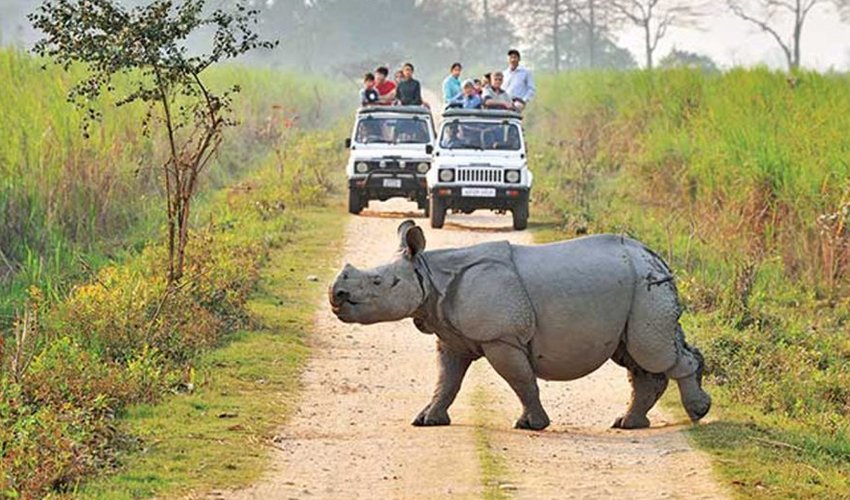
Kaziranga is a completely different safari experience from the tiger-focused central India parks. A UNESCO World Heritage Site in the Brahmaputra flood plains of Assam, Kaziranga is home to the world’s largest population of one-horned rhinoceroses — approximately 2,600 rhinos in a single park. Kaziranga showcases one-horned rhinos with elephants, swamp deer, and abundant birdlife against Brahmaputra floodplains on thrilling jeep or elephant safaris.
Elephant-back safaris at Kaziranga — where you approach rhinoceroses and other wildlife from the height and silence of an elephant — are available in the early morning and are one of India’s most distinctive wildlife experiences.
Wildlife: One-horned rhinoceros (world’s largest population), Asian elephants, Royal Bengal tigers, swamp deer, wild water buffalo, Gangetic dolphins, 500+ bird species Best time: November to April. Park closed May to October (monsoon flooding). Getting there: Fly to Guwahati, then 4–5 hours by road to the park
6. Tadoba Andhari Tiger Reserve, Maharashtra — Rising Star
Tadoba is one of India’s most reliable tiger-sighting parks. Its tigers are bold, active, and often walk on safari routes — perfect for photography lovers. High-density tiger reserve with excellent backlit photography, thick bamboo forests and lakes.
Tadoba is the largest national park in Maharashtra, covering over 625 square kilometres of dry deciduous teak and bamboo forest, interspersed with open grassland that makes wildlife spotting far easier than in denser jungle parks.
Tadoba’s reputation among India’s wildlife photography community has grown dramatically in recent years. The park’s waterholes attract tigers with remarkable regularity, and the open terrain around them makes for the kind of sustained, close tiger encounters that produce genuinely exceptional photographs.
Wildlife: Royal Bengal tigers (high density), leopards, sloth bears, gaur, wild dogs, Indian grey wolves, 195+ bird species Best time: February to May (peak), October to January (good) Distance from Mumbai: ~600 km (fly to Nagpur, 2–3 hours by road)
7. Gir National Park, Gujarat — The Only Wild Asiatic Lions
India is home to iconic species including Asiatic lions, found nowhere else on earth. The Asiatic lion — smaller and slightly maned differently from the African lion — was reduced to fewer than 20 individuals by the early 20th century. Today, Gir National Park in Gujarat protects a recovered population of over 600 lions. Seeing an Asiatic lion in the wild is a genuinely rare global experience — it is simply not possible anywhere else on earth.
Gir safaris run in zones with naturalist-guided vehicles. Lion sightings are reliably high — lions are less shy than tigers and more frequently seen in open terrain.
Wildlife: Asiatic lions (only wild population), leopards, hyenas, chital, sambar, nilgai, marsh crocodiles, 300+ bird species Best time: October to March. Avoid the intense heat of April to June.Getting there: Fly to Rajkot or Diu, then road transfer
Understanding the Indian Safari System — How It Works
This is the section most beginner guides skip — and it’s where most first-time safari visitors get confused or miss out on the best zones.
Zones and Permits
Every Indian national park is divided into zones — designated areas within the park that safari vehicles are permitted to enter. Each zone has a daily cap on the number of vehicles — typically 8–20 jeeps per session — to minimise wildlife disturbance and maximise sighting quality.
Permits are issued for a specific zone, on a specific date, for a specific session (morning or evening). You cannot enter a zone without a valid permit, and you cannot switch zones once your permit is issued.
Zone quality varies enormously within the same park. In Ranthambore, zones 3 and 4 historically produce the best tiger sightings. In Jim Corbett, Bijrani and Dhikala are the premium zones. Booking the right zone matters as much as booking the park itself.
How to Book Safari Permits
Bookings for core zones open 90 days in advance and often sell out within minutes for popular dates. Log in exactly when the booking window opens to secure your preferred zone.
The official booking process:
- Visit the official government portal for your chosen park (each park has its own portal — Ranthambore uses ranthambore.rajasthan.gov.in; Jim Corbett uses corbettonline.uk.gov.in)
- Create an account with your email address
- Select your preferred date, zone, shift (morning or evening), and vehicle type (jeep or canter)
- Enter the details of all travellers — name, age, and ID proof type. Indian nationals need Aadhaar card or government-issued photo ID. Foreign tourists must enter passport details.
- Complete payment. The portal accepts credit cards, debit cards, net banking, and UPI.
- Receive your e-ticket — carry it printed or on your phone on safari day
The practical reality: For peak season (October–March) at popular parks like Ranthambore and Bandhavgarh, permits for the best zones sell out within hours of opening 90 days ahead. If you’re booking independently, set a calendar reminder for the exact date and time the booking window opens and be ready to move fast. If you’re booking through Squid Travel India, we handle all permit bookings as part of your package — with access to real-time availability and contingency zone options if your first choice is full.
Jeep vs Canter — Which to Choose
A jeep is a private vehicle that can seat up to 6 people. It provides the most flexibility for morning or afternoon trips.
Canter safari is the most economical safari type. A canter can hold up to 20 tourists at a time. They are economical for bigger group sizes. There is no expert tiger tracker assigned on canter safari. The canter cannot penetrate into deep woods and hence less possibility of sightings. Canter is not recommended for wildlife photographers.
Choose a jeep if:
- You’re travelling as a family or small group (2–6 people)
- Wildlife photography is a priority
- You want a naturalist or tracker guiding your specific vehicle
- You want flexibility to stop, reverse, and wait at sightings
- You want the best possible chance of tiger encounters
Choose a canter if:
- You’re on a tight budget
- You have a large group (8–20 people)
- You specifically want to visit the Dhikala zone at Jim Corbett (only canter access for day visitors)
- The social experience of a group safari appeals to you
For first-time visitors, the jeep is almost always the better investment. The additional cost pays for itself in a more intimate, responsive safari experience.
Morning vs Evening Safari
Safaris happen twice a day — morning (sunrise) and afternoon. Morning safaris usually offer better birding and fresh pugmarks, while evenings are great for spotting predators waking up.
Morning safari (approximately 6:00–6:30 AM to 9:30–10:00 AM):
- Tigers most active in cooler early hours
- Best light for photography — golden hour sunrise through the forest canopy
- Fresh animal movements and tracks from the overnight hours
- Cooler temperatures for both animals and visitors
- The more popular session — book this first
Evening safari (approximately 2:30–3:00 PM to 5:30–6:00 PM):
- Animals active again as temperatures drop
- Good for predators beginning their evening hunts
- Warm afternoon light (good for photography, though directionally different from morning)
- Generally less competitive to book than morning slots
For first-time visitors, the morning safari is the definitive recommendation. If you can only do one, do the morning.
When to Go — India Safari Season Guide
Understanding safari season is essential. Most Indian national parks close during the monsoon months (roughly June to October) — the heavy rainfall makes forest roads impassable and the dense vegetation makes wildlife spotting extremely difficult.
| Park | Open Season | Peak Sighting |
|---|---|---|
| Ranthambore | Oct 1 – Jun 30 | Mar – May |
| Jim Corbett | Oct 15 – Jun 30 (zone-dependent) | Nov – Jun |
| Bandhavgarh | Oct 1 – Jun 30 | Mar – Jun |
| Kanha | Oct 1 – Jun 30 | Mar – Jun |
| Tadoba | Oct 15 – Jun 15 | Feb – May |
| Kaziranga | Nov 1 – Apr 30 | Feb – Apr |
| Gir | Oct 16 – Jun 15 | Oct – Mar |
The best overall safari season is October to March — comfortable temperatures, manageable humidity, and good wildlife visibility as vegetation is less dense than the monsoon months. March to May offers the highest tiger sighting probability as the forest thins out and animals gather near water sources — but the heat (35–42°C in May) is demanding. October to January balances good sighting rates with comfortable conditions.
For beginners, October to December is the sweet spot: parks are newly reopened after monsoon, the forests are still green from the rains, temperatures are pleasant, and crowds haven’t yet reached the peak-season levels of January and February.
Read our best time to see tigers in India guide for a deeper month-by-month breakdown of sighting rates across all major reserves.
What to Expect on Your First Safari
The Pre-Dawn Start
Every serious Indian wildlife safari begins before sunrise. Your resort wake-up call will likely be at 5:00–5:30 AM. This is non-negotiable and entirely worth it. Tigers are most active in the hours around dawn, the light is at its most beautiful, and the cool morning air makes the open jeep experience genuinely pleasant.
You’ll reach the park gate for opening — typically 6:00–6:30 AM depending on the season — where your naturalist will collect your permits and the forest guard assigned to your vehicle will join you. Every safari jeep is accompanied by a government-appointed forest guard in addition to your driver and naturalist. The guard carries a log of the morning’s animal sightings reported by other vehicles via radio — this network of information is how skilled naturalists know where to head first.
The Alarm Call System
In the Indian forest, you don’t just watch for tigers with your eyes. You listen for alarm calls — the warning cries of other animals that signal a predator’s presence.
Deer alarm calls: A sharp, repeated bark from spotted deer (chital) or sambar means a predator is nearby — often a tiger or leopard within 100–200 metres. Experienced naturalists can identify which species is calling, the direction, and the distance from the quality and frequency of the call.
Langur monkeys: The langur’s high-pitched alarm call from the treetops is another classic tiger indicator. Langurs have exceptional height advantage and often spot predators before ground-level animals do.
Peacocks: The peacock’s loud, distinctive call in response to ground movement is another reliable alarm indicator in many Indian reserves.
Your naturalist is interpreting this acoustic landscape throughout the entire safari. When the jeep stops and everyone goes silent, it’s because the forest itself is speaking.
Reading Pugmarks
Fresh tiger pugmarks — paw prints — in the dusty track are one of the most exciting safari sights before the tiger itself is seen. Experienced trackers can read gender, approximate age, and direction of travel from a pugmark. A forest guard may stop your vehicle, crouch beside the track, and determine from prints made in the last hour or two exactly which tiger was walking here and which direction it headed.
Patience and Stillness
The most important thing a first-time safari visitor can do is nothing. Don’t stand up in the jeep. Don’t use flash photography. Don’t make sudden movements or loud sounds. When a tiger is sighted, the instinct is to scramble for your phone or camera — do it slowly, smoothly, and silently.
Tigers in Indian reserves are habituated to vehicles but not to sudden movement or noise. A careless lurch for a camera has ended sightings that would otherwise have lasted twenty minutes.What to Pack for an India Safari
Clothing
Colour is critical. Wear earth tones — greens, browns. Bright colours startle animals. This isn’t just advice — bright clothing has been linked to animals retreating before vehicles can approach. Pack specifically for the safari: khaki, olive, dark green, tan, brown. Leave white, red, and bright blue in the hotel room.
Layers matter. Pre-dawn jeep drives in October–February are genuinely cold — 12–18°C in the open vehicle at 6 AM. A fleece or down jacket over your safari clothes for the first hour is essential. By 9 AM you’ll be shedding layers.
Long sleeves and trousers. Even in warmer months, full-length clothing protects against insects, thorns, and sunburn during extended outdoor exposure.
Equipment
Camera: A zoom lens (at least 200mm, ideally 300–400mm) for wildlife photography. Animals are not always close. A phone camera is fine for wide environmental shots but will struggle with distant wildlife.
Binoculars: The single most underrated safari item. Many wildlife encounters begin as a shape in the distant treeline — binoculars close that distance dramatically and reveal details invisible to the naked eye. A compact 8×42 or 10×42 pair is ideal.
Sun protection: Sunscreen, sunglasses, and a hat for the open jeep once the sun rises.
Insect repellent: Apply before the safari. Mosquitoes and forest insects are active at dawn and dusk, exactly when you’re outside.
Water and snacks: Bring your own. Most parks don’t permit stopping for food, and long safaris (3+ hours) require hydration. Your resort will typically prepare a packed breakfast or flask of chai for early morning departures.
Dust protection: A light scarf or buff around your nose and mouth is useful on dry season drives — forest tracks produce significant dust at vehicle speed.
Safari Costs — What to Budget
Safari costs vary by park, zone, vehicle type, and nationality. Here’s a realistic 2026 breakdown:
Ranthambore
| Item | Indian | Foreign |
|---|---|---|
| Jeep permit (core zone, per seat) | ₹1,500–₹2,000 | ₹3,500–₹4,500 |
| Canter permit (buffer zone, per seat) | ₹600–₹800 | ₹1,500–₹2,000 |
| Camera fee | ₹200–₹500 | ₹200–₹500 |
| Naturalist (optional, recommended) | ₹500–₹1,000 per safari | ₹500–₹1,000 per safari |
Jim Corbett
| Item | Indian | Foreign |
|---|---|---|
| Jeep permit (Bijrani/Jhirna, per seat) | ₹1,000–₹1,500 | ₹3,000–₹4,000 |
| Canter permit (Dhikala, per seat) | ₹800–₹1,200 | ₹2,500–₹3,500 |
| Camera fee | ₹150–₹300 | ₹150–₹300 |
Accommodation significantly affects total cost. Budget forest guesthouses near park gates run ₹3,000–₹6,000 per night. Mid-range wildlife lodges run ₹8,000–₹15,000. Premium wildlife resorts and camps at Ranthambore, Bandhavgarh, and Kanha run ₹20,000–₹60,000 per night — but include safaris, meals, and naturalist services in the rate.
Combining Safari with the Golden Triangle
For most international visitors, the India wildlife safari is not a standalone trip — it’s part of a broader India itinerary that includes the Taj Mahal, Rajasthan, and Delhi.
The most popular combination is the Golden Triangle with Ranthambore: Delhi – Agra (Taj Mahal) – Ranthambore (2 nights safari) – Jaipur – Delhi. This 8–9 day circuit covers India’s most iconic monument and its most accessible tiger reserve in a single trip, with a seamless road connection between each destination.
Our best wildlife tour packages in India cover this combination in full — from the October opening of Ranthambore through to the peak-season months of November to March.
Alternatively, Jim Corbett works as a 2-night extension from Delhi for those who want the Himalayan foothills experience and prefer the atmosphere of Corbett’s riverine forests to Ranthambore’s drier terrain.
For travellers with 12–14 days, a multi-park itinerary — Ranthambore plus Kanha or Bandhavgarh — gives you two completely different forest types, double the wildlife diversity, and a much richer understanding of India’s wild landscapes.
Safari Etiquette — The Rules That Matter
Never pressure your naturalist for a specific animal. The jungle cannot be guaranteed. A skilled naturalist will maximise your sighting chances — but demands for “more tigers” create pressure that leads to rule-bending and animal disturbance. Trust the process.
Maintain silence when directed. When your naturalist raises a hand, stop talking immediately. This is always because something is nearby.
Stay in the vehicle at all times unless at a designated stopping point. Exiting a vehicle in Indian national parks is strictly prohibited and genuinely dangerous — both to you and to the animals.
No flash photography. Flash disturbs wildlife and is prohibited in all Indian national parks. Use natural light and a lens with good low-light performance.
Don’t litter. Keep all waste — water bottles, food wrappers, tissue — with you. No food is to be thrown into the forest.
Respect other vehicles. At a tiger sighting, multiple vehicles may converge. Don’t position your jeep in a way that blocks another group’s view or crowds the animal. The forest is large enough for everyone.
Frequently Asked Questions — India Safari for Beginners
Is it guaranteed I’ll see a tiger? No safari on earth guarantees sightings — the jungle is wild. However, at India’s best tiger reserves in peak season, sighting rates run at 70–85% per safari. Booking two morning safaris on consecutive days at a park like Bandhavgarh or Ranthambore gives most visitors at least one tiger encounter.
How close do you get to tigers? Closer than most people expect. Sightings of 10–30 metres are not uncommon in Ranthambore and Bandhavgarh. The animals are fully habituated to safari vehicles and often walk directly alongside them.
Is it safe? Completely safe in a vehicle. India’s national parks operate with strict safety protocols. Tigers (and other predators) rarely associate vehicles with prey and almost never approach an occupied jeep aggressively. The golden rule — stay in the vehicle — makes incidents essentially impossible.
Can children go on safari? Yes. There is no age limit by the forest department — infants to senior citizens are all allowed to enjoy the forest. Children below 5 years are complimentary without official seat allocation. Many families find the India wildlife safari an exceptional experience for older children (8+) who can maintain quiet in the vehicle.
What if it rains? Light rain is actually beneficial — animals move more freely in cooler, wet conditions, and the forest looks extraordinary in the rain. Most jeeps carry a tarpaulin cover for heavy rain. Safaris rarely cancel due to rain unless conditions make forest roads impassable.
Do I need a naturalist/guide? Every jeep comes with a government-appointed forest guard, but a private naturalist — arranged through your lodge or tour operator — adds enormous value. A good naturalist interprets animal behaviour, reads alarm calls, knows individual tigers by their markings, and provides the context that transforms a wildlife sighting into a genuine understanding of the ecosystem. We strongly recommend one.
Plan Your India Wildlife Safari with Squid Travel India
Squid Travel India designs wildlife tour packages across Ranthambore, Jim Corbett, Kanha, Bandhavgarh, Tadoba, and Kaziranga — as standalone wildlife itineraries and as extensions of our Golden Triangle tours.
Every wildlife booking includes:
- Safari permit bookings at the best zones (handled 90 days in advance)
- Accommodation at carefully selected wildlife lodges and resorts
- Private jeep with experienced naturalist and government-assigned forest guard
- Airport and inter-destination transfers
- Full itinerary support before and during your trip
We’ve completed over 1,800 tours with a 98% satisfaction rate and TripAdvisor Travelers’ Choice recognition for 2024–25. Our wildlife team has run safari itineraries at every major Indian reserve and knows which zones, which lodges, and which seasons deliver the best experiences for first-time visitors.
Plan your India wildlife safari with Squid Travel India → Call us: +91 9990812499
India Wildlife Safari — Quick Reference
| Park | Best For | Peak Season | Nearest Airport | Distance from Delhi |
|---|---|---|---|---|
| Ranthambore | First-timers, GT combination | Oct–May | Jaipur (3 hrs) | 390 km |
| Jim Corbett | Himalayan experience, birding | Nov–Jun | Delhi (250 km) | 250 km |
| Bandhavgarh | Highest tiger density | Nov–Jun | Jabalpur (2 hrs) | ~800 km (fly) |
| Kanha | Jungle Book landscape, barasingha | Oct–Jun | Jabalpur (3 hrs) | ~900 km (fly) |
| Tadoba | Photography, bold tigers | Feb–May | Nagpur (2 hrs) | ~900 km (fly) |
| Kaziranga | One-horned rhinos, elephants | Nov–Apr | Guwahati (4 hrs) | ~2000 km (fly) |
| Gir | Asiatic lions | Oct–Mar | Rajkot (2.5 hrs) | ~950 km (fly) |
Squid Travel India is a New Delhi-based, award-winning tour operator specialising in Golden Triangle tours, Rajasthan packages, wildlife safaris, and South India and Kerala tours. Our wildlife team manages safari bookings across all major Indian tiger reserves.

Comment (0)