

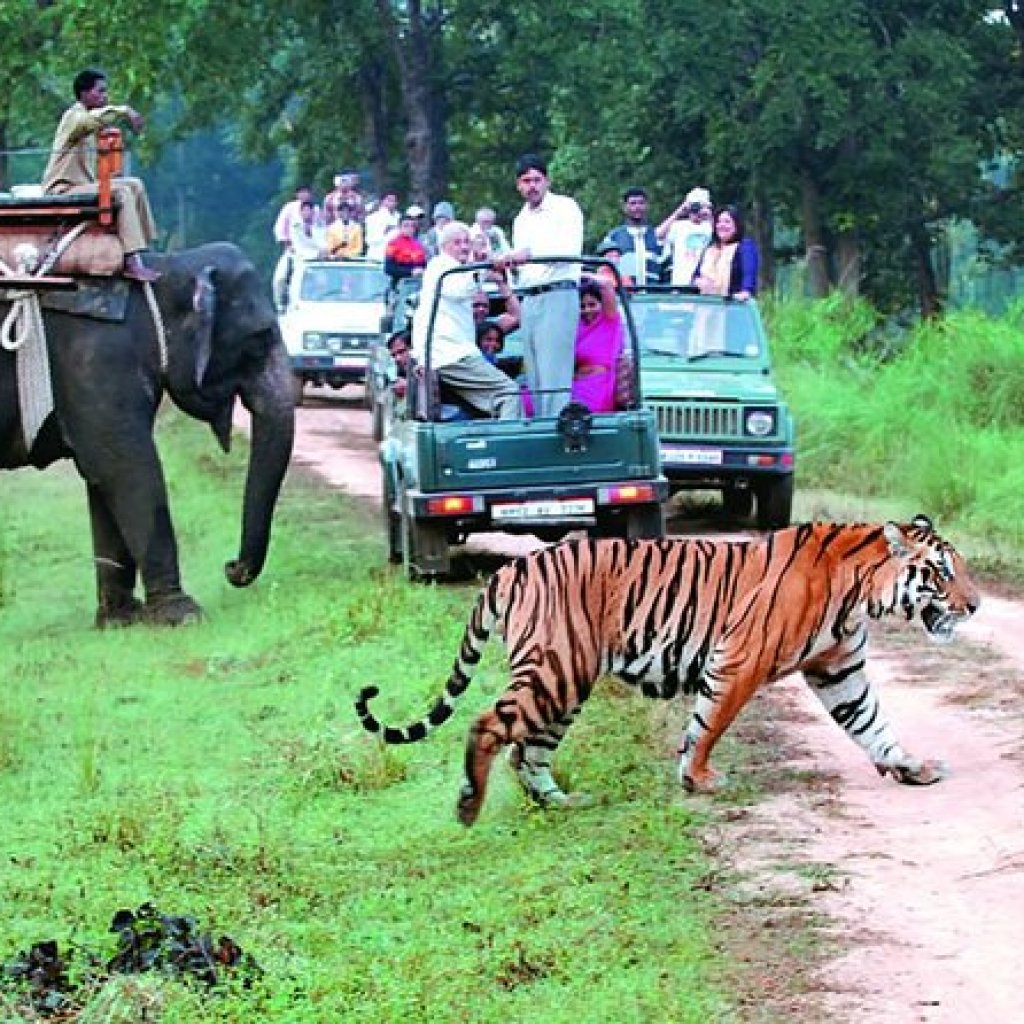
Most people picture the Taj Mahal when they think of an India trip. Few picture standing in an open-top jeep at dawn, engine off, as a Royal Bengal tiger walks unhurried across a forest track twenty feet away.
But that’s exactly what India offers — and arguably does better than almost anywhere else on earth.
India is home to roughly 3,000–4,000 wild tigers, which is close to three-quarters of the entire global wild tiger population. Spread across 50+ tiger reserves and over 100 national parks, the country offers wildlife encounters that range from the dry deciduous forests of Rajasthan to the misty Himalayan foothills, the Jungle Book landscapes of Madhya Pradesh, and the rhino-filled grasslands of Assam.
At Squid Travel India, we’ve designed wildlife tour packages for everyone from first-time safari-goers wanting a single unforgettable jeep ride to dedicated wildlife photographers chasing a complete tiger reserve circuit. In this guide, we’ll walk you through the best parks, the best packages, what to actually expect, and how to plan a wildlife trip that delivers real sightings — not just hope.
Why India Is One of the World’s Great Wildlife Destinations
Before we get into specific parks and packages, it’s worth understanding why India punches so far above its weight as a safari destination — especially compared to the African safari circuits most people default to.
Tiger density unmatched anywhere on earth. Parks like Bandhavgarh have some of the highest tiger densities of any reserve in the world. Where African safaris are built around the “Big Five,” Indian safaris are built around a single, near-mythical predator — and the odds of seeing one are genuinely good in the right park, at the right time.
Diversity of landscape. In a single trip, you can move between the rocky, fort-studded scrubland of Ranthambore, the dense sal forests of Kanha that inspired The Jungle Book, and the Himalayan foothill terrain of Corbett — three completely different ecosystems within a few hours’ flight of each other.
Easy combination with cultural travel. Unlike most safari destinations, India lets you pair a wildlife trip with the Taj Mahal, Rajasthan’s palaces, or Varanasi’s ghats in the same itinerary — wildlife and heritage, back to back, without long-haul flights in between.
A genuine range of species beyond tigers. Leopards, sloth bears, striped hyenas, Asiatic lions (found nowhere else on the planet outside Gir), one-horned rhinos in Kaziranga, wild Asian elephants, and over 300 bird species across the major parks.
India’s Best National Parks for Wildlife Tours
1. Ranthambore National Park, Rajasthan
Best for: First-time safari-goers, photographers, families
Ranthambore is India’s single most popular tiger destination — and for good reason. Its tigers are famously diurnal (active during the day), its forests are relatively open compared to central India’s dense sal woodlands, and the ancient Ranthambore Fort rising from the landscape gives every photograph a cinematic backdrop few other parks can match.
Sitting in eastern Rajasthan, just a few hours from Jaipur, Ranthambore is also the easiest major tiger reserve to combine with a Golden Triangle trip — making it the most popular “add-on” wildlife destination for first-time visitors to India.
Wildlife to expect: Royal Bengal tigers, leopards, sloth bears, striped hyenas, sambar deer, nilgai, marsh crocodiles, and over 300 species of birds.
Best time to visit: October to June, with March–May offering the highest tiger sighting probability as the forest thins out and animals gather near water sources.
2. Bandhavgarh National Park, Madhya Pradesh
Best for: Highest tiger sighting probability
If your single goal is to see a tiger, Bandhavgarh is consistently ranked among the best — and often the very best — places in India to do it. The park has one of the highest tiger densities of any reserve in the country, layered with genuine mythological and historical significance from the ancient Bandhavgarh Fort within its boundaries.
Madhya Pradesh as a whole is sometimes called the “Tiger State of India,” and Bandhavgarh is its flagship reserve.
Wildlife to expect: Bengal tigers (in unusually high concentration), leopards, wild boar, chital, barasingha, and various primate species.
Best time to visit: November to April for the best balance of weather and sightings.
3. Kanha National Park, Madhya Pradesh
Best for: Jungle Book atmosphere, diverse ecosystems
Kanha is the landscape that inspired Rudyard Kipling’s The Jungle Book, and it shows. Sprawling sal and bamboo forests, open meadows, and a genuinely “deep jungle” atmosphere set it apart from the more open terrain of Ranthambore.
Wildlife to expect: Tigers, leopards, wild dogs, the rare hard-ground barasingha (a species saved from near-extinction specifically in Kanha), and exceptional birdlife.
Best time to visit: February to April for the most reliable wildlife activity.
4. Jim Corbett National Park, Uttarakhand
Best for: Scenery, birdwatching, India’s oldest national park
Established in 1936, Corbett is India’s oldest national park and sits in the Himalayan foothills — giving it a dramatically different feel from the flat scrubland of Rajasthan or the central Indian forests. The Ramganga, Kosi, and Sonanadi rivers run through the reserve, and the combination of river, forest, and mountain backdrop makes it a favourite among photographers and birders alike.
Wildlife to expect: Tigers (among the highest density in India), Asian elephants, leopards, sloth bears, deer, and crocodiles.
Best time to visit: November to March for the best wildlife activity and most comfortable weather.
5. Pench National Park, Madhya Pradesh
Best for: Combining with Kanha, Jungle Book enthusiasts
Pench is the other major contender for the “real-life Jungle Book” title, and many wildlife specialists pair it with Kanha in a single multi-park itinerary. Its forests are slightly less crowded with tourists than the bigger-name parks, which often means a more peaceful, immersive safari experience.
Wildlife to expect: Tigers, leopards, wild dogs, sloth bears, and four-horned antelope.
6. Kaziranga National Park, Assam
Best for: One-horned rhinos, completely different ecosystem
For travellers wanting something beyond the tiger-and-fort combination of central and northern India, Kaziranga offers an entirely different world: vast grasslands and wetlands along the Brahmaputra River, home to the largest population of one-horned rhinoceros on Earth.
Wildlife to expect: One-horned rhinos, wild Asian elephants, Bengal tigers, and over 480 species of birds.
7. Gir National Park, Gujarat
Best for: Asiatic lions — found nowhere else on Earth
Gir is the only place on the entire planet where you can see wild Asiatic lions. If a lion safari is on your bucket list and an African trip isn’t on the cards, this is genuinely a once-in-a-lifetime, India-only opportunity.
Wildlife to expect: Asiatic lions, leopards, deer species, and marsh crocodiles.
Popular Wildlife Tour Package Types
Single-Park Tiger Safari (3–5 Days)
A focused trip to one reserve — typically Ranthambore or Bandhavgarh — with multiple morning and afternoon safari drives. Ideal for travellers with limited time who want a concentrated wildlife experience without extensive travel between parks.
Typical inclusion: 4–6 jeep safaris, jungle lodge accommodation, naturalist guide.
Multi-Park Wildlife Circuit (7–12 Days)
Combines two or three major reserves — commonly Bandhavgarh, Kanha, and Pench in central India, or Ranthambore and Corbett in the north. This style of trip significantly increases your chances of multiple tiger sightings and exposes you to different ecosystems within a single journey.
Golden Triangle + Wildlife Combination (7–9 Days)
The most popular package style for first-time international visitors. Combines Delhi, Agra, and Jaipur’s heritage circuit with a tiger safari extension — most commonly to Ranthambore, given its proximity to Jaipur. This lets travellers experience both the Taj Mahal and a real tiger safari in a single, well-paced trip.
Luxury Wildlife Lodge Experiences
Premium properties — including names like Taj Safaris and Oberoi Vanyavilas — positioned near major reserves, offering five-star accommodation, private naturalist-led drives, and a level of comfort that pairs the thrill of the jungle with genuine indulgence afterward.
Specialist & Photography Tours
For dedicated wildlife enthusiasts: extended stays focused entirely on photography, with experienced naturalists, optimal-timing safari slots, and sometimes extensions into specialist territory like snow leopard tracking in Ladakh or red panda spotting in Sikkim.
Best Time to Visit for Wildlife Tours in India
This is one of the most important planning factors, and it varies more than most travellers expect.
| Season | Months | What to Expect |
|---|---|---|
| Winter | November – February | Comfortable weather, good sightings, dense foliage can limit visibility slightly |
| Summer (Peak Sightings) | March – May | Best tiger sighting probability — forests thin out, animals gather near water sources. Hot during the day. |
| Monsoon | July – September | Most parks are closed for tiger safaris (though some buffer zones remain open). Lush scenery, fewer crowds, lower sighting odds. |
The single most important insight: if your primary goal is tiger sightings, March to May offers the best odds, despite the heat — because the forest canopy thins and animals are forced to visit fewer, more predictable water sources. If comfort matters more than maximizing sighting probability, November to February is the better trade-off.
Most parks close entirely during the core monsoon months (roughly July–September) for tiger zone safaris, reopening from October onward.
What Actually Happens on a Wildlife Safari
If you’ve never done one before, here’s what to expect:
Timing: Safaris run in two slots — early morning (typically starting around 6:00 AM) and afternoon (around 3:00 PM). Each drive lasts roughly 3–4 hours.
Vehicle: Open-top jeeps (Gypsies) for smaller groups, or larger canter vehicles in some zones. Your naturalist guide and a local tracker accompany every drive.
What you’ll see, even without a tiger: Deer species, langurs, peacocks, crocodiles, occasionally sloth bears or leopards, and rich birdlife — a tiger sighting is the headline, but far from the only reward.
Realistic sighting odds: At top reserves like Ranthambore and Bandhavgarh during peak season, sighting probability for at least one safari drive across a multi-day stay regularly runs in the 50–70% range. No operator can ever guarantee a sighting — these are wild animals in genuinely wild terrain — but the odds improve significantly with more safari drives and the right park selection.
Lodging: Options range from comfortable mid-range jungle lodges to genuine luxury properties, almost always located just outside the park’s buffer zone.
How Many Days Do You Need?
2–3 days, single park: Enough for 4–6 safari drives — a solid chance at a sighting, ideal as an add-on to a larger India itinerary.
5–7 days, multi-park: The sweet spot for serious wildlife travellers — enough drives across two or three reserves to see meaningfully different ecosystems and substantially improve your odds.
10+ days, full circuit: For dedicated wildlife enthusiasts wanting to cover Central India’s major reserves (Bandhavgarh, Kanha, Pench) or combine northern parks (Ranthambore, Corbett) with bird sanctuaries like Bharatpur.
Combining Wildlife with Cultural Travel
One of India’s biggest advantages over other safari destinations is how naturally wildlife integrates with heritage travel. Popular combination itineraries include:
- Golden Triangle + Ranthambore — Delhi, Agra, Jaipur, then a tiger safari extension. The most popular combination for first-timers.
- Tiger & Taj — A tighter loop focused purely on the Taj Mahal and a single major reserve.
- Wildlife + Khajuraho — Pairing central India’s tiger reserves with the famous temple complex of Khajuraho.
- Tiger, Taj & Temples — An extended circuit covering multiple parks alongside Agra, Jaipur, and Khajuraho — popular with longer-stay international visitors.
Practical Tips for Planning Your Wildlife Tour
Book safari permits well in advance. Major parks like Ranthambore and Bandhavgarh operate a strict permit system with limited daily vehicle entries per zone. Popular zones and peak-season dates can sell out weeks ahead.
More drives mean better odds, not certainty. If a tiger sighting genuinely matters to you, build in at least 4–6 safari drives rather than just one or two.
Pack for both heat and early-morning cold. Even in winter, dawn safari starts can be genuinely cold; by mid-morning, temperatures rise quickly. Layers are essential.
Choose your park based on your priority. Want the best tiger odds? Bandhavgarh or Ranthambore. Want Jungle Book scenery? Kanha or Pench. Want something completely different? Kaziranga’s rhinos or Gir’s lions.
Stay inside or near the buffer zone. Most quality lodges are positioned just outside the core zone for both access and atmosphere — falling asleep to genuine jungle sounds is part of the experience.
Respect the wildlife and the rules. No park guarantees sightings, and respecting safe distances and guide instructions isn’t just about safety — it’s part of what keeps these ecosystems thriving for the next traveller too.
Why Book Your Wildlife Tour with Squid Travel India?
We design every wildlife itinerary around your priorities — whether that’s maximizing tiger sighting odds, combining heritage and wildlife in one trip, or building a dedicated multi-park photography circuit.
- ✅ 1,800+ trips completed
- ✅ 98% happy client rate
- ✅ TripAdvisor Travelers’ Choice 2024–2025
- ✅ Private vehicles and expert naturalist guides
- ✅ Seamless combination with Golden Triangle and Rajasthan itineraries
- ✅ 24/7 on-trip support
Ready to Plan Your Wildlife Adventure?
From a focused 3-day Ranthambore tiger safari to a complete multi-park central India circuit, we’ll help you choose the right parks, the right season, and the right pace for the trip you actually want.
📞 Call us: +91 9990812499
📧 Email: squidtravelindia@gmail.com
🌐 Explore packages: squidtravelindia.com
[Get a Free Wildlife Tour Quote →]

Comment (0)