

By Squid Travel India | Updated September 2026
The Finest Week in the India Travel Calendar
Twice a year, the India travel community has the same conversation: when is the single best week to visit?
The answer in 2026 is the week of November 6 to 12.
That window gives you the Golden Triangle — Delhi, Agra, and Jaipur — in its finest October-to-March weather. It gives you the Taj Mahal under a vivid November blue sky. It gives you Jaipur’s Amber Fort glowing amber-gold at dawn. And it gives you Diwali on November 8 — the Festival of Lights — which transforms every city in India into something so beautiful that travellers who witness it consistently describe it as the most extraordinary thing they have ever seen anywhere in the world.
Diwali 2026 falls on Sunday, November 8. The five-day festival runs from Dhanteras on November 6 through Bhai Dooj on November 10. This guide builds a complete Golden Triangle itinerary around those dates — so that you are in Jaipur on Diwali night, at the Taj Mahal at sunrise the morning before, and in Delhi for the pre-Diwali bazaar energy that begins on November 6.
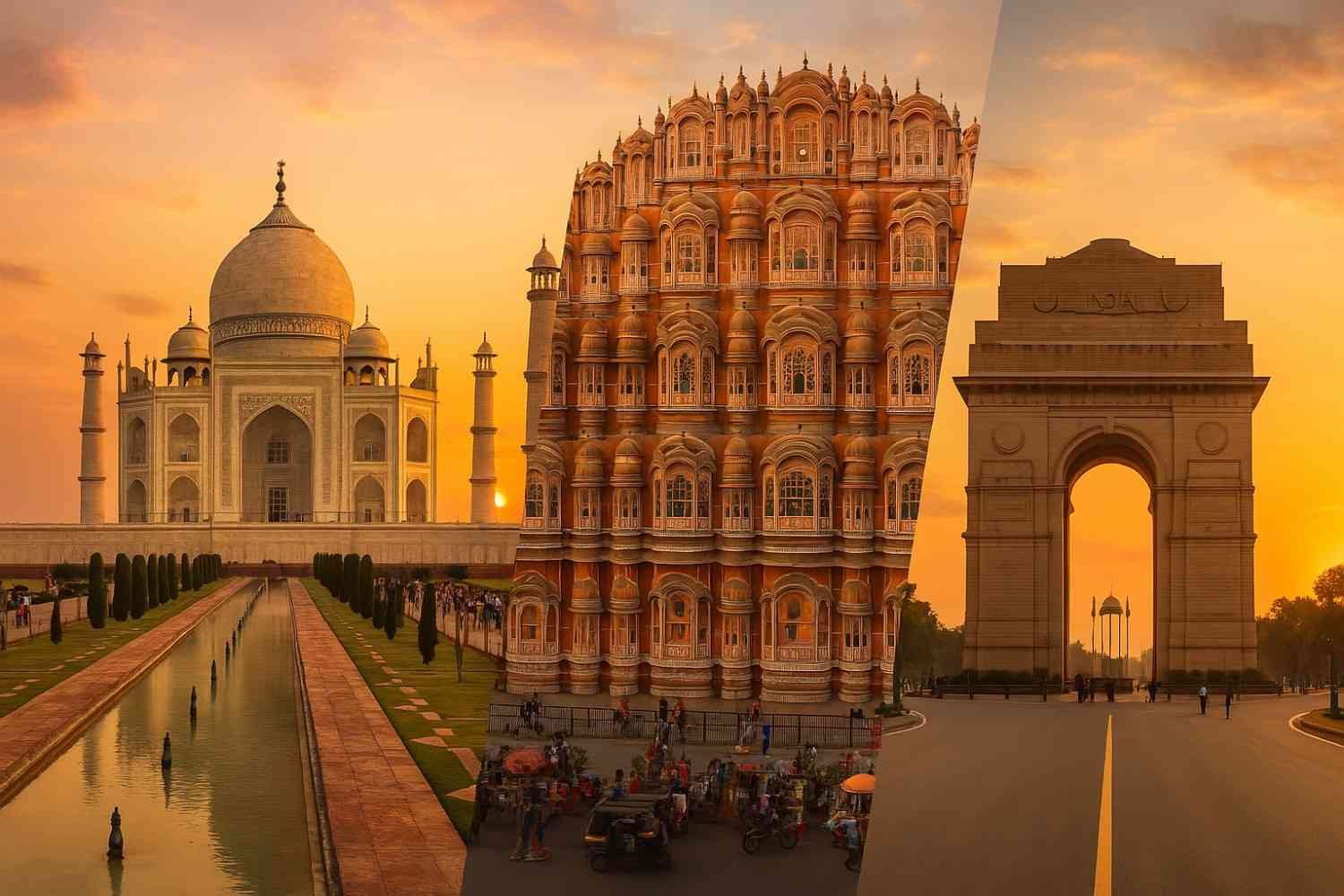
This is the trip.
Diwali 2026: The Dates You Need to Know
Before the itinerary — confirm these dates in your diary.
November 6 (Friday) — Dhanteras. The festival opens. The most auspicious day of the year to buy gold and silver. Johari Bazaar in Jaipur and Chandni Chowk in Delhi blaze with jewellery shops open late, families shopping in their finest clothes, the first diyas appearing on doorsteps as evening falls.
November 7 (Saturday) — Choti Diwali. The pre-Diwali evening. The city begins to glow in earnest. Homes and shops light their first serious rounds of diyas. The markets are decorated. The air begins to carry the smell of incense and gunpowder. A more intimate version of what is coming tomorrow.
November 8 (Sunday) — Diwali / Lakshmi Puja. The main night. The auspicious window for Lakshmi Puja in Jaipur opens at approximately 5:45 PM. From this moment, every home, shop, and temple in the city lights up simultaneously. Amber Fort is illuminated on the hillside. The Pink City’s terracotta buildings are outlined in warm lights. Fireworks burst over the Aravalli Hills from dusk until past midnight. This is the night this entire itinerary is built around.
November 9 (Monday) — Govardhan Puja. The day after Diwali. Temples hold special ceremonies. The city has a warm, generous, post-celebration atmosphere. Families visit each other. Thandai and sweets are shared between households.
November 10 (Tuesday) — Bhai Dooj. The final day of Diwali. A gentle wind-down. The bazaars are quieter. The decorations stay up. Jaipur returns toward its normal rhythm — but the memories stay.
Why the Golden Triangle Is the Perfect Diwali Framework
The Golden Triangle works for Diwali for one specific reason: the geographic sequence puts you in the right city on the right night.
Delhi on November 6 and 7 — the pre-Diwali days — is the finest version of the experience. Chandni Chowk on Dhanteras is extraordinary. The old city on Choti Diwali, with the first diyas appearing and the fireworks beginning to pop overhead, is deeply atmospheric.
Agra on November 7 — Choti Diwali evening. The Taj Mahal visited at sunrise on November 8 before the celebration begins. There is something specific about seeing the Taj Mahal on Diwali morning — the monument completely calm and beautiful, knowing that by evening the entire country will be lit in celebration.
Jaipur on November 8 — Diwali night. This is the destination. The Pink City on Diwali is widely considered the finest Diwali celebration in Rajasthan and one of the finest in India. Amber Fort illuminated on the hillside above the city. The old city’s bazaars blazing with diyas and marigolds. Fireworks over the Aravalli Hills from every direction simultaneously.
The sequence is not arbitrary. It is designed so that each day builds toward the climax of November 8 in Jaipur — and each city adds its own Diwali dimension to the overall experience.
Complete Day-by-Day Itinerary
Day 1: Arrive Delhi — November 4 (Wednesday)
Arrive Delhi with a two-day buffer before the festival begins. This is deliberate. Long-haul travel is disorienting and the last thing you want is to arrive in India the morning of Diwali after an overnight flight.
Your private driver meets you at Indira Gandhi International Airport and transfers you directly to your hotel. Check in. Rest. Eat something. Let India arrive slowly rather than trying to absorb it all at once.
If you arrive with energy in the evening, Connaught Place — Delhi’s grand colonial-era commercial centre — is a short drive from most central hotels. The wide colonnaded walkway in the evening, with the city at full flow around you, is a perfect gentle introduction to Delhi’s energy.
Day 2: Delhi Sightseeing — November 5 (Thursday)
A full day across Old and New Delhi with your licensed local guide and private vehicle.
The morning belongs to Old Delhi. Begin with a cycle rickshaw ride through the lanes of Chandni Chowk — the great Mughal-era bazaar, where the smell of spices, incense, street food, and centuries of commerce arrives from every direction simultaneously. Visit Jama Masjid — India’s largest mosque, built by Shah Jahan — and climb the minaret for a panoramic view over Old Delhi’s rooflines. Walk to Paranthe Wali Gali for breakfast stuffed parathas from shops that have been frying them since the 1870s.
In the afternoon, switch to New Delhi. Visit Humayun’s Tomb — a UNESCO World Heritage Site and the architectural predecessor of the Taj Mahal, built in 1572 and far less crowded than the Taj while being almost equally magnificent. Then Qutub Minar — the 73-metre medieval tower of victory, surrounded by the ruins of Delhi’s oldest mosque. Drive past India Gate and through Lutyens’ New Delhi — the grand colonial-era capital with its wide ceremonial boulevards.
In the evening, Chandni Chowk is already beginning to show its Diwali preparations. Shop fronts are being decorated. The first fairy lights are going up. The smell of marigolds — used in vast quantities for Diwali garlands — begins to mix with the usual street food smoke. This is the pre-festival Delhi that most visitors miss because they arrive a day too late.
Day 3: Delhi — Dhanteras Preparation and Evening — November 6 (Friday)
Dhanteras is the day the Diwali festival officially opens — and it is one of the finest single days to be in Delhi.
Spend the morning at leisure. Visit the Purana Qila (Old Fort), the National Museum, or the Lodhi Art District if you have not been. Or simply walk through the Lodhi Colony market and INA Market, watching the city prepare for the festival — vendors selling diyas, rangoli colours, silver items, and marigold garlands on every corner.
In the afternoon, visit Chandni Chowk and Karol Bagh — the two finest areas in Delhi to witness Dhanteras shopping at its peak. Johari Bazaar in Chandni Chowk is where Delhi’s gold and silver market concentrates on Dhanteras — entire families in their finest clothes examining jewellery under warm lights, the clink of bangles and the quiet negotiation of prices conducted on the same street corners for 400 years.
By early evening, the first diyas are being lit across the city. Doorsteps, windowsills, temple entrances. The smell of burning oil, incense, and marigolds fills every lane. Delhi at dusk on Dhanteras is one of the most beautiful urban evenings in India.
Dinner at one of Delhi’s rooftop restaurants with views over the city as the lights come on.
Day 4: Delhi to Agra — Choti Diwali — November 7 (Saturday)
After an early breakfast, drive to Agra — approximately 3 to 3.5 hours along the Yamuna Expressway. Alternatively, take the Gatimaan Express from Hazrat Nizamuddin station — 1 hour 40 minutes to Agra Cantonment, the finest train journey on the Golden Triangle circuit.
Arrive Agra by midday. Check into your hotel.
In the afternoon, visit Agra Fort — the massive red sandstone Mughal fortress that is the other UNESCO World Heritage Site in Agra. The ramparts looking toward the Taj Mahal across the Yamuna — the view Shah Jahan had of his monument in the final years of his imprisonment — are one of the finest viewpoints in India.
As evening approaches on Choti Diwali — November 7 — go to Mehtab Bagh. This garden, directly across the Yamuna from the Taj Mahal, is the finest external viewpoint for the monument. On Choti Diwali evening, the city of Agra is beginning to light up around you. Fireworks pop intermittently in the distance. The Taj Mahal stands white and serene across the river while the city behind you slowly catches fire with light and celebration.
This juxtaposition — the Taj Mahal’s timeless quiet against the warmth and noise of the approaching festival — is one of the most distinctive experiences on this entire itinerary. Stay until after dark. The Taj Mahal lit by Agra’s Diwali fireworks, seen from Mehtab Bagh, is a view that almost nobody has described because almost nobody has thought to position themselves there.
Day 5: Taj Mahal at Sunrise — Then Drive to Jaipur — November 8 (Diwali)
Wake at 4:30 AM. This is the most important morning alarm of the entire trip.
Be at the West Gate of the Taj Mahal by 5:15 AM. Enter at gate opening — approximately 5:30 AM — with your pre-booked online tickets.
Walk through the main gateway arch. Stop. The Taj Mahal at sunrise on Diwali morning — white marble against the sky turning from grey to pink to gold, the reflecting pool still and glassy, the minarets framing the dome in perfect symmetry — is a version of the monument that perhaps only a handful of people in the world have ever experienced. It is Diwali morning. There are fewer people than on a typical November sunrise because many domestic visitors delayed their Agra trip until after Diwali. The monument is nearly yours.
Spend the first 90 minutes at the complex before tour groups arrive. Enter the mausoleum — the inner chamber where the cenotaphs of Shah Jahan and Mumtaz Mahal are kept — before 8 AM. The mausoleum add-on ticket (₹200 extra) is essential.
After breakfast, begin the drive to Jaipur — approximately 5 hours including a stop at Fatehpur Sikri en route. The abandoned Mughal capital — built by Emperor Akbar in 1571, deserted 14 years later — is worth 90 minutes. The vast red sandstone courts and the Buland Darwaza gateway are extraordinary.
Arrive Jaipur by late afternoon. Check into your heritage hotel. Rest briefly.
By 6 PM, the city will be transforming. The Lakshmi Puja auspicious window opens at approximately 5:45 PM. Step outside. Look up at the Aravalli Hills above the city. The first fireworks are beginning to burst over the hillsides where Amber Fort and Nahargarh Fort sit illuminated against the darkening sky.
Walk toward the old city. The lanes of Johari Bazaar and Bapu Bazaar are a continuous wall of light and colour — every shop front decorated, every doorway outlined in diyas, the air thick with incense and marigold and gunpowder. The sound of fireworks builds steadily. By 8 PM it is continuous — every direction simultaneously, the sky above the Pink City alive with colour.
This is Diwali in Jaipur. This is the night this whole trip was built for.
Day 6: Jaipur — Post-Diwali Morning, Amber Fort, City — November 9 (Monday)
After the energy of Diwali night, the morning of November 9 has a particular quality that experienced India travellers recognise — warm, generous, slightly euphoric. The city is relaxed and open. Families are visiting each other. Sweets are being shared. The bazaars open later than usual.
Use the morning for Amber Fort — the finest single monument in Jaipur and one of the most spectacular forts in India. The jeep ride up to the entrance gate, the views across Maota Lake from the ramparts, and the Sheesh Mahal (Hall of Mirrors) within are all extraordinary. In the November post-Diwali morning light — clear, gold, and still — Amber Fort is at its most photogenic.
After Amber Fort, visit the City Palace — still partially the residence of the Jaipur royal family. The museum within houses extraordinary collections of royal textiles, weapons, and manuscripts. Then Jantar Mantar — the 18th-century outdoor astronomical observatory, a UNESCO World Heritage Site.
In the afternoon, walk through the bazaars. Johari Bazaar for gemstones. Bapu Bazaar for block-print textiles. Tripolia Bazaar for lac bangles. The bazaars the day after Diwali are still decorated — the garlands and diyas still fresh — and the atmosphere is unhurried and generous.
Optional evening: Nahargarh Fort at sunset. From the hilltop fort, you can see the entire Pink City spread below — still dotted with the last decorations of Diwali, the Aravalli Hills golden in the evening light. The Sound and Light Show at Amber Fort is also excellent on post-Diwali evenings when the fort is still illuminated.
Day 7: Jaipur at Leisure — Depart — November 10 (Tuesday — Bhai Dooj)
Your final morning in Jaipur falls on Bhai Dooj — the last day of the Diwali festival. The city is winding down from five days of celebration, but the decorations are still up and the atmosphere is still warm.
Use the morning for anything you missed — the textile museum, a cooking class with a local family, or simply a long breakfast on a heritage rooftop overlooking the old city.
Drive or fly back to Delhi for your international departure. Those with afternoon or evening flights have time for a final lunch at Connaught Place or a last shopping run at Dilli Haat.
Alternative Sequence: Delhi → Jaipur → Agra
If you prefer to experience Diwali in Jaipur AND see the Taj Mahal after the festival, the reverse sequence works equally well.
Arrive Delhi November 4. Delhi sightseeing November 5. Drive to Jaipur November 6 — Dhanteras evening in the Pink City. Full Jaipur sightseeing November 7 (Choti Diwali). Diwali night in Jaipur November 8. Drive to Agra via Fatehpur Sikri November 9. Taj Mahal sunrise November 10. Agra Fort November 10 afternoon. Return to Delhi November 11 for departure.
This sequence works well if you prefer your Taj Mahal visit on a slightly quieter post-Diwali day. The Taj Mahal on November 10 (Bhai Dooj) will be less crowded than a typical November day — most domestic visitors who delayed Agra for after Diwali will have returned home. A very quiet sunrise visit on November 10 is entirely possible.
What Diwali in Jaipur Actually Looks Like
The question most travellers ask before they go — and the question that is impossible to answer adequately in advance.
The lights come on all at once. That is the most accurate description. At approximately 6 PM on November 8, the Lakshmi Puja window opens. Within twenty minutes, every building in the old city is outlined in lights. Every doorstep carries diyas. Every shop front has fairy lights and marigold garlands. The sky above the Aravalli Hills — Amber Fort is up there, illuminated — begins to light with the first fireworks.
By 7 PM, the fireworks are continuous. Every rooftop. Every open ground. The hills above the city. The sound is extraordinary — a constant rolling wave of explosions from every direction. The smoke from the fireworks creates a low haze over the old city through which the lights look softer and more diffused. The smell is gunpowder and marigolds and incense simultaneously.
By 8 PM you are standing in the lanes of Johari Bazaar surrounded by thousands of people all doing the same thing — looking up, looking around, smiling at strangers, shouting over the noise of fireworks, laughing at the sudden close burst of a rocket from the next rooftop. This is Diwali.
By 10 PM the fireworks begin to reduce. By midnight the city is quieter. But the lights stay on — all night, in many buildings — and the smell of the night lingers through until dawn.
Where to Watch Diwali Fireworks in Jaipur
Nahargarh Fort (best overall view): The hilltop fort on the Aravalli ridge above the city offers a 270-degree panoramic view of Jaipur and the surrounding hills. From Nahargarh, you watch fireworks burst over the entire Pink City simultaneously while Amber Fort is illuminated on the adjacent hillside. Arrive by 5:30 PM. The fort closes around 10 PM.
Heritage hotel rooftops (most atmospheric): Many heritage hotels in and around the old city have rooftop terraces that become the finest Diwali viewing platforms imaginable. A rooftop table overlooking the illuminated old city, with fireworks bursting at eye level and above, is the most intimate version of the experience. Book well in advance — rooftop tables on Diwali night sell out by October.
Outside Hawa Mahal (most iconic): The five-storey Palace of Winds, outlined in lights, photographed from the road directly across with fireworks in the sky above. The classic Jaipur Diwali photograph. Arrive by 5:30 PM to claim a good position on the pavement outside.
Johari Bazaar and Bapu Bazaar (most immersive): Walking through the blazing lanes of Jaipur’s jewellery and fabric streets at the peak of Diwali night — surrounded by celebration, colour, sound, and thousands of Jaipur residents in their finest clothes — is the experience that takes the longest to describe and the longest to forget.
Practical Tips for Diwali on the Golden Triangle
Book everything by September. Heritage hotels in Jaipur for Diwali week sell out by October every year. The Rambagh Palace, Samode Haveli, Jai Mahal Palace, and Narain Niwas Palace all have Diwali waiting lists by the time most international visitors begin planning. If you are reading this in September 2026 — book today.
Taj Mahal tickets must be booked in advance. The Taj Mahal entry is now cashless and requires pre-booked online tickets. The sunrise slot on November 8 (Diwali morning) will be competitive. Book through the official ASI portal as soon as your dates are confirmed.
Air quality on Diwali night. Jaipur’s air quality on the main Diwali night deteriorates due to fireworks smoke. If you are sensitive to air quality or have respiratory conditions, carry an N95 mask for the peak fireworks hours (approximately 7 PM to 10 PM on November 8). Most healthy visitors find the smoke adds atmosphere rather than causing discomfort.
Traffic on Diwali day. The roads from Agra to Jaipur on November 8 will be busier than usual — it is a national public holiday. Depart Agra by 11 AM at the latest. Your driver will know the best route and traffic patterns for the day.
Dress for the occasion. November 8 evenings in Jaipur are cool — around 16°C to 20°C as the night progresses. Dress warmly in layers for outdoor Diwali watching. Traditional Indian dress — kurta and churidar for men, salwar kameez or saree for women — is warmly welcomed and makes the experience feel more participatory.
Heritage hotel Diwali events. Many of Jaipur’s finest heritage hotels host special Diwali dinner events — traditional Rajasthani food, cultural performances, a safe viewing space for the fireworks from the hotel’s own terrace, and organised puja ceremonies for guests. These events combine the authenticity of the festival with the organisation that first-time Diwali visitors appreciate. Book through your tour operator.
Extending the Itinerary: What to Add
Ranthambore Tiger Safari: Add two nights at Ranthambore National Park before or after Jaipur. October is the first month of the safari season — the vegetation is still lush and the tigers are active near water. A Ranthambore extension makes this the finest combined wildlife and festival itinerary available in India.
Pushkar Camel Fair: After Jaipur, continue to Pushkar — just 150 km away. The Pushkar Camel Fair runs November 17 to 24, reaching its spiritual climax on Kartik Purnima (November 24). Adding three nights in Pushkar after Diwali in Jaipur gives you the two finest festival experiences in Rajasthan in a single trip.
Varanasi for Dev Deepawali: On November 24 — exactly fifteen days after Diwali — Varanasi hosts Dev Deepawali. Every ghat on the Ganges is illuminated with hundreds of thousands of earthen lamps. Those who have seen both Diwali and Dev Deepawali consistently say Dev Deepawali in Varanasi is the most beautiful single night in India. Add it as a four-night extension from Jaipur by flying Delhi to Varanasi.
Explore extensions:
Frequently Asked Questions
When is Diwali 2026?
Diwali 2026 (Lakshmi Puja — the main night) falls on Sunday, November 8. The five-day festival runs from Dhanteras on November 6 through Bhai Dooj on November 10.
Which is the best city for Diwali on the Golden Triangle?
Jaipur. The Pink City’s illuminated old city, the forts lit on the hillsides above, and the fireworks over the Aravalli Hills make Jaipur the most spectacular Diwali destination in Rajasthan. Plan to be in Jaipur for November 8.
Can I visit the Taj Mahal on Diwali day?
Yes. November 8 is a Sunday and the Taj Mahal is open. The itinerary is built around a Taj Mahal sunrise visit on November 8 morning — before the Diwali celebrations begin. Book your ticket in advance through the official ASI portal.
Is the Taj Mahal ever closed on Diwali?
The Taj Mahal closes every Friday regardless of festivals. In 2026, Diwali falls on a Sunday — the Taj Mahal will be fully open.
How far in advance should I book for Diwali 2026?
Book immediately. Heritage hotels in Jaipur for Diwali week sell out by October. The Rambagh Palace Diwali event books out months in advance. If you are reading this in September 2026, book today.
Is a Golden Triangle Diwali tour suitable for first-time visitors?
Absolutely. The Golden Triangle is India’s finest first-time itinerary regardless of festivals — Diwali adds an extraordinary dimension that makes it unforgettable. Book with a reputable tour operator who manages the Taj Mahal tickets, Jaipur hotel, and Diwali logistics in advance.
What does the Rambagh Palace Diwali event involve?
The Rambagh Palace hosts a special Diwali dinner and celebration for hotel guests and invited visitors — traditional Rajasthani food, cultural performances in the Mughal gardens, a safe fireworks viewing from the palace grounds, and a puja ceremony. Dress code is smart. Book directly through your tour operator.
Book Your Golden Triangle Diwali 2026 Tour
At Squid Travel India, the Golden Triangle at Diwali is one of our most-requested itineraries — and November 8, 2026’s timing makes this year’s Diwali the finest available for some time.
We handle everything: heritage hotel bookings secured months in advance, Taj Mahal tickets pre-booked for the November 8 sunrise visit, private transport that accounts for Diwali day traffic, licensed expert guides who know exactly where to be in Jaipur on Diwali night, and 24/7 support throughout the seven days.
Tell us your travel dates and group size. We will build your perfect Diwali Golden Triangle itinerary and send a full quote within 24 hours.
Also worth reading:
- Golden Triangle Tour from Delhi
- Diwali 2026 in Jaipur — Complete Guide
- India in November 2026
- Golden Triangle Tour Cost 2026
- Taj Mahal Tickets, Timings & Entry Fee 2026
- Make Your Own Tour
📞 Call / WhatsApp: +91 9990812499 📧 Email: Squidtravelindia@gmail.com 🌐 Visit: squidtravelindia.com
1,800+ trips completed | 98% happy clients | TripAdvisor Travelers’ Choice 2024–2025
Last updated: September 2026. Diwali 2026 confirmed as November 8 (Lakshmi Puja). Taj Mahal entry fees and timings subject to change — verify at the official ASI portal before booking.
Comment (0)