

There is nothing else like it on earth.
For eight days every November, a small, sacred temple town in the Rajasthan desert — population 20,000 on a quiet day — transforms into one of the most extraordinary gatherings of people, animals, colour, music, and ancient ritual that the modern world still produces.
Tens of thousands of camels. Horses decorated with tassels and bells. Cattle traders from every corner of Rajasthan sleeping under the desert stars beside their animals. Pilgrims bathing in a sacred lake at dawn. Hot air balloons drifting above the dunes at sunrise. Folk dancers performing by firelight. And at the centre of it all — a full moon rising over the ghats of Pushkar Lake as hundreds of thousands of devotees raise their hands to the sky in one of the most spiritual moments available to any traveller anywhere in the world.
The Pushkar Camel Fair 2026 runs from November 17 to November 24. The sacred climax — Kartik Purnima — falls on Tuesday, November 24, 2026.
This guide tells you everything you need to plan your visit: the exact dates, what happens each day, where to stay, what to eat, how to get there, what it costs, and how to experience it properly rather than just passing through.
Quick Facts: Pushkar Camel Fair 2026
| Official dates | November 17–24, 2026 |
| Sacred peak night | Kartik Purnima — Tuesday, November 24, 2026 |
| Also called | Pushkar Mela, Kartik Mela, Pushkar ka Mela |
| Location | Pushkar, Ajmer District, Rajasthan |
| Distance from Jaipur | 145 km (approximately 3 hours by road) |
| Distance from Delhi | 405 km (approximately 7 hours by road) |
| Entry fee to fair | Free (no ticket required) |
| Estimated attendance 2026 | 400,000+ visitors over 8 days |
| Best days to visit | November 19–24 (peak cultural events + Kartik Purnima) |
| Best for | Photography, culture, spiritual experience, camel rides |
| Not recommended for | Anyone who cannot handle large crowds on the final night |
What Is the Pushkar Camel Fair?
The Pushkar Camel Fair — known locally as the Pushkar Mela or Kartik Mela — is simultaneously two completely different festivals happening in the same place at the same time.
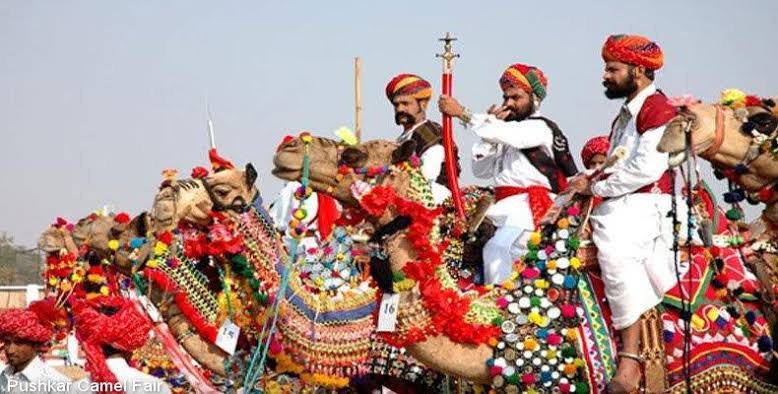
The first festival is one of the world’s largest livestock trading fairs. Tens of thousands of camels, horses, and cattle are brought to the desert plains outside Pushkar by traders from across Rajasthan and neighbouring states. Herds of camels decorated with colourful embroidery, tassels, and bells arrive over the course of several days, their traders camping beside them on the open ground. Trading, haggling, veterinary inspections, and the ancient economics of rural Rajasthan play out across the fairground in a spectacle that has been happening — essentially unchanged — for centuries.
The initial intention behind the festival was to draw local livestock traders to do business during the Hindu month of Kartik. That practical purpose still exists. Real camels are still bought and sold for real money. The economics are genuine. You are not watching a re-enactment — you are watching a working market that happens to be extraordinary.
The second festival is a Hindu pilgrimage of profound significance. Kartik Purnima is one of the holiest bathing days in Hinduism and Pushkar Lake is a deeply sacred pilgrimage water. On and around this full moon night, hundreds of thousands of Hindu pilgrims come to Pushkar to bathe in the lake’s sacred waters — an act believed to cleanse sins accumulated over a lifetime — and to pray at the Brahma Temple, one of only a handful of temples in the world dedicated to Lord Brahma, the creator of the universe in Hindu theology.
These two festivals — the raucous trading fair and the solemn religious pilgrimage — coexist, overlap, and create something that is uniquely, irreducibly Pushkar.
The Story Behind the Fair
According to Hindu mythology, Lord Brahma — one of the gods in the Hindu Trinity, believed to be the creator of the universe — dropped a lotus flower here and named the place “Pushkar”, which means “Blue Lotus flower”. On the eve of Kartik Purnima, hundreds of pilgrims from around the world come to take a dip in Pushkar Lake to remove their sins.
The Brahma Temple in Pushkar — just steps from the lake — is one of the rarest temples in India. Lord Brahma has few temples dedicated to him across the entire subcontinent; the reasons for this are complex and rooted in ancient mythology. The Pushkar Brahma Temple is considered the most important of them all. During Kartik Purnima, it becomes the centre of the religious world.
The livestock fair grew organically around the pilgrimage — traders and pilgrims always travel the same ancient roads, and the economic opportunity of a massive gathering of people was not lost on Rajasthan’s camel herders and horse traders. Over centuries, the two traditions became inseparable.
2026 Dates — Day by Day
The Pushkar Camel Fair 2026 will be held from November 17 to 24, with the main events and ceremonies occurring on the religious holiday Kartik Purnima.
Here is what happens each day:
November 17–18 — Arrival Days
The first traders begin arriving with their animals. This is actually one of the most atmospheric times to visit — the camel trains arriving across the desert, the traders setting up camps, the first fires being lit as evening falls. If you want photographs of camels without the crowds, November 17–18 is the time.
The fairground is quieter than it will be in the following days. Accommodation is still available. Prices are lower. And the sense of witnessing something ancient and genuine — not yet overwhelmed by the tourist infrastructure — is strongest in these first two days.
November 19–21 — Peak Trading and Cultural Events
The last five days prior to Kartik Purnima are extremely popular for all types of trade, athletic competitions, ritual celebrations and, of course, bathing in the holy waters of Pushkar Lake.
These three days are when the fair is at its most visually spectacular for international visitors. The cultural programme is in full swing:
Camel decoration competitions — camels groomed, embroidered, and adorned to extraordinary standards are judged in formal competitions. The winning camels are celebrated with as much seriousness as any prize animal at an agricultural show anywhere in the world.
Camel races — the flat desert ground outside Pushkar makes for a natural racetrack. Camel races are fast, surprisingly thrilling, and draw enormous crowds from both local and international visitors.
Camel beauty pageant — one of the most photographed events of the entire fair. Camels are decorated with intricate patterns painted on their necks and bodies, their riders in full traditional Rajasthani dress. The judging criteria are genuine and contested fiercely.
Longest moustache competition — one of the fair’s most famous and most photographed events. Rajasthani men with extraordinary moustaches compete for the prize. The lengths achieved are genuinely astounding.
Tug of war and traditional games — village teams from across Rajasthan compete in athletic events on the fairground.
Folk music and dance — traditional Rajasthani musicians play throughout the day and evening at various points across the fairground. Kalbelia dancers — the snake-charmer community whose circular folk dance is listed by UNESCO as Intangible Cultural Heritage — perform nightly to packed audiences.
Hot air balloon rides — the hot air balloon festival runs across the peak days of the fair. Balloon rides over the fair at sunrise — looking down at the camels, the camp fires, and the desert town — are one of the most extraordinary photographic experiences available in India.
November 22–23 — Spiritual Peak Approaching
The fair begins to shift in character as Kartik Purnima approaches. More pilgrims arrive. The ghats of Pushkar Lake — the steps leading down to the sacred water — become increasingly crowded with devotees performing rituals. Priests conduct elaborate ceremonies at the lake’s edge throughout the day and night.
The atmosphere on the evening of November 23 — the night before Kartik Purnima — is extraordinary. The full moon is rising. The lake is full of devotees bathing by moonlight. The smell of incense, marigolds, and wood smoke fills the air.
November 24 — Kartik Purnima (The Sacred Climax)
The sacred climax falls on Kartik Purnima, Tuesday 24 November 2026.
This is the night that everything builds toward. The full moon rises over the desert and the lake simultaneously. Hundreds of thousands of pilgrims bathe in the sacred water at dawn — an act of profound religious significance performed with complete conviction by people who have sometimes travelled hundreds of miles to be here.
Throughout the day, the religious atmosphere intensifies. By evening, the ghats are lit with oil lamps. Flower offerings float on the lake surface. Priests conduct final ceremonies. The Brahma Temple receives a continuous stream of devotees throughout the night.
Kartik Purnima is the fair’s culminating day. The fair officially closes by sunset.
For international visitors, watching Kartik Purnima from a rooftop or from a boat on the lake — rather than trying to push through the enormous crowd at the ghats — is the most manageable and most beautiful way to experience the climax.
The Fairground — What You’ll Actually See
The Pushkar Mela fairground spreads across the sandy desert plain immediately outside the town of Pushkar — a vast open area that, in ordinary months, is essentially empty desert. During the fair, it becomes one of the most densely populated square miles in India.
The camel ground — the heart of the trading fair. Tens of thousands of camels are tethered in long lines across the desert. Their traders camp beside them, cooking on open fires, tending their animals, and negotiating with buyers who move methodically down the rows examining legs, teeth, and temperament. The sheer scale — as far as the eye can see, camels and their people — is overwhelming in the best way.
The horse trading area — horses are bought and sold alongside camels. Rajasthan’s horse traders are a distinctive community whose animals are often extraordinarily beautiful — high-stepping Marwari horses with their distinctive inward-curving ears.
The cultural arena — a central arena where the organised events (camel races, beauty pageants, folk performances) take place. Seating is available around the perimeter. Major events draw thousands of spectators.
The craft bazaar — running alongside the livestock fair, a vast market of handicraft vendors from across Rajasthan sells everything from Jaisalmer embroidery to Barmer block prints, silver jewellery, leather goods, and traditional Rajasthani toys. This is among the finest concentrated craft shopping available anywhere in India.
The food stalls — hundreds of vendors selling dal baati churma, laal maas, bajra roti, and the full range of Rajasthani village cooking alongside chai stalls that operate through the night.
The entertainment area — acrobats, fire jugglers, snake charmers, puppet shows, folk musicians, and the Kalbelia dancers create a continuous performance environment that operates from morning to late at night.
The Brahma Temple and Pushkar Lake
The spiritual core of Pushkar Mela is not the fairground at all — it is the town itself, specifically Pushkar Lake and the Brahma Temple on its shore.
Pushkar Lake is a sacred body of water ringed by 52 ghats — bathing steps — leading down to the water. Every ghat has its own name, its own resident priests, and its own ritual significance. During Kartik Purnima, every one of these ghats is filled with pilgrims bathing, praying, and making offerings.
The lake is considered so sacred that leather goods, meat, fish, and alcohol are all strictly prohibited in Pushkar town — a rule enforced seriously. The entire town is vegetarian. Pushkar’s famous lassi (thick yoghurt drink) and its cannabis-infused bhang products (legal in religious context in Pushkar) are among its distinctive culinary offerings.
The Brahma Temple stands just a few minutes’ walk from the lake. Built in the 14th century with a distinctive red spire, it is one of the world’s few temples dedicated to Lord Brahma and is the most important of them. Non-Hindu visitors are welcome — shoes must be removed and heads covered before entering.
Where to Stay During Pushkar Camel Fair 2026
Pushkar’s accommodation fills months in advance for fair dates. Book the moment your dates are confirmed — do not leave this to chance.
Tent Cities (Most Popular with International Visitors)
The tent cities that appear on the desert plain outside Pushkar specifically for the fair period are the most atmospheric and most memorable accommodation option. Luxury tented camps offer surprisingly comfortable conditions — proper beds, attached bathrooms, electricity, and often restaurants — within walking distance of the fairground.
RTDC (Rajasthan Tourism Development Corporation) camps — the government-run tented accommodation is well-organised and affordable. Book directly through the Rajasthan Tourism website. Prices range from ₹5,000–₹15,000 per night depending on the tent category.
Private luxury tented camps — several operators (Meraki Pushkar, The Tent City, and others) offer premium experiences with larger tents, better facilities, and camp fires. Prices range from ₹8,000–₹25,000 per night. Book 3–4 months ahead — these fill first.
Hotels in Pushkar Town
Pushkar has a range of guesthouses and small hotels within the town itself, most within walking distance of the lake. These fill up completely for fair dates by September.
Budget guesthouses: ₹1,500–₹3,000 per night during fair. Comfortable but basic. Many offer rooftop access with lake views.
Mid-range hotels: ₹4,000–₹8,000 per night during fair. Some have lake-facing rooms — book the best ones immediately.
Heritage properties: The Pushkar Palace Hotel (directly on the lake) and Ananta Spa & Resort are the finest in-town options. Expect ₹12,000–₹25,000 per night during fair week.
Hotels in Ajmer (Budget Alternative)
Ajmer — 11 km from Pushkar — has significantly more accommodation at lower prices. Daily transport between Ajmer and Pushkar runs throughout the fair period. This is a viable option for budget-conscious visitors who couldn’t secure accommodation in Pushkar.
How to Get to Pushkar
From Jaipur (Most Common Route)
Jaipur to Pushkar is 145 km — approximately 3 hours by road. This is the standard approach for travellers on the Golden Triangle who are adding Pushkar to their Rajasthan itinerary.
Private taxis from Jaipur to Pushkar cost approximately ₹2,500–₹3,500 for a full car. This is the most comfortable option, door to door.
Shared taxis from Jaipur’s Sindhi Camp bus stand are cheaper (₹300–500 per person) but take longer due to stops.
Jaipur to Ajmer by express train takes approximately 2 hours; from Ajmer, auto-rickshaws and taxis cover the 11 km to Pushkar in 20–30 minutes.
From Delhi (Direct Journey)
Delhi to Pushkar is approximately 405 km — 7 hours by road or by train via Ajmer.
Train from Delhi to Ajmer: Several daily trains on the Delhi–Mumbai or Delhi–Ahmedabad routes stop at Ajmer. The journey takes 5–7 hours. From Ajmer station, Pushkar is 11 km (20–30 minutes).
Flight from Delhi to Jaipur (1 hour), then road to Pushkar (3 hours) — often faster than the direct road or rail journey.
Nearest Airport
Jaipur International Airport (JAI) — 145 km from Pushkar. Flights from Delhi (1 hour), Mumbai (1.5 hours), and other major cities connect to Jaipur. From Jaipur Airport, private taxis to Pushkar take approximately 3 hours.
Activities at the Pushkar Camel Fair
Camel Rides
The most straightforward and most-photographed Pushkar experience. Camel rides across the desert fringe of the fairground are available throughout the fair period. Prices are negotiable — agree the route, duration, and price before mounting. A 30-minute ride typically costs ₹200–500 depending on negotiation.
Hot Air Balloon Rides
Hot air balloons dot the sky above the fair during the peak days. Watching the fairground from the air at sunrise — tens of thousands of camels below you, cooking fires starting, the desert turning gold — is genuinely extraordinary. Balloon rides are booked through operators in Pushkar and at the tent cities. Prices range from ₹7,000–₹12,000 per person. Book in advance — rides fill up quickly during fair week.
Photography
Pushkar Camel Fair is one of the world’s great photography destinations. The combination of extraordinary subjects (camel traders in turbans, decorated animals, fire dancers, bathing pilgrims), extraordinary light (desert dawn and dusk are spectacular), and genuine non-staged activity creates conditions that professional photographers travel enormous distances to work in.
Best photography times:
- Dawn (5:30–7:30 AM) — the golden light on the camel ground, traders making chai, animals waking
- Late afternoon (4:00–6:00 PM) — the warmest light of the day on turbans, embroidery, and animal coats
- Kartik Purnima night — lamp-lit ghats, full moon reflections on the lake
Photography etiquette: Always ask permission before photographing individuals. Most traders are happy to be photographed and may ask for a small payment (₹20–50 is appropriate). Never photograph women without explicit permission.
Kalbelia Dance Performances
The Kalbelia community — whose traditional dance is listed by UNESCO as Intangible Cultural Heritage of Humanity — perform nightly at the Pushkar fair. Their circular, spiralling dance in black skirts embroidered with mirror work, performed to the haunting sound of the been (snake charmer’s flute), is one of the most beautiful folk dance traditions in India. Do not miss an evening performance.
Exploring Pushkar Town
Beyond the fairground, Pushkar town rewards exploration. The 52 ghats of the lake, the narrow lanes of shops selling silver jewellery and Rajasthani textiles, the aromatic chai stalls, the extraordinary range of people — pilgrims, traders, international travellers, sadhus, and local families — all coexist in a town that has been a pilgrimage destination for millennia.
The rooftop cafes around the lake offer views over the water and are the finest places to watch the evening aarti ceremony as the sun sets over the ghats.
What to Eat in Pushkar
Pushkar is a strictly vegetarian town — no meat, fish, or eggs are served anywhere in Pushkar due to its sacred status. This is not a hardship — Rajasthani vegetarian food is extraordinary.
Dal baati churma — Rajasthan’s signature dish. Hard-baked wheat balls (baati) served with a rich spiced lentil dal and sweetened crushed wheat (churma). Eaten together in the traditional way, it is one of the most satisfying and distinctive meals in India.
Mawa kachori — Pushkar’s famous sweet — a fried pastry filled with sweetened condensed milk, served warm. Available at every sweet shop in town and genuinely delicious.
Aloo pyaz kachori — the savoury version — fried pastry filled with spiced potato and onion. The definitive Pushkar breakfast.
Lassi — Pushkar’s lassi is exceptionally thick and rich, served in clay cups. The sweet lassi is excellent. The town also produces the famous “special lassi” infused with bhang (cannabis) — legal in this religious context, very strong, and not recommended before an afternoon of walking.
Chai — consumed in enormous quantities throughout the fair, served in small clay cups from vendors across the fairground. ₹10 per cup.
The fair food stalls — across the fairground, numerous stalls serve simple vegetarian food to traders and visitors alike. The dal, sabji (vegetable curry), and rotis from the most popular stalls are genuinely excellent and cost ₹50–100 for a full plate.
What to Buy at the Pushkar Fair
The craft market running alongside the livestock fair is one of the finest concentrated shopping experiences in Rajasthan.
Silver jewellery — Pushkar is one of the best places in India to buy traditional Rajasthani silver jewellery. Tribal bangles, anklets, nose rings, and necklaces of genuine silver are available at prices that are a fraction of what the same pieces cost in Jaipur’s tourist shops. Bargaining is essential and enjoyable.
Embroidered textiles — traders bring textiles from across Rajasthan and Gujarat. Kutch embroidery, Barmer block prints, Jaisalmer mirror work, and Bagru tie-dye are all available. Buy lengths of fabric rather than made-up garments for the best value.
Leather goods — mojari (embroidered leather shoes), camel leather bags, and belts. Quality varies significantly — handle the stitching and leather thickness before buying.
Puppets and folk art — the Rajasthani string puppet tradition is extraordinary. Fair-quality puppet sets make distinctive gifts that pack flat. ₹200–500 for a good pair.
Camel wool products — blankets and shawls woven from camel wool. Distinctive, warm, and genuinely local.
Bargaining note: Opening prices at the fair are typically set 3–5x above the price at which a seller will happily complete the sale. Counter at 30–40% of the opening price and settle somewhere in the middle. Do this with a smile and genuine interest — it is a social exchange, not a confrontation.
Practical Tips for Visiting Pushkar 2026
Book early — this cannot be overstated
Accommodation for Pushkar Camel Fair dates is one of the most competitive booking situations in India. Quality tent city spots and lake-facing hotel rooms are booked by July–August every year. If you are reading this in August 2026 — book today.
The crowd on Kartik Purnima
November 24 — Kartik Purnima night — sees the largest crowds. Hundreds of thousands of pilgrims at the lake ghats creates a genuine crowd management situation. International visitors should:
- Be at their viewing position (rooftop, boat, or elevated ground) before 5:00 PM
- Avoid trying to push through to the ghats on this specific evening
- Watch from above rather than from within the crowd
Dress modestly and respectfully
Pushkar is a holy town. Shorts, sleeveless tops, and revealing clothing are inappropriate and, in some areas, will attract negative attention. Dress with shoulders and knees covered. A dupatta (scarf) for women is appropriate near the lake and temple. Shoes must be removed before entering the ghats and the Brahma Temple.
No leather, no meat, no alcohol
Pushkar has strict rules about all three. Leather goods (belts, bags, shoes) should not be brought to the ghats or temple — leave them at your accommodation when visiting sacred areas. Meat and alcohol are not available anywhere in Pushkar town and should not be consumed openly.
Protect your belongings
The fair is crowded and pickpocketing occurs in dense crowd areas, particularly around the cultural events and on Kartik Purnima night. Use a money belt. Keep your phone in a zippered pocket. Do not carry more cash than you need for the day.
Dust and sun
The desert environment means dust, particularly in the early days when the camel ground is most active. A scarf or bandana to cover nose and mouth is useful. Sunscreen and a hat are essential — the Rajasthan sun is intense even in November.
Water
Carry sealed bottled water at all times. Dehydration in the desert environment happens faster than most visitors expect, particularly during active sightseeing days.
Sample Pushkar Fair Itinerary — 3 Days
Day 1 — Arrive and Explore (November 20)
Arrive in the late morning from Jaipur or Delhi. Check into your tent camp or hotel. After lunch, walk to Pushkar Lake for your first view of the town in fair mode. Explore the ghats — watch the priests conducting rituals, observe the pilgrims bathing, photograph the flower offerings floating on the water.
In the late afternoon, head to the fairground for the golden hour. The light on the camel ground between 4:00 and 6:00 PM is spectacular. Walk the camel lines, watch the traders at work, observe the decoration competition preparations.
Evening: Kalbelia dance performance at the cultural arena. Dinner at a rooftop restaurant with lake views.
Day 2 — The Full Fair Experience (November 21)
6:00 AM: Sunrise balloon ride over the fairground if booked in advance. The aerial view of tens of thousands of camels as the desert turns gold is extraordinary.
Morning: Camel beauty pageant and racing competitions at the cultural arena. This is the finest photography window of the entire fair.
Afternoon: Explore the craft bazaar. Take a camel ride across the dune fringe. Visit the Brahma Temple during a quieter midday period.
Evening: Attend the evening aarti ceremony at the lake ghats — much less crowded than on Kartik Purnima and genuinely beautiful.
Day 3 — Kartik Purnima (November 24)
This is the sacred night. Be at your rooftop or boat position by 5:00 PM. Watch the full moon rise over the lake as the pilgrims bathe and the priests conduct ceremonies. The atmosphere — reverent, intense, ancient — is unlike any other experience in India.
Depart the following morning for Jaipur, Delhi, or onward.
Adding Pushkar to Your Golden Triangle Tour
Pushkar sits perfectly within a Rajasthan extension of the classic Golden Triangle itinerary. From Jaipur — the third point of the Golden Triangle — Pushkar is just 3 hours by road.
Recommended extended Golden Triangle + Pushkar itinerary (9 nights):
| Day | Location |
|---|---|
| 1–2 | Delhi — Red Fort, Qutub Minar, Old Delhi |
| 3 | Agra — Taj Mahal at sunrise, Agra Fort |
| 4 | Jaipur — Amber Fort, City Palace |
| 5 | Jaipur — bazaars, Jantar Mantar, Nahargarh |
| 6 | Pushkar — arrive, lake, fairground |
| 7 | Pushkar — full fair day + Kalbelia dance |
| 8 | Pushkar Kartik Purnima / return to Jaipur |
| 9 | Jaipur to Delhi — depart |
This itinerary gives you the complete Golden Triangle experience plus two full days at one of the world’s great festivals. It is our most requested November itinerary at Squid Travel India.
Pushkar vs Other India Festivals — How It Compares
| Festival | Location | When | Type | Best For |
|---|---|---|---|---|
| Pushkar Camel Fair | Pushkar, Rajasthan | Nov 17–24, 2026 | Livestock + pilgrimage | Culture, photography, wildlife |
| Diwali | All of India | Nov 8, 2026 | Lights + fireworks | Spectacle, families |
| Dev Deepawali | Varanasi | Nov 24, 2026 | Spiritual | Spiritual seekers |
| Holi | Mathura/nationwide | March 2027 | Color festival | Fun, participation |
| Jaipur Lit Fest | Jaipur | Jan 2027 | Literary | Ideas, culture |
The unique thing about Pushkar: Every other major India festival is primarily about spectacle — watching something beautiful happen. Pushkar is the only major India festival where you are embedded within a real, working, ancient economic and spiritual event rather than observing a performance of one.
Frequently Asked Questions
When is the Pushkar Camel Fair 2026?
The Pushkar Camel Fair 2026 runs from November 17 to November 24, 2026. The sacred climax — Kartik Purnima — falls on Tuesday, November 24, 2026. The best days to visit for cultural events and photography are November 19–22. The most spiritual experience is Kartik Purnima night (November 24).
Is there an entry fee for the Pushkar Camel Fair?
No — entry to the Pushkar Camel Fair fairground is completely free. There is no ticket required to attend the fair or to access the fairground. Individual activities (camel rides, balloon rides, some cultural performances) have their own charges.
How many days do you need at Pushkar Camel Fair?
Two to three days gives you a complete experience — enough time for the camel ground, cultural events, lake and temple, Kalbelia dance, and shopping. If you can arrange your dates to include Kartik Purnima (November 24), three nights is ideal.
Where is Pushkar and how do I get there?
Pushkar is in Ajmer District, Rajasthan, 145 km from Jaipur (3 hours by road) and 405 km from Delhi (7 hours). The nearest railway station is Ajmer Junction (11 km from Pushkar). The nearest airport is Jaipur International (145 km).
Is Pushkar safe for international tourists during the fair?
Yes — Pushkar Camel Fair is one of the most-visited festivals in India and has a well-developed international tourism infrastructure. The main precautions are crowd management on Kartik Purnima night (stay elevated rather than in the crowd at the ghats), standard pickpocket awareness in dense areas, and the cultural sensitivities of a holy town (modest dress, no leather/meat/alcohol).
What is Kartik Purnima and why is it important?
Kartik Purnima is the full moon of the Hindu month of Kartik — one of the holiest bathing days in the Hindu calendar. At Pushkar, it is the night when hundreds of thousands of pilgrims bathe in the sacred lake to cleanse their sins. It is the spiritual climax of the entire Pushkar Mela and falls on November 24, 2026.
Is Pushkar vegetarian?
Yes — Pushkar is a strictly vegetarian town due to its sacred status. No meat, fish, or eggs are served anywhere in Pushkar. Alcohol is also not available. This is not a hardship — Rajasthani vegetarian food is extraordinary and the local mawa kachori and dal baati churma are among the finest things you will eat in India.
Can I combine Pushkar with the Golden Triangle?
Absolutely — this is one of the most popular November itineraries. Pushkar sits 3 hours from Jaipur, making it a natural extension of a Golden Triangle tour. See our sample itinerary above.
Plan Your Pushkar Camel Fair 2026 Tour with Squid Travel India
The Pushkar Camel Fair is one of our most popular November packages — and one of the experiences that visitors most frequently describe as the highlight of their entire India trip.
We organise complete Pushkar packages combining the Golden Triangle with Pushkar, including tent city accommodation secured well in advance, private AC transport, expert local guides, hot air balloon ride bookings, and 24/7 on-trip support.
Golden Triangle + Pushkar packages start from $650 per person.
Book now — Pushkar tent city accommodation for fair dates is one of the most competitive booking situations in India and the best options are secured months ahead.
📞 WhatsApp: +91 9818489607 📧 Email: squidtravelindia@gmail.com 🌐 Browse packages: squidtravelindia.com/tours/golden-triangle-tours/ 🏆 TripAdvisor Travelers’ Choice Award Winner 2024–25
We reply within 24 hours. Free quote, no obligation.

Comment (1)