

Every year on October 1, something extraordinary happens in the scrub forests of eastern Rajasthan.
The gates of Ranthambore National Park open after four months of monsoon closure — and the first jeeps roll into a forest that has been left entirely to its animals since June. The grass is tall. The waterholes are full. The tigers have had the entire park to themselves for 120 days. And the first visitors of the new season get to discover what the park looks like when it has had four uninterrupted months to simply be wild.
Ranthambore is India’s most accessible and most famous tiger reserve. Situated just three hours from Jaipur and five hours from Delhi on the main highway, it sits almost exactly between Agra and Jaipur on the classic Golden Triangle route — making it the single most practical wildlife addition to any North India itinerary. It is where most international visitors see their first wild tiger, and where many of them say the experience permanently changes how they think about wildlife and wild places.
This is your complete guide to Ranthambore’s October 1, 2026 opening — what to expect, why October is worth planning for specifically, how to book safari permits before they sell out, what the forest looks like in October, and how to combine the park with the Golden Triangle Tour from Delhi for the most complete North India itinerary available.
Why October 1 Matters — The Season Opening Effect
Ranthambore closes every year on June 30 and reopens on October 1. The closure is not ceremonial — it is a genuine four-month pause during which human presence is completely withdrawn from the core zones of the park. No jeeps. No guides. No tourists. Just the animals, the monsoon rain, and 392 square kilometres of Rajasthani dry deciduous forest regenerating at its own pace.
What this four-month withdrawal does to the park — and to the tigers specifically — is significant.
The tigers use the full territory of the park during the closure months in a way they cannot when daily safari circuits are running. They establish new patrol routes, occupy waterholes they share with visiting jeeps during the season, raise cubs away from human observation, and in general behave in ways that four months of wildlife solitude allows. When the gates open on October 1, the tigers are using the park differently than they were on June 30. Their confidence is high. Their territory is fresh. And the forest, full from the monsoon rains, is as alive as it gets.
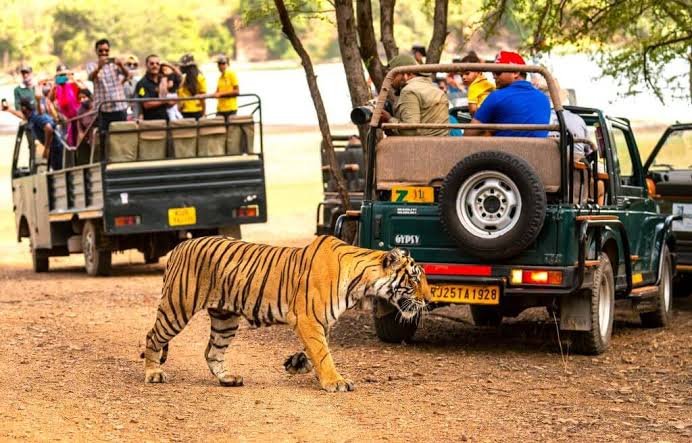
For visitors arriving in early October, there is an additional advantage: you are in the park before the word has fully spread that the season has opened. The permit quota for October fills quickly but not instantly in the first week — unlike December and January when every available permit for every zone sells out weeks in advance. The first two weeks of October represent one of the better windows to secure quality permits without the months-of-advance-booking pressure of peak season.
What Ranthambore Looks Like in October
Most people picture Ranthambore from photographs taken in winter — the dry, golden landscape of November through February, where the forest floor is open and visibility through the trees is long. October looks completely different. And in its own way, it is more beautiful.
The monsoon has just ended. The forest is at its most lush and green — the dry deciduous trees carrying full foliage, the grasslands vivid, the waterholes full to their edges. The ancient Ranthambore Fort, which rises above the forest on a rocky ridge inside the park, is draped in monsoon greenery that disappears completely by January.
The light in October is extraordinary. The post-monsoon sky is a deep, saturated blue — the kind of blue that only exists after the atmosphere has been washed clean by weeks of rain. Against this sky, the forest is vivid, the ancient fort is dramatic, and a tiger sighting — when it comes — happens in photographic conditions that the flat light of January and February cannot match.
The temperature in October is genuinely pleasant — 22–32°C during the day and 12–18°C at dawn and dusk when the safaris run. You will want a light jacket for the early morning jeep ride. By 9:00 AM the sun is warm and comfortable. This is not the freezing January early morning that requires a full winter coat for the dawn safari, and it is not the 42°C heat of April that makes afternoon sitting in an open jeep exhausting.
October is one of the most physically comfortable months to be in Ranthambore — and one of the most visually rewarding. For a full picture of what India looks like across every region this month, read our India in October 2026 guide.
Tiger Sighting Chances in October
This is the question every visitor asks first. Here is an honest answer.
October sighting rates at Ranthambore are good — meaningfully lower than the peak months of February and March, but significantly higher than the first weeks after the June reopening in years when the park opens mid-season.
The forest is at its most dense in October. The tall monsoon grass and full tree foliage make the tigers harder to spot than in December, when the deciduous forest has shed a large proportion of its leaves and visibility through the trees is long. A tiger that would be immediately visible in January can be invisible at ten metres in October — and you might drive within metres of it without seeing it.
This sounds discouraging. It is not — for two reasons.
First, the waterholes in October are the key to sightings. Ranthambore’s multiple permanent lakes — Padam Talao, Malik Talao, and Raj Bagh Talao — are the largest and most reliable in the park. The tigers come to them. In October, the waterholes are full from the monsoon and the tigers are not competing for diminishing water resources the way they do in March and April when the pools are low. Sightings at and around the waterholes in October can be extraordinary — a tiger drinking, entering the water to cool off, or hunting at the water’s edge is one of the finest wildlife sights available anywhere in India.
Second, October cubs are often visible. Several of Ranthambore’s tigresses gave birth during or just before the monsoon closure months. By October, their cubs are mobile and increasingly active — appearing at waterholes, playing in the grass, and beginning to follow their mothers on hunts. A tigress with three-to-four-month-old cubs in October 2026 is one of the most extraordinary wildlife sights available anywhere in Asia.
Ranthambore currently has approximately 70 tigers across its core and buffer zones. The park’s core zones — where the safari jeeps operate — have a high enough density that a sighting, while never guaranteed, is more likely than not across two safari visits.
Sighting probability estimate for October (two safaris): 65–75%. This rises to 85–90% across three or four safaris.
For a complete guide to when tiger sightings are highest across all of India’s parks, read our Best Time to See Tigers in India guide.
Safari Zones: Which to Book for October
Ranthambore divides its safari area into ten zones — Zone 1 through Zone 10. The core zones (1 through 5) are the most established and historically productive for tiger sightings. The buffer zones (6 through 10) are less visited but increasingly productive as the tiger population has grown.
Here is what each zone offers specifically in October:
Zone 1 — Padam Talao and Ranthambore Fort The most famous zone in the park. Padam Talao — the largest lake in Ranthambore — is the centrepiece, and the ancient Ranthambore Fort rises above it on the rocky ridge. In October, the lake is full and the fort is draped in monsoon green. Tiger sightings at the lake edge and on the road below the fort are among the most photographed in the park’s history. Zone 1 is the single most sought-after permit and sells out fastest — book the moment permits open.
Zone 2 — Raj Bagh Talao Another waterhole-centred zone with strong October sighting history. The Raj Bagh ruins — the crumbling remains of a Mughal-era rest house — sit at the edge of the lake and provide an extraordinary backdrop for wildlife photography. Several resident tigresses with established home ranges use this zone consistently.
Zone 3 — Malik Talao The third major waterhole zone. Smaller and more intimate than Zones 1 and 2. October sightings here are less predictable but when they happen — particularly at the waterhole at dawn — they tend to be close and unhurried.
Zone 4 — Kachida Valley A longer, more open zone running through a valley system. Good for leopard sightings in addition to tigers, and strong for general wildlife — sloth bears, sambar deer, nilgai, and birds of prey. Tiger sightings in Zone 4 are less frequent than Zones 1–3 but the landscape is among the most dramatic in the park.
Zone 5 — Rajbagh and Lakarda A mixed zone covering both dense forest and more open terrain. Zone 5 has produced some of the finest tiger sightings and photographs of recent seasons — particularly of young tigers from the park’s growing population.
Buffer Zones 6–10 Less visited and significantly easier to book. Buffer zone permits can often be secured with 2–3 weeks’ notice even in peak season. Sighting rates are lower than the core zones but by no means zero — the buffer zones border the core territories and tigers cross regularly. For visitors who cannot secure core zone permits, buffer zones are a genuinely worthwhile alternative.
Our recommendation for October: Book Zone 1 and Zone 2 as your first choices. If unavailable, Zone 3 and Zone 5 are strong alternatives. For your second safari, try a different zone from your first — zone diversity increases your chances of finding tiger activity.
Safari Types: Jeep vs Canter
Ranthambore offers two types of safari vehicle — the Gypsy (open-top 6-seater jeep) and the Canter (open-top 20-seater bus). Both enter the same zones on the same safari circuits.
Gypsy (Jeep) — Strongly Recommended
The Gypsy carries a maximum of 6 visitors plus the driver and naturalist guide. It is more manoeuvrable, can stop and reverse quickly when a tiger is sighted, and offers a more intimate and responsive wildlife experience. In October’s dense forest, the Gypsy’s ability to position quickly at a sighting point is a genuine advantage.
Gypsy permits cost ₹1,000–₹1,500 per person for Indian nationals and ₹3,000–₹3,500 per person for foreign nationals (fees include camera fees and forest development charges). Prices are approximate and confirmed on the official booking portal.
Canter — Budget Alternative
The Canter carries 20 visitors and is significantly cheaper per person — approximately ₹600–₹800 for Indian nationals and ₹1,500–₹2,000 for foreign nationals. The trade-off is less flexibility, more people, and a larger vehicle that is harder to manoeuvre quickly at a sighting. For budget travellers or larger groups, the Canter is a perfectly viable option.
Our recommendation: Always book the Gypsy. The cost difference between Gypsy and Canter is modest relative to the total cost of travelling to Ranthambore, and the difference in experience is significant.
Safari Timings in October
Ranthambore runs two safaris per day — a morning safari and an afternoon safari. Both timings shift through the season as sunrise and sunset times change.
October 2026 timings (approximate):
| Safari | Departure | Return |
|---|---|---|
| Morning | 6:30 AM | 10:00 AM |
| Afternoon | 2:30 PM | 6:00 PM |
The morning safari is superior for tiger sightings in October. Tigers are most active in the cooler morning hours and tend to be at or near waterholes at first light. The afternoon safari catches the golden hour light near sunset — excellent for photography — and tigers are occasionally active in the late afternoon as temperatures drop.
If you are doing two safaris, do both morning and afternoon on the same day, or morning safaris on consecutive days. Avoid doing two afternoon safaris — mornings in Ranthambore are consistently more productive.
How to Book Ranthambore Safari Permits for October 2026
This is the most time-sensitive part of your Ranthambore planning. Here is exactly how it works.
Official booking: Ranthambore safari permits are booked through the official Rajasthan Forest Department portal — rajasthan.gov.in or the Rajasthan Tourism booking portal. This is the only legitimate booking channel for core zone permits.
When permits open: Core zone permits for October open approximately 45–60 days before the safari date. This means October 1 permits open in approximately mid-August 2026. October 15 permits open in late September. If you are reading this in early August — the booking window for the first week of October is opening right now or in the next few days.
How fast they sell out: Zone 1 and Zone 2 morning Gypsy permits for October sell out within hours of opening. Zone 3, 4, and 5 permits last longer — sometimes days. Buffer zone permits are available with much shorter lead times.
Step-by-step booking process:
- Create an account on the Rajasthan Forest Department portal before the permits open — do not wait until the morning they open, as registration delays cost you your slot
- Have your passport details (for foreign nationals) or Aadhaar details (for Indian nationals) ready
- Choose your zone, safari type (Gypsy or Canter), and date
- Pay online — the portal accepts credit/debit cards and UPI
- Download and print your permit confirmation — carry it on the day of the safari
Permit quota per zone per safari: Each zone allows a fixed number of vehicles per safari — typically 3–4 Gypsies and 1–2 Canters per zone per session. This keeps the forest roads uncrowded and the wildlife undisturbed.
If you cannot get core zone permits: Book buffer zones directly. Or contact Squid Travel India — we have established relationships with licensed operators who can sometimes access permits through the licensed guide quota that is not available to direct public booking. We handle all Ranthambore bookings for our Best Wildlife Tour Packages in India packages.
What to Expect on Your Ranthambore Safari
The jeep picks you up from your hotel at 6:00 AM. You drive to the park gate, where your permits are checked and your naturalist guide boards the vehicle. The gate opens promptly and vehicles enter in sequence — no jostling, no rushing. The forest road opens ahead of you.
The first fifteen minutes are always the same. The guide reads the radio chatter from other jeeps already inside the park, processing information about where tiger pugmarks were found this morning, which waterholes had activity at dawn, and whether any jeep has already spotted movement. This radio network among Ranthambore’s guides is one of the most effective informal tiger-location systems in India.
Then the forest takes over. Ranthambore is not a forest you pass through to find a tiger and leave. The landscape itself — the ancient fort on the ridge, the lakes in the early light, the sambar deer at the water’s edge, the painted storks in the shallows, the peacocks calling from the grassland — is worth the safari before any tiger appears. Ranthambore has over 300 species of birds. It has leopards, sloth bears, striped hyenas, jungle cats, marsh crocodiles at the lakeshores, and an extraordinary density of deer. A safari without a tiger sighting is not a failed safari. It is still extraordinary.
When a tiger is spotted, the guide communicates its position and the jeep moves to the sighting point. At Ranthambore, tiger sightings tend to be prolonged rather than brief — the tigers here have been observed by vehicles their entire lives and are not disturbed by a stationary jeep at a respectful distance. A tiger at a waterhole in October can spend 20–30 minutes in view, entering the water, cooling off, and moving along the bank. This is not a glimpse. This is an experience.
The safari ends at the gate at 10:00 AM for morning sessions. Most visitors sit in silence for part of the drive back, processing what they have just seen.
Getting to Ranthambore
From Jaipur: 160 km, approximately 3 hours by road. The most common approach for Golden Triangle visitors.
From Agra: 240 km, approximately 4 hours by road. Ranthambore sits almost exactly between Agra and Jaipur — making a stop of one or two nights completely natural on the Golden Triangle circuit.
From Delhi: 370 km, approximately 5.5 hours by road.
By Train: Sawai Madhopur Railway Station is the nearest major station, 10 km from the park gate. It is well-connected to Delhi (4–5 hours), Jaipur (2 hours), and Agra (3.5 hours).
By Air: The nearest airports are Jaipur (160 km) and Delhi (370 km). Most international visitors fly into Delhi, complete the Golden Triangle circuit, and reach Ranthambore overland via Jaipur.
Where to Stay Near Ranthambore
Ranthambore has a well-developed hotel and lodge ecosystem — from budget guesthouses in Sawai Madhopur town to exceptional luxury wildlife lodges on the park boundary.
Luxury wildlife lodges (₹15,000–₹50,000+ per night): Aman-i-Khas, The Oberoi Vanyavilas, and Sher Bagh are three of the finest luxury wildlife properties in India. All sit on the park boundary, all include private safari arrangements, and all book out months in advance for October. If luxury is your tier, book immediately.
Mid-range hotels (₹4,000–₹12,000 per night): Several excellent mid-range properties sit within 5 km of the park gate and provide comfortable accommodation, good food, and reliable safari logistics. These are what most standard Golden Triangle with Ranthambore packages include and represent excellent value.
Budget guesthouses (₹1,200–₹3,500 per night): Available in Sawai Madhopur town — basic but clean. Good for independent budget travellers who have already booked their own safari permits.
Booking note: October is the start of peak season at Ranthambore. Book accommodation at the same time you book your safari permits — ideally in August for early October dates.
Ranthambore and the Golden Triangle: The Natural Combination
Ranthambore is geographically positioned between Agra and Jaipur — the second and third cities of the classic Golden Triangle circuit. Adding one or two nights at Ranthambore to a standard Golden Triangle itinerary requires almost no additional distance.
The logistics work like this:
Delhi → Agra (Day 1–2) → Ranthambore (Day 3–4, drive 240 km from Agra) → Jaipur (Day 5–6, drive 160 km from Ranthambore) → Delhi (Day 7)
This seven-day itinerary gives you the Taj Mahal sunrise in Agra, two full safari days at Ranthambore in the first week of October, and two full days in Jaipur — the most complete North India first-time experience available anywhere.
The October timing works particularly well for this combination. The Taj Mahal in early October is post-monsoon vivid — lush green gardens, blue sky, brilliant white marble — at its most beautiful outside of February. Ranthambore is newly opened with high tiger activity. Jaipur in October is warm, comfortable, and the Amber Fort and City Palace are at their most photogenic in the autumn light.
For the complete planning guide and costs across every budget tier, read our Golden Triangle Tour from Delhi guide and our Golden Triangle Tour Cost 2026 guide.
Ranthambore Fort — The Wildlife Backdrop No Other Park Has
Inside Ranthambore National Park, rising above Padam Talao on a rocky ridge, stands Ranthambore Fort — a 10th-century Rajput fortification that is a UNESCO World Heritage Site and one of the most dramatic fort settings in all of Rajasthan.
Most national parks have wildlife. Ranthambore has wildlife and a thousand-year-old fort inside the safari circuit.
The fort is accessible by road from outside the park (a separate visit from the safari) and it is worth a dedicated half-day alongside your safari days. The fort walls enclose ancient temples, step wells, a haunted palace, and a series of pavilions with views across the forest that give you a completely different perspective of the landscape you were exploring at ground level from the jeep.
In October, the fort is green from the monsoon — unusual, given that by December the same stone will be completely bare and dry. The monsoon greenery clinging to the ancient walls gives the fort in October a quality that the more-visited winter months do not share.
Practical Tips for Your October Ranthambore Safari
Wear muted colours. Bright colours — particularly white, red, and orange — disturb wildlife. Wear khaki, olive, brown, or grey for the safari.
No perfume or strong scents. Tigers in particular have an extraordinary sense of smell. Go fragrance-free on safari days.
Keep your voice down inside the park. Noise carries in the forest and can move a tiger away from a sighting point before other vehicles arrive.
Bring a proper camera if you have one. A 300–500mm telephoto lens gives you the detail that makes the difference between a record shot and a photograph you print and frame.
Keep arms and legs inside the vehicle at all times. This is a safety rule, not a formality.
Two safaris minimum. One safari gives you a taste. Two safaris give you a meaningful experience. Three or four safaris across two days is what experienced Ranthambore visitors consistently recommend for first-time visitors who specifically want a tiger sighting.
Do not leave litter inside the park. Take everything you bring in back out with you.
Ranthambore in November and Beyond
If October does not work for your schedule, November is equally outstanding — and in some ways better for tiger sightings, as the post-monsoon vegetation thins and visibility through the forest improves significantly. For a complete guide to what India and Ranthambore look like in November, read our India in November 2026 guide.
For the broadest overview of the best tiger safari destinations across India — including Bandhavgarh, Jim Corbett, Kanha, and Kaziranga — read our Best Wildlife Tour Packages in India 2026 guide.
Frequently Asked Questions: Ranthambore October 2026
Q: When does Ranthambore National Park open in 2026?
A: Ranthambore National Park reopens on October 1, 2026 after its annual monsoon closure from July 1. The park then remains open until June 30, 2027.
Q: How likely am I to see a tiger at Ranthambore in October?
A: Across two safaris in October, experienced operators estimate a 65–75% chance of a tiger sighting. This rises to 85–90% across three or four safaris. The dense post-monsoon vegetation makes October slightly less predictable than February and March — but waterhole sightings in October can be extraordinary.
Q: Which zone is best for tiger sightings in October?
A: Zone 1 (Padam Talao and Ranthambore Fort) and Zone 2 (Raj Bagh Talao) have the strongest October sighting history. Both are centred on waterholes where tiger activity is highest in the early morning. Both also sell out fastest — book immediately when permits open.
Q: When do October safari permits go on sale?
A: Approximately 45–60 days before the safari date — meaning permits for early October open in mid-August. For Zone 1 and 2 morning Gypsy safaris, book the moment the portal opens. Contact Squid Travel India to manage the booking process on your behalf.
Q: How far is Ranthambore from Jaipur and Agra?
A: 160 km from Jaipur (approximately 3 hours by road) and 240 km from Agra (approximately 4 hours). It sits almost exactly between the two cities, making it a natural stop on the Golden Triangle Tour.
Q: How many nights should I spend at Ranthambore?
A: Two nights minimum — giving you three safari opportunities (one afternoon on arrival, one morning and one afternoon on your main day). For the best chance of a tiger sighting, plan for two full days and four safari sessions.
Q: Is Ranthambore worth combining with the Golden Triangle?
A: Absolutely — it is the single most recommended addition to the standard Golden Triangle circuit. It adds India’s finest tiger reserve to a journey that already includes the Taj Mahal, Agra Fort, Amber Fort, and the Pink City. The geographical routing requires almost no additional distance. Read our Golden Triangle Tour Cost 2026 guide for the full budget breakdown.
Q: What should I wear on the Ranthambore safari?
A: Muted, earthy colours — khaki, olive, brown, grey. No bright colours, no white. No perfume or strong-scented products. Light layers for the October morning chill that can be removed as the day warms. Comfortable, closed-toe shoes.
Book Your Ranthambore Safari with Squid Travel India
October 1, 2026 is not just a date on a calendar. It is the beginning of one of India’s finest wildlife seasons — the moment Ranthambore’s tigers reclaim their position as the most extraordinary wildlife encounter available to any visitor in India.
At Squid Travel India, we manage every aspect of the Ranthambore experience for our clients — safari permit booking the moment the portal opens, accommodation in properties we have personally vetted, naturalist guides who know this forest and its tigers by name, and seamless integration with the Golden Triangle itinerary so you are not navigating logistics on your own in the middle of a North India trip.
Permits for Zone 1 and Zone 2 in October sell out fast. Contact us now to begin planning your Golden Triangle with Ranthambore itinerary for October 2026.
📞 WhatsApp: +91 9818489607 📧 Email: squidtravelindia@gmail.com 🌐 Browse packages: squidtravelindia.com/tours/wildlife-tour-packages/ 🏆 TripAdvisor Travelers’ Choice Award Winner 2024–25
Comment (0)