

October is the month Varanasi wakes up.
Through July and August the monsoon floods the lower ghats — the stone steps that descend to the Ganges are submerged, the river runs brown and fast, and the burning ghats at Manikarnika work in near-darkness through the rain. September sees the river begin to recede. By October, the ghats re-emerge, the sky clears, the pilgrims return in force, and Varanasi resumes its ancient rhythm.
For visitors, October means the best version of Varanasi: clear morning skies over the Ganges at dawn, the ghats dry and accessible, Dussehra celebrations lighting the city in early October, and — if your dates reach the end of the month — the build-up beginning toward Dev Deepawali, the festival of 800,000 lamps that transforms Varanasi into something beyond description.
This guide covers everything you need to plan your Varanasi visit in October 2026: temperatures by time of day, the monsoon exit timeline, ghat conditions, crowd levels, the best time for the sunrise boat ride, what to pack, and how Varanasi’s October weather compares to November and December.
Varanasi Temperature in October 2026
Like Agra and Delhi, Varanasi in October has two distinct halves. The first two weeks carry the residual warmth and humidity of the monsoon. The second half of October feels noticeably fresher — the beginning of North India’s finest travel season.
Early October (1–15 October)
| Time of Day | Temperature |
|---|---|
| Pre-dawn / sunrise (5–7 AM) | 24°C to 27°C |
| Morning (7–11 AM) | 27°C to 31°C |
| Midday (11 AM–2 PM) | 32°C to 35°C |
| Afternoon (2–5 PM) | 30°C to 33°C |
| Evening (5–8 PM) | 26°C to 29°C |
| Night (after 9 PM) | 23°C to 26°C |
Early October is warm. The sunrise boat ride — the defining Varanasi experience — is done at 5:30 AM when the temperature is a comfortable 24–26°C. The main challenge is the midday heat (32–35°C), which makes early starts and afternoon rest the right strategy.
Late October (16–31 October)
| Time of Day | Temperature |
|---|---|
| Pre-dawn / sunrise (5–7 AM) | 20°C to 23°C |
| Morning (7–11 AM) | 23°C to 28°C |
| Midday (11 AM–2 PM) | 29°C to 32°C |
| Afternoon (2–5 PM) | 27°C to 30°C |
| Evening (5–8 PM) | 22°C to 26°C |
| Night (after 9 PM) | 19°C to 22°C |
Late October is excellent. The sunrise at 5:30 AM is a fresh 20–22°C — comfortable on the river. Afternoons are warm but not punishing. Evenings on the ghats for the Ganga Aarti are pleasantly cool. This is the temperature range that makes Varanasi in late October one of the best windows of the year.
Average October high: 34°C (early) → 30°C (late) Average October low: 25°C (early) → 20°C (late)
The Ganges in October: River Level and Ghat Conditions
This is the most important practical weather question for Varanasi visitors, and it is rarely addressed clearly.
The monsoon Ganges: During July–September, the Ganges rises 8–12 metres above its dry-season level. The lower ghats — the steps nearest the water — are submerged. The burning ghats at Manikarnika and Harishchandra operate from higher platforms. The boat rides still run but the river’s edge is muddy and the ghat steps are inaccessible.
October recovery timeline:
| Period | River Level | Ghat Condition |
|---|---|---|
| Early October (1–7) | Still elevated | Lower ghats partially submerged or muddy at base |
| Mid-October (8–15) | Receding fast | Lower ghats re-emerging; some mud at water’s edge |
| Late October (16–31) | Near normal | Most ghats fully accessible; steps clean and dry |
For visitors: If your Varanasi dates fall in the first week of October, the lower ghats may still be partially wet and the famous Dashashwamedh Ghat steps may not be fully accessible to the water’s edge. By mid-October the ghats are largely recovered. By the last week of October, conditions are excellent — the ghats are fully accessible, the stone steps are dry, and the Ganges has settled into its clear, post-monsoon blue-green colour.
The Ganges colour change: One of October’s gifts to Varanasi visitors is the colour of the river itself. The monsoon Ganges is brown and opaque — heavy with silt from the rains. As October progresses and the river level drops, the Ganges gradually clears. By late October it is a remarkable blue-green that photographers find extraordinary in the sunrise light.
Does It Rain in Varanasi in October?
Varanasi’s monsoon typically ends in the last week of September. October is the transition month.
Rainfall in Varanasi in October: Average 25–30mm for the entire month. In practice this usually means:
- First week of October: one or two brief afternoon showers possible — residual monsoon
- Mid-October onwards: effectively dry
- Last two weeks: no meaningful rain risk
What this means for you: Pack a light rain jacket if arriving before October 10. From mid-October, you will not need it. The Ganga Aarti runs in light rain but is best experienced on a clear evening — late October almost guarantees clear skies for the ceremony.
Humidity: Drops from 65–70% in early October to 45–55% by month end. Late October air feels clean and dry — a significant improvement from September’s damp heat.
Sunshine Hours in Varanasi in October
Varanasi averages 8 to 9 hours of sunshine per day in October. Sunrise is approximately 5:55 AM on 1 October, shifting to 6:05 AM by 31 October. Sunset moves from approximately 5:55 PM at the start of the month to 5:30 PM by month end.
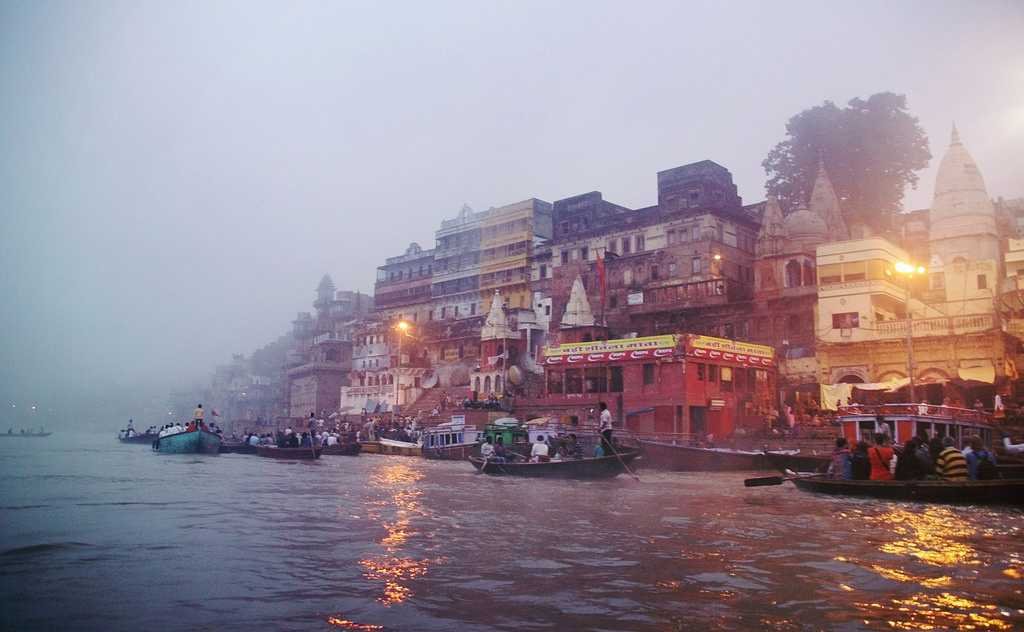
The post-monsoon October sky over the Ganges is some of the clearest of the year. The monsoon has washed dust and particulate matter out of the atmosphere. The light on the ghats in the 6–9 AM window — the low morning sun catching the sandstone temples, the silk of the priests’ robes, the river mist, the smoke from Manikarnika — is why Varanasi photographers consistently rate October among their finest months.
Best Time of Day to Visit Varanasi in October
Sunrise Boat Ride: 5:30 AM
The defining Varanasi experience. A wooden boat on the Ganges in the pre-dawn dark, the ghats emerging from the mist as the sky lightens, the priests beginning the morning puja, the first bathers entering the river, and the smoke from Manikarnika rising in the windless air.
In October: Sunrise is around 6:00 AM. Depart the ghat by 5:30 AM for the full pre-dawn to post-sunrise experience. In early October this means leaving in 26°C warmth; in late October, 20–22°C — bring a light layer.
The boat ride typically lasts 60–90 minutes. Most guides recommend rowing from Assi Ghat (the southernmost major ghat) northward to Manikarnika, then returning. This covers the full stretch of active ghats and allows you to observe the cremation at Manikarnika from the river — the respectful viewing distance. Photography of the cremation is strictly prohibited and should not be attempted.
Booking: Negotiate directly with a boatman at Assi Ghat or Dashashwamedh Ghat the evening before, or have your hotel or tour operator arrange it. Standard rate: ₹300–800 for a private boat for the 90-minute sunrise ride (negotiate before boarding). Do not accept the first price if offered far above this range.
Ghat Morning Walk: 7:00 AM to 9:30 AM
After the boat ride, walk the ghats on foot from Assi Ghat northward. Each ghat has its own character, its own presiding deity, its own community of priests, boatmen, wrestlers, and launderers. The wrestling grounds (akharas) at Tulsi Ghat are active at this hour. The silk weavers of the Lallapura neighbourhood are beginning their looms. The morning light is at its most extraordinary at this hour.
Key ghats to walk in October:
- Assi Ghat: The gathering point for students, sadhus, and intellectual Varanasi. The morning chai stalls.
- Kedar Ghat: One of the most photographed — the red and white striped temple, the steps full of bathers.
- Harishchandra Ghat: The smaller of Varanasi’s two burning ghats. Less intense than Manikarnika; the electric crematorium beside it provides stark contrast.
- Dashashwamedh Ghat: The main ghat — the busiest, the most photographed, the site of the evening Ganga Aarti. Mornings here are calmer than evenings.
- Manikarnika Ghat: Varanasi’s primary cremation ghat. Never stops — fires burn 24 hours a day. Observe respectfully from the river or the upper viewing area. Do not photograph.
- Scindia Ghat: The partially submerged Shiva temple here — a small shikhara tilted at an angle into the river — is one of the most evocative images in Varanasi. In October, as the river recedes, the temple re-emerges and the image becomes accessible again.
Evening Ganga Aarti: 6:00 PM to 7:15 PM
The evening Ganga Aarti at Dashashwamedh Ghat is Varanasi’s other defining experience — seven priests simultaneously performing the fire ceremony on the main ghat, synchronized, with large brass oil lamps, conch shells, incense, and the rising sound of devotional singing.
In October: Aarti timing follows sunset — it begins approximately 30 minutes after sunset. In early October (sunset ~5:55 PM), aarti starts around 6:10–6:20 PM. By late October (sunset ~5:30 PM), it starts around 5:50–6:00 PM.
Viewing options:
- From the ghat steps: Arrive by 5:30 PM for a ground-level position. By 5:45 PM the ghat is full. The energy at ground level — the crowd, the heat of the lamps, the smoke and sound — is immersive.
- From a boat on the river: A boat positioned 20–30 metres from the ghat gives an elevated, wide-angle view of all seven priests simultaneously. In October’s post-monsoon clarity, the reflection of the lamps on the water adds to the scene. Arrange the boat through your hotel or a boatman the same afternoon.
- From the upper terrace: Some guesthouses on the ghats have roof terraces with Aarti views. The Brijrama Palace (a heritage hotel on the ghats) has one of the finest vantage points.
October crowd level: The Aarti draws large crowds every evening year-round. October is moderate — busy but not as packed as December–January. The front rows fill by 6 PM so arrive 45 minutes early for a ground-level position.
October 2026 Events in Varanasi
Dussehra — 2 October 2026
Varanasi celebrates Dussehra with the Ramnagar Ramlila — a 31-day dramatic performance of the Ramayana, staged annually since the 18th century at Ramnagar Fort (across the Ganges from the main ghats). The final night — on Dussehra, 2 October — is the burning of the Ravana effigy, accompanied by fireworks and tens of thousands of spectators.
The Ramnagar Ramlila is UNESCO-recognised as an Intangible Cultural Heritage. It is a genuinely extraordinary event — not a tourist show but a living religious performance that the entire city participates in. If your Varanasi dates overlap with Dussehra, prioritise this.
Getting there: The fort is 3km across the Ganges. Boats run from Tulsi Ghat (30 minutes each way). Go early — the routes fill up by 7 PM on the Dussehra night.
Diwali — 20 October 2026
Diwali in Varanasi is celebrated across the ghats with diyas (oil lamps), fireworks, and the city lit entirely by flame. It is a preview, in smaller form, of what the city becomes for Dev Deepawali a month later. The ghats on Diwali evening — lined with rows of clay lamps, the reflections on the Ganges, the fireworks over the river — are one of the most beautiful scenes in India.
Dev Deepawali — 20 November 2026
Dev Deepawali is Varanasi’s greatest festival — the night when the ghats are lined with 800,000 to 1 million oil lamps simultaneously. It falls on the full moon of Kartik (15 days after Diwali) — in 2026, on 20 November.
If your Varanasi visit is in late October, you are arriving in the build-up month. The city is already preparing — clay lamp vendors filling the lanes behind the ghats, priests rehearsing the expanded Aarti, guesthouses on the waterfront booked months in advance.
For late October visitors: You will not see Dev Deepawali itself (that is 20 November), but late October is the right time to book it and the right time to experience Varanasi without the 400,000-person crowd that attends the festival. Full Dev Deepawali guide: Dev Deepawali Varanasi 2026
What to Pack for Varanasi in October 2026
Early October (1–15 October)
Essential:
- Light, breathable clothing — linen or cotton for the 30–35°C afternoons
- A light layer for the sunrise boat ride (24–26°C pre-dawn is comfortable but a long-sleeve shirt is pleasant on the water)
- Comfortable walking shoes with grip — the ghat steps are uneven stone, often wet at the base in early October
- Sunscreen and sunglasses — the October sun reflects intensely off the river and the white temple walls
- A light rain jacket for the first week of October
Specific to Varanasi:
- Old clothes or clothes you don’t mind getting dusty — the alleys behind the ghats are narrow, and ash from Manikarnika drifts
- A scarf or shawl for temple entry (covering head required at some temples, shoulders and knees everywhere)
- Cash in small denominations — the ghats are almost entirely cash-based; ATMs in the Godaulia area near Dashashwamedh Ghat are the most accessible
Late October (16–31 October)
Essential:
- A light fleece or jacket for the 20–22°C pre-dawn sunrise boat ride
- Light layers that can be added and removed — mornings cool, afternoons warm
- All the above; no rain gear needed
Getting to Varanasi in October 2026
By air: Lal Bahadur Shastri International Airport (VNS), 26km from the main ghats. Direct flights from Delhi (1.5 hours, Air India, IndiGo, SpiceJet), Mumbai (2 hours), Kolkata (1.5 hours), Bangalore (2.5 hours). October is not peak season for Varanasi flights — advance booking 2–3 weeks ahead is usually sufficient.
By train: Varanasi Junction (BSB) connects to Delhi (10–12 hours on overnight trains including the Kashi Vishwanath Express and Vibhuti Express), Agra (10–12 hours), Jaipur (14–16 hours), and Mumbai (22–24 hours). Train travel to Varanasi is very comfortable in air-conditioned classes and is the authentic Indian way to arrive.
From the Golden Triangle: Most travellers add Varanasi as a 2–3 night extension after the Delhi–Agra–Jaipur circuit. Delhi to Varanasi by overnight train (10–12 hours, depart Delhi evening, arrive Varanasi morning) or by air (1.5 hours) are both clean options.
Varanasi October vs November vs December
| Month | Temperature | Events | Ghat Condition | Crowds | Verdict |
|---|---|---|---|---|---|
| October | 20–34°C | Dussehra, Diwali | Recovering → Excellent | Moderate | ⭐⭐⭐⭐⭐ Excellent |
| November | 14–28°C | Dev Deepawali (Nov 20) | Excellent | High around Dev Deepawali | ⭐⭐⭐⭐⭐ Peak |
| December | 8–22°C | None major | Excellent | Building to peak | ⭐⭐⭐⭐ Very good |
October is the entry point to Varanasi’s finest season. Late October specifically — after the ghat recovery is complete, with Dussehra and Diwali adding festival energy, at temperatures that make the dawn boat ride comfortable — is an outstanding time to visit. The city is less crowded than November’s Dev Deepawali week but has all the atmospheric qualities that make Varanasi one of the world’s great travel experiences.
Varanasi in October: Is It Worth It?
Yes — emphatically.
Varanasi is one of those cities that some travellers find overwhelming on first encounter. The lanes behind the ghats are narrow and maze-like. The smell of incense, marigolds, and cremation smoke is ever-present. The religious intensity — this is one of Hinduism’s holiest cities, believed by devotees to be the place where dying grants moksha, liberation from the cycle of rebirth — is not background colour but foreground reality.
October brings all of this in ideal conditions: clear sky, clean river, accessible ghats, comfortable temperatures, and the energy of Dussehra and Diwali. The sunrise boat ride in October morning light, with the mist on the river and the city waking behind the ghats, is one of the experiences that changes how travellers think about India — and about the world.
Frequently Asked Questions
What is the weather in Varanasi in October 2026?
October in Varanasi is warm in the first half (32–35°C highs) and pleasant in the second half (28–30°C highs). Mornings are comfortable from the start — 24–26°C in early October, 20–22°C in late October. Post-monsoon clear skies from mid-October. Minimal rain after the first week.
Is October a good time to visit Varanasi?
Yes — late October especially. Post-monsoon clear skies, the Ganges settling into its blue-green post-monsoon colour, accessible ghats, Dussehra and Diwali festival energy, and comfortable sunrise temperatures. One of the better months of the year.
Are the ghats accessible in October?
Early October the lower ghats may still be partially recovering from monsoon flooding. By mid-October most ghats are fully accessible. By late October conditions are excellent — all ghats open, steps dry, river near its clear post-monsoon colour.
What time is the Ganga Aarti in October 2026?
The Ganga Aarti at Dashashwamedh Ghat follows sunset. In early October (sunset ~5:55 PM) the aarti begins around 6:10–6:20 PM. In late October (sunset ~5:30 PM) it begins around 5:50–6:00 PM. Arrive at least 45 minutes early for a ground-level position.
What is Dev Deepawali and when is it in 2026?
Dev Deepawali is Varanasi’s greatest festival — 800,000 oil lamps lit simultaneously along the ghats on the Kartik full moon. In 2026 it falls on 20 November. If visiting in October you will miss the festival itself but the build-up energy is already present in late October. Full guide: Dev Deepawali Varanasi 2026
What should I wear at the Varanasi ghats in October?
Light clothing for the midday hours. A light jacket or fleece for the 5:30 AM sunrise boat ride — pre-dawn temperatures in late October are 20–22°C on the river. Comfortable shoes with grip for the uneven ghat steps. Modest clothing (covered shoulders and knees) for temples. Old or dark-coloured clothes for the Manikarnika area where ash drifts.
Plan Your Varanasi Visit with Squid Travel India
Varanasi is the city we add most often as a Golden Triangle extension — and October is one of the finest months for it. We arrange the sunrise boat ride, the ghat walk with a guide who knows the stories behind each one, and the Ganga Aarti viewing from the right position.
Every tour is private. Your own guide. Your own vehicle. No shared groups.
Contact us with your dates. We will send a full itinerary — Golden Triangle plus Varanasi — and pricing within 24 hours.
Also worth reading:
- Varanasi in October 2026
- Dev Deepawali Varanasi 2026: Complete Guide
- India in November 2026
- Golden Triangle Itinerary 10 Days
- Best Time to Visit Agra and the Taj Mahal 2026
- Agra Weather in October 2026
- India in January 2027
📞 Call / WhatsApp: +91 9990812499 📧 Email: Squidtravelindia@gmail.com 🌐 Visit: squidtravelindia.com
1,800+ trips completed | 98% happy clients | TripAdvisor Travelers’ Choice 2024–2025
Last updated: September 2026.

Comment (0)