

Ten days is the ideal length for a Golden Triangle trip.
Seven days is the minimum — enough to see the main monuments without feeling rushed. Fourteen days allows deep exploration. But ten days is the sweet spot: enough time to do Delhi, Agra, and Jaipur properly, add Ranthambore National Park for a tiger safari, and still have a buffer day for the Taj Mahal if January fog or an unexpected closure disrupts the schedule.
This itinerary has been refined over 1,800+ private tours. It is built around the specific logic of each city: which monuments to visit in which order, which time of day each site is best, where to stay, what to eat, and how to move between cities without wasting half a day in transit.
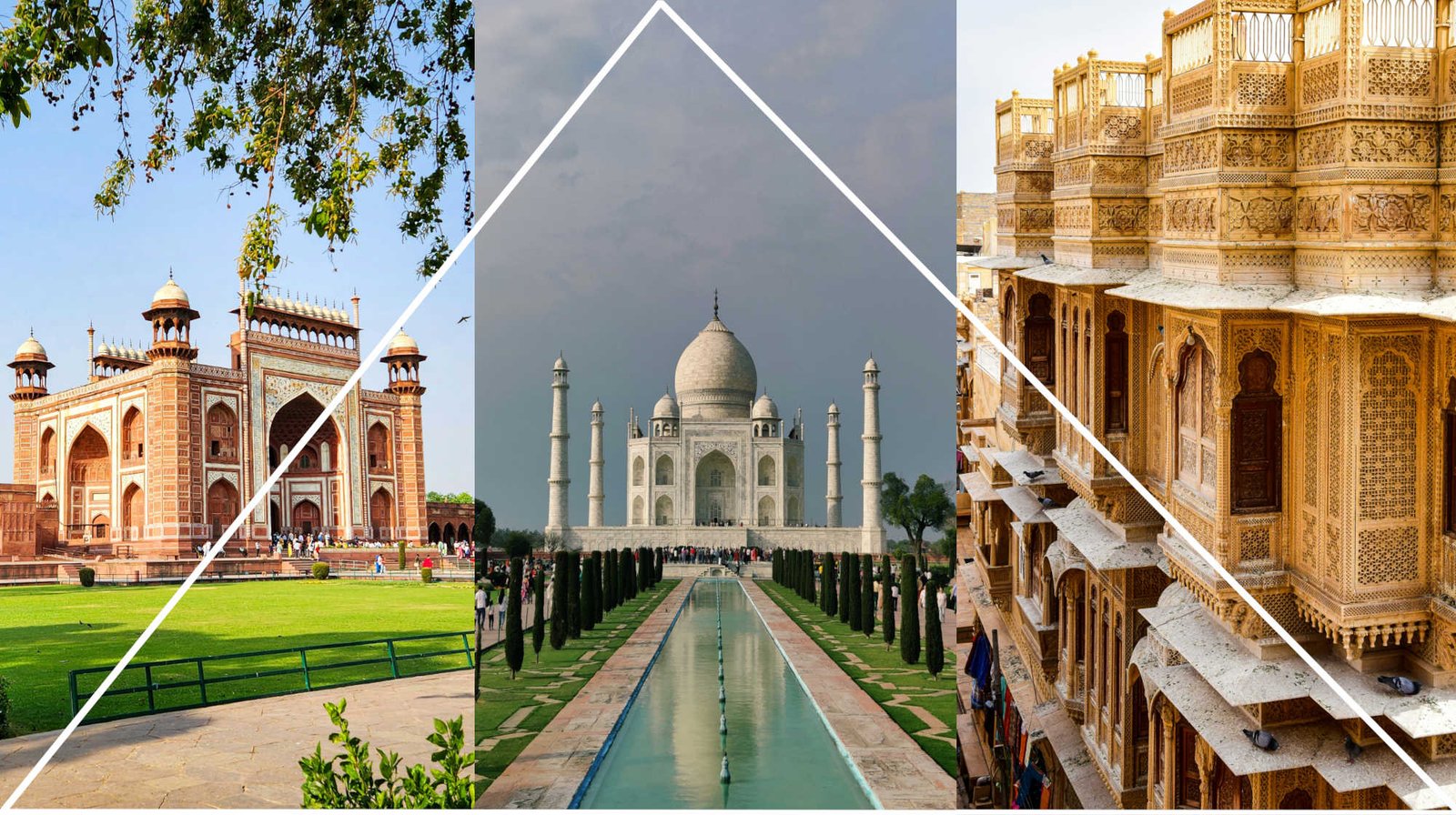
The 10-Day Golden Triangle Route
Delhi (3 nights) → Agra (2 nights) → Ranthambore (2 nights) → Jaipur (2 nights) → Delhi (1 night)
Or, reversed: Delhi → Jaipur → Ranthambore → Agra → Delhi
The Delhi-first direction is recommended for most travellers — it gives you time to acclimatise to India (jet lag, heat, sensory adjustment) in a large city before the monument-intensive Agra and Jaipur days.
Day 1: Arrive Delhi
Focus: Arrival, orientation, recovery
You will be tired. The flight from Europe takes 8–9 hours; from the US East Coast, 14–15 hours non-stop or 18–22 hours with a connection. Do not fight the jet lag on day 1.
What to do:
- Transfer from IGI Airport Terminal 3 to your hotel. In Delhi traffic, allow 45–90 minutes depending on the time of day.
- Check in, shower, and rest for a few hours.
- Late afternoon, if you have energy: a short walk around your hotel’s neighbourhood. If staying in South Delhi (Lodhi Colony, Defence Colony), a walk in Lodi Garden — 90 acres of medieval tombs in a city park — is a perfect low-effort first experience of India.
- Dinner at your hotel or a nearby recommended restaurant. Go to bed early.
Do not plan: Taj Mahal on day 1 (it is 200km away and requires a 6 AM start). Major monuments. Long drives.
Where to stay in Delhi:
- Budget–mid: The Claridges, The Manor, Bloomrooms
- Mid-range: The Lodhi, Taj Mahal Hotel New Delhi, ITC Maurya
- Luxury: The Oberoi New Delhi, The Imperial, Leela Palace New Delhi
Area to stay: South Delhi (Lodhi Colony / Golf Links) puts you close to the main monuments and the best restaurants. Connaught Place is central and convenient for transport. Avoid airport-area hotels unless your transit requires it — they are remote from everything.
Day 2: Delhi — Old Delhi & Mughal Monuments
Focus: Old Delhi immersion, Jama Masjid, Chandni Chowk, Red Fort
Morning:
- 8:30 AM: Red Fort (Lal Qila). The great Mughal fort on the banks of the Yamuna, built by Shah Jahan in 1639. The Diwan-i-Am (Hall of Public Audience), the Rang Mahal, the Nahr-i-Bihisht water channel. Allow 90 minutes. Entry: ₹600 foreigners / ₹35 Indians.
- 10:30 AM: Jama Masjid — India’s largest mosque, directly opposite Red Fort. Built by Shah Jahan for 5,000 workers over 6 years. Climb the southern minaret for the finest aerial view of Old Delhi. Modest dress required (shawls available at the gate for ₹10). Entry: small fee for camera/tower climb.
Midday:
- 12:00 PM: Chandni Chowk by cycle rickshaw. The 400-year-old market street, best experienced at walking pace. The spice market (Khari Baoli — Asia’s largest wholesale spice market), the silver market, the wedding street. Chaotic, colourful, extraordinary.
- 1:00 PM: Lunch in Chandni Chowk. Karim’s (near Jama Masjid) for Mughal-style kebabs and nihari — a restaurant that has been operating since 1913. Or Paranthe Wali Gali (Fried Bread Lane) for Delhi’s famous stuffed flatbreads.
Afternoon:
- 3:00 PM: Transfer to Humayun’s Tomb — the 1565 Mughal mausoleum that directly inspired the design of the Taj Mahal. UNESCO World Heritage Site. Much quieter than the Taj, equally beautiful gardens, and the architecture shows the clear prototype of what Shah Jahan would perfect 70 years later. Entry: ₹600 foreigners.
- 5:00 PM: Lodi Garden — the park surrounding four 15th-century sultanate tombs. Evening walkers, birds, and the light on the medieval domes.
Evening: Dinner in South Delhi. Khan Market area for excellent modern Indian restaurants.
Day 3: Delhi — New Delhi & Imperial Monuments
Focus: New Delhi, Qutb Minar, India Gate, Rashtrapati Bhavan
Morning:
- 8:00 AM: Qutb Minar — India’s oldest surviving minaret (73 metres, built 1193) and the surrounding complex of the first mosque built in India after the Islamic conquest of Delhi. The iron pillar within the complex has stood rust-free for 1,600 years — a metallurgical mystery. UNESCO World Heritage Site. Allow 90 minutes. Entry: ₹600 foreigners.
- 10:00 AM: Mehrauli Village — the historic village surrounding Qutb Minar, with excellent cafés and the Zafar Mahal and Jamali Kamali mosque (lesser-visited but beautiful).
Midday:
- 12:00 PM: Drive through Lutyens’ Delhi — Edwin Lutyens’ imperial city of wide avenues, roundabouts, and colonial bungalows. The Rajpath (now Kartavya Path), the view from India Gate to Rashtrapati Bhavan (the President’s House), the Parliament building. This is Delhi as the British Empire imagined a capital: geometrically vast, architecturally imposing, deliberately intimidating.
- 1:30 PM: Lunch at a restaurant near Connaught Place or Khan Market.
Afternoon:
- 3:30 PM: National Museum of India — the finest collection of Indian art and archaeology in the country. The Harappan civilisation galleries, the Mughal miniature paintings, the Buddhist sculpture. Allow 2 hours. Closed Mondays.
- 5:30 PM: India Gate at sunset — the war memorial and the centrepiece of New Delhi. In the evening, the lawns fill with Indian families and vendors. A strong contrast to the monument tourism of the day — this is Delhi as its citizens use it.
Evening: Dinner at a South Delhi restaurant. Consider a tasting menu at one of Delhi’s acclaimed modern Indian restaurants — Indian Accent, Dum Pukht, Bukhara, or Varq, depending on budget.
Day 4: Delhi → Agra (Taj Mahal First View)
Focus: Travel to Agra, Agra Fort, sunset Taj Mahal view
The Delhi–Agra journey:
The best option is the Gatimaan Express — India’s fastest train (160 km/h), departing Hazrat Nizamuddin Station at 8:10 AM, arriving Agra Cantt at 9:50 AM. The 1 hour 40 minute journey is comfortable, air-conditioned, and avoids Delhi traffic entirely. Book in advance at irctc.co.in (Executive Chair Car class is excellent value).
Alternatively, private vehicle (2.5–3.5 hours on the Yamuna Expressway — India’s finest highway) gives more flexibility if your start time is not fixed.
Morning on the train: Breakfast is served on the Gatimaan Express. Arrive Agra refreshed.
Agra Day 4 Schedule:
- 10:00 AM: Check in to your Agra hotel and leave bags. Do not waste time settling in — save that for evening.
- 10:30 AM: Agra Fort. The Mughal seat of power where Akbar, Jahangir, and Shah Jahan all held court — and where Shah Jahan was imprisoned by his son Aurangzeb and died gazing at the Taj Mahal. The Jahangiri Mahal, the Khas Mahal, the Diwan-i-Khas, the Musamman Burj with its view of the Taj across the Yamuna. Allow 2 hours. Entry: ₹650 foreigners. Full details: Agra Fort Complete Guide
- 1:00 PM: Lunch near Agra Fort. Pind Balluchi or Pinch of Spice are reliable mid-range options near the fort.
- 3:00 PM: Fatehpur Sikri (40km, 45 minutes). Akbar’s abandoned Mughal capital — a complete city frozen in the 16th century. The Buland Darwaza, Jodha Bai’s Palace, the Diwan-i-Khas, the Panch Mahal. Allow 2 hours. Entry: ₹610 foreigners.
- 5:30 PM: Mehtab Bagh — the garden directly across the Yamuna River from the Taj Mahal. Your first view of the Taj Mahal in the golden evening light, from across the river. This is where Shah Jahan planned to build his own black marble tomb, facing the white Taj. The view at sunset is extraordinary. Entry: ₹300 foreigners.
- 7:00 PM: Return to hotel. Dinner on a rooftop overlooking the Taj Mahal — Saniya Palace Hotel rooftop or Sheroes Hangout.
Day 5: Agra — Taj Mahal at Dawn
Focus: The reason for the entire trip
Set your alarm for 5:00 AM. This is the most important morning of the Golden Triangle.
- 5:15 AM: Wake up. Light breakfast or coffee at the hotel.
- 5:45 AM: Depart for the East Gate (the quietest entrance, shortest queue in the early morning).
- 6:00 AM: Gates open at sunrise. Walk directly through the Darwaza-i-Rauza — the red sandstone gateway — and stop.
The Taj Mahal appears at the far end of the central waterway. In the morning light, the white dome is pink-tinged from the rising sun. The cypress trees flank the reflecting pool. The garden is nearly empty. This is the moment.
- 6:00–7:30 AM: Walk the gardens. Take your time at the far end of the reflecting pool (the classic photograph). Walk up the side paths. There is no crowd. The Taj changes colour every 15 minutes as the sun rises — gold, then brilliant white, then the dome catches the blue of the sky.
- 7:30 AM: Climb the plinth and enter the mausoleum. The cenotaphs of Shah Jahan and Mumtaz Mahal in the central chamber (the actual tombs are in the chamber below, not accessible). The interior is quiet, lit by filtered light through the marble screens. The pietra dura inlay at close range is astonishing.
- 8:30 AM: Exit as the first tour buses arrive. Your Taj Mahal is done and perfect.
Practical:
- Entry: ₹1,300 foreigners (garden) + ₹200 (mausoleum interior). Total ₹1,500 per person.
- Photography permitted throughout.
- No food inside the complex. No tripods without a permit.
- The Taj Mahal is closed every Friday. Full closure details
Remainder of Day 5:
- 9:30 AM: Rooftop breakfast with a Taj Mahal view.
- 11:00 AM: Itimad-ud-Daulah (Baby Taj) — the tomb that was the prototype for the Taj Mahal’s pietra dura inlay technique. Quieter and more intimate than the Taj. Entry: ₹310 foreigners.
- 1:00 PM: Lunch and check-out.
- 3:00 PM: Transfer to Ranthambore (4.5–5 hours by road). Arrive Ranthambore in the evening.
Day 6: Ranthambore National Park — Morning & Evening Safari
Focus: Bengal tiger in the wild
Ranthambore is one of India’s finest tiger reserves and the most productive in terms of sighting probability. The park’s tigers are relatively habituated to safari vehicles and the dense grassland and lake terrain makes visibility good.
Day 6 Schedule:
- 5:30 AM: Morning game drive. Three-hour safari in a government-allocated zone (Zones 1–10; Zones 1–5 are considered the best for tiger sightings). Open Gypsy (6-person jeep) or Canter (20-person open truck). Your guide will track pugmarks, alarm calls from deer and monkeys, and known tiger routes.
- 8:30 AM: Return to lodge. Breakfast and rest.
- 2:30 PM: Afternoon game drive. Three-hour safari (afternoon zones often differ from morning allocation). The golden afternoon light in Ranthambore — the lakes reflecting the fort above, sambar deer at the water’s edge, and if you are fortunate, a tiger walking the ridge — is one of the finest wildlife scenes in Asia.
- 5:30 PM: Return to lodge. Dinner and debrief.
Zone allocation: Safari zones are allocated by the government booking system — you cannot choose your zone at the gate. Book as early as possible through the official Ranthambore booking portal (ranthamborepark.com) or through your tour operator, who will manage this on your behalf. Early booking significantly increases your chances of preferred zones.
Tiger sighting probability at Ranthambore: Approximately 60–70% per safari in peak season (October–March). Two safaris over one day means a sighting probability of 85–90% for the overall visit. This is among the highest of any Indian reserve.
Full safari guide: Ranthambore Zone Guide
Where to stay at Ranthambore:
- Mid-range: RTDC Hotel Vinayak, Khem Villas
- Luxury: Oberoi Vanyavilas (one of Asia’s finest safari lodges), Aman-i-Khas, Sher Bagh
Day 7: Ranthambore — Second Safari & Transfer to Jaipur
Focus: Second safari, drive to Jaipur
- 5:30 AM: Second morning safari. If you did not see a tiger yesterday, this is your second chance. If you did, this safari often produces a different sighting — a mother with cubs, or a different individual in a different zone.
- 8:30 AM: Breakfast and check-out.
- 10:30 AM: Drive Ranthambore to Jaipur (3–3.5 hours on good roads through the Aravalli Hills). Lunch en route or on arrival in Jaipur.
- 2:00 PM: Arrival in Jaipur. Check in to your hotel.
- 3:30 PM: Afternoon introduction to the old city — a tuk-tuk ride through the pink-painted bazaars of the walled city. Johari Bazaar (the jewellery market), Bapu Bazaar (textiles and handicrafts), Tripolia Gate.
- 5:00 PM: Hawa Mahal (Wind Palace) external photograph. The iconic 953-window pink sandstone façade is best photographed from the rooftop café directly across Badi Choupad — late afternoon light on the east-facing façade creates a golden glow. Entry to the interior is available but secondary to the external view.
- 6:30 PM: Return to hotel. Dinner at Jaipur’s best restaurants — Suvarna Mahal (Rambagh Palace), 1135 AD inside Amber Fort (open evenings), or Tapri Central rooftop for a more casual experience.
Where to stay in Jaipur:
- Mid-range: Alsisar Haveli, Samode Haveli (inside the old city — excellent location)
- Luxury: Rambagh Palace (Taj), Jai Mahal Palace, Samode Palace
- Boutique: Narain Niwas Palace, Hotel Diggi Palace
Day 8: Jaipur — Amber Fort & City Monuments
Focus: Jaipur’s finest monuments — Amber Fort, City Palace, Jantar Mantar
Morning:
- 7:45 AM: Depart for Amber Fort (11km from city centre, 20 minutes by vehicle).
- 8:00 AM: Arrive at Amber Fort at opening. The first hour is the least crowded. The fort is on a hillside above Maota Lake — the reflection of the fort in the lake at dawn is one of Rajasthan’s great views. Entry: ₹550 foreigners. The Sheesh Mahal (Mirror Palace) is the highlight: a room lined entirely with mirror mosaic inlay that, when a single candle is lit, fills with a thousand reflections.
- 10:00 AM: Drive back toward Jaipur. Stop at Jal Mahal (Water Palace) — the mid-lake palace in Man Sagar Lake. The palace is not open for entry but the view from the lakeside — the five-storey palace rising from the water — is worth five minutes.
Midday:
- 11:00 AM: City Palace. The royal palace complex at the heart of the walled city — still partially occupied by the Jaipur royal family. The Mubarak Mahal, the Diwan-i-Khas, the two enormous silver urns (the largest silver objects in the world, used to carry Ganges water for the Maharaja’s trip to England in 1901). Entry: ₹700 foreigners (includes the museum).
- 12:30 PM: Jantar Mantar — the astronomical observatory built by Maharaja Jai Singh II in 1734. Nineteen precision instruments including the world’s largest stone sundial (the Samrat Yantra, accurate to 2 seconds). UNESCO World Heritage Site. A good guide is essential — the instruments are not self-explanatory. Entry: ₹200 foreigners.
- 1:30 PM: Lunch in the old city. Peacock Rooftop Restaurant (Hotel Pearl Palace) for reliable food and old city views.
Afternoon:
- 3:00 PM: Shopping in the old city bazaars. Jaipur is India’s finest city for shopping: block-printed textiles (Anokhi and Soma in the newer city for quality, street markets for adventure), blue pottery (Kripal Kumbh is the most respected studio), gemstones (the gem market near Panch Batti for loose stones; reputable dealers in Johari Bazaar), silver jewellery, and miniature paintings.
- 5:00 PM: Nahargarh Fort sunset. Drive 20 minutes up the Aravalli ridge to Jaipur’s finest viewpoint. The entire Pink City spreads below — the old city’s pink rooftops, the havelis, the distant Amber Fort on its ridge. Sunset here in October–February is one of Rajasthan’s most atmospheric experiences. Arrive by 5 PM; sunset is approximately 5:50 PM in October, 5:35 PM in December.
- 7:00 PM: Return to hotel. Dinner.
Day 9: Jaipur — Leisure, Day Trip Options & Farewell
Focus: Leisure, optional day trips, final Jaipur experiences
Day 9 is intentionally relaxed — a buffer day that serves two purposes: it gives you flexibility if any earlier day was disrupted, and it offers optional extensions that reward slower travel.
Option A: Jaipur at leisure
- Morning at the hotel pool or spa.
- Afternoon: revisit the bazaars. Commission a block-printed suit or textile.
- Evening: cooking class at a haveli, or a heritage walk through the old city with a local guide who knows the stories behind the painted havelis and the old merchant families.
Option B: Abhaneri Stepwell day trip Abhaneri (95km, 2 hours from Jaipur) is one of India’s most spectacular stepwells — a 1,200-year-old nine-storey inverted pyramid of 3,500 narrow steps descending 20 metres to the water. The geometric precision and the scale are extraordinary. Combine with the Chand Baori (same site) and the Harshat Mata Temple. Best visited early morning in October–March.
Option C: Samode Palace 45km north of Jaipur in the Aravalli Hills. The 475-year-old palace of the Samode dynasty — now a heritage hotel — has the finest Sheesh Mahal (Mirror Hall) in Rajasthan. Even if not staying there, a visit to the Durbar Hall and the palace grounds is possible with advance arrangement.
Evening: Final Jaipur dinner. The 1135 AD restaurant inside Amber Fort — open for dinner — is one of the finest dining experiences in Rajasthan: Rajasthani folk music, traditional thali, and the floodlit fort above you.
Day 10: Jaipur → Delhi → Departure
Focus: Return to Delhi, departure
Jaipur to Delhi options:
| Option | Time | Notes |
|---|---|---|
| Flight (JAI → DEL) | 1 hour | Best option if your international flight is same-day. Book in advance — IndiGo, Air India, SpiceJet. |
| Train (Shatabdi Express) | 4.5 hours | Comfortable, scenic Aravalli views. Departs Jaipur at 5:50 AM arriving New Delhi 10:40 AM — good for afternoon international flights. |
| Private vehicle | 5–5.5 hours | Flexible, door-to-door. Use if you have a late international departure. |
Delhi layover time (if departing same day):
- International flights from Delhi require check-in 3 hours before departure.
- Allow 1–1.5 hours from the city to IGI Airport Terminal 3 (longer in peak traffic hours — 5–8 PM).
- If your flight is after 8 PM, you have time for lunch and a final Delhi stop (India Gate, Dilli Haat craft market, or a last shopping run in Connaught Place).
If your international flight is the following morning, stay a final night in Delhi near the airport or in South Delhi and depart relaxed rather than rushing.
10-Day Itinerary at a Glance
| Day | City | Key Activities |
|---|---|---|
| Day 1 | Delhi | Arrive, rest, orientation walk |
| Day 2 | Delhi | Old Delhi — Red Fort, Jama Masjid, Chandni Chowk, Humayun’s Tomb |
| Day 3 | Delhi | New Delhi — Qutb Minar, Lutyens’ Delhi, National Museum |
| Day 4 | Agra | Gatimaan Express, Agra Fort, Fatehpur Sikri, Mehtab Bagh sunset |
| Day 5 | Agra → Ranthambore | Taj Mahal at dawn, Itimad-ud-Daulah, drive to Ranthambore |
| Day 6 | Ranthambore | Morning & afternoon tiger safari |
| Day 7 | Ranthambore → Jaipur | Second safari, drive to Jaipur, Hawa Mahal |
| Day 8 | Jaipur | Amber Fort, City Palace, Jantar Mantar, Nahargarh sunset |
| Day 9 | Jaipur | Leisure / Abhaneri stepwell day trip |
| Day 10 | Jaipur → Delhi → Home | Return to Delhi, international departure |
10-Day Golden Triangle Budget (Per Person)
| Category | Budget | Mid-Range | Luxury |
|---|---|---|---|
| Accommodation (9 nights) | $500 | $1,200 | $4,000+ |
| Private vehicle & guides | $400 | $700 | $1,200 |
| Monument entry tickets | $100 | $100 | $100 |
| Ranthambore safaris (4 rides) | $80 | $150 | $300 |
| Meals (not included in hotel) | $150 | $300 | $600 |
| Total land (excl. flights) | ~$1,230 | ~$2,450 | $6,200+ |
International flights from the UK add £600–£1,200 economy / £3,000–£6,000 business. From the USA, $900–$1,400 economy / $4,000–$7,000 business.
Frequently Asked Questions
Is 10 days enough for the Golden Triangle?
Yes — 10 days is the ideal length. It covers Delhi (3 nights), Agra (2 nights), Ranthambore (2 nights), and Jaipur (2 nights) with a buffer day and without rushing. Seven days is the minimum; 10 days is comfortable.
What is the best order for the Golden Triangle?
Delhi first, then Agra, then Jaipur (or with Ranthambore between Agra and Jaipur). Starting in Delhi gives you time to adjust to India before the monument-intensive days. Ending in Jaipur (or returning to Delhi from Jaipur by flight) is efficient.
Should I include Ranthambore in a 10-day Golden Triangle itinerary?
Yes, if you have any interest in wildlife. Ranthambore adds 2 nights and is 3–4 hours from both Agra and Jaipur. Tiger sighting probability is among the highest in India. For many visitors, the Ranthambore game drive rivals the Taj Mahal as the highlight of the trip.
What is the best time for a 10-day Golden Triangle tour?
October to February. October–November: post-monsoon clear skies, lush green gardens, moderate crowds. December–January: the most popular months — cool weather, vivid blue sky, but fog risk in Agra in January. February: slightly underrated — warm days, no fog, lower prices than peak.
Can I do the Golden Triangle without a tour operator?
Yes — Delhi, Agra, and Jaipur are all independently navigable with trains and hotels booked directly. However, a private tour operator adds: pre-booked monument entry (avoids queues), licensed guides who know each monument’s history in depth, and a vehicle that waits for you rather than chasing taxis. For 10 days including Ranthambore (where safari bookings require advance coordination), a tour operator is strongly recommended.
How do I get between cities on the Golden Triangle?
Delhi to Agra: Gatimaan Express (1h 40m) or private vehicle (3–3.5h). Agra to Ranthambore: private vehicle (4.5–5h). Ranthambore to Jaipur: private vehicle (3–3.5h). Jaipur to Delhi: flight (1h) or Shatabdi Express (4.5h) or private vehicle (5.5h).
Plan Your 10-Day Golden Triangle Tour with Squid Travel India
This is the itinerary we run most frequently — refined across 1,800+ private tours. We handle everything: the Gatimaan Express bookings, the Ranthambore safari zone allocation, the Amber Fort early-morning access, the Taj Mahal pre-dawn logistics. You show up; we make sure it works.
Every tour is private. Your own licensed guides in each city. Your own vehicle. Your own schedule. No shared groups.
Contact us with your travel dates. We will send a full itinerary and pricing within 24 hours.
Also worth reading:
- Golden Triangle Tour from the USA
- Golden Triangle Tour from Delhi
- Golden Triangle Tour Cost 2026
- Best Time to Visit Agra and the Taj Mahal 2026
- Agra Fort Complete Guide
- Taj Mahal Friday Closure Guide
- Ranthambore Zone Guide
- Jaipur Weather in January 2027
- India in January 2027
📞 Call / WhatsApp: +91 9990812499 📧 Email: Squidtravelindia@gmail.com 🌐 Visit: squidtravelindia.com
1,800+ trips completed | 98% happy clients | TripAdvisor Travelers’ Choice 2024–2025
Last updated: September 2026.

Comments (4)