

Varanasi does not reveal itself gradually. It arrives all at once — the smell of incense and marigolds, the sound of bells and chanting carried across the water, the sight of the ancient ghats stacked against the river, alive with bathers and priests and pilgrims at five in the morning just as they were five hundred years ago.
Now imagine all of that in October. The monsoon has just retreated, leaving the air clean and the skies sharp. The temperature has dropped to something genuinely pleasant. The Ganges runs full and wide after the rains. And the city is building, day by day, toward one of the most extraordinary nights in the Indian calendar.
October is when Varanasi becomes Varanasi at its most itself.
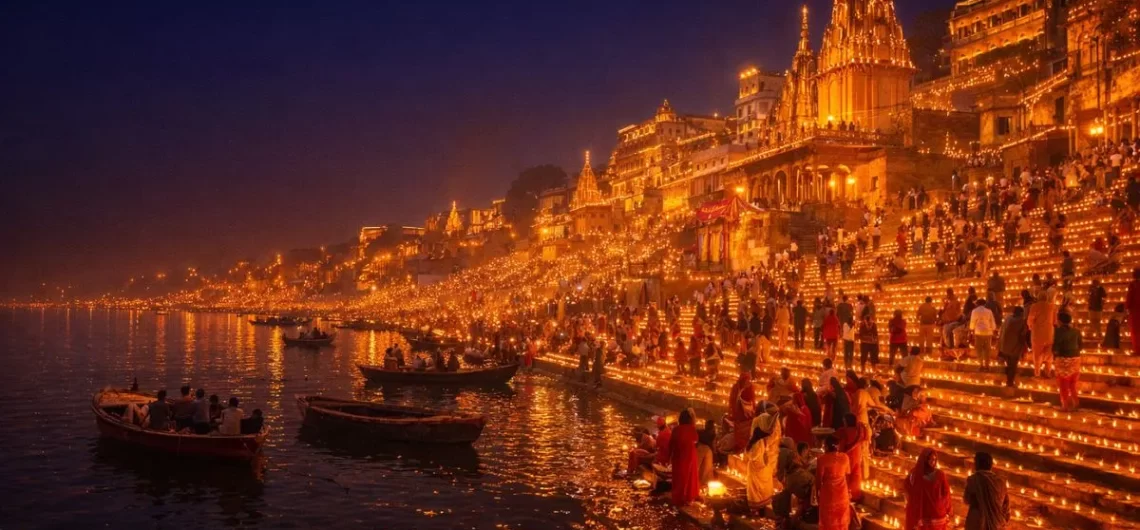
This guide covers everything you need to know about visiting Varanasi in October 2026 — the weather, the ghats, the Ganga Aarti, the Dussehra celebrations, the approach of Diwali, and the practical details that make the difference between a rushed visit and a genuinely transformative one.
Varanasi Weather in October 2026
October is the beginning of the best season in Varanasi, and it gets better as the month progresses.
Temperature
Daytime temperatures in Varanasi in October sit between 29°C and 33°C, cooling steadily as the month advances. By the final week of October, afternoon highs ease to around 28–29°C and morning temperatures drop to a genuinely comfortable 18–20°C — cool enough to make early morning ghat walks and sunrise boat rides feel like a pleasure rather than an endurance exercise.
The change from September is significant and immediately felt. The high humidity of the monsoon months — which can push the feels-like temperature well above the thermometer reading — drops sharply in October. The air is drier, cleaner, and lighter. Breathing it at six in the morning on the river feels different.
Rain
October is essentially rain-free in Varanasi. The monsoon withdraws from Uttar Pradesh in late September, and October typically sees only one or two brief showers across the entire month. You do not need to plan around rain. Bring a compact umbrella as a precaution and forget about it.
Sunshine
October brings nine to ten hours of bright sunshine daily — 75% of daylight hours. The post-monsoon clarity produces the kind of sharp, golden light that makes the ghats and river look exactly as they do in the best photographs of Varanasi. Morning golden hour on the Ganges in October is extraordinary.
Week by Week
Early October (1st–10th): Still slightly warm — highs of 31–33°C — but the humidity is gone and the mornings are pleasant. The river is at its fullest from the monsoon, creating impressive, wide water views.
Mid-October (11th–20th): The sweet spot begins. Highs drop to 29–31°C, evenings cool noticeably, and the festive build-up to Dussehra (October 2) creates a charged atmosphere across the city.
Late October (21st–31st): Increasingly perfect. Highs of 28–29°C, mornings of 18–20°C, clear skies, and the growing energy of the approaching Diwali season (main night: November 8) beginning to colour the city’s mood. This is Varanasi at its most comfortable and most alive simultaneously.
Why October Is One of the Best Months to Visit Varanasi
The honest answer is simple: October gives you Varanasi without its extremes.
Not the summer heat. April to June sees Varanasi temperatures touching 40–44°C, which turns ghat walks into endurance tests and makes midday sightseeing genuinely unpleasant.
Not the monsoon disruption. July and August bring flooding risk to the lower ghats, make boat rides unpredictable, and reduce the river’s visual drama as silt clouds the water.
Not the peak winter crowds. December and January bring the highest tourist numbers of the year, with guesthouses near the ghats filling months in advance and the Ganga Aarti watched from behind dense crowds.
October sits in the ideal middle ground — post-monsoon freshness, comfortable temperatures, manageable crowds, and the unique festive energy of Dussehra and the approaching Diwali season. The Ganges in October is at its most visually powerful: running full and strong from the monsoon rains, its colour shifting from the silty grey-brown of the flood season to the clearer, more sacred-looking waters that pilgrims bathe in at dawn.
The Ghats — Heart of October Varanasi
Varanasi has 84 ghats — great stone staircases descending to the Ganges, each with its own character, history, and ritual significance. Walking them is how you understand Varanasi. October is the best month to do it.
The Essential Ghats
Dashashwamedh Ghat is the centre of Varanasi’s ritual life and the most famous ghat in India. Every evening without exception, the Ganga Aarti is performed here by a group of priests in synchronised ceremony. In October, the sunset over the river and the ceremony that follows it reach a quality that draws visitors back night after night.
Assi Ghat — at the southern end of the ghat sequence — is where most travellers begin their morning boat ride. Quieter than Dashashwamedh, with a more local character, it has a morning aarti of its own at sunrise and a string of good cafés and guesthouses along its embankment. This is where most long-stay Varanasi visitors base themselves.
Manikarnika Ghat is Varanasi’s cremation ghat — one of the most sacred sites in Hinduism. At Manikarnika, the fire has never gone out; it has burned continuously for centuries. Day and night, bodies wrapped in white and orange cloth are carried down the lanes to the river and cremated on the stepped stone platforms above the water. This is not a spectacle — it is a living religious practice, witnessed with respect. Visitors are permitted to observe from a distance. Do not photograph without explicit permission, do not accept “guide” services from anyone who approaches you unsolicited near the ghat, and observe quietly from the upper levels.
Scindia Ghat — just north of Manikarnika — has a partially submerged temple, its foundations having sunk into the river over centuries. The image of the tilting, water-level temple against the full river is one of Varanasi’s most striking photographs, and in October with the post-monsoon water level still high, it is particularly dramatic.
Panchganga Ghat is where five rivers are said to converge invisibly beneath the Ganges. The Alamgir Mosque above it — built by Aurangzeb on the foundations of a Hindu temple — creates one of Varanasi’s most historically layered architectural views, particularly in early morning light.
Harishchandra Ghat is the second cremation ghat, smaller and less visited than Manikarnika. The atmosphere here is more intimate, and the view back toward the river in the late afternoon has a quality that photographers specifically seek.
The Ghat Walk
The most important thing you can do in Varanasi is walk the ghats — slowly, without a fixed destination, at 6 AM when the morning light is coming across the river and the city is waking up.
The full ghat sequence from Assi to Adi Keshava (the northernmost ghat) is approximately 6.5 kilometres. You don’t need to walk the whole thing. The section from Assi Ghat north to Manikarnika — roughly 3 kilometres — covers the most historically and spiritually significant ghats and takes about 90 minutes at a comfortable pace.
Do this walk in October’s early morning air and it will be among the most memorable things you do in India.
Sunrise on the Ganges — The Morning Boat Ride
The sunrise boat ride on the Ganges is not a tourist activity. It is the experience that defines what Varanasi is.
At 5:30 AM, before the sun has risen, your boatman pushes out from Assi Ghat or Dashashwamedh Ghat into the dark river. The ghats are already alive — bathers descending the steps, priests beginning their morning rituals, the smell of incense and wood smoke drifting across the water. As you drift north, the sky behind the ghats slowly lightens. And then the sun comes up.
The view from the water looking back at the ghats at sunrise is unlike anything else in India. The ancient stone steps, the temples and palace facades rising behind them, the silhouettes of people bathing and praying in the golden morning light — it is the image that defines Varanasi for anyone who has been here.
October’s sunrise falls at approximately 6:00–6:15 AM. The light is warm, directional, and perfect for an hour on either side of sunrise.
Practical details:
A private rowboat (the correct choice — motorboats are noisier and break the atmosphere) carries two to four people and costs approximately ₹600–₹1,200 for a 1.5 to 2-hour ride from Assi Ghat to Manikarnika and back. Book through your hotel or guesthouse the evening before to arrange a trusted boatman at a fair price. Never accept offers from touts on the ghat steps — they invariably overcharge.
Go north from Assi toward Manikarnika. Pass the key ghats in the morning light. Ask your boatman to pause at Manikarnika so you can observe the cremation ground briefly from the water. Then drift slowly back south as the city fully wakes around you.
The Ganga Aarti — Varanasi’s Greatest Evening
Every evening at Dashashwamedh Ghat, as the sun drops toward the western horizon, a group of priests in saffron robes takes position at the river’s edge and performs the Ganga Aarti — a 45-minute ceremony of fire, bells, chanting, and incense that is one of the most visually powerful ritual experiences in the world.
Seven priests (one at each of the ghat’s ritual stations) lift enormous five-tiered brass oil lamps — each standing five feet tall — and begin the synchronized ritual: the lamps are rotated, raised, and offered to the river in a choreography that has been performed here every single evening without interruption for centuries.
The sound builds with each stage — bells, conch shells, the call-and-response of the priests, the chanting of the gathered crowd. When all seven lamps are raised simultaneously and the flames catch the darkness of the river and the watching faces around you, it is genuinely moving in a way that is difficult to prepare for or explain.
In October, the Ganga Aarti begins at approximately 5:30–6:00 PM as the sun sets over the western bank. The temperature at this hour is ideal — warm enough to be comfortable outdoors but cool enough to make standing in the crowd pleasant.
How to watch:
There are two options, and they produce different experiences.
Watching from the ghat itself — either from the steps or from one of the small platforms on the water’s edge — puts you close to the ceremony with the crowd. Arrive 30–45 minutes early to find a good position. The seats closest to the river fill first. Do not pay for so-called “VIP” access offered by touts near the ghat — seating at the front is free and allocated on a first-arrival basis.
Watching from a boat on the river gives you the full panoramic view — the entire ghat, the crowd, the priests, and the flame reflections on the water — from a position that no land-based viewer can access. A private boat for the evening aarti costs ₹400–₹700 per person for a good viewing position directly opposite the ceremony. Position your boat slightly downstream of the ghat’s altar for the best angle, where the flame movements are fully visible and the river reflection is unbroken. This is the photographer’s choice and the better option for first-time visitors who want to understand the ceremony in its full scale.
Dussehra in Varanasi — October 2, 2026
Dussehra falls on October 2, 2026 — the very beginning of your October window — and it transforms Varanasi with its own particular energy.
Dussehra marks the victory of Lord Rama over the demon king Ravana, culminating in the burning of enormous effigies of Ravana, Kumbhakarna, and Meghnath that have been built over weeks and stuffed with fireworks. The evening burning — in parks and open grounds around the city — draws huge crowds. The effigies fall in a cascade of fire and explosions, and the night fills with smoke and celebration.
But Varanasi’s Dussehra has a dimension that makes it unique: the Ramlila performances that lead up to it. For the nine nights preceding Dussehra (Navratri), Ram Lila performances — theatrical retellings of the Ramayana epic with elaborately costumed actors — take place across the city. The Ramnagar Ramlila, held across the river at Ramnagar Fort, is the most famous in India — a month-long, city-scale performance in which the entire fort and its surrounding grounds become the stage for the epic. International theatre scholars visit specifically to see it.
If your October visit begins in the first two weeks of the month, the Ramnagar Ramlila is an experience worth building your Varanasi days around.
Diwali in Varanasi — The Build-Up in October
Diwali 2026 falls on November 8 — just beyond the October window. But the approach of Diwali in the final week of October is already unmistakably felt in Varanasi.
Sweet shops fill with fresh mithai. Clay diya makers set up stalls throughout the old city lanes. Textile shops display their best silks and brocades. The lane leading to Kashi Vishwanath Temple — already one of Varanasi’s most intense sensory experiences — becomes even more alive with garland sellers and devotees in festive clothing.
If your travel dates extend into early November, the main Diwali night in Varanasi (November 8) is one of India’s most extraordinary festival experiences — the ghats lined with diyas, the Ganga Aarti performed at maximum scale, boats on the river carrying lit lamps into the current. See our Diwali 2026 travel guide for the full picture.
And if you can stay through November 24, Dev Deepawali — the Diwali of the Gods — transforms the ghats with a million earthen lamps in one of the most spiritually overwhelming visual experiences available anywhere on earth.
Top Things to Do in Varanasi in October
1. Sunrise Boat Ride on the Ganges
The non-negotiable experience. Every morning. At least twice — the first time you absorb the shock of it; the second time you actually see it. October’s clear skies and warm light make this the finest version of the ride available all year.
2. Ganga Aarti at Dashashwamedh Ghat
Every evening without exception. From the ghat steps for intimacy, or from a boat on the river for the full panoramic view. Don’t leave Varanasi without seeing it at least twice — once from each position.
3. Ghat Walk at Dawn
The full walk from Assi Ghat north to Manikarnika Ghat and back. Allow 90 minutes. Don’t rush it. Varanasi is experienced at walking pace, not from a vehicle.
4. Kashi Vishwanath Temple
One of the 12 Jyotirlinga temples of Shiva — among the holiest sites in all of Hinduism. The Kashi Vishwanath Corridor, completed in 2021, has made access significantly easier while connecting the temple directly to the ghats. Go early morning for darshan (the queue is shorter before 8 AM) and then walk the corridor down to Dashashwamedh Ghat.
Note for foreign visitors: The main temple inner sanctum is restricted to Hindus. Non-Hindu visitors can view the temple complex from the Kashi Vishwanath Corridor viewing galleries without restriction.
5. Sarnath Day Trip
12 kilometres from Varanasi’s old city, Sarnath is where the Buddha gave his first sermon after attaining enlightenment — one of Buddhism’s four holiest sites. The Dhamek Stupa (a massive 5th-century structure marking the exact spot of the first teaching), the ruins of the ancient monastery complex, and the Sarnath Museum (which houses the original Ashoka Lion Capital — India’s national emblem) make this one of the most historically significant half-day trips in North India.
October’s weather makes the outdoor archaeological site completely comfortable to explore. Hire an auto-rickshaw from your guesthouse for a half-day trip (approximately ₹300–₹500 return including wait time) or include Sarnath in a guided day itinerary.
Entry: ₹20 (Indian) / ₹250 (Foreign) for the stupa complex. Museum entry: ₹5 (Indian) / ₹100 (Foreign).
6. Ramnagar Fort and Museum
Across the Ganges by ferry (10 minutes, ₹10) stands Ramnagar Fort — the palace of the Maharaja of Varanasi, built in the 18th century in Mughal-Rajput style. The fort museum contains an extraordinary and eccentric collection: vintage cars, silver palanquins, astronomical clocks, medieval weapons, ivory work, and royal memorabilia accumulated over centuries.
The Ramnagar Ramlila, held in the fort’s grounds in early October, is the most famous Ram Lila performance in India — a theatrical retelling of the Ramayana that has run continuously for over two centuries.
Entry: ₹15 (Indian) / ₹100 (Foreign). Open 10 AM to 6 PM.
7. Old City Lane Walks
The lanes behind the ghats — the narrow, winding alleys called galis — are where Varanasi’s oldest street life operates. Silk weavers, flower sellers, chai wallahs, sweet shops, small temples in unexpected corners, cows navigating impossible spaces — it is dense, disorienting, and completely unlike anything else in India.
The lane connecting Assi Ghat to Dashashwamedh Ghat through the old city is one of the world’s great urban walking routes. Walk it in the early morning and again in the evening. They are entirely different experiences at different hours.
8. Silk Weaving Workshops
Varanasi’s Banarasi silk — characterised by its gold and silver brocade work, fine weave, and intricate geometric patterns — is among India’s most prized textiles. The weaving workshops in the Lallapura and Madanpura neighbourhoods welcome visitors and explain the hand-loom process that produces these textiles. Buying silk directly from a workshop is both cheaper and more authentic than the tourist shops near the ghats.
What to Eat in Varanasi in October
Varanasi has one of India’s most distinctive regional food cultures, grounded in Hindu vegetarian traditions and Banarasi street food that locals are fiercely proud of.
Kachori-sabzi — the Banarasi breakfast. Crispy, spiced lentil-stuffed fried bread (kachori) served with a tangy, turmeric-heavy potato curry (sabzi) and fresh chutney. Available from early morning at stalls throughout the city, particularly near the ghats. Best at Deena Chat Bhandar near Dashashwamedh and from any of the old city stalls that have been frying kachori for generations.
Lassi — Varanasi’s lassi is in a category of its own. Thick, cold, poured into terracotta cups that are smashed after use. The famous Blue Lassi shop in the gali near Vishwanath Temple has been operating since 1925. Go early morning or you’ll queue.
Chaat — Banarasi chaat is the most complex and flavour-layered version of the snack in North India. Tamatar chaat (tomato-based), dahi chaat (yoghurt-based), and the local aloo tikki — all available along the main ghat embankment and in the old city.
Baati chokha — traditional Bihari/UP dish: wheat dumplings baked over coals, served with roasted, spiced brinjal and potato. A complete meal and an experience of the region’s older culinary traditions.
Malaiyo — a Varanasi winter speciality that begins appearing in October: a foam-like dessert made from milk, saffron, and rose water, collected from the morning dew and consumed immediately. Seasonal, fragile, and genuinely extraordinary. Available only in the early morning hours from vendors near the ghats from October to February.
Practical Tips for Varanasi in October
How Many Days Do You Need?
Two full days covers the essential experiences: sunrise boat ride, Ganga Aarti, Kashi Vishwanath, ghat walk, and a Sarnath half-day. Three to four days is more comfortable — it gives you time to explore the old city lanes at genuine pace, revisit the ghats at different hours, attend multiple Ganga Aartis, and sit quietly at the river without the pressure of a checklist.
Where to Stay
The best Varanasi accommodation is on or immediately near the ghats — the experience of waking up, walking downstairs, and being at the river in two minutes is worth more than any hotel amenity. The stretch from Assi Ghat north to Shivala Ghat has the best concentration of guesthouse and boutique hotel options at every price point.
Luxury: BrijRama Palace (a 200-year-old palace converted to a luxury hotel, directly on the Ganges — views of the ghats from every room), Taj Nadesar Palace (a heritage property in a quieter location with palace gardens).
Mid-range: Suryauday Haveli and Ganpati Guest House (Assi Ghat area — excellent ghat views, reliable service, good rooftop).
Budget: The gali lanes behind Dashashwamedh Ghat and the Assi Ghat area have dozens of clean, well-located guesthouses for ₹1,000–₹2,500 per night.
Getting Around
Varanasi’s old city is not navigable by car or auto-rickshaw beyond the main roads. The ghats and the old city lanes are pedestrian-only (and sometimes cow-only). Walk. Use a bicycle rickshaw or e-rickshaw for longer distances between the old city and the cantonment area or railway station.
For day trips to Sarnath and Ramnagar, hire an auto-rickshaw or book a private car through your hotel.
Navigation in the Old City
The gali system of the old city is genuinely confusing and designed — over centuries — to disorient. Do not expect Google Maps to save you. The most reliable navigation tool is asking locals, which also produces the most interesting encounters. Memorise the name of your ghat and your guesthouse, and use the river as your compass — the Ganges is always east.
What to Wear
Varanasi in October calls for lightweight cotton or linen in the day — breathable fabric for the 30°C afternoons and ghat walks. For evening Ganga Aarti, add a light shawl or layer for the river breeze and the post-sunset cool.
Modest clothing is important throughout the city — both out of cultural respect and practical necessity for temple access. Shoulders and knees should be covered for temple visits. Remove shoes before entering any temple or shrine.
Photography
October light in Varanasi is extraordinary — golden at dawn, sharp and blue-skied through the day, warm amber at dusk. The sunrise boat ride and the Ganga Aarti are the two unmissable photography moments.
At Manikarnika Ghat, photography of the cremation process is strictly prohibited and deeply disrespectful. Put your camera away entirely near the burning ghats and observe with the quiet dignity the setting demands.
Safety and Scams
Varanasi is safe for tourists. The primary hazards are touts — particularly near the ghats and Kashi Vishwanath Temple — who offer inflated boat rides, “free” temple guides who expect large payments, and silk shop operators who begin with friendly conversation and end with high-pressure selling.
Simple rules: book boats through your hotel at a fixed price; hire guides through your hotel or a government-registered guide service; and be politely but firmly clear with anyone who approaches you unsolicited near the main sights.
Getting to Varanasi
By Air
Lal Bahadur Shastri International Airport (VNS) connects Varanasi to Delhi (1 hour 15 minutes), Mumbai (2 hours), Kolkata (1 hour), and other major cities. Taxis from the airport to the old city ghats take 45–90 minutes depending on traffic and cost approximately ₹500–₹800 by pre-paid booth.
By Train
Varanasi Junction (BSB) connects to Delhi (8–12 hours overnight on the Shiv Ganga or Kashi Express), Kolkata (12 hours), Mumbai (24+ hours), and Agra (10–14 hours). For visitors combining Varanasi with a Golden Triangle tour, the most common routing is Delhi → Agra → Jaipur by road, then fly or overnight train from Delhi to Varanasi.
By Road from Agra
Agra to Varanasi is approximately 565 kilometres — a 10–12 hour drive or overnight journey. Most travellers flying or taking the train from Delhi to Varanasi. For those doing the Golden Triangle with Varanasi, a domestic flight from Delhi or Jaipur to Varanasi takes under 2 hours and is strongly recommended.
Varanasi + Golden Triangle — The Natural Combination
Varanasi and the Golden Triangle are the two complementary poles of the classic India cultural itinerary. Delhi, Agra, and Jaipur give you Mughal history, Rajput architecture, and the Taj Mahal. Varanasi gives you something older and less architectural — a living city that has been continuously inhabited for over 3,000 years and has been the centre of Hindu spiritual life throughout.
A 10-day October itinerary combining both:
Days 1–2: Delhi — Old Delhi, Humayun’s Tomb, Qutub Minar Day 3: Agra — Taj Mahal, Agra Fort, Mehtab Bagh Days 4–5: Jaipur — Amber Fort, City Palace, Hawa Mahal Day 6: Fly Delhi or Jaipur → Varanasi Days 7–10: Varanasi — sunrise boat rides, Ganga Aarti, ghat walks, Sarnath, Ramnagar Fort, old city exploration
This is one of Squid Travel India’s most requested October itineraries, and October’s timing is ideal for every city on the route. See our Golden Triangle with Varanasi package for the full itinerary.
Varanasi in October — Quick Reference
| Details | |
|---|---|
| Temperature (early Oct) | 23°C – 33°C |
| Temperature (late Oct) | 18°C – 29°C |
| Rain days | 1–3 (effectively rain-free) |
| Sunshine hours | 9–10 hours daily |
| River conditions | Full and strong — post-monsoon peak |
| Crowds | Moderate — manageable, not peak |
| Ganga Aarti time | Approx 5:30–6:00 PM (Oct) |
| Sunrise boat ride | 5:30 AM from Assi or Dashashwamedh |
| Dussehra 2026 | October 2 |
| Diwali 2026 | November 8 (just after October) |
| Dev Deepawali 2026 | November 24 |
| Best ghat for Aarti | Dashashwamedh Ghat |
| Best ghat for sunrise | Assi Ghat (start point) |
| Private boat cost | ₹600–₹1,200 (sunrise ride) |
| What to wear | Light cotton, add layer for evenings |
| Must bring | Comfortable walking shoes, respect, patience |
Plan Your Varanasi October Trip with Squid Travel India
Squid Travel India includes Varanasi as part of our Golden Triangle with Varanasi tours, with October itineraries timed around Dussehra, the approach of Diwali, and the post-monsoon clarity that makes October the finest month to be on the Ganges.
Every Varanasi booking includes accommodation on or near the ghats, a private sunrise boat ride with a trusted boatman, guided ghat and old city walks, Sarnath day trip, and transfers to and from the airport and railway station.
We’ve completed over 1,800 tours with a 98% satisfaction rate and TripAdvisor Travelers’ Choice recognition for 2024–25.
Plan your Varanasi October trip with Squid Travel India → Call us: +91 9990812499
Squid Travel India is a New Delhi-based, award-winning tour operator specialising in Golden Triangle tours, Rajasthan packages, South India and Kerala tours, and wildlife safaris across India.

Comment (1)