

There is a particular kind of traveller who plans a Golden Triangle tour from Poland.
They have likely already visited Western Europe’s classic destinations — the French châteaux, the Italian cities, the Spanish coast. They are looking for something genuinely different: a country with a culture entirely unlike anything in Europe, a scale that is hard to comprehend until you are standing in front of it, and the single most visited building on earth — the Taj Mahal.
The Golden Triangle — Delhi, Agra, and Jaipur — is the natural starting point for any first trip to India from Poland. Seven days is a workable minimum. Ten days is better. The combination of a Mughal imperial capital, the world’s greatest marble monument, and a Rajput Pink City gives you three completely different faces of India in a single manageable circuit.
This guide covers everything a Polish traveller needs to plan a Golden Triangle trip — flights from Warsaw and Kraków, the Indian eVisa process, costs in Polish złoty, the best time of year based on Polish school holidays, and what to expect on the ground.
Flights from Poland to India for the Golden Triangle
The entry airport for the Golden Triangle is Delhi Indira Gandhi International Airport (DEL). Every Polish Golden Triangle tour starts and ends here.
Flights from Warsaw Chopin (WAW)
Warsaw is the main hub for Polish travellers flying to India. There are no direct Warsaw–Delhi flights operating as of 2026 — all routes connect through a Middle Eastern or European hub. The main options:
Via Dubai (Emirates): Warsaw to Delhi with one stop in Dubai. Total journey time approximately 10 to 12 hours. Emirates operates this route consistently and is the most popular option for Polish travellers. Prices from approximately PLN 2,200 to PLN 3,800 return in economy, depending on season and booking lead time. Business class from approximately PLN 10,000 to PLN 18,000.
Via Istanbul (Turkish Airlines): Warsaw to Delhi via Istanbul Atatürk. Total journey time approximately 9 to 11 hours. Turkish Airlines operates strong Polish routes and offers competitive pricing. From approximately PLN 1,900 to PLN 3,400 return in economy. Turkish Airlines is frequently the cheapest option for Warsaw–Delhi on the budget-conscious booking window.
Via Amsterdam (KLM/Air France-KLM): Warsaw to Delhi via Amsterdam Schiphol. Journey time approximately 12 to 14 hours including the Amsterdam connection. Prices slightly higher than Turkish or Emirates at PLN 2,400 to PLN 4,200 return, but KLM is a strong option for travellers from northern Poland or those who prefer Western carrier service.
Via Doha (Qatar Airways): Warsaw via Doha to Delhi. Qatar Airways is among the world’s top-rated airlines and the connection through Hamad International Airport in Doha is exceptionally smooth. Prices from PLN 2,200 to PLN 3,600 return. Often worth the small premium over Turkish for the ground experience.
Via Frankfurt or Munich (Lufthansa): Polish travellers can also connect via LOT Polish Airlines to Frankfurt or Munich and then take the Lufthansa direct to Delhi (7.5 to 8 hours from Frankfurt). Total journey time approximately 11 to 13 hours. Prices competitive at PLN 2,300 to PLN 4,000 return.
Flights from Kraków (KRK)
Kraków John Paul II Airport has fewer long-haul connection options. The most practical route is to fly first to Warsaw, Dubai, Istanbul, or Amsterdam and connect onward to Delhi. Alternatively, some travellers drive or take a Kraków–Warsaw bus/train (2.5 hours) and fly from Warsaw Chopin.
Flights from Katowice (KTW), Wrocław (WRO), Gdańsk (GDN)
Polish regional airports connect primarily via Warsaw, Vienna, or other European hubs. LOT Polish Airlines operates feeder services from most major Polish cities to Warsaw for onward connections. For a Golden Triangle trip, a Warsaw connection is the most reliable and usually the cheapest combined routing.
Booking Strategy
Book Warsaw–Delhi return flights at least 2 to 3 months in advance for the best prices. For peak Indian tourist season (October to March), book 3 to 4 months ahead. December and January flights from Warsaw to Delhi are expensive and fill fast — book by September for winter travel.
Indian eVisa for Polish Citizens
Polish citizens require a visa to enter India. The Indian eVisa system is straightforward and can be completed online without visiting an embassy.
Indian eVisa — The Process
- Apply at indianvisaonline.gov.in — the official Indian government eVisa portal.
- Complete the application form online with personal details, travel dates, and upload a recent passport photo and a scanned copy of your passport’s bio data page.
- Pay the fee online by card.
- Processing time: typically 2 to 5 business days. Apply at least 7 to 10 days before travel to allow margin.
- Receive the eVisa confirmation by email. Print or save it on your phone — you present it at Delhi airport immigration alongside your passport.
Polish Citizens eVisa Fee
The Indian eVisa fee for Polish citizens as of 2026 is approximately USD 25 (approximately PLN 100 to PLN 110 at current exchange rates). The tourist eVisa for a single country like India has different tiers:
- 30-day eVisa (most common for the Golden Triangle): USD 25
- 1-year Multiple Entry eVisa: USD 40
- 5-year Multiple Entry eVisa: USD 80
For a first Golden Triangle trip, the 30-day single entry eVisa is sufficient.
Important Notes for Polish Travellers
- Use only the official Indian government portal (indianvisaonline.gov.in) — there are numerous unofficial fee-charging services that look official. You do not need an agent or a third-party service.
- The eVisa is only valid for the specific airport of arrival you list on the application — enter Delhi (DEL) as your point of entry.
- Carry a printed copy of your eVisa email to immigration at Delhi airport — some airlines require it at check-in too.
Poland to India Exchange Rate — Costs in PLN
Approximate exchange rate (2026): PLN 1 = ₹21 to ₹22
This is a favourable exchange rate for Polish travellers. India is significantly cheaper than Poland for accommodation, food, and local services once you are on the ground — especially outside the luxury tier.
What Things Cost in PLN
| Item | INR Cost | PLN Equivalent |
|---|---|---|
| Taj Mahal entry (foreign visitor) | ₹1,100 | PLN 50–52 |
| Agra Fort entry (foreign visitor) | ₹550 | PLN 25–26 |
| Amber Fort entry (foreign visitor) | ₹500 | PLN 23–24 |
| Qutub Minar entry | ₹600 | PLN 27–29 |
| Street food meal (local dhaba) | ₹80–150 | PLN 4–7 |
| Restaurant meal (mid-range) | ₹800–1,500 | PLN 37–70 |
| Dinner at heritage hotel restaurant | ₹2,500–5,000 | PLN 115–230 |
| Local auto-rickshaw (short trip) | ₹50–100 | PLN 2–5 |
| Bottled water (500ml) | ₹20–30 | PLN 1–1.40 |
| Delhi–Agra Gatimaan Express (2nd AC) | ₹1,050 | PLN 48–50 |
Tour Package Costs in PLN
A private 7-day Golden Triangle tour — 4-star hotels, private air-conditioned vehicle throughout, licensed guides at each city, all monument entry fees — costs approximately:
- Budget 4-star: PLN 8,500 to PLN 12,000 per person (for two people travelling together)
- Mid-range heritage properties: PLN 12,000 to PLN 17,000 per person
- Luxury 5-star (Oberoi, Taj properties): PLN 22,000 to PLN 38,000 per person
Adding two nights at Ranthambore tiger reserve brings the cost up by approximately PLN 2,500 to PLN 5,000 per person depending on lodge tier.
All-in cost including return flights from Warsaw: A 10-day private Golden Triangle plus Ranthambore tour from Poland costs approximately PLN 12,000 to PLN 20,000 per person in total — flights included at economy class prices.
Best Time to Visit India from Poland
India’s best tourist season for the Golden Triangle is October to March. For Polish travellers, the school holiday calendar maps well onto this window.
Ferie Zimowe (Winter School Holidays) — February
Poland’s winter school break — ferie zimowe — runs through February, with different regions having different weeks off (usually two consecutive weeks between late January and late February). This falls in the heart of India’s peak tourist season. Ferie zimowe is the single best Polish school holiday window for a Golden Triangle trip:
- Weather in Delhi, Agra, and Jaipur in February is ideal — 10°C to 26°C, clear skies, no fog risk (fog is mainly January).
- Ranthambore National Park is fully open and tiger sightings are at seasonal best.
- No monsoon, no extreme heat.
If you are travelling with children and must align with school holidays, ferie zimowe is the optimal Indian tourist window.
Ferie Wiosenne / Wielkanoc (Easter / Spring Holidays) — March–April
Easter falls in late March or April. The fortnight around Easter is a popular Polish travel window. For India:
- Late March is still pleasant — temperatures rising but not extreme (22°C to 34°C in Delhi and Agra).
- April is already warming quickly — Rajasthan reaches 36°C to 40°C by mid-April.
Late March is acceptable. April departures are fine for the Golden Triangle but get hot by the final days. Goa and Kerala remain pleasant in March-April (beach season is winding down).
Lato (Summer Holidays) — July–August: Avoid
Polish summer holidays run from late June through August. This coincides precisely with India’s southwest monsoon season — heavy rain across the entire Golden Triangle, flooded roads in Rajasthan, and reduced wildlife visibility at Ranthambore. Avoid India in July and August if possible.
The only exception: Goa and Kerala are extremely cheap and uncrowded in July (the monsoon is actually part of their appeal for some travellers who want silence and dramatic rain-swept scenery), but they are not Golden Triangle months.
October Half-Term and Autumn (Wrzesień–Październik)
Polish schools typically have a one-week autumn break in October or early November. India’s peak season starts October 1 when Ranthambore opens after monsoon closure. October and November are excellent months for the Golden Triangle — cooler than summer, clear air, monuments with slightly fewer crowds than December–January.
October is a hidden gem for Polish travellers: school half-term aligns with the very first tiger safari weeks at Ranthambore, and Diwali (early November) is the most spectacular festival in India. The Diwali 2026 in Udaipur article covers what the festival looks like in Rajasthan.
Recommendation for Polish Travellers
First choice: Ferie zimowe (February) Second choice: October–November (autumn half-term) Third choice: Late March
The Golden Triangle Itinerary for Polish Travellers
Why 10 Days Rather Than 7
From Poland, the total door-to-door travel time to Delhi is 12 to 16 hours including connection and transfer time. This is not a short-haul trip. A 7-day holiday leaves only 5 actual sightseeing days once you subtract arrival and departure. Ten days is the minimum we would recommend for Polish travellers to feel the trip was worth the journey — and 12 to 14 days allows you to add Ranthambore, Varanasi, or a few days at a beach.
10-Day Golden Triangle Tour from Poland
Day 1 — Arrive Delhi Fly overnight from Warsaw (via Dubai or Istanbul). Arrive Delhi morning or afternoon. Transfer to hotel. Rest and acclimatise. Easy dinner in Connaught Place or at your hotel. Delhi’s scale hits immediately.
Day 2 — Delhi Old Delhi: Red Fort, Jama Masjid, Chandni Chowk bazaar. Rickshaw through the old quarter. Lunch at Karim’s near the mosque — 150-year-old Mughal kitchen. Afternoon: Humayun’s Tomb (a quieter, more atmospheric precursor to the Taj). Evening at India Gate.
Day 3 — Delhi New Delhi: Qutub Minar (Delhi’s oldest mosque-complex, 12th century), Lodhi Garden, Hauz Khas village for shopping or coffee. Option: National Museum for context on Indian history before seeing the Mughal monuments.
Day 4 — Delhi to Agra Morning Gatimaan Express to Agra (1 hour 40 minutes). Check into hotel near the Taj. Afternoon: Agra Fort — the red sandstone citadel from which Shah Jahan was later imprisoned and could only see the Taj Mahal in the distance. At sunset, walk to Mehtab Bagh across the river from the Taj for the famous rear view in the golden hour.
Day 5 — Taj Mahal at Sunrise 5:45 AM departure from hotel. At the Taj Mahal gates for opening at 6:00 AM. The first 90 minutes inside the complex before the tour groups arrive are the finest 90 minutes of any India trip. Return to hotel for breakfast. Afternoon: Fatehpur Sikri — the ghost city 40km from Agra, built and abandoned by Emperor Akbar in the 16th century. One of the most extraordinary abandoned places on earth.
Day 6 — Agra to Jaipur (via Fatehpur Sikri if not done Day 5) Morning: second dawn attempt at the Taj Mahal if the first was foggy (or in February, fog risk is lower). Drive Agra to Jaipur (4.5 hours via National Highway 21). En route stop at Fatehpur Sikri if not visited Day 5. Arrive Jaipur afternoon. Sunset at Nahargarh Fort above the Pink City.
Day 7 — Jaipur Amber Fort at 8:00 AM (before crowds). Elephant courtyard, Sheesh Mahal (Hall of Mirrors), parapets with views across the Aravalli Hills. City Palace — the current Maharaja of Jaipur still occupies part of it. Jantar Mantar — the 18th-century astronomical observatory with instruments that measured time, position, and eclipses with naked-eye precision.
Day 8 — Jaipur Hawa Mahal (the Palace of Winds — best photographed from the cafe across the road). Johari Bazaar and Bapu Bazaar for Rajasthani shopping: block-print textiles, blue pottery, gemstones, leather juttis. Afternoon cooking class or textile workshop option. Rooftop dinner.
Day 9 — Ranthambore Drive from Jaipur to Ranthambore (3 hours). Afternoon arrival — afternoon safari in the jeep. First tiger zone allocation. The November–February window is the best of the year for sightings.
Day 10 — Ranthambore to Delhi Early morning safari — the morning safaris have consistently higher sighting rates than afternoon. Drive back to Delhi (5 hours) or take the Sawai Madhopur–Delhi train. Evening flight home via Warsaw.
What to See: The Golden Triangle Monuments for First-Time Visitors
Delhi
Red Fort (Lal Qila): The seat of the Mughal Empire from 1648 until the British took it in 1857. The main Lahori Gate, the Diwan-i-Am audience hall, and the Rang Mahal are the key sections. Allow 2 hours. Entry: ₹600 (PLN 27–29).
Humayun’s Tomb: Built in 1570, this is the direct predecessor of the Taj Mahal — the first garden tomb in India, built for the second Mughal emperor. The gardens are immaculate and the monument is less crowded than the Taj. Entry: ₹600 (PLN 27–29).
Qutub Minar: A 73-metre minaret begun in 1193 — the tallest brick minaret in the world. The complex around it contains ruins of Delhi’s earliest mosques. Entry: ₹600 (PLN 27–29).
Agra
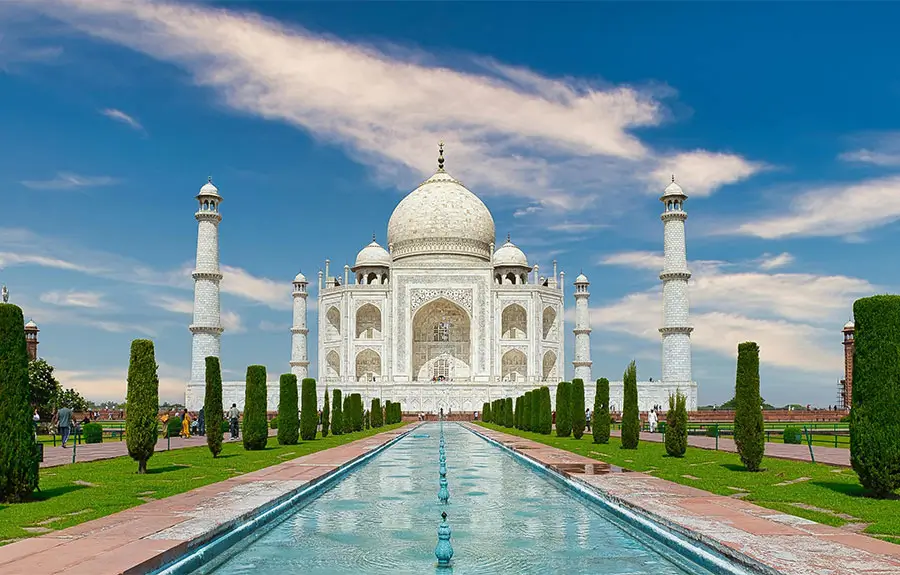
Taj Mahal: Shah Jahan built the Taj Mahal between 1632 and 1653 as a mausoleum for his wife Mumtaz Mahal. 20,000 workers. 28 types of precious stone inlaid into white Makrana marble. Entry: ₹1,100 (PLN 50–52). Closed on Fridays.
Agra Fort: Red sandstone fort completed by Akbar in 1573, later expanded by Shah Jahan in white marble for the palace sections. The Musamman Burj tower has a direct view of the Taj Mahal — from it, the imprisoned Shah Jahan is said to have spent his final years gazing at his creation. Entry: ₹550 (PLN 25–26).
Fatehpur Sikri: 40km from Agra — the imperial capital built by Akbar and abandoned after 15 years due to water supply problems. The abandoned palace complex is one of India’s most atmospheric sites. Entry: ₹610 (PLN 28–29).
Jaipur
Amber Fort: The seat of the Kachwaha Rajput clan from the 16th century. Built into a hillside above Maota Lake. The approach on foot or by jeep, the entrance courtyard, and the rooftop views over the Aravalli Hills are extraordinary. Entry: ₹500 (PLN 23–24).
City Palace: The current royal palace of the Maharaja of Jaipur. Part museum, part residence. The Chandra Mahal’s seven stories rise above the city. The Diwan-i-Khas houses two enormous silver urns used to carry Ganges water for the Maharaja’s travel — each holds 4,000 litres and is recorded in the Guinness Book of Records as the largest silver objects in the world. Entry: ₹700 (PLN 32–33).
Hawa Mahal: The Palace of Winds is Jaipur’s most recognisable façade — 953 honeycombed windows allowing Rajput noblewomen to observe street life while remaining unseen. The building has only one room deep — it is essentially a very elaborate screen. Entry: ₹50 (PLN 2.30).
Jantar Mantar: Maharaja Jai Singh II built this astronomical observatory in 1734. The Samrat Yantra is a sundial that tells time to the nearest two seconds. UNESCO World Heritage Site. Entry: ₹200 (PLN 9–10).
Practical Advice for Polish Travellers
Polish Banking Cards in India
India operates on a cash economy for many transactions — local markets, auto-rickshaws, street food, small guesthouses, and many temple and monument fee windows. Have cash in Indian rupees available.
Currency exchange: Exchange PLN to INR before departure (larger Polish banks and Kantor exchange offices offer competitive rates) or use ATMs in Delhi on arrival. Delhi airport has ATMs immediately after customs. The exchange rate at Indian airports is reasonable but slightly below inter-bank rates.
Best cards for India:
- Revolut (Poland): Zero foreign transaction fees, competitive exchange rates, works on the Mastercard/Visa network throughout India. The most popular option for Polish travellers. Keep a PLN account funded and exchange to INR in-app or pay directly.
- N26 (if you have it): Similar to Revolut — zero FX fees on the base account tier.
- mBank/PKO BP/ING: Standard Polish bank cards work in India but usually charge a 2–3% foreign transaction fee. Notify your bank of travel dates before departure to avoid card blocking.
- Always carry cash (INR): Some areas — especially monument queues and heritage property restaurants — do not reliably accept card payment. Carry ₹5,000 to ₹10,000 in cash at all times.
Plugs and Adapters
Poland uses Type C and Type E sockets (Schuko system, 230V). India uses Type C, Type D, and Type M sockets — a mix of old British round-pin (large) and Indian round-pin formats. In practice:
- Type C plugs (standard Polish phone charger, laptop, USB adapter) fit directly into Indian Type C sockets found in most modern hotels.
- For any appliances with a Type E (Schuko flat) plug, carry a Type C adapter (widely available in Empik, Media Markt, or Amazon.pl before departure).
- Higher-end hotels in Delhi, Agra, and Jaipur typically have multi-socket adapters already at the desk — ask the hotel if in doubt.
- India’s voltage is 230V (same as Poland) — no voltage conversion needed.
Travel Insurance from Poland
Polish EU health insurance (EKUZ/EHIC/Europejska Karta Ubezpieczenia Zdrowotnego) does not cover travel outside the European Union. India is not covered by EKUZ. You need a dedicated travel insurance policy before entering India.
Major Polish providers for travel insurance:
- PZU Podróże — Poland’s largest insurer, comprehensive international travel coverage
- Allianz Polska — international emergency medical and trip cancellation
- Ergo Hestia — competitive medical + luggage coverage
- Generali Polska — strong for medical and repatriation
Ensure your policy specifically covers India and includes medical evacuation (repatriacja medyczna). Medical care in private Delhi and Jaipur hospitals is good — but it is expensive if paid out of pocket, and repatriation by air to Poland is extremely costly without insurance.
Polish Embassy and Consular Assistance in India
Embassy of the Republic of Poland in New Delhi: 50M Shantipath, Chanakyapuri, New Delhi 110021 Tel: +91 11 4149 8000 Email: newdelhi.emb.sekretariat@msz.gov.pl Consular hours: check the MSZ website (gov.pl/web/indie) for current appointment availability.
MSZ travel advice for India: The Polish Ministry of Foreign Affairs (Ministerstwo Spraw Zagranicznych — MSZ) publishes country-specific travel advisories at podróże.msz.gov.pl. Check this before departure for the current India advisory, visa requirements, and any regional safety notices.
Emergency assistance abroad (Dyżurna Służba Konsularna): +48 22 523 9091 — the 24-hour emergency consular line for Polish citizens in distress abroad.
Language
English is widely spoken in the hotel, tourism, and guide sector across Delhi, Agra, and Jaipur. Communication with a licensed guide, a hotel concierge, or a private driver is entirely in English. Basic Hindi phrases are appreciated but not necessary. The Polish language profile is similar to most European visitors — English is your working language throughout the trip.
Health and Food Safety
- Drink only bottled or filtered water — no tap water, ever.
- Eat at your hotel restaurant, recommended restaurants, or busy local establishments. Avoid raw salad, street food with standing water, and cut fruit from carts in your first few days as your stomach adjusts.
- Take intestinal resilience seriously — carry Smecta (diosmectite) or loperamide from your Polish pharmacy. Digestive disruption affects roughly 30% of first-time India visitors from Europe.
- Standard travel vaccinations for India: Hepatitis A, Typhoid, Tetanus/Diphtheria. Consult your travel medicine doctor (medycyna podróży) 4 to 6 weeks before departure.
Ranthambore National Park: Adding a Tiger Safari
No country-specific reason stops Polish travellers from including Ranthambore — but it is worth emphasising how remarkable the combination is.
The Taj Mahal at sunrise and a Bengal tiger on a morning jeep safari: these are not simply good travel experiences. They are the kind of experiences people describe twenty years later. Ranthambore sits between Jaipur and Delhi — it fits naturally into the Golden Triangle circuit without additional backtracking.
January and February (which align perfectly with ferie zimowe) are among the strongest months for tiger sightings at Ranthambore. The winter cold keeps tigers moving in daylight. Morning safaris at 6:30 AM are cold (8°C to 12°C in an open jeep — dress warmly), but the light on the water and the dry deciduous forest is extraordinary.
Book Ranthambore safari permits and accommodation at least 2 to 3 months in advance. January and February permits sell out well ahead.
Full zone guide and booking advice: Ranthambore Zone Guide
How the Golden Triangle Compares to Other India First Trips
Polish travellers considering India for the first time sometimes ask whether they should go to Goa instead of the Golden Triangle. The honest answer is: the Golden Triangle first.
Goa is a beach destination — genuinely lovely, warm and relaxed, but not the India that stays with you. The Taj Mahal, the Red Fort, the Amber Fort, Fatehpur Sikri — these are monuments that exist nowhere else on earth. They are why India is India. Goa can come later (and pairs beautifully with a 14-day trip extending after the Golden Triangle).
For Polish travellers who want a complete two-week India experience: 7 to 9 nights Golden Triangle (including Ranthambore), then fly from Jaipur to Goa (1-hour direct) for 4 to 5 nights on the beach. Return home from Goa via Mumbai. This is the itinerary that produces the most complete first-India experience.
Frequently Asked Questions
Do Polish citizens need a visa for India?
Yes. Polish citizens require a visa to enter India. The Indian eVisa is available online at indianvisaonline.gov.in and takes 2 to 5 business days to process. Cost approximately USD 25 (PLN 100–110). Apply at least 7 to 10 days before travel.
How long is the flight from Poland to India?
There are no direct flights from Warsaw to Delhi. The fastest connections are via Istanbul (Turkish Airlines, approximately 9 to 11 hours total) or via Dubai (Emirates, approximately 10 to 12 hours total). Via Amsterdam or Frankfurt adds 1 to 2 hours.
What is the best time to visit India from Poland?
For Polish travellers, ferie zimowe (February school holidays) is the optimal window — perfect Golden Triangle weather, open Ranthambore, and the best of the Indian winter season. October (autumn half-term) is the second-best option, coinciding with the start of the tiger safari season and the week of Diwali.
How much does a Golden Triangle tour cost from Poland?
A 10-day private Golden Triangle tour including flights from Warsaw and 4-star hotels costs approximately PLN 12,000 to PLN 20,000 per person. Budget to mid-range all-inclusive private tours with return flights start from PLN 12,000. Luxury 5-star options with business class flights reach PLN 45,000 to PLN 65,000 per person.
Is India safe for Polish travellers?
India is safe for tourists visiting the Golden Triangle. The major cities — Delhi, Agra, Jaipur — are established tourist destinations with large tourist infrastructure and police presence at monuments. The MSZ (Ministerstwo Spraw Zagranicznych) and most travel advisories categorise tourist areas of India as safe with standard precautions. Use a licensed guide and licensed driver, book through a reputable tour operator, and apply the same awareness you would in any major Asian city.
Is English widely spoken in India for Polish visitors?
Yes. English is the working language of Indian tourism, hotels, guides, and drivers throughout the Golden Triangle. You will not need Hindi for any tourist interaction. Signage at all major monuments is in English. Most restaurant menus in tourist areas are in English.
Plan Your Golden Triangle Tour from Poland with Squid Travel India
At Squid Travel India, we build fully private India tours for European travellers — including an increasing number of Polish clients who have discovered that India’s peak tourist season aligns almost perfectly with the Polish ferie zimowe and autumn school breaks.
Every tour we build is entirely private. Your own air-conditioned vehicle throughout. Your own licensed English-speaking guide at each destination. No group coaches, no fixed-schedule departures, no compromise on timing.
We handle the full logistics: hotel bookings at the best properties (months in advance for Ranthambore and Agra), Taj Mahal entry ticket pre-booking, and safari zone allocation at Ranthambore. You arrive in Delhi and everything is waiting.
Contact us with your travel dates from Poland and your group size. We will send a full itinerary and pricing in GBP, USD, and INR within 24 hours — and we are happy to convert to PLN on request.
Also worth reading:
- Golden Triangle Tour from Delhi
- Golden Triangle Tour Cost 2026
- Ranthambore Zone Guide
- India in November 2026
- Diwali 2026 in Jaipur
- Diwali 2026 in Udaipur
- Best Time to Visit Agra and the Taj Mahal 2026
- Golden Triangle Tour from Australia
- Golden Triangle Tour from Germany
📞 Call / WhatsApp: +91 9990812499 📧 Email: Squidtravelindia@gmail.com 🌐 Visit: squidtravelindia.com
1,800+ trips completed | 98% happy clients | TripAdvisor Travelers’ Choice 2024–2025
Last updated: September 2026.

Comment (0)