

Germany is one of the largest sources of international tourists to India in Europe — and the Golden Triangle is where the overwhelming majority of them begin. Delhi, Agra, and Jaipur. Three cities. Three UNESCO World Heritage Sites. The Taj Mahal, the Red Fort, Amber Fort. All within a seven to ten day trip from Frankfurt, Munich, or Berlin.
German travellers bring specific expectations to a long-haul holiday. They research thoroughly, they value quality and honesty, and they dislike vague estimates and surprise costs. This guide is written with that in mind.
Everything here is specific to German travellers — flights from German airports, the India visa process for German passport holders, costs in Euros, the best timing around German school holidays and public holidays (Schulferien and Feiertage), and the full practical picture of what a Golden Triangle holiday from Germany actually involves.
Step 1: Flights from Germany to Delhi — City by City
All Golden Triangle tours begin and end at Indira Gandhi International Airport in New Delhi (airport code: DEL). Here is the realistic flight picture from German departure airports.
Frankfurt (FRA) to Delhi (DEL)
Frankfurt is Germany’s primary long-haul hub and has the best connections to Delhi. Lufthansa operates direct flights from Frankfurt to Delhi — flying time approximately 7.5 to 8 hours. This is one of the shorter long-haul routes from Central Europe, making Frankfurt the most convenient German gateway to India.
Air India also operates direct Frankfurt–Delhi service. Condor offers seasonal direct flights at competitive prices, popular with German leisure travellers.
One-stop connections via Dubai (Emirates), Abu Dhabi (Etihad), Doha (Qatar Airways), Istanbul (Turkish Airlines), or Amsterdam (KLM) are also available and often price-competitive. Total journey time with one stop: approximately 10 to 12 hours.
Economy return fares from Frankfurt to Delhi: approximately €550 to €950 booked 2 to 3 months in advance. Business class on Lufthansa direct: approximately €2,500 to €4,500 return on promotional fares booked well in advance.
Munich (MUC) to Delhi (DEL)
Lufthansa operates direct Munich–Delhi flights, with flying time approximately 7.5 to 8 hours — comparable to Frankfurt. Munich is Germany’s second major long-haul hub and an excellent starting point.
Economy return fares from Munich: approximately €550 to €950. Air India, Emirates via Dubai, and Turkish Airlines via Istanbul are popular alternatives.
Berlin (BER) to Delhi (DEL)
No direct service from Berlin. Connect via Frankfurt or Munich (Lufthansa), Amsterdam (KLM), Istanbul (Turkish Airlines), or Dubai (Emirates). Total journey time from Berlin: approximately 11 to 13 hours. Economy return fares: approximately €550 to €1,000.
Düsseldorf (DUS), Hamburg (HAM), Stuttgart (STR), Cologne (CGN)
All connect via Frankfurt, Munich, Amsterdam, or Middle Eastern hubs. Total journey times: approximately 11 to 14 hours including the domestic or short-haul connection. For Düsseldorf travellers, the quick rail or road connection to Frankfurt Airport is often the most efficient route.
The Open-Jaw Option
If you plan to extend the trip into South India — Goa, Kerala, or Rajasthan — consider flying into Delhi and out of Mumbai, Kochi, or Goa. This is often the same price as a return to Delhi and eliminates a long internal journey back north. Many German travellers combine the Golden Triangle with Goa beaches or Kerala backwaters in a two-week open-jaw itinerary.
When to Book
For German school holiday periods (Schulferien) — autumn half-term (Herbstferien, typically October), Christmas holidays (Weihnachtsferien), and winter break — book flights at least 3 to 4 months in advance. India’s peak season (October to March) overlaps directly with the most popular German travel windows.
Step 2: India eVisa for German Passport Holders
Every German citizen requires a visa to enter India. The process is completely online and takes approximately 72 hours.
Apply at: indianvisaonline.gov.in — the official Government of India portal. Do not use third-party Visaagenturen (visa agencies) that charge significantly more for the same result with no added value.
Which visa to choose: For most German travellers taking a 10 to 14-day Golden Triangle holiday, the 30-day single-entry e-Tourist Visa is sufficient. The fee is approximately €25 to €30 and processing takes 72 hours — often faster. If you plan to return to India within the same year, the 1-year multiple-entry eVisa is better value.
Passport requirements: Your German passport (Reisepass) must be valid for at least 6 months beyond your intended departure date from India. Check your expiry date now. Bundesdruckerei / Personalausweis offices have varying processing times — allow at least 4 to 6 weeks for a standard passport renewal application.
2026 Mandatory Requirement — Su-Swagatam Digital Arrival Card: All international visitors including German citizens must complete a mandatory digital arrival card within 72 hours before landing in India. This replaced the old paper arrival card (Einreisekarte) handed out on the aircraft. As of 2026, the paper version no longer exists. Complete it at indianvisaonline.gov.in/earrival — it takes approximately 5 minutes and requires your passport details, flight number, and hotel address for your first night. Save the confirmation on your phone and carry a printed backup copy. Failure to complete this before arrival causes delays at Delhi immigration.
Your pre-India checklist:
- eVisa approved and saved (digital + printed copy)
- Su-Swagatam digital arrival card completed within 72 hours of departure
- German passport (Reisepass) valid for 6+ months beyond India departure date
- Biometric passport photos (needed for the visa application)
- Hotel address for your first night in Delhi (required for Su-Swagatam)
Step 3: Best Time to Visit India from Germany — Aligned to the German Calendar
The Golden Triangle is best visited between October and March. Here is how that maps to the German Schulferien and Feiertage specifically.
Herbstferien (October Half-Term — typically mid-October)
Herbstferien dates vary by Bundesland — typically falling in the second or third week of October. This is one of the finest India windows of the year. The Indian monsoon has fully retreated from North India. Temperatures are perfect — 22°C to 32°C. Ranthambore National Park reopens on October 1 after the monsoon closure. Diwali in 2026 falls on November 8 — a trip that covers Herbstferien and extends slightly into early November puts you in Jaipur or Varanasi for the most spectacular festival in India.
Herbstferien is our top recommendation for German travellers with school-age children or anyone who wants the ideal combination of perfect weather, open tiger reserves, and pre-Diwali festivity.
Weihnachtsferien (Christmas Holidays — typically December 23 to January 6)
Peak season and peak prices. India in late December is beautiful — Delhi and Agra are cool and clear, the Taj Mahal shines under a vivid winter blue sky, and Rajasthan is at its most vibrant. Christmas week in Jaipur and Agra is extraordinary. The downside: this is India’s most expensive and most crowded window. Book accommodation by September for Weihnachtsferien travel. Heritage properties in Jaipur and Agra at quality hotels sell out completely by October for Christmas week.
Winter (January to February)
January and February are arguably the finest months for the Golden Triangle. Peak season pricing in January drops somewhat by mid-February. Ranthambore tiger sightings are excellent. February is less crowded than December or January, and temperatures — 10°C to 25°C — are perfectly comfortable. The Jaipur Literature Festival in late January is an added cultural draw. For German travellers with flexibility outside fixed Schulferien, January to mid-February is ideal.
Osterferien (Easter Holidays — typically 2 weeks in April)
Temperatures are warming significantly by April — 28°C to 38°C in Delhi and Agra. Manageable with morning-focused sightseeing and good hotel air conditioning. Ranthambore tiger sighting rates are at their annual peak in April — sightings are most frequent when the heat drives tigers to water sources. Osterferien is viable but not the most comfortable window for young children. Book 3 to 4 months in advance.
Sommerferien (Summer Holidays — July/August)
The Indian monsoon runs June through September. Sommerferien in India means rain, humidity, and heat across the Golden Triangle. Ranthambore is closed. Not recommended for a first India visit. However — Ladakh in July and August is spectacular: high-altitude desert with no monsoon rain, clear Himalayan skies, and extraordinary mountain scenery. An excellent alternative for adventurous German travellers during Sommerferien.
Step 4: How Many Days You Need
7 days minimum for the classic Golden Triangle. This gives you 2 nights Delhi, 1 to 2 nights Agra, and 2 nights Jaipur. From Germany, the flight is 8 hours direct from Frankfurt — manageable enough that a 7-day trip works well, especially from Frankfurt or Munich.
10 days is better. Ten days allows the full Golden Triangle done properly (2 nights Delhi, 2 nights Agra, 2 nights Jaipur) with the addition of Ranthambore National Park — 2 nights and 3 jeep safaris between Jaipur and the return to Delhi. This is the most popular length for German travellers.
14 days is the complete experience. Two weeks allows the Golden Triangle, Ranthambore, and either Varanasi or a southern extension to Goa or Kerala. Many German travellers do the open-jaw routing — fly into Delhi, out of Goa or Kochi — combining the north and south in a single trip.
Time difference from Germany to India: India Standard Time (IST) is UTC+5:30. Germany in winter (CET) is UTC+1, making India 4.5 hours ahead. In German summer time (CEST, UTC+2), India is 3.5 hours ahead. The time adjustment from Germany to India is gentle by international standards — most travellers adjust within a day.
Step 5: What It Costs — Honest EUR Numbers
German travellers benefit from a strong exchange rate when visiting India. As of 2026, €1 buys approximately ₹90 to ₹95 Indian Rupees — making India very good value compared to European or American destinations at comparable quality levels.
Ground Package (Hotels, Transport, Guides, Monument Fees)
The ground package covers 4-star hotels, your own private air-conditioned vehicle throughout the tour, licensed English-speaking guides in each city, all monument entry fees as per itinerary, and daily breakfast. It does not include international flights, personal lunches and dinners beyond breakfast, or tips.
A standard private 7-day Golden Triangle ground package for two adults travelling together costs approximately €900 to €1,500 per person. This covers quality 4-star hotels — not basic guesthouses, not luxury palaces.
Heritage hotel upgrades — palace havelis, boutique Rajasthani properties — run €1,500 to €2,800 per person on the ground package.
Full luxury — Oberoi Amarvilas in Agra (the finest Taj Mahal view hotel in the world), Rambagh Palace in Jaipur (Jaipur’s former royal residence, now Taj Hotels), The Leela Palace in Delhi — runs €3,500 to €9,000+ per person on the ground.
All-In Numbers for German Travellers
A comfortable 7-day Golden Triangle holiday from Germany — Lufthansa economy from Frankfurt, 4-star hotels, private guided tour, all monument entries: Approximately €2,000 to €3,200 per person for two adults travelling together.
A 10-day Golden Triangle plus Ranthambore — economy flights, 4-star hotels: Approximately €2,500 to €4,200 per person.
A full luxury 10-day trip — business class on Lufthansa, Oberoi Amarvilas, Rambagh Palace: €8,000 to €16,000+ per person.
Monument Entry Fees for German Nationals
Entry fees at major Indian monuments are tiered by nationality. Foreign national prices for German passport holders:
- Taj Mahal: ₹1,300 (approximately €14) for the garden and mausoleum, plus ₹200 (€2.20) for the inner chamber
- Agra Fort: ₹650 (approximately €7)
- Fatehpur Sikri: ₹610 (approximately €6.80)
- Red Fort, Delhi: ₹600 (approximately €6.70)
- Qutub Minar, Delhi: ₹600 (approximately €6.70)
- Humayun’s Tomb, Delhi: ₹600 (approximately €6.70)
- Amber Fort, Jaipur: ₹550 (approximately €6.10)
Important: Children under 15 years of age enter all ASI-protected monuments entirely free of charge regardless of nationality. A significant saving for German families with children.
Total monument entry cost for a comprehensive Golden Triangle tour: approximately €120 to €180 per adult.
Step 6: Private Tour vs Package Holiday — The Difference That Matters
Many German travellers book India through Reiseveranstalter (tour operators) — package deals from TUI, Neckermann, DERTOUR, or Lufthansa Holidays that combine flight and accommodation. The convenience is real. The experience is often a compromise.
Group India tours through German operators typically involve Reisegruppen of 20 to 40 people from across Germany, shared coaches, fixed daily programmes with no flexibility, mid-range chain hotels, and guides who must balance the needs of the entire group simultaneously. The Taj Mahal at 9 AM in a group of 35 is a fundamentally different experience from the Taj Mahal at 5:30 AM with your own private guide and no other visitors on the marble platform.
A private tour — your own vehicle throughout, your own licensed expert guide at each monument, your own schedule — is available at comparable cost to many German operator packages when you book the international flight separately and the ground tour directly with a specialist India operator.
At Squid Travel India, every tour we operate for German clients is entirely private. Ihr eigenes Fahrzeug für die gesamte Tour. Your own licensed guide in each city. No group coaches, no fixed Reiseprogramm. Our packages are transparently priced and include all monument entry fees — no hidden extras.
Step 7: The Day-by-Day Golden Triangle Itinerary
Here is the 10-day Golden Triangle plus Ranthambore itinerary that works best for German visitors — built around a typical Frankfurt or Munich departure.
Day 1 — Depart Germany
Evening flight from Frankfurt or Munich. Direct Lufthansa or Air India to Delhi, arriving the next morning.
Day 2 — Arrive Delhi
Arrive Delhi morning. Private transfer to your hotel. Rest — do not attempt sightseeing on arrival day. A gentle walk through Connaught Place in the evening or a rooftop dinner overlooking the city is the right introduction.
Day 3 — Delhi: Old and New
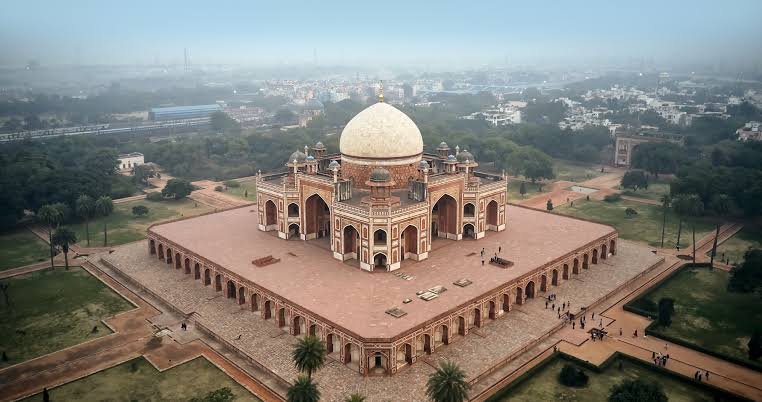
Full day Delhi with your licensed local guide. Morning in Old Delhi — cycle rickshaw through the lanes of Chandni Chowk, India’s most extraordinary spice and textile market, followed by Jama Masjid (India’s largest mosque) and the Red Fort, a UNESCO World Heritage Site built by the Mughal Emperor Shah Jahan. Afternoon in New Delhi — Humayun’s Tomb (the architectural predecessor to the Taj Mahal and far less crowded), Qutub Minar (the world’s tallest brick minaret), and a drive past India Gate, Parliament House, and Rashtrapati Bhavan. Delhi’s three thousand years of layered history — Delhi Sultanate, Mughal Empire, British Raj — is entirely visible within a single full day.
Day 4 — Delhi to Agra
Drive to Agra — approximately 3.5 hours on the Yamuna Expressway, or take the Gatimaan Express train (1 hour 40 minutes, the fastest connection in India). Arrive in time for Agra Fort in the afternoon — the massive Mughal fortress built by Emperor Akbar, from which the imprisoned Shah Jahan could see the Taj Mahal he had built for his wife Mumtaz. Late afternoon at Mehtab Bagh — the garden directly across the Yamuna River from the Taj Mahal, almost entirely unknown to casual tourists, offering the finest external view of the monument. As the sun sets, the Taj turns from white to gold to orange. This is your preview before the main event.
Day 5 — Taj Mahal at Sunrise, Then Fatehpur Sikri
Wake at 4:30 AM. Transfer to the Taj Mahal East Gate by 5:30 AM. Walk through the main Darwaza-i-Rauza gateway and stop. The Taj Mahal in the first light of dawn — the white marble shifting from grey to pale gold, the central reflecting pool completely still, the four minarets framing the great dome in perfect symmetry — is genuinely unlike anything you have seen before or will see again. Enter the mausoleum itself before 8 AM to appreciate the pietra dura inlay work and the tombs of Shah Jahan and Mumtaz Mahal before the day visitors arrive. After breakfast, drive to Jaipur via Fatehpur Sikri — Emperor Akbar’s magnificently preserved red sandstone capital, abandoned in the 16th century due to water shortage. Worth 90 minutes of anyone’s time.
Day 6 — Jaipur: Amber Fort and the Pink City
Amber Fort (Amer Fort) at dawn — the jeep ride up the cobbled road to the main gate, the Sheesh Mahal (Hall of Mirrors), views over the terraced Maota Lake below and the Aravalli Hills beyond. City Palace, still partly home to the Jaipur royal family. Jantar Mantar, the UNESCO-listed observatory with the world’s largest stone sundial. Hawa Mahal (Palace of Winds) photographed from the street opposite — the iconic pink sandstone honeycomb facade. Afternoon in the bazaars — Johari Bazaar for gemstones and Rajasthani gold, Bapu Bazaar for block-print textiles, Tripolia Bazaar for traditional lac bangles. Heritage hotel rooftop dinner.
Day 7 — Jaipur to Ranthambore
Drive from Jaipur to Ranthambore National Park — approximately 3 hours through the Aravalli landscape. Check into your safari lodge. Evening jeep safari — your first look at one of India’s finest tiger reserves. The lodge naturalist will brief you on current tiger territories, recent sightings, and the park’s geography.
Day 8 — Ranthambore Safaris
Dawn jeep safari at 6 AM — into the forest as the park wakes up, following the naturalist’s knowledge of current tiger movements. Return for breakfast. Afternoon jeep safari at 2:30 PM. Two full safari sessions give you the best coverage of the park’s zones. With experienced guides and good zone allocation, tiger sighting probability across two sessions: 65 to 80%.
Day 9 — Ranthambore to Delhi
Drive from Ranthambore to Jaipur (3 hours) and take a domestic flight to Delhi (1 hour), or drive the full journey (5 to 6 hours). Final evening in Delhi — last dinner at one of Delhi’s excellent restaurants, some shopping at Connaught Place or Dilli Haat, or simply a good night’s sleep before the flight home.
Day 10 — Fly Home to Germany
Transfer to Indira Gandhi International Airport. Direct Lufthansa or Air India flight back to Frankfurt or Munich. Arrive home the same evening.
Step 8: Practical Information German Travellers Specifically Need
German Foreign Office (Auswärtiges Amt) Travel Advice
The German Foreign Office (Auswärtiges Amt) maintains travel advice for India at auswaertiges-amt.de. The general assessment for tourist destinations including Delhi, Agra, Jaipur, and Rajasthan is to exercise normal precautions (normale Sicherheitsvorkehrungen). Specific border regions have higher advisory levels — none of which affect the Golden Triangle circuit. Check the advice before departure and note the emergency contact number for the German Embassy in New Delhi.
German Embassy in New Delhi: Shantipath, Chanakyapuri, New Delhi 110021. Tel: +91 11 4419 9199.
Travel Insurance (Reiseversicherung)
Your European Health Insurance Card (EHIC) does not cover medical treatment in India. Comprehensive Auslandskrankenversicherung (international health insurance) is essential. Ensure your policy includes:
- Medical treatment costs in India
- Medical evacuation / Rücktransport nach Deutschland
- Cancellation cover for flight delays or natural disruptions (monsoon-related in September/October)
- Cover for all activities you plan — jeep safari, trekking, adventure activities
German travel insurance providers including ERGO, Allianz, HanseMerkur, and ERV offer good India-specific coverage. Annual multi-trip policies are cost-effective for frequent travellers.
Currency and Banking
Indian Rupees (INR). As of 2026, approximately €1 = ₹90 to ₹95. German Visa, Mastercard, and Girocard debit and credit cards work at ATMs across all three cities. Deutsche Bank, Commerzbank, and DKB cards all function at Indian ATMs — check your international transaction and Auslandseinsatzentgelt (foreign use fee) in advance, as charges vary significantly between German banks. DKB and N26 users typically have low or zero international ATM fees.
Withdraw cash in Delhi on arrival — carry ₹5,000 to ₹10,000 at all times for markets, auto-rickshaws, and street vendors who are cash-only.
Mobile Phones
Your German SIM will work in India on international roaming but rates can be expensive. A local Indian SIM — Airtel or Jio prepaid — costs approximately €8 to €12 for 28 days of unlimited data. Available at Delhi airport on arrival and in any phone shop. German phones on unlocked networks (entsperrte Geräte) accept Indian SIMs without issue.
Electrical Adapters
India uses Type C and Type D plugs at 230V / 50Hz. Germany uses Type C and Type F plugs (Schuko) at 230V / 50Hz — the voltage is identical. Most Indian sockets accept the standard German Type C Eurostecker directly, but carry a universal adapter for Type D sockets (the large round-pin Indian plug). Your German appliances work in India without a voltage converter.
Water and Food
Drink only bottled water throughout — never tap water, including for brushing teeth. Carry oral rehydration sachets (Elektrolytpulver), ibuprofen, and anti-diarrhoeal medication such as Imodium for the first few days of adjustment. Quality restaurants and hotels in tourist areas are safe. Indian street food is delicious and generally safe from reputable vendors — use your judgement and avoid anything sitting in open air for extended periods.
Language
English is widely spoken in Delhi, Agra, and Jaipur by anyone working in tourism, hospitality, or transport. German language skills are not necessary for the Golden Triangle. Your licensed guide will speak fluent English; some guides in Jaipur and Delhi also speak basic German or French.
Step 9: Extending Beyond the Golden Triangle
Ranthambore Tiger Safari (2 to 3 extra nights)
The most popular extension for German travellers. Two nights at a Ranthambore safari lodge and three jeep safaris give 65 to 80% tiger sighting probability. October to February is peak season for sightings. Book safari permits and lodge months in advance.
Varanasi (2 extra nights, fly from Delhi or Jaipur)
India’s oldest city and the spiritual heart of Hinduism. The sunrise boat ride on the Ganges River as pilgrims bathe and pray. The Ganga Aarti fire ceremony each evening. Sarnath, 10 km from Varanasi, where the Buddha delivered his first sermon and the famous Ashoka Pillar lion capital — now India’s national emblem — was discovered. For German travellers interested in philosophy, history, and spirituality, Varanasi is irreplaceable.
Goa (3 to 5 extra nights, fly from Delhi)
Complete contrast with North India. Warm beaches, Portuguese colonial heritage, Goan seafood, and complete relaxation. German travellers are among the most frequent European visitors to Goa — the combination of Golden Triangle culture and Goa beaches in one open-jaw trip is the most popular two-week India itinerary for Germans. Fly Delhi to Goa (approximately 2 hours on IndiGo or Air India) and fly home from Goa via Mumbai.
Kerala (3 to 5 extra nights, fly from Delhi to Kochi)
Houseboat (Hausboot) on the Alleppey backwaters — a uniquely Indian experience. Tea gardens at Munnar in the Western Ghats. Ayurvedic treatments. Beaches at Varkala or Kovalam. October to February is peak Kerala season. Fly home from Kochi (COK) via Dubai, Mumbai, or Singapore.
Rajasthan Full Circuit (add 4 to 5 nights)
After Jaipur, continue into Rajasthan proper — Udaipur (the Lake City, widely regarded as the most romantic city in India), Jodhpur (the Blue City with its towering Mehrangarh Fort), and Jaisalmer (the golden desert city on the edge of the Thar Desert). Rajasthan is India’s most visited state after Delhi, and the full circuit is extraordinary. October to February is the perfect Rajasthan window.
Frequently Asked Questions from German Travellers
Do German citizens need a visa for India?
Yes. Every German citizen (Staatsbürger) requires a visa to enter India. Apply online at indianvisaonline.gov.in for the e-Tourist Visa — the 30-day single-entry option costs approximately €25 to €30 and is processed within 72 hours. Also complete the mandatory Su-Swagatam digital arrival card within 72 hours of departure. Your Reisepass must be valid for at least 6 months beyond your India departure date.
How long is the flight from Germany to India?
Lufthansa operates direct flights from Frankfurt and Munich to Delhi in approximately 7.5 to 8 hours — one of the shorter direct long-haul routes from Germany. From Berlin, Düsseldorf, or Hamburg via a hub, total journey time is approximately 11 to 13 hours.
What is the best time to visit India from Germany?
October to March — ideal weather across the Golden Triangle, open tiger reserves, and the most vibrant travel conditions. Herbstferien in October is our top recommendation: the monsoon has cleared, Ranthambore is open, and Diwali in early November is extraordinary. Weihnachtsferien offers beautiful winter conditions but at peak prices. January and February are the finest weather months with slightly lower prices than December.
How much does a Golden Triangle holiday cost from Germany in Euros?
A comfortable 7-day private Golden Triangle holiday from Germany — Lufthansa economy from Frankfurt, 4-star hotels, private guided tour, all monument entries — costs approximately €2,000 to €3,200 per person for two adults travelling together. Budget from €1,500. Full luxury from €8,000.
Is India safe for German tourists?
Yes. The Auswärtiges Amt (German Foreign Office) classifies Delhi, Agra, Jaipur, and the main Rajasthan tourist circuit under standard travel precautions (normale Sicherheitsvorkehrungen). Hundreds of thousands of German tourists visit India each year without incident. Booking with a reputable private tour operator substantially improves both safety and logistics throughout the trip.
Is the Taj Mahal worth visiting?
Without question. The Taj Mahal is consistently ranked among the most extraordinary man-made structures on earth. In low morning light — the first hour after gate opening — the white marble and the scale of the building produce an experience that photographs cannot replicate. German travellers who visit once almost universally list it among the most memorable travel experiences of their lives.
How many days should I allow for the Golden Triangle from Germany?
Seven days is the minimum — and from Frankfurt it works well given the short direct flight. Ten days is significantly better: it allows the full Golden Triangle properly paced, plus Ranthambore. Fourteen days allows the complete experience with a southern extension to Goa or Kerala.
Plan Your Golden Triangle Tour from Germany with Squid Travel India
At Squid Travel India, we operate private Golden Triangle tours for German clients throughout the year. We understand the German travel calendar, the Schulferien windows, and the expectation of honest, transparent pricing with no hidden extras.
Every tour is entirely private — Ihr eigenes Fahrzeug, Ihr eigener Guide, kein Gruppenbus. No shared coaches. No group timetables. Your own licensed expert guide at each monument.
Tell us your travel dates from Germany, your group size, and your preferred hotel level. We will build your complete Golden Triangle itinerary and send a full Euro pricing breakdown within 24 hours — no obligation.
Also worth reading:
- Golden Triangle Tour from Delhi
- Golden Triangle Tour Cost 2026
- Ranthambore Zone Guide
- India in November 2026
- Diwali 2026 in Jaipur
- Best Time to Visit Agra and the Taj Mahal 2026
- Golden Triangle Tour from the UK
- Golden Triangle Tour from Australia
📞 Call / WhatsApp: +91 9990812499 📧 Email: Squidtravelindia@gmail.com 🌐 Visit: squidtravelindia.com
1,800+ trips completed | 98% happy clients | TripAdvisor Travelers’ Choice 2024–2025
Last updated: September 2026. Visa fees, flight prices, and entry fees are current as of September 2026. Su-Swagatam digital arrival card requirement confirmed mandatory as of April 2026.

Comment (0)