

If you are visiting India for the first time, there is one journey that has been welcoming travellers from across the world for decades — and for good reason.
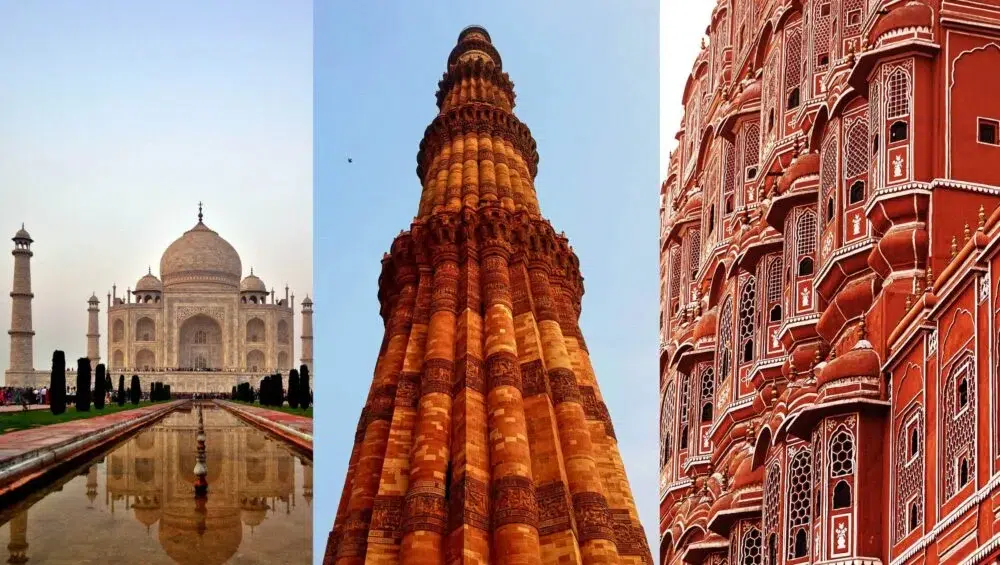
The Golden Triangle tour from Delhi is India’s most iconic travel circuit. It connects three of the country’s most historically magnificent cities: Delhi, Agra, and Jaipur — forming a near-perfect triangle on the map of North India. Within the span of just four to six days, you travel through a thousand years of history, from the grand Mughal empire to the opulent courts of Rajput royalty, with the world’s most recognised monument — the Taj Mahal — at the very centre of it all.
Starting from the vibrant capital of Delhi, you journey through the Mughal splendour of Agra before immersing yourself in the royal grandeur of Jaipur. What makes the Golden Triangle so special is the way these three cities encapsulate India’s diversity — from Delhi’s bustling streets filled with ancient monuments, to Agra’s world-renowned Taj Mahal, and finally Jaipur’s regal Amber Fort and Pink City charm.
Whether you have 3 days or 7, whether you travel budget or luxury, whether you are a solo adventurer or a family on holiday — this journey delivers. This guide covers everything: the best itineraries, what to see in each city, costs, tips, best time to visit, and how to book the right tour. Let’s begin.
Why the Golden Triangle is the Perfect Introduction to India
The Golden Triangle is India’s most popular tourist circuit, connecting Delhi, Agra, and Jaipur in a roughly triangular route. Each city sits approximately 200 to 280 km from the others, making this an ideal introduction to North India for first-time visitors and a convenient short itinerary for those with limited time.
But beyond the logistics, what this circuit offers is something rare: three completely distinct personalities in one seamless journey.
Delhi is chaos and magnificence in equal measure. It’s India’s capital — a city where Mughal-era monuments stand in the shadows of glass skyscrapers, where the aroma of street food in Old Delhi hits you before you even reach the lane, and where every corner holds a story that goes back centuries.
Agra is about reverence. You go there for one reason — and that reason is one of the most breathtaking things any human being has ever built. The Taj Mahal is not overhyped. It is, if anything, impossible to prepare for.
Jaipur is colour, royalty, and living heritage. The Pink City wraps you in warmth — in the terracotta hue of its old buildings, the hospitality of its people, and the sheer grandeur of fortresses that dominate the hillsides above the city.
Together, these three cities give you the full spectrum of what makes India extraordinary.
Best Time to Visit the Golden Triangle
The best time to visit the Golden Triangle is from October to March, when the weather is pleasant for sightseeing in Delhi, Agra, and Jaipur. Summers can be hot, while winter months are perfect for enjoying outdoor tours.
Here’s a month-by-month breakdown to help you decide:
October to November — Arguably the golden window. The climate is pleasant, with temperatures between 10°C and 27°C during the day, and nights can be chilly. This is the ideal time for sightseeing and cultural tours. Diwali falls in this period, and the cities are lit up and alive with celebration.
December to February — Peak tourist season. This period offers ideal temperatures ranging between 15°C and 25°C, though prices are higher and bookings should be made two to three months in advance. January mornings can be misty in Agra, which creates an ethereal atmosphere around the Taj Mahal but can limit early photography.
March — Holi festival transforms Jaipur and Delhi into a riot of colour. A magical time to visit if you want to experience one of India’s greatest celebrations.
April to June — Hot, with temperatures crossing 40°C. Not ideal for heavy sightseeing, but tour prices drop by 40 to 60 percent despite warmer temperatures, making it an option for budget travellers who don’t mind the heat.
July to September — Monsoon season. The monsoon months bring additional discounts, fewer crowds, and a greener landscape, making them suitable for budget-focused travellers. Agra can see flooding near the Yamuna, but the Taj against dramatic monsoon clouds is genuinely spectacular.
Pro tip from Squid Travel India: Book your trip for October–November or February–March for the sweet spot of great weather, festival atmosphere, and reasonable prices.
Golden Triangle Itinerary: Day-by-Day Breakdown
The Classic: 5 Days / 4 Nights Golden Triangle Tour from Delhi
This is the most popular itinerary — long enough to breathe, short enough to keep the pace exciting.
Day 1: Delhi — Old & New
Delhi deserves more than a half-day. Start in Old Delhi — the city that the Mughal emperors built.
Begin at the Red Fort (Lal Qila), the 17th-century red sandstone fortress that served as the main residence of the Mughal emperors for nearly 200 years. From the outside, it is fortress-like and imposing. Inside, it opens into a complex of palaces, halls, and gardens that speak of extraordinary refinement.
Walk or take a cycle rickshaw through the lanes of Chandni Chowk — Old Delhi’s legendary bazaar. This is sensory overload at its finest: the smell of spices and street food frying in open kadais, the sound of vendors and traffic, the narrow lanes lined with shops selling everything from silver jewellery to wedding garments.
Don’t miss Jama Masjid, India’s largest mosque, built by Emperor Shah Jahan — the same man who built the Taj Mahal. Climb the minaret for a sweeping view over Old Delhi’s rooftops.
In the afternoon, switch gears to New Delhi. Drive past India Gate, the grand war memorial at the heart of the capital. Visit Humayun’s Tomb — a UNESCO World Heritage Site and the architectural predecessor of the Taj Mahal. Its proportions and symmetry are extraordinary, and it is far less crowded than the Taj.
End the day at Qutub Minar, a 73-metre-high medieval tower of victory, surrounded by the ruins of Delhi’s oldest mosque. The complex turns golden in the late afternoon light.
Stay overnight in Delhi.
Day 2: Delhi to Agra — The Taj Mahal
Rise early. Drive to Agra via the Yamuna Expressway — a smooth, modern highway that takes approximately 3 to 3.5 hours. If you prefer the train, the Vande Bharat Express covers Delhi–Agra in approximately 1 hour 40 minutes, making it one of the most efficient options for travellers.
Arrive in Agra and go directly to the Taj Mahal.
Let’s be honest: no description does it justice. Described as the “epitome of love,” this white marble mausoleum is a UNESCO World Heritage Site and one of the New Seven Wonders of the World. Emperor Shah Jahan built it between 1631 and 1648 as an eternal monument to his beloved wife Mumtaz Mahal, who died during childbirth. Over 20,000 artisans worked for 17 years to complete it.
Stand at the main gateway, take a breath, and walk through. The moment the full view of the Taj opens before you — framed by the arched gateway, reflected in the long central pool — is one of those travel moments that stays with you for the rest of your life.
Taj Mahal entry tips:
- Entry fees as of 2026: ₹250 for Indians, ₹1,300 for foreign nationals, plus ₹200 for entry to the main mausoleum
- The Taj is closed every Friday
- Sunrise and sunset are the best times for photography — the marble changes colour dramatically in different light
- Buy your ticket online in advance to avoid queues at the gate
After the Taj, visit Agra Fort — another UNESCO World Heritage Site. This massive red sandstone fort served as a royal residence and military base during the Mughal era. From its ramparts, you can see the Taj Mahal shimmering in the distance — the view that the imprisoned Emperor Shah Jahan had of his masterpiece in the final years of his life.
If time permits, visit Itmad-ud-Daulah (the “Baby Taj”) — a delicate white marble tomb that predates the Taj Mahal and is considered its architectural predecessor. Smaller, more intimate, and far less crowded.
In the late afternoon, drive to Mehtab Bagh, a garden directly across the Yamuna river from the Taj. This is the best sunset viewpoint for the Taj Mahal — and largely overlooked by tourists.
Stay overnight in Agra.
Day 3: Agra to Jaipur via Fatehpur Sikri
After breakfast, drive towards Jaipur (approximately 4.5 to 5 hours). On the way, stop at Fatehpur Sikri — one of the most remarkable and underrated sights in all of India.
Just an hour from Agra, Fatehpur Sikri was once the capital of the Mughal Empire and is home to several well-preserved structures. Built by Emperor Akbar in 1571 as his grand new capital, it was abandoned just 14 years later — most likely due to a water shortage — leaving behind a perfectly preserved ghost city of red sandstone palaces, courtyards, and mosques. Walking through Fatehpur Sikri feels like stepping directly into the 16th century.
Continue driving to Jaipur. Arrive by evening. Explore the old city’s bazaars or simply check in and rest.
Stay overnight in Jaipur.
Day 4: Jaipur — The Pink City
Jaipur is Rajasthan’s capital and its most visited city — and it earns every bit of the attention.
Start the morning at Amber Fort, perched on a hillside 11 km from central Jaipur. The stunning hilltop fort features the famous Sheesh Mahal — the Mirror Palace — where a single candle flame is reflected in thousands of tiny mirror tiles embedded in the ceiling, creating the effect of a sky full of stars. The views from the fort walls over the surrounding landscape are extraordinary.
In the city, don’t miss:
Hawa Mahal — the “Palace of Winds,” an iconic five-storey sandstone façade with 953 intricately latticed windows. It was designed to allow royal ladies of the court to observe street life without being seen. It is one of Jaipur’s most photographed landmarks — and rightfully so.
City Palace — the royal residence of the Jaipur royal family, parts of which remain in use today. The palace museum houses an extraordinary collection of royal artefacts, textiles, manuscripts, and weaponry.
Jantar Mantar — a UNESCO World Heritage Site, this astronomical observatory built by Maharaja Jai Singh II is a must-visit for science and history enthusiasts. The giant instruments — sundials and astronomical devices built entirely of stone and marble — are both beautiful and startlingly precise.
Spend the afternoon exploring Jaipur’s famous markets. The city is one of India’s best shopping destinations for gemstones, block-printed textiles, blue pottery, leather goods, and silver jewellery. The Johari Bazaar and Bapu Bazaar are the best places to start.
Stay overnight in Jaipur.
Day 5: Jaipur to Delhi
A leisurely morning — perhaps a final walk through the old city, or breakfast at one of Jaipur’s rooftop cafes with views over the Pink City’s terracotta skyline. Drive back to Delhi (approximately 5 to 6 hours via NH48), arriving in time for an evening flight or a final night in the capital.
Golden Triangle Tour Cost: Honest 2026 Breakdown
The standard Golden Triangle route covers approximately 800 km, takes 3 days at a minimum, and costs between USD 250 and USD 900 per person depending on hotel category, transport, and inclusions.
Here’s a realistic breakdown for different travel styles:
Budget Traveller (Hostels, public transport, local dhabas)
- Accommodation: ₹800–₹2,500 per night
- Transport: Volvo buses + shared taxis
- Food: ₹500–₹800 per day
- Total for 5 days: ₹15,000–₹25,000 per person
Mid-Range Traveller (3-star hotels, private cab, restaurant meals)
- Accommodation: ₹3,000–₹8,000 per night
- Private AC car with driver for the full circuit: ₹18,000–₹28,000 (split among travellers)
- Food: ₹1,000–₹2,000 per day
- Total for 5 days: ₹35,000–₹55,000 per person
Luxury Traveller (Heritage hotels, palace stays, private guide)
- Accommodation: Luxury options include Oberoi Amarvilas in Agra and Rambagh Palace in Jaipur, starting from ₹25,000–₹30,000 per night
- Private vehicle + experienced guide throughout
- Total for 5 days: ₹1,50,000–₹3,00,000+ per person
International package tours through operators like Squid Travel India typically include private transport, licensed guides at all monuments, hotel accommodation, and daily breakfast — starting from approximately USD 80 per day for 3-star packages and USD 230 per day for premium packages.
Getting Around: Transport Options Explained
Private Car with Driver — Hiring a car with a driver is the most comfortable and flexible way to do the Golden Triangle. Having the same driver throughout the journey means a more personalised, stress-free experience. Drivers often double as informal guides and can suggest stops and restaurants that aren’t in any guidebook. Recommended for families, couples, and first-time visitors.
Train — The Gatimaan Express between Delhi and Agra covers the distance in just 1.5 hours, making it the fastest train option. The Shatabdi takes approximately 2 hours. Trains are comfortable, scenic, and a fantastic way to experience Indian rail travel. However, managing luggage and coordinating onward transport adds complexity.
Bus — Budget-friendly Volvo services connect all three cities. Good for solo backpackers comfortable with independent travel. Less convenient for families or those with tight schedules.
Recommended route sequence: Delhi → Agra → Jaipur → Delhi. This allows a sunrise visit to the Taj Mahal on day 2 before the crowds arrive — the single best way to experience the monument.
Top Experiences Not to Miss on the Golden Triangle
1. Taj Mahal at Sunrise The most clichéd advice in India travel — and the most correct. Arrive at the east gate before 6 AM. In the early morning light, the Taj Mahal’s white marble glows pink and gold. The crowd is thin. The silence is extraordinary for such a famous place.
2. Old Delhi Street Food Walk Parathas in Paranthe Wali Gali. Jalebi from a 100-year-old shop. Nihari. Kulfi. Kebabs. Old Delhi’s food lanes are a world-class culinary experience and cost almost nothing.
3. Sheesh Mahal at Amber Fort, Jaipur Stand inside the Mirror Palace with a single candle or a flashlight. Thousands of tiny mirrors embedded in the ceiling and walls reflect the light in every direction. You are standing inside a galaxy.
4. Sunset at Mehtab Bagh, Agra The garden across the Yamuna from the Taj Mahal, offering the most beautiful and least crowded sunset view of the monument. Book a small boat on the Yamuna for an even more special angle.
5. Cycle Rickshaw Through Chandni Chowk Hire a cycle rickshaw and let the driver take you through the lanes of Old Delhi’s greatest bazaar. Chaotic, colourful, loud, and one of the most vivid urban experiences in all of Asia.
6. A Heritage Hotel in Jaipur Even one night in a genuine haveli or heritage hotel — converted from a Rajput nobleman’s mansion — transforms the Jaipur experience entirely. Breakfast on a rooftop terrace looking over the Pink City’s rooflines is worth every rupee.
7. Jaipur’s Gem & Jewellery Markets Jaipur is one of the world’s largest centres for precious and semi-precious gemstone trading. The Johari Bazaar is authentic and extraordinary — even if you’re not buying, just walking through is an education.
Practical Tips for Your Golden Triangle Tour
Book the Taj Mahal ticket in advance. Online booking at the Archaeological Survey of India website saves you the queue. The Taj Mahal now has strict daily visitor limits — on busy days, on-the-gate tickets can sell out.
The Taj is closed every Friday. Plan your itinerary accordingly. A surprising number of travellers arrive in Agra on a Friday and make this discovery at the gate.
Hire government-licensed guides at monuments. Unlicensed touts outside monument gates will offer themselves at lower prices — but the difference in knowledge and quality is enormous. Your tour operator should arrange licensed guides in advance.
Carry cash. While UPI and cards are widely accepted in hotels and restaurants, cash is essential for rickshaws, street food, market shopping, and smaller transactions. ATMs are plentiful in all three cities.
Dress respectfully at religious sites. Cover shoulders and knees at mosques and temples. Carry a light scarf or shawl. Shoes must be removed before entering the Taj Mahal’s main plinth and all mosques.
Beware of gem and carpet scams in Jaipur. Jaipur shopping requires awareness of common scams — particularly “factory direct” gem dealers and carpet shops where drivers earn commissions. Buy from established shops or through your tour operator’s recommendations.
October to March — book 2 to 3 months in advance for peak season travel, especially if you want heritage hotels. Palace stays and boutique heritage properties book out months in advance during peak season.
Extending Your Golden Triangle: What to Add
The Golden Triangle works perfectly as a standalone trip — but it also makes an exceptional foundation for a longer India journey.
Add Ranthambore — Just 3.5 hours from Jaipur lies Ranthambore National Park, home to one of India’s largest populations of Bengal tigers. A two-night extension gives you two or three safaris — and the chance to see a tiger in the wild is genuinely life-changing.
Add Varanasi — India’s oldest living city and the spiritual heart of Hinduism. Take an overnight train from Agra or a short flight from Delhi. Nothing prepares you for the ghats of Varanasi at dawn.
Add Rajasthan — After Jaipur, continue deeper into Rajasthan: Jodhpur (the Blue City), Udaipur (the City of Lakes), and Jaisalmer (the golden desert city). A full Rajasthan circuit adds 5 to 7 days and takes the journey to another level entirely.
Add Kerala — For those combining North and South India, fly from Delhi or Jaipur to Kochi after the Golden Triangle. The contrast between Rajasthan’s desert forts and Kerala’s backwater tranquillity is one of the great travel experiences on earth.
Why Book Your Golden Triangle Tour with Squid Travel India
At Squid Travel India, the Golden Triangle is at the heart of everything we do. We have been crafting personalised Golden Triangle tours for international travellers for years — and we know this route better than anyone.
Here’s what sets us apart:
1,800+ trips completed. 98% of our clients rate their experience as excellent. We are TripAdvisor Travelers’ Choice 2024–2025 — not because we tell you we’re good, but because our clients do.
Every tour we design is fully private and personalised. No shared buses. No rushed group itineraries. Your driver, your guide, your pace.
We handle everything — from airport pickups and hotel bookings to monument tickets, licensed guides, Inner Line Permits, and restaurant recommendations that aren’t in any guidebook.
And if you want to extend beyond the Golden Triangle — into Rajasthan, Kerala, Varanasi, or a tiger safari — we build that seamlessly around your schedule and budget.
Frequently Asked Questions
How many days do I need for the Golden Triangle tour from Delhi?
A minimum of 3 days is possible but very rushed. Four days is comfortable. Five days is ideal and allows you to truly absorb each city without feeling hurried.
Is the Golden Triangle worth it for a first-time visitor to India?
Absolutely. It is India’s most popular tourist circuit for a reason. The combination of Mughal history, Rajput royalty, extraordinary food, and the Taj Mahal makes it the most concentrated and accessible introduction to India available.
What is the best way to travel between the three cities?
A private car with driver is the most comfortable, flexible, and recommended option — especially for first-time visitors. It gives you complete control over your schedule and stops.
Can I customise the Golden Triangle itinerary?
Absolutely — and that is exactly what Squid Travel India specialises in. We can add Ranthambore for a tiger safari, extend into Rajasthan, or combine with a South India experience based on your interests and time.
Book Your Golden Triangle Tour with Squid Travel India
Ready to experience the journey that has inspired travellers from every corner of the world for generations?
📞 Call / WhatsApp: +91 9990812499 📧 Email: Squidtravelindia@gmail.com 🌐 Website: squidtravelindia.com
Tell us your travel dates, group size, and preferred style — and we will design your perfect Golden Triangle itinerary within 24 hours. No obligation. No pressure. Just honest, expert travel planning from a team that lives and breathes India.
1,800+ trips completed | 98% happy clients | TripAdvisor Travelers’ Choice 2024–2025
Disclaimer: Entry fees, monument timings, and travel requirements are subject to change. Always verify current information with the Archaeological Survey of India or your tour operator before travel.
Comments (13)