

Agra. The name alone conjures images of white marble domes at dawn, the faint scent of jasmine, and the echoing grandeur of empires long past. Situated on the banks of the Yamuna River in Uttar Pradesh, Agra is one of India’s most visited cities — and for very good reason.
Home to three UNESCO World Heritage Sites within a single city boundary, Agra is not just a day-trip destination. It is a deep, layered experience that rewards the curious traveller with art, history, architecture, and flavour at every turn.
Whether you are planning a quick weekend trip from Delhi, building out a classic Golden Triangle Tour (Delhi–Agra–Jaipur), or carving out a full week to absorb Mughal India at your own pace — this guide covers the 10 most famous tourist places in Agra you simply cannot miss in 2026.
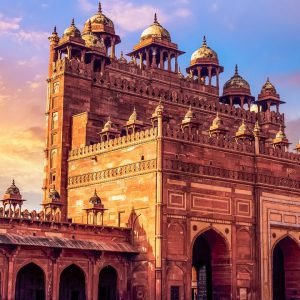
1. Taj Mahal — The Crown of All Tourist Places in Agra
There is a reason the Taj Mahal tops every “places to visit in Agra” list ever written. This ivory-white marble mausoleum, commissioned by Mughal Emperor Shah Jahan in 1631 in memory of his beloved wife Mumtaz Mahal, is widely considered the world’s greatest monument to love.
Designated a UNESCO World Heritage Site in 1983 and one of the Seven Wonders of the Modern World, the Taj Mahal draws more than 6–7 million visitors every year.
What Makes It Special
The Taj’s perfection lies in its symmetry, its shifting appearance across the day (blush pink at dawn, blazing white at noon, golden at dusk), and the extraordinary inlay work — over 28 varieties of semi-precious stones embedded into white Makrana marble by craftsmen from across the Mughal empire.
Insider Tips
- Best time to visit: Arrive at opening (6:00 AM) for soft golden light and far fewer crowds.
- Full moon nights: The ASI offers special Moonlight Viewing on the five nights around every full moon — a magical and rarely-taken option.
- Skip the touts: Book your tickets online at the Archaeological Survey of India website to avoid queues.
- What’s included: The main mausoleum, the mosque (Masjid), the rest house (Mehman Khana), and the formal Charbagh garden.
Timings: Sunrise to Sunset (closed on Fridays) Entry Fee: ₹1,300 for foreign nationals Time Needed: 2–3 hours minimum
2. Agra Fort — The Red Jewel of Mughal Power
Just 2.5 kilometres from the Taj Mahal stands the magnificent Agra Fort, a UNESCO World Heritage Site and a testament to the military might and artistic ambition of the Mughal dynasty. Built primarily during the reign of Emperor Akbar in 1565 and expanded under Jahangir and Shah Jahan, this massive red sandstone and marble complex served as the main Mughal residence until 1638.
What to See Inside
- Diwan-i-Aam (Hall of Public Audience): Where the Emperor met citizens and heard petitions.
- Diwan-i-Khas (Hall of Private Audience): An exquisite chamber where Shah Jahan originally housed the Peacock Throne.
- Musamman Burj: The octagonal tower where Shah Jahan spent his final years under house arrest — with a heartbreaking direct view of the Taj Mahal.
- Jahangir’s Palace: The largest residential structure in the fort, notable for its blend of Hindu and Central Asian architectural elements.
- Khas Mahal: Shah Jahan’s private quarters, built entirely in white marble.
Insider Tips
- Combine Agra Fort and the Taj Mahal on the same day — they are close and deeply complementary.
- The view of the Taj Mahal from the Musamman Burj is one of the most emotionally powerful sights in all of India.
Timings: 6:00 AM – 6:00 PM daily Entry Fee: ₹650 for foreign nationals Time Needed: 2–3 hours
3. Fatehpur Sikri — The Ghost City of Akbar
About 37 kilometres from Agra, Fatehpur Sikri is one of the most extraordinary and underrated tourist places near Agra. Built by Emperor Akbar between 1571 and 1585, this city served as the Mughal capital for just 14 years before being mysteriously abandoned, reportedly due to water scarcity. The result is an almost perfectly preserved 16th-century Mughal city, frozen in time.
Must-See Highlights
- Buland Darwaza (Gate of Magnificence): At 54 metres tall, this is the highest gateway in the world. The scale will stop you mid-step.
- Jama Masjid: One of India’s finest early Mughal mosques.
- Tomb of Salim Chishti: A stunning white marble tomb where devotees still tie threads to the marble lattice screens seeking blessings.
- Panch Mahal: A five-storied palace with 176 columns, inspired by Buddhist architecture.
- Diwan-i-Khas: Features a singular central pillar with a seat at the top — still debated by historians.
Timings: Sunrise to Sunset Entry Fee: ₹610 for foreign nationals Distance from Agra: 37 km (about 1 hour by road) Time Needed: 3–4 hours
4. Mehtab Bagh — The Best Free View of the Taj Mahal
Directly across the Yamuna River from the Taj Mahal, Mehtab Bagh (Moonlit Garden) is a 16th-century Mughal garden that offers what many photographers consider the most beautiful view of the Taj Mahal — without the crowds, without the entry queue, and at a fraction of the cost.
Emperor Babur originally designed it as part of a chain of eleven gardens along the Yamuna. Archaeological excavations here gave rise to the legend of Shah Jahan’s planned “Black Taj” — a mirror mausoleum in black marble — though no definitive evidence has confirmed this story.
Why Visit
- Unobstructed, elevated view directly opposite the Taj Mahal.
- Perfect for sunset and photography.
- Peaceful and relatively uncrowded — a rare thing in Agra.
Timings: 6:00 AM – 7:00 PM Entry Fee: ₹300 for foreign nationals Time Needed: 45 minutes – 1 hour
5. Itmad-ud-Daulah — The Baby Taj
Often called the “Baby Taj” or the “Jewel Box”, the Tomb of Itmad-ud-Daulah is one of Agra’s most beautiful and most overlooked monuments. Built between 1622 and 1628 by Empress Nur Jahan for her father, it holds huge architectural significance: it is the first Mughal structure built entirely in white marble, predating the Taj Mahal.
What Makes It Special
- The entire surface is covered in pietra dura inlay — flowers, vines, and geometric patterns in semi-precious stones.
- The delicate marble jali (lattice) screens are the finest examples of Mughal stone craftsmanship in Agra.
- Far fewer tourists than the Taj — you can actually sit and absorb it in silence.
Timings: 6:00 AM – 6:00 PM Entry Fee: ₹310 for foreign nationals Time Needed: 1–1.5 hours
6. Akbar’s Tomb, Sikandra — The Emperor’s Final Resting Place
Located about 10 kilometres from central Agra in a place called Sikandra, Akbar’s Tomb is one of Agra’s most undervisited yet most fascinating monuments. Emperor Akbar himself began designing this mausoleum during his own lifetime — a blend of Hindu, Christian, Buddhist, and Islamic architectural styles that perfectly reflects his philosophy of religious tolerance.
Why It’s Worth Your Time
- The tomb complex is set in a large walled garden with hundreds of deer roaming freely — an extraordinary and peaceful experience.
- The four-storey structure shifts from red sandstone at the base to white marble at the top.
- The main gateway is a stunning example of Mughal mosaic work.
Timings: 6:00 AM – 6:00 PM Entry Fee: ₹310 for foreign nationals Distance from Agra city: 10 km Time Needed: 1–2 hours
7. Mariam’s Tomb — Akbar’s Christian Wife
One of Agra’s most unusual and least-visited monuments, Mariam’s Tomb is the resting place of Mariam-uz-Zamani, the Hindu Rajput princess who became one of Emperor Akbar’s most favoured queens and the mother of Emperor Jahangir. Located near Sikandra, this quiet red-sandstone tomb, surrounded by green gardens, is a moving example of Mughal India’s multicultural character.
If you are interested in the human stories behind the monuments — the queens, the politics, the daily life of the Mughal court — this is a must-visit.
Timings: Sunrise to Sunset Entry Fee: Minimal / free Time Needed: 30–45 minutes
8. Jama Masjid Agra — The City’s Grand Mosque
Built in 1648 by Shah Jahan’s daughter Jahanara Begum and dedicated to her, Agra’s Jama Masjid is one of the largest mosques in India. With its striking red sandstone and white marble facade, its three domes decorated with zigzag patterns, and its vast open courtyard, it is a place of both immense spiritual significance and architectural beauty.
Unlike many of Agra’s monuments, the Jama Masjid is a living, working place of worship — giving it an atmosphere and authenticity that purely tourist sites cannot replicate.
Visitor Notes
- Dress modestly — cover shoulders and legs, and carry a scarf.
- Non-Muslims are welcome outside prayer times.
- Located in Agra’s bustling old city — pair it with a walk through the nearby bazaars.
Timings: Open daily (closed during prayer times for non-Muslim visitors) Entry Fee: Free Time Needed: 45 minutes – 1 hour
9. Chini Ka Rauza — The Persian Tile Masterpiece
Chini Ka Rauza (literally “China Tomb”) is one of Agra’s true hidden gems and is almost never mentioned in mainstream travel guides. This 17th-century tomb of Allama Afzal Khan Mullah, a Persian poet and high official in Shah Jahan’s court, is the only monument in Agra and one of very few in all of India decorated with glazed tile mosaic work (kashi-kari) in the Persian style.
The vivid blue, yellow, and green tiles that once covered the entire exterior have faded and partially fallen away over the centuries, giving the monument a melancholy, time-worn beauty that is deeply evocative.
For anyone interested in architecture, Persian art, or simply discovering Agra beyond the postcard, Chini Ka Rauza is essential.
Timings: 6:00 AM – 6:00 PM Entry Fee: Free Time Needed: 30–45 minutes
10. Agra Bear Rescue Facility — Wildlife with a Conscience
For travellers who want to go beyond monuments, the Agra Bear Rescue Facility — run by Wildlife SOS — is one of the most moving and responsible wildlife experiences in India. This sanctuary is home to rescued sloth bears, many of them former “dancing bears” who were rescued from a cruel practice that has since been eliminated in India thanks largely to Wildlife SOS’s work.
Why Include This in Your Agra Itinerary
- You can observe sloth bears in a natural, spacious, and ethical environment.
- Guided tours explain the rescue stories of individual bears — powerful and memorable.
- Supports a genuinely important conservation mission.
- Great for families with children.
Timings: 9:00 AM – 5:30 PM (closed Sundays) Entry Fee: Donation-based Distance from Agra: 20 km (Sur Sarovar Bird Sanctuary, Keetham) Time Needed: 2–3 hours
Best Time to Visit Agra
October to March is the ideal window to visit Agra. The weather is cool and comfortable, visibility is good, and the monuments look their most beautiful in the crisp winter light. Avoid April to June — temperatures routinely exceed 45°C and the experience is genuinely harsh. Monsoon season (July to September) brings relief from the heat but humidity is high and visibility at the Taj Mahal can be poor.
How to Reach Agra
By Train: Agra is excellently connected to Delhi (2–3 hours on Gatimaan Express or Shatabdi), Jaipur (4 hours), and Varanasi (8–10 hours). The Gatimaan Express is the fastest and most comfortable option from Delhi.
By Road: About 230 km from Delhi via the Yamuna Expressway — a smooth, fast highway with a journey time of roughly 3–3.5 hours by car.
By Air: Agra’s Pandit Deen Dayal Upadhyay Airport (AGR) has limited direct connections. Most international visitors fly into Delhi and travel to Agra by train or road.
How Many Days Do You Need in Agra?
1 day: Taj Mahal + Agra Fort — a tight but doable classic day trip from Delhi. 2 days: Add Fatehpur Sikri, Mehtab Bagh, Itmad-ud-Daulah, and Akbar’s Tomb. 3 days: Absorb everything at a relaxed pace, including Chini Ka Rauza, the Jama Masjid, and the Bear Rescue Facility. This is what we recommend for first-time visitors.
Frequently Asked Questions About Tourist Places in Agra
Q: Is Agra safe for tourists? A: Yes. Agra is one of India’s most heavily visited and well-managed tourist cities. Standard precautions apply — be aware of touts near the Taj Mahal gates, use reputable transport, and book accommodation in advance during peak season.
Q: Can I see the Taj Mahal and Agra Fort in one day? A: Yes, comfortably. Both are close together and two to three hours each is sufficient. Start at the Taj at dawn, then head to Agra Fort by mid-morning.
Q: What is the entry fee for the Taj Mahal in 2025? A: ₹1,300 for foreign nationals, which includes entry to the main mausoleum. The Taj Mahal Photography Ticket (for professional cameras) costs extra.
Q: Is Fatehpur Sikri worth visiting from Agra? A: Absolutely. It is one of the most remarkable and uncrowded UNESCO World Heritage Sites in India. Budget a half-day for the round trip from Agra.
Q: What is the best time of day to photograph the Taj Mahal? A: Sunrise (6:00–7:30 AM) for the warm golden light and empty forecourts. Sunset from Mehtab Bagh across the river is equally spectacular.
Q: Are Agra’s monuments closed on any day? A: The Taj Mahal is closed on Fridays. Most other monuments are open daily.
Q: Do I need a guide in Agra? A: A knowledgeable local guide transforms Agra from a sightseeing checklist into a living story. We strongly recommend booking a licensed guide — your Squid Travel India tour package includes an expert guide throughout.
Plan Your Agra Trip with Squid Travel India
Agra is best experienced not as a rushed checkbox, but as an immersion. At Squid Travel India, our Golden Triangle Tour packages are built around giving you the right amount of time in each city — with expert guides, handpicked accommodation, and all transfers handled seamlessly.
Whether you choose our 5-Day Golden Triangle Tour (Delhi–Agra–Jaipur) or the Delhi–Agra Tour Package for a focused two-day experience, every itinerary is crafted with the same care we bring to every journey.
Your Agra adventure begins here. Contact us today to start planning.

Comment (0)