

The Night India Burns Ravana
Every October, India stages one of the most dramatic public spectacles available anywhere in the world.
Across the country — from the grounds of Delhi’s Ramlila Maidan to the streets of Mysore to the mountain valleys of Kullu — enormous effigies of the demon king Ravana are set ablaze simultaneously. Some reach ten storeys high. All are packed with fireworks. When they ignite, the explosions last for minutes, lighting the night sky in every direction while hundreds of thousands of people gathered below cheer, photograph, and feel — in that specific way that only comes from a shared public event — something profound about the story being told.
The story is the Ramayana. The festival is Dussehra. And it is the culmination of ten days of Navratri celebrations that makes the end of October India’s most concentrated cultural moment.
Dussehra 2026 falls on Tuesday, October 20. Navratri runs October 11 to 19 — nine nights of the goddess — before Dussehra arrives on the tenth day as its spectacular conclusion.
This guide covers the five finest places to celebrate Dussehra in India in 2026 — what happens, what to expect, how to get there, and how to include Dussehra in a Golden Triangle itinerary.
What Is Dussehra and Why Does It Matter?
Dussehra — also known as Vijayadashami, meaning “the tenth day of victory” — celebrates two simultaneous triumphs.
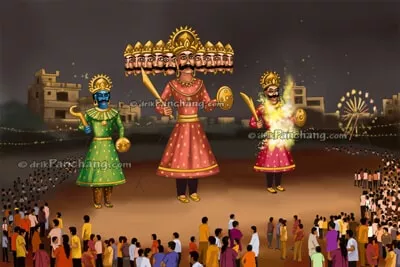
In North India, the dominant story is from the Ramayana: Lord Rama’s defeat of the ten-headed demon king Ravana, who had abducted Rama’s wife Sita. The burning of Ravana’s effigy commemorates this victory of righteousness over evil. The “duss” in Dussehra refers to Ravana’s ten heads — each representing a different vice — and their simultaneous destruction.
In South India, particularly in Mysore, the dominant story is different. Here, the goddess Chamundeshwari defeated the buffalo-demon Mahishasura on this day — and the Mysore Dasara procession celebrates her victory with an extraordinary royal ceremony that has been held continuously since 1610.
Both celebrations draw on the same fundamental theme — the victory of good over evil — expressed in two completely different forms. The North Indian version is fire, chaos, and popular spectacle. The South Indian version is order, grandeur, and royal pageantry. Both are extraordinary in their own way.
Dussehra 2026: The Key Dates
Navratri 2026: October 11 to 19 — Nine nights of the goddess. Delhi hosts nightly Ramlila performances. Gujarat celebrates Garba dancing. Kolkata concludes its extraordinary Durga Puja pandal season.
Dussehra 2026: Tuesday, October 20 — The tenth day. Ravana effigies burned across North India. The main Dussehra celebration at Ramlila Maidan in Delhi. Mysore’s famous Jamboo Savari elephant procession on October 21.
Diwali 2026: November 8 — Eighteen days after Dussehra, the Festival of Lights arrives. Planning a trip that covers both is entirely possible with the right itinerary.
The Best Places to Celebrate Dussehra 2026
1. Delhi — The Most Dramatic Ravana Burning in India
For sheer drama and scale, nothing on the Dussehra calendar matches Delhi’s Ramlila Maidan celebration.
The Ramlila Maidan — a vast open ground near Connaught Place in the heart of Delhi — has been the stage for Delhi’s Dussehra for decades. In the evenings of Navratri, the Ramlila — the dramatic open-air re-enactment of the Ramayana — takes place here nightly before enormous crowds. Professional performers in elaborate costumes and makeup retell the story of Ram’s exile, Sita’s abduction, the war with Lanka, and the final victory over Ravana.
The climax comes on the evening of October 20. Three enormous effigies rise above the Ramlila Maidan grounds — Ravana himself (with ten heads), his son Meghnath, and his brother Kumbhkaran. At Dussehra events in Delhi, these effigies have historically reached 70 to 80 feet in height. Each one is packed tightly with fireworks.
As darkness falls, the Prime Minister or a designated dignitary fires the ceremonial arrow at the first effigy. The fireworks ignite from the feet upward. The explosions travel through the entire structure in seconds and the night sky erupts simultaneously in light and sound. All three effigies burn within minutes of each other.
The crowd at Ramlila Maidan on Dussehra night can exceed 100,000 people. Surrounding streets and rooftops fill with additional thousands who have come for the spectacle.
For Golden Triangle travellers: Delhi is the starting point of the classic circuit. Arriving on October 16 or 17 gives you Delhi sightseeing days plus the Ramlila performances in the evenings before Dussehra on October 20. A natural sequence for Golden Triangle travellers who want Dussehra in Delhi.
Getting there: Ramlila Maidan is two kilometres from Connaught Place and accessible by Metro (Shivaji Stadium station on the Violet Line). Arrive by 5 PM on October 20 to find a good position before the crowds build. The effigy burning typically begins after dark — approximately 7 to 8 PM.
Practical note: October 20 is a national public holiday. Delhi traffic is severely disrupted from midday onwards. Walk or use the Metro rather than relying on road transport to reach the venue.
2. Mysore — India’s Most Magnificent Dussehra Celebration
If Delhi’s Dussehra is fire and popular spectacle, Mysore’s Dasara is royal grandeur and cultural depth — and it is genuinely like nothing else in India.
The Mysore Dasara festival has been held continuously since 1610, when Raja Wadiyar I began the celebration under the Chamundeshwari goddess tradition. Over 400 years later, the basic ceremony is the same: a royal procession from the Mysore Palace to Bannimantapa, led by a decorated elephant carrying a golden howdah with an image of the goddess Chamundeshwari — exactly the image that has been paraded through these streets every October for four centuries.
The Mysore Dasara 2026 calendar runs as follows. The festival opens on Sunday, October 11 with a puja to the goddess at Chamundi Hill. For ten days, daily cultural events take place across the city — classical music and dance performances, food festivals, sports competitions, and exhibitions. Every night throughout the festival, the Mysore Palace is illuminated with more than 100,000 light bulbs — one of the most extraordinary illuminated buildings in India. From sunset to 10 PM, the palace glows from a distance as a single white and golden structure against the night sky.
The grand finale — Vijayadashami on October 21 — is the day that draws over a million visitors to Mysore. The Jamboo Savari (elephant procession) begins from the Mysore Palace in the afternoon. The idol of Goddess Chamundeshwari is placed on the 750-kilogram golden howdah on the back of the lead elephant — Arjuna, the most senior of Mysore’s ceremonial elephants. Behind him come a procession of more decorated elephants, cavalry on horseback, traditional musicians, cultural tableaux from every district of Karnataka, police bands, and folk performers representing the full diversity of the state’s traditions.
The five-kilometre procession from the Mysore Palace to Bannimantapa takes several hours. The lead elephant, the golden howdah, and the ceremonial musicians at the front are the most-photographed element. When the procession passes, the crowd — lining every centimetre of the five-kilometre route — produces an extraordinary sound. Then, as darkness falls, the Torchlight Parade begins — mounted troops with torches creating a final ceremonial close to the festival.
The Mysore Palace illumination during the entire festival period is worth an extended stay in itself. Every evening from sunset until 10 PM, the entire building is lit — the white neoclassical Indo-Saracenic architecture designed by Henry Irwin becomes a single glowing form, reflected in the surrounding grounds. Walking around the palace exterior in the evening during Dasara is one of the finest heritage experiences available anywhere in South India.
Getting there from Bengaluru: Mysore is 150 km from Bengaluru by road — approximately 3 hours. The Shatabdi Express train from Bengaluru City Station covers the distance in under 2 hours. During Dasara week, trains and hotels in Mysore fill completely — book three to four months in advance.
Accommodation: Book by July for any visit during October 11 to 21. Mysore’s most popular properties — including the Radisson Blu (adjacent to the palace), heritage properties in the Nazarbad area, and guesthouses near the Chamarajapuram neighbourhood — sell out by August every year.
3. Kullu Dussehra — India’s Most Unique Festival Version
While Delhi burns Ravana and Mysore parades elephants, the Kullu Valley in Himachal Pradesh celebrates Dussehra in a way that exists nowhere else in India.
Kullu Dussehra begins where every other city’s Dussehra ends — on the evening of October 20, when most of India’s celebrations are winding down, Kullu’s festival is just opening. The Kullu Dussehra runs for seven days after the main Dussehra date, continuing until approximately October 26 or 27.
The festival is entirely different in character from the North Indian Ravana-burning tradition. In Kullu, the central ceremony involves 284 local village deities — carried on ornately decorated palanquins by their respective temple communities — converging on the Dhalpur Maidan in Kullu town for a ceremonial meeting. The procession of deities arriving from their respective valleys, each accompanied by their temple musicians, priests, and devotees, is one of the most extraordinary processional events in India.
The arrival is followed by seven days of folk music, dance, crafts, and cultural exchange. The Himachali folk traditions — Nati dance, traditional instruments, the extraordinary embroidered costumes of the hill communities — are all on full display in ways that the modernised urban festivals of Delhi and Mumbai no longer preserve.
The setting alone justifies the trip. The Kullu Valley in October is one of the finest landscapes in the Himalayas — the apple orchards turning golden, the Beas River running clear, and the peaks of the Pir Panjal visible above the valley. Dussehra in Kullu is India’s most atmospheric festival in its most beautiful October setting.
Getting there: Fly Delhi to Bhuntar (Kullu’s airport — 10 km from town) with Air India or IndiGo. Or drive from Delhi — approximately 500 km via NH44, taking 10 to 11 hours. Manali is 40 km further north and offers better hotel options than Kullu town itself.
4. Varanasi — The Most Spiritual Dussehra in India
Varanasi’s Dussehra is for travellers who want depth over spectacle.
The Ramlila performances in Varanasi during Navratri week are among the oldest and most traditional in North India. Performed on the ghats and in temple precincts across the old city, the Varanasi Ramlila follows the full Ramayana narrative over the nine nights in a style that has been preserved for centuries. The music, the costumes, and the theatrical conventions are different from Delhi’s modernised productions — more ritualistic, more rooted in devotional practice.
On Dussehra evening (October 20), the effigies are burned on open grounds near the river. The burning at Ramleela ground near Lanka and at Nati Imli are the most traditional. More intimate than Delhi’s Ramlila Maidan spectacle — but experienced in a city where the weight of the past is entirely credible.
Varanasi in October also provides an extraordinary preview of what is coming. In eighteen days, Diwali will transform the ghats. And in thirty-four days, on November 24, Dev Deepawali will illuminate every one of the 84 ghats with hundreds of thousands of earthen lamps in what many experienced travellers describe as the most beautiful single night in India.
Visiting Varanasi for Dussehra and then returning for Dev Deepawali a month later is a genuinely compelling itinerary for those with time.
5. Ahmedabad and Gujarat — The Navratri to Dussehra Transition
Gujarat’s contribution to the Dussehra week is unique because it begins ten days earlier — with the extraordinary Garba dancing of Navratri.
Ahmedabad’s GMDC Ground hosts what has been recognised as the world’s largest Garba celebration during Navratri — tens of thousands of dancers in traditional embroidered chaniya choli moving in concentric circles to the rhythm of dhol drums, every evening from October 11 to 19. This is one of the most visually extraordinary cultural events available anywhere in India.
Dussehra on October 20 then arrives as the natural conclusion — the tenth day — with Ravana effigies burned in the evening across Ahmedabad and other Gujarat cities. The contrast between the feminine, devotional energy of Navratri Garba and the masculine, climactic energy of Dussehra Ravana Dahan — experienced in sequence — gives the full festival arc a depth that visiting on Dussehra day alone cannot provide.
For travellers with flexibility, arriving in Ahmedabad on October 15 or 16 — catching the final four or five nights of Garba — and then staying through Dussehra on October 20 is the finest Gujarat festival itinerary available.
Getting there: Fly Delhi to Ahmedabad (1.5 hours), Mumbai to Ahmedabad (1 hour), or Jaipur to Ahmedabad (1 hour). Ahmedabad is also reachable by the Shatabdi Express train from Mumbai.
Dussehra on the Golden Triangle: How to Include It
The Golden Triangle — Delhi, Agra, and Jaipur — fits naturally around Dussehra on October 20.
The most popular Dussehra Golden Triangle sequence positions you in Delhi on October 20 for the Ramlila Maidan celebration, then moves to Agra and Jaipur in the days immediately following. Here is a complete 8-day sequence.
Arrive Delhi on October 16. Two nights of Delhi sightseeing — Red Fort, Humayun’s Tomb, Qutub Minar. Evening Ramlila performances at Ramlila Maidan on October 17 and 18. Dussehra October 20 at Ramlila Maidan — the main event. Drive to Agra on October 21. Taj Mahal at sunrise on October 22 — post-Dussehra, the monument is significantly quieter than it was during the October 18 to 20 peak holiday period. Drive to Jaipur on October 23 via Fatehpur Sikri. Two days in Jaipur — Amber Fort, City Palace, bazaars. Return to Delhi on October 25 for international departure.
This sequence gives you Dussehra in Delhi at its finest, the Taj Mahal in outstanding October conditions, and Jaipur’s bazaars with Diwali preparations beginning — the marigold garlands and diya sellers that appear from the day after Dussehra as Jaipur prepares for November 8.
For those who want Dussehra in Jaipur rather than Delhi — Jaipur’s Dussehra is smaller than Delhi’s but held at the Sawai Mansingh Stadium in an atmospheric open-air setting. The Ravana effigy burning in Jaipur is a genuine local celebration rather than a national spectacle.
Plan your Golden Triangle:
What Happens During Navratri — The Nine Days Before Dussehra
Understanding Navratri (October 11 to 19) is essential for planning a Dussehra trip, because the nine days before the festival are as rich as the finale itself.
Across Delhi, Jaipur, and North India, Ramlila performances run every evening of Navratri at outdoor stages in parks and grounds. These dramatic re-enactments of the Ramayana draw enormous local crowds and are free to attend. The production values vary enormously from neighbourhood-level shows (deeply local and authentic) to the massive professional productions at Delhi’s Sri Lal Quila Ramlila (organised by the Delhi government) that draw hundreds of thousands of spectators over nine nights.
In Gujarat, Navratri means Garba — the circular folk dance performed in honour of the goddess. Ahmedabad’s celebrations are the largest in India. In Kolkata, the same nine days are Durga Puja — when 30,000+ artistic pandals display artistic representations of the goddess across the city.
If you are visiting India for Dussehra, arriving during Navratri rather than on Dussehra day itself gives you the full context of the celebration — understanding the nine days makes the tenth day’s climax genuinely meaningful rather than just visually spectacular.
Practical Tips for Dussehra Travel
Book early. Dussehra week — particularly October 20 to 22 — is one of the most competed-for travel periods in India. Hotels in Delhi, Mysore, and Kullu fill weeks in advance. If you are planning a Dussehra 2026 trip, book accommodation by September at the latest.
October 20 is a national public holiday. Shops, offices, and government buildings are closed. Traffic in all major cities is severely disrupted. The Monument entry fees apply normally — the Taj Mahal, Red Fort, and other ASI monuments are open on Dussehra. Plan any monument visits for the morning of October 20 and position yourself near the Dussehra venue by mid-afternoon.
Arrival times matter enormously. Delhi’s Ramlila Maidan fills from 5 PM onwards. To get a good viewing position for the October 20 effigy burning, arrive by 4:30 to 5 PM. For Mysore’s Jamboo Savari on October 21, position yourself along the procession route by 2 PM.
Photography opportunities. Dussehra provides some of the finest photography opportunities available in Indian travel — the lit effigies against a dark sky, the fire and smoke of the burning, the crowd reactions, and (in Mysore) the decorated elephants and golden howdah in the afternoon procession light. Carry a camera you are willing to have in a crowd. A wide-angle lens for the effigy moments, a medium telephoto for crowd and procession photography.
Safety. Both the Delhi and Mysore events have significant security and crowd management. Stay with your group, keep valuables secure in front pockets or money belts, and follow the directions of the police and security personnel who manage crowd flow at these events. The events are genuinely safe — but the crowds are genuinely large.
Combine with Navratri. Arrive three to four days before Dussehra — October 17 or 18 — to experience the Navratri Ramlila or Garba celebrations in full flow before the finale. The full nine-plus-one-day experience is far more rewarding than arriving on October 20 alone.
Dussehra 2026 and What Comes Next
Dussehra is not the end of India’s festival season — it is the opening of the most extraordinary consecutive cultural period in the calendar.
Exactly eighteen days after Dussehra, Diwali arrives on November 8. Then the Pushkar Camel Fair runs November 17 to 24. Then Dev Deepawali in Varanasi on November 24 — when every ghat on the Ganges is lit with hundreds of thousands of earthen lamps.
A trip built around Dussehra in Delhi on October 20, the Golden Triangle in the days following, and Diwali in Jaipur on November 8 — with Pushkar Camel Fair added between — is the finest consecutive India festival itinerary available in any year.
The full October and November picture:
Frequently Asked Questions
When is Dussehra in 2026?
Dussehra (Vijayadashami) 2026 falls on Tuesday, October 20. It is the tenth and final day of Navratri, which runs October 11 to 19.
When is Mysore Dasara 2026?
The Mysore Dasara festival runs October 11 to 21, 2026. The grand finale — the Jamboo Savari elephant procession and Torchlight Parade — takes place on Vijayadashami, October 21. The Mysore Palace illumination with 100,000+ light bulbs is visible every evening throughout the festival from October 11 onwards.
Which is the best city for Dussehra in India?
For the most dramatic Ravana burning: Delhi, where effigies reach 70 to 80 feet and the crowd at Ramlila Maidan can exceed 100,000. For the most magnificent procession: Mysore, where the royal Dasara tradition dates to 1610. For the most unique festival: Kullu, where 284 local deities converge for a seven-day post-Dussehra celebration.
Is Dussehra a public holiday?
Yes. Vijayadashami / Dussehra is a gazetted national public holiday in India. October 20 is a day off across most of India.
Can I visit the Taj Mahal on Dussehra?
Yes. The Taj Mahal is open on Dussehra — it is only closed on Fridays. October 20, 2026 is a Tuesday. However, it is a national public holiday and Agra will be busy. Consider visiting the Taj Mahal on October 21 or 22 — the post-Dussehra days when domestic holiday traffic reduces.
Is Dussehra in October or November 2026?
October. Dussehra 2026 is on October 20. Diwali — which follows Dussehra by eighteen days — is on November 8.
How does Dussehra relate to Navratri?
Dussehra is the tenth day of Navratri — its finale and culmination. Navratri (nine nights of the goddess) runs October 11 to 19. Dussehra falls on the tenth day, October 20, as the victory day that concludes the nine nights of worship.
Plan Your Dussehra 2026 Trip with Squid Travel India
At Squid Travel India, we build October itineraries around the festival calendar — Navratri performances, Dussehra effigy burning, and the days that follow toward Diwali on November 8.
Every October package includes private transport that accounts for public holiday traffic, Taj Mahal and monument tickets pre-booked in advance, heritage hotel accommodation secured months ahead, and expert guides who know exactly where to position you in Delhi on Dussehra evening for the best viewing experience.
Also worth reading as you plan:
- Golden Triangle Tour from Delhi
- India in October 2026 — Complete Guide
- Golden Triangle Tour with Diwali 2026
- Navratri 2026 — Dates & Best Places
- India in November 2026
- Make Your Own Tour
📞 Call / WhatsApp: +91 9990812499 📧 Email: Squidtravelindia@gmail.com 🌐 Visit: squidtravelindia.com
1,800+ trips completed | 98% happy clients | TripAdvisor Travelers’ Choice 2024–2025
Last updated: September 2026. Dussehra 2026 confirmed as October 20. Mysore Dasara Jamboo Savari confirmed as October 21. Always verify exact timings and venue arrangements with your local guide before travel.
Comment (0)