

October is one of the best months to visit Jaipur. The monsoon finishes, the skies open up, the desert air clears, and Rajasthan’s Pink City shakes off the heat and humidity that makes July and August difficult. Two of India’s most spectacular festivals — Dussehra (2 October) and Diwali (20 October) — both fall in October 2026, making this a month with extraordinary energy in a city that does festivals better than almost anywhere in India.
This is everything you need to plan a Jaipur trip in October 2026.
Jaipur Weather in October 2026
October marks the transition from monsoon to Rajasthan’s finest season. The month splits clearly into two halves — and the difference between them is significant.
Early October (1–15 October): Post-Monsoon Warmth
The monsoon officially retreats from Jaipur in late September. In early October, the city is still warming down from the monsoon — temperatures are warm to hot but the humidity is falling fast, the sky is clearing, and Rajasthan’s landscape is at its most vivid. The Aravalli Hills around Amber Fort are green, the reservoirs at Jal Mahal are full, and the old city’s pink sandstone shines after the rains.
Mornings are lovely — 22–25°C at 6 AM, rising comfortably to 28–32°C by mid-morning. Afternoons are the challenge: 32–36°C from noon to 4 PM. This is not brutal by Rajasthan standards (May and June hit 45°C) but it is hot enough that wandering around in full sun at 2 PM is not enjoyable. Evenings recover well — temperatures drop to 28–30°C by 6 PM, and nights are warm and pleasant at 22–24°C.
The classic approach works well: start early (6–7 AM at Amber Fort), take a proper break from 12–3 PM at your hotel, and resume late afternoon for monuments and markets. This rhythm suits October perfectly.
Rainfall in early October is 20–40mm — mostly brief afternoon showers that clear in an hour. Jaipur receives far less monsoon rain than Delhi or Agra since Rajasthan’s desert climate keeps October drier than you might expect. A light shower at 3 PM and clear skies by 4 PM is typical.
Late October (16–31 October): The Season Opens
By mid-October, Jaipur undergoes a noticeable shift. Mornings drop to 18–21°C — genuinely cool and fresh. Afternoons ease to 28–32°C, which is warm but manageable with shade and water. Evenings become beautiful, 23–26°C, perfect for the old city bazaars and rooftop dinners. Nights dip to 16–19°C for the first time since April.
This is when Rajasthan properly opens for the season. The air is dry, the light is clear, and Diwali on 20 October means the old city transforms into something extraordinary.
Late October in Jaipur is close to perfect. The crowds are lower than December and January (Jaipur’s peak months), the weather is near-ideal, and the city’s energy is high from the festival season. If you can choose any two-week window for a first Jaipur visit, mid-to-late October is hard to beat.
How October Compares to Other Months
October sits in a sweet spot. August and September are the monsoon months — manageable but not Jaipur’s finest. December and January are peak season with colder mornings (6–10°C at dawn in January) and the highest hotel prices and crowds. November is excellent — slightly cooler than October, fewer festivals, still good value. February is Jaipur’s other standout month — mild temperatures, the Jaipur Literature Festival (late January into February), and the tail end of peak season.
For festival experiences specifically, October 2026 is exceptional. Both Dussehra and Diwali falling in October is a function of the lunar calendar — it does not happen every year — making 2026 an unusually rich month.
Festivals in Jaipur in October 2026
October 2026 has four significant festivals in Jaipur. For travellers who want to experience India’s festival culture, this single month offers more than most people see in a full trip.
Dussehra — 2 October 2026
Dussehra marks the victory of Lord Rama over the demon king Ravana, celebrated on the tenth day of Navratri. In Jaipur, Dussehra is a large public spectacle built around the burning of massive Ravana effigies at dusk.
The effigies — sometimes 40–50 feet tall, stuffed with firecrackers — are built and burned at grounds across the city. The Ram Lila grounds in the old city and the fields near SMS Stadium host the main events. Throughout the day, processions move through the streets with idols of Rama, Sita, and Lakshmana. The old city — Johari Bazaar, Tripolia Bazaar — is lively from mid-afternoon onwards.
For travellers: be in the old city by 5 PM. The effigy burning happens at dusk, around 6:30–7:00 PM. Bring earplugs if you are sensitive to noise — the firecrackers are relentless and loud.
Navratri Conclusion — 1–2 October 2026
Navratri (nine nights of Goddess Durga worship) concludes on Dussehra. In the days leading up to 2 October, Jaipur’s temples host evening Garba and Dandiya Raas dances. The Govind Dev Ji temple and Birla Mandir are the main venues. Visiting a Garba night in Jaipur is a distinct experience: Rajasthani women in mirror-work ghaghra-cholis dancing in temple courtyards under floodlights, with drums and devotional music that builds through the night.
Diwali — 20 October 2026
Diwali is India’s festival of lights, and Jaipur does it with Rajasthani grandeur. The festival spans five days in 2026.
Dhanteras (18 October) is the gold and silver buying day. Johari Bazaar — Jaipur’s jewellery market, genuinely significant since the city produces 90% of the world’s hand-cut coloured gemstones — is extraordinary on Dhanteras evening: packed, lit with thousands of clay oil lamps (diyas), and doing record business. An evening walk through Johari Bazaar on Dhanteras is one of the great Jaipur experiences regardless of whether you buy anything.
Diwali night (20 October) is the main event. Every building in the old city is lit with diyas and fairy lights. The Hawa Mahal, City Palace, and Amber Fort are floodlit. Fireworks begin around 7 PM and continue well past midnight. The old city — Johari Bazaar, Tripolia Bazaar, MI Road — fills with families, street food sellers, and firecrackers. The combination of the pink sandstone architecture and the diyas is one of the most visually striking things you will see in India.
Govardhan Puja (21 October) is a quieter day of worship, followed by Bhai Dooj (22 October), a family festival celebrating the bond between siblings.
For accommodation: hotels in and near the old city fill up for 18–21 October. Book at least 6–8 weeks in advance for Diwali dates.
Karva Chauth — 28 October 2026
Karva Chauth is a Hindu married women’s festival where wives fast from sunrise to moonrise for their husbands’ longevity. In Rajasthan, it is observed with traditional dress (women wear bridal jewellery and red or orange clothing), songs, and the ritual of viewing the moon through a sieve at moonrise. Not a public spectacle in the way of Dussehra or Diwali, but visible at temple gatherings in the evening — a quieter, more personal window into Rajasthani life.
Top Things to Do in Jaipur in October
Amber Fort — Best Done at Dawn
Amber Fort is Jaipur’s centrepiece: a 16th–17th century Rajput citadel rising above Maota Lake, 11km north of the old city. In October, Amber Fort is at its most scenic — the surrounding Aravalli Hills are still green from the monsoon, the lake below reflects the fortifications, and the early morning light on the golden-pink sandstone is exceptional.
The fort opens at 8:00 AM. Arrive at opening — by 10:30 AM, tour groups arrive and the main courtyards fill. The key spaces are the Ganesh Pol gate (covered in fresco paintings), the Sheesh Mahal (Hall of Mirrors — thousands of mirror inlays that reflect a single candle into the appearance of a full chandelier), Jai Mandir (ivory and glass private apartments), and the Sukh Niwas (an early air-conditioning system that circulated cool water through the walls).
Allow 2.5–3 hours. Take the shared jeep up from Jaleb Chowk in the old city (₹20 per person) and walk back down — the descent on foot offers the best views of the fort and lake. Do not take the elephant ride; the welfare conditions for the elephants used at Amber are a documented concern.
Entry is ₹550 for foreign visitors, ₹100 for Indian nationals.
City Palace — Jaipur’s Living Royal Heritage
The City Palace is not a museum piece — the Maharaja of Jaipur still lives in part of it. The public sections include the Mubarak Mahal (a textile museum with extraordinary Mughal and Rajput fabrics), the Diwan-i-Khas (the private audience chamber, which houses two enormous silver urns that hold Ganges water), the Diwan-i-Am (public audience hall), and the Sileh Khana (one of the best armouries in Rajasthan).
Visit in the morning before the old city’s foot traffic builds. The Chandra Mahal — the seven-storey palace in the inner courtyard — is viewable from outside; the upper floors can be entered with a premium ticket.
Entry is ₹700 for foreign visitors (comprehensive ticket covering all public areas). Allow 2 hours.
Jantar Mantar — The Astronomical Observatory
Built by Maharaja Jai Singh II in the 1720s and 1730s, Jantar Mantar is one of five astronomical observatories he constructed across India. The Jaipur one is the largest and best-preserved, containing 19 stone-and-masonry instruments for measuring time, predicting eclipses, tracking stars, and calculating astronomical positions with extraordinary precision. The largest sundial in the world is here — it is accurate to 2 seconds.
Jantar Mantar is often overlooked in favour of the monuments around it, but it is one of the most intellectually engaging sites in India. Hire a guide here — without explanation, the instruments look like abstract sculptures. Entry is ₹200 for foreign visitors. Allow 1 to 1.5 hours. UNESCO World Heritage Site.
Hawa Mahal — The Palace of Winds
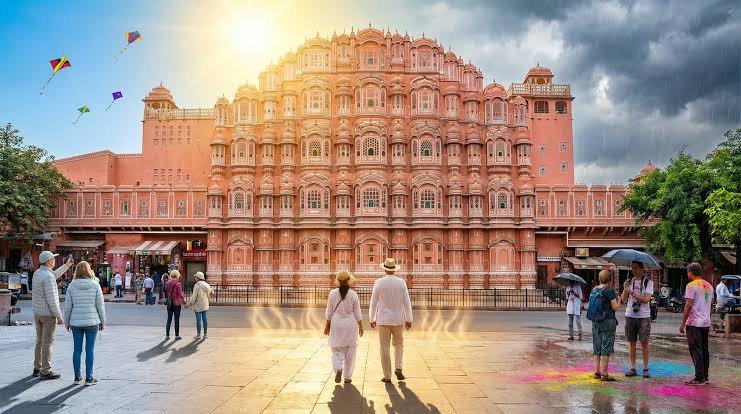
Jaipur’s most photographed structure: five stories of 953 small latticed windows (jharokhas) in pink sandstone, designed so that royal women could observe street life without being seen. The facade is extraordinary. The interior is modest — what you come for is the photograph.
The best light on the Hawa Mahal is morning, when the sun hits the east-facing facade directly. Photograph from the tea stall rooftop across the road — ask the staff and they will usually let you up for the price of a chai. The interior entrance is via the rear gate, from the lane to the left when facing the facade.
Entry is ₹200 for foreign visitors. Best visited before 10 AM.
Nahargarh Fort — Jaipur’s Best View
Nahargarh Fort (1734) sits above the city in the Aravalli Hills and offers the finest panoramic view of Jaipur — particularly at sunset. The drive up through the forested hill road is pleasant in October, when the hills are still green.
During Diwali week, the sunset view from Nahargarh is something else: the entire city below begins lighting up its diyas as the sun goes down. Arrive at 4:30 PM, stay for sunset (around 6:10 PM in early October, 5:50 PM by late October), and drive back down after dark. Entry is ₹200 for foreign visitors.
Jal Mahal — The Water Palace
The Jal Mahal appears to float in the middle of Man Sagar Lake, 6km north of Jaipur on the road to Amber. The palace itself is closed to visitors (ongoing restoration), but the view from the road — at sunrise or sunset — is one of Jaipur’s iconic images.
October is the best month to see Jal Mahal. Man Sagar Lake is at its fullest after the monsoon — the palace rises from a full, blue lake. By February, the lake level drops and the base of the palace is exposed. Plan for either sunrise (6:15 AM) or sunset, both of which give the most photogenic light.
Jaipur’s Bazaars — Old City Shopping
The old city’s markets are best experienced on foot in the morning or evening. October evenings, particularly in Diwali week, are when the bazaars are most alive.
Johari Bazaar is Jaipur’s jewellery quarter — gems (the city produces emeralds, rubies, sapphires, and tourmaline from Rajasthan’s mines), kundan and meenakari work, and gold and silver. On Dhanteras evening (18 October), Johari Bazaar is extraordinary. It is a working market, not a tourist bazaar, and you can walk into workshops and watch the goldsmiths.
Bapu Bazaar is the textile market — block-printed cotton, Rajasthani tie-and-dye (bandhani), mojri shoes (pointed-toe leather footwear), and lac bangles. The block-printing is produced in villages around Jaipur; hand-printed cloth has slight irregularities that machine-printed versions do not.
Nehru Bazaar is the place for juttis (embroidered leather shoes) and Jaipur blue pottery — white and blue ceramics made from powdered quartz using a Persian technique, produced in small workshops on the city’s outskirts.
Tripolia Bazaar is older and less touristic — metalwork, brassware, and marble inlay at more honest prices.
Chand Baori — A Day Trip Worth Making
Ninety-five kilometres from Jaipur, near the village of Abhaneri, is the most spectacular stepwell in India. Chand Baori descends 13 storeys into the earth with 3,500 steps arranged in a perfect geometric pattern on three sides. It has appeared in several films, including The Dark Knight Rises, and photographs cannot fully prepare you for the scale.
In October, the stepwell has its best water levels after the monsoon — the lower chambers hold clear water that reflects the staircase geometry. The drive from Jaipur is 2 hours through Rajasthan’s rural landscape, passing mustard fields and village temples. Entry is ₹25 for all visitors. Combine it with the Harshat Mata Temple adjacent to the stepwell.
This is worth a full day if you have three or more days in Jaipur.
Where to Stay in Jaipur in October
Jaipur has the finest range of heritage hotel accommodation in India — palaces, havelis, and forts converted into hotels at every price point. October is shoulder season moving into high season, so rates are below the December–January peak but rising through the month. Diwali week (18–22 October) is the exception: book well in advance.
For a luxury stay, Rambagh Palace (Taj Hotels) is the former royal residence of the Maharaja of Jaipur — 47 acres of gardens, impeccable service, and the most famous address in the city. October rates run ₹25,000–45,000 per night. Samode Haveli, a 475-year-old nobleman’s mansion in the old city with painted interiors and a rooftop pool, is a more intimate option at ₹15,000–25,000 per night.
For mid-range travellers, Alsisar Haveli and Shahpura House are both old-city heritage havelis with rooftop restaurants, pools, and comfortable rooms at ₹4,500–9,000 per night. Hotel Diggi Palace, with its gardens and European traveller following, is a longtime favourite at similar rates.
Budget travellers are well served by Jaipur’s hostel scene. Moustache Jaipur and Zostel Jaipur are both reliable, with private rooms and dormitories, in or near the old city. Beds from ₹600; private rooms from ₹1,500.
Getting to Jaipur in October
By air: Jaipur International Airport (JAI) has direct flights from Delhi (45 minutes), Mumbai (1.5 hours), Bangalore (2 hours), and Kolkata (2.5 hours). IndiGo, Air India, and SpiceJet are the main carriers. Book early for Diwali week — fares spike significantly around 18–22 October.
By train from Delhi: The Shatabdi Express (12015) departs Delhi at 6:05 AM and arrives Jaipur at 10:35 AM — ideal for day travellers or those starting a Golden Triangle tour. Vande Bharat trains on the route complete the journey in around 3.5–4 hours. Book through IRCTC (irctc.co.in) — Tatkal quota is available for last-minute tickets.
By road from Delhi: 280km on NH48. Private car door-to-door is 4.5–5 hours depending on traffic. Rajasthan Roadways buses depart regularly from Delhi’s Sarai Kale Khan terminus (₹400–700, 5.5 hours). A private taxi runs ₹3,500–5,000.
By road from Agra: 240km, 4.5–5 hours via the Agra–Jaipur Highway. This is the standard third leg of the Golden Triangle — private car is the most practical option on this route.
Getting Around Jaipur in October
The old city monuments — Hawa Mahal, City Palace, Jantar Mantar — are close to each other and walkable in the morning or evening. Amber Fort requires a separate vehicle (11km from the city centre).
Auto-rickshaws are the default for short trips within the old city. Negotiate before getting in or insist on the meter — ₹50–150 covers most old-city distances. App cabs (Ola and Uber) are available and take the negotiation out of it.
For covering Amber Fort, Jal Mahal, Nahargarh, and the old city monuments in one day, hiring a private car for the full day is the most efficient option — ₹1,200–2,000 for an air-conditioned car, arranged through your hotel or directly with a driver.
A Sample 3-Day Jaipur October Itinerary
Day 1: Amber Fort and the Old City
Start at 6:45 AM with a taxi to Amber Fort, arriving as the gates open at 8:00 AM. Spend 2.5 hours inside — Sheesh Mahal, Ganesh Pol, and Jai Mandir are the highlights. Walk back down the hill on foot for the views, then stop at Panna Meena ka Kund (the geometric stepwell 5 minutes from Amber Fort) before returning to the city.
Take a midday break from 12:00–2:30 PM. In the afternoon, drive past Jal Mahal for photographs, visit the Hawa Mahal exterior and interior, and spend the evening walking through City Palace and Johari Bazaar. Dinner at a rooftop restaurant overlooking the old city.
Day 2: City Palace, Jantar Mantar, and Nahargarh
Begin at 8:00 AM at City Palace (before the crowds). Follow with Jantar Mantar (with a guide — book at the City Palace ticket counter). Late morning in Tripolia Bazaar and Bapu Bazaar for textiles and shoes. Midday break.
At 3:30 PM, walk Nehru Bazaar and the lanes near the Hawa Mahal. Drive to Nahargarh Fort at 4:30 PM and stay for sunset — one of the best views in Rajasthan. Return to the old city for dinner at a haveli restaurant.
Day 3: Chand Baori Day Trip
Depart at 7:30 AM for Abhaneri (Chand Baori). The drive is 2 hours through rural Rajasthan — a different India from the old city bazaars. Spend 2 hours at the stepwell in the morning light. Visit the adjacent Harshat Mata Temple. Return to Jaipur by 2:00 PM for a final afternoon of shopping or a spa at your hotel. Evening free for the old city one last time.
What to Pack for Jaipur in October
For early October (1–15), pack light cotton clothing throughout — long trousers and breathable shirts are ideal, covering ankles and shoulders for temples and bazaars. Bring a strong sunscreen (SPF 50 minimum), sunglasses, and a wide-brimmed hat. A light scarf or dupatta is useful for covering shoulders at religious sites and as sun protection on the back of an auto-rickshaw. A reusable water bottle is essential — drink more than you think you need.
For late October (16–31), add a light jacket or cardigan for evenings. Mornings at Amber Fort at 8:00 AM in late October can feel genuinely cool. Everything else stays the same.
Comfortable walking shoes with good grip are important for Amber Fort’s uneven stone surfaces. Sandals are fine for the bazaars and restaurants.
Modest dress is respected in Jaipur’s old city. Shorts and sleeveless tops are acceptable at hotel pools and tourist sites. At temples and in bazaars, covered knees and shoulders are the norm and are expected — this applies to all genders.
Is October a Good Time to Visit Jaipur?
Yes — one of the two best windows in the year, alongside February.
What makes October 2026 specifically exceptional is the festival calendar. Dussehra on 2 October and Diwali on 20 October both falling in October is a function of the lunar year — this alignment does not happen every year. The Jaipur old city on Diwali night — every building lit with diyas, the pink sandstone glowing, fireworks over the Hawa Mahal — is the kind of thing that stays with people for years.
Crowds are below the December–January peak, prices are lower than peak season, and the landscape is at its most vivid after the monsoon. The afternoons in early October require a midday break, but the mornings and evenings are outstanding.
For first-time visitors to Jaipur, October is an excellent choice. For travellers who have been before and want to see the city at its most alive, Diwali week in October 2026 is the pick.
Frequently Asked Questions
Is October a good time to visit Jaipur?
Yes — October is one of Jaipur’s two best months. Post-monsoon weather, clear skies, and in 2026, both Dussehra (2 October) and Diwali (20 October) in the same month.
What is the weather like in Jaipur in October?
Early October runs 22–36°C — warm mornings, hot afternoons, pleasant evenings. Late October is 18–32°C with cool mornings and evenings and comfortable afternoons. The month improves week by week as the season opens.
Is Jaipur crowded in October?
Below the December–January peak. Amber Fort and City Palace are manageable with early morning visits. Diwali week (18–22 October) is the busiest period — hotel rooms in the old city fill up quickly.
What festivals happen in Jaipur in October 2026?
Dussehra on 2 October (Ravana effigy burning, street processions), Dhanteras on 18 October (Johari Bazaar shopping and diyas), Diwali on 20 October (city-wide illuminations and fireworks), and Karva Chauth on 28 October.
How many days do I need for Jaipur?
Two full days for the core monuments — Amber Fort, City Palace, Jantar Mantar, Hawa Mahal, Nahargarh. Three days adds the Chand Baori day trip and deeper time in the bazaars. Four days is comfortable for a relaxed festival-season visit.
Is Jaipur safe for tourists in October?
Yes. Jaipur is one of India’s most tourist-friendly cities. Standard precautions apply — watch your belongings in crowded bazaars, avoid unofficial guides who approach unsolicited. During Diwali, the old city is very crowded and loud from fireworks — keep your group together.
Can I visit Jaipur as part of a Golden Triangle tour in October?
Absolutely — October is ideal for the full Golden Triangle. Agra weather in October is also post-monsoon excellent. A 7–10 day Delhi, Agra, and Jaipur tour in October 2026 gives you Dussehra and/or Diwali in one of those cities. See our Golden Triangle Itinerary 10 Days for a full day-by-day route.
Plan Your Jaipur October 2026 Trip with Squid Travel India
We run private Golden Triangle tours throughout October — including tours timed specifically around Dussehra and Diwali in Jaipur. If you want to be in Jaipur for Diwali, get in touch early: hotels in the old city book out for Diwali week well in advance.
Every tour is private — your own vehicle, your own guide, your own schedule. No shared coaches, no fixed departure times.
Also worth reading:
- Agra in October 2026
- Varanasi Weather October 2026
- Golden Triangle Itinerary 10 Days
- Top 5 Festivals in India in November 2026
- Diwali 2026 in Jaipur
- Golden Triangle Tour Cost 2026
📞 Call / WhatsApp: +91 9990812499 📧 Email: Squidtravelindia@gmail.com 🌐 Visit: squidtravelindia.com
1,800+ trips completed | 98% happy clients | TripAdvisor Travelers’ Choice 2024–2025
Last updated: September 2026.

Comment (0)