Australia's summer school holidays land in peak India season. Here is everything you need to plan a Golden Triangle tour from Sydney, Melbourne, Brisbane or Perth — flights, visa, itinerary and when to visit the Taj.
India and Australia have more in common than you might expect. English is widely spoken throughout the Golden Triangle circuit, making navigation far easier than it looks on paper. Australia and India are both cricket nations, which opens conversations in ways that surprise first-time Australian visitors. And — most importantly for the planning calendar — Australia's summer school holidays fall almost exactly in the middle of India's best travel season.
The Golden Triangle covers Delhi, Agra and Jaipur: three of the most historically significant cities in India, connected by good roads and a reasonable train network, all visited within a single circuit that returns to Delhi for the flight home. For Australian travellers weighing up India against Southeast Asia, the Golden Triangle is usually the answer — the monuments are genuinely world-class, the food is extraordinary, and the density of things worth seeing within a compact area makes it one of the most efficient trips in Asia.
The distance from Australia is real — this is not a weekend getaway — but the Australian travel market is experienced with long-haul trips, and India's value proposition (the exchange rate is very favourable for Australian dollars, accommodation is excellent for the price, and private guided tours are affordable) makes the journey worth making properly.
India's North has a distinct climate with four seasons. The Golden Triangle sits in the northern plains, where October through March is cool and clear — genuinely pleasant days, cold nights in December and January, and the best visibility for monument photography. April heats up fast. May and June are the hottest months (40°C+). July through September is monsoon season — hot, humid, with heavy rain. The good news for Australian families is that the two main holiday windows land in the ideal part of India's calendar.
Indira Gandhi International Airport (DEL) in Delhi is the natural entry point for the Golden Triangle. All major Australian cities connect to Delhi, though the routing and flight time varies considerably depending on where you're flying from. Perth has a geographical advantage most Australians overlook — it is significantly closer to India than Sydney or Melbourne, and the Perth–Delhi routing is some of the best-value long-haul flying out of Australia.
Book flights to Delhi at least 3–4 months in advance for the Christmas/New Year window — this is one of the busiest periods on the Australia–India route and prices rise sharply after September. The October school holidays are easier to book last-minute. Flying into Delhi and out of Delhi keeps the itinerary simple; some travellers fly into Delhi and out of Jaipur (JAI), which removes the need to backtrack.
Australian passport holders require a visa to enter India. The good news is the process is entirely online and straightforward. The India e-Visa (eTV — Electronic Travel Authorisation) is applied for through the Indian government's official portal at indianvisaonline.gov.in. The tourist e-Visa costs approximately AUD 25 and is valid for 90 days from the date of arrival, with double entry permitted. Processing typically takes 3–5 business days, though applying at least 2 weeks before travel is recommended during peak periods.
Australian citizens of Indian origin who hold an OCI (Overseas Citizen of India) card do not require a visa. The OCI card functions as a lifelong multi-entry visa and OCI holders travel with the same freedom as Indian nationals at most heritage sites — including reduced entry fees at the Taj Mahal and other Archaeological Survey of India monuments. If you have Indian heritage and do not yet have an OCI card, it is well worth applying before your trip.
The Golden Triangle is the name given to the tourist circuit connecting Delhi, Agra and Jaipur — three cities that together give a comprehensive picture of Mughal and Rajput India, two of the most architecturally and historically significant civilisations in Asian history. The distances are real but manageable: Delhi to Agra is 230km (3–4 hours by car, or 1 hour 40 minutes on the Gatimaan Express), and Agra to Jaipur is 240km (4–5 hours by car). Most tours run clockwise — Delhi, Agra, Jaipur — with an optional return to Delhi for the flight home.
India's capital operates on a scale that takes a day to adjust to. Old Delhi — the walled city built by the Mughal emperor Shah Jahan in the 17th century — contains the Red Fort, Jama Masjid (India's largest mosque), and the chaotic commerce of Chandni Chowk market. New Delhi, designed by Edwin Lutyens and Herbert Baker in the 1920s, offers a completely different character: wide tree-lined boulevards, Rashtrapati Bhavan (the Presidential Palace), India Gate, and the extraordinary Humayun's Tomb, which predates the Taj Mahal and prefigures it architecturally.
Allow at least two nights in Delhi. Three nights is better — the city rewards the time, and arriving on the first night and recovering from the flight before sightseeing begins makes the whole trip run smoother.
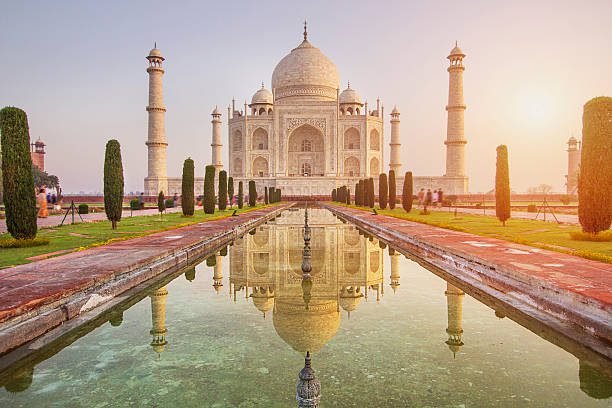
Agra exists primarily because of one building, and that building — the Taj Mahal — is precisely as good as its reputation. Commissioned by the Mughal emperor Shah Jahan in 1632 as a mausoleum for his wife Mumtaz Mahal, it took 22 years and 20,000 workers to complete. The marble was quarried in Makrana, Rajasthan and transported 400km by elephant. The scale and the precision are both staggering, and no photograph — including the best photographs ever taken of it — fully prepares you for the experience of standing in front of it.
Beyond the Taj, Agra Fort is a genuinely impressive Mughal fortification where Shah Jahan spent his final years as a prisoner of his own son, with a view of the Taj Mahal across the river. Fatehpur Sikri, 40km west of Agra, is a 16th-century Mughal city built and then mysteriously abandoned — one of the most atmospheric sites on the entire circuit.
Jaipur — the Pink City — is the capital of Rajasthan and the most visually distinctive of the three cities. The old walled city was painted terracotta-pink in 1876 to welcome the Prince of Wales, and the colour has been maintained by law ever since. The result is one of the most photogenic cities in India. Amber Fort (also called Amer Fort), perched on a ridge above the city, is a 16th-century Rajput palace of extraordinary complexity — multiple courtyards, the Sheesh Mahal (mirror mosaic hall), and views across the valley that make it worth arriving early and staying late. The City Palace, still partially occupied by the royal family, and Jantar Mantar, an 18th-century astronomical observatory, are both within the walled city.
Jaipur is also the place to engage with Rajasthani craft — block-print textiles, blue pottery, and the famous Johari Bazaar gemstone market. Allow at least two nights; three is better if you want time to explore the bazaars and outlying forts at a reasonable pace.
Twelve days is the minimum Australians should allow for a Golden Triangle trip — the flight time alone justifies staying long enough to do it properly. This itinerary allows for a recovery day on arrival, comfortable pacing at each city, and a free day in Jaipur before the return flight. It can be extended to 14 days by adding a night in Agra and a day at Fatehpur Sikri.
The Taj Mahal is closed every Friday for Friday prayers at the mosque within the complex. This is a permanent closure — it applies every week of the year without exception.
Any professional tour operator will route your Agra visit away from Friday automatically. If you are self-planning, check the day of the week your Agra date falls on before booking anything else. The fix is always simple — shift Agra by one day — but it must happen at the planning stage, not at the gate.
Christmas Day 2026 falls on a Friday. If you are travelling over the Australian summer holidays and planning to visit Agra around Christmas, your Taj Mahal day cannot be December 25. Plan for December 26, 27, or 28 instead. Tell us your dates when you enquire and we will confirm the schedule is correct before anything is confirmed.
Australians travel further for India than almost any other nationality, which is an argument for staying longer and seeing more. The Golden Triangle is the core of a North India trip, but India's breadth is extraordinary and several extensions connect naturally onto the Jaipur–Delhi axis without adding significant extra transit.
Ranthambore National Park sits directly between Agra and Jaipur — it is literally on the route, adding zero additional transit. It has the highest tiger-sighting probability of any reserve in India. Luxury lodges inside or adjacent to the reserve (Oberoi Vanyavilas is the benchmark) offer a genuinely exceptional safari experience. A family travelling for two weeks from Australia with children who may never have another opportunity to see Bengal tigers in the wild should seriously consider two nights at Ranthambore as a non-negotiable addition.
Varanasi is the oldest continuously inhabited city on earth — it has been occupied for over 3,000 years. The Ganges ghats at dawn from a private boat, the temples, the cremation ceremonies, the extraordinary density of spiritual life — there is nowhere else like it. A short domestic flight from Delhi connects to Varanasi (BNY) in under 1.5 hours. Two nights is enough to experience the city; three nights allows for a day trip to Sarnath, where the Buddha gave his first sermon.
The Lake Palace hotel — an 18th-century marble palace floating on Lake Pichola, reached by boat — is one of the most photographed hotels in Asia. Udaipur is 5 hours south of Jaipur by car, or a short domestic flight from Jaipur airport (JAI). The white marble city, the rooftop restaurants, and the boat dinners on the lake are a natural continuation of the Rajasthan part of the trip.
Instead of returning to Delhi, some Australian travellers end their Golden Triangle trip with 3–4 nights in Goa or Kerala before flying home. Goa offers beaches and Portuguese colonial architecture — a genuinely relaxing finish to an intense cultural trip. Kerala's backwaters (a private houseboat on the inland waterways near Alleppey) offer something completely different — silence, ricefields, village life at water level. Both Goa (GOI) and Kochi (COK) in Kerala have direct or one-stop connections to Australian cities.
If you want to do this trip at the top end — Oberoi Amarvilas in Agra (the best Taj view hotel in the world), Rambagh Palace in Jaipur, private licensed guides and luxury vehicles — read our detailed Luxury Golden Triangle Tour India guide. It covers every hotel, experience, and itinerary detail for a premium trip from an international market.
Tell us your travel dates, group size and what matters most to you — we'll come back with a full itinerary and hotel proposal within 24 hours. No obligation, no boilerplate packages.