

The question most parents ask before booking an India wildlife safari isn’t “which park has the most tigers?” It’s a different question entirely: “Will my children actually enjoy this?”
The honest answer is that it depends — on your children’s ages, on which park you choose, on how you structure the days, and on what you explain to them before the jeep sets off at 6 AM. An eight-year-old who has been briefed on alarm calls and who understands that silence is the price of a tiger sighting is a completely different safari companion from an eight-year-old who hasn’t.
This guide is written specifically for parents. Not wildlife enthusiasts who happen to have children, but parents who are genuinely trying to decide whether an India wildlife safari is right for their family — and if so, which park, which season, which age to wait until, and what to do to make it work.
The short answer: India offers some of the finest family wildlife experiences on earth. Ranthambore, Jim Corbett, and Kaziranga specifically are designed for it. With the right preparation and the right expectations, a family tiger safari in India is the kind of experience children carry with them for the rest of their lives.
Is an India Wildlife Safari Right for Your Family?
The Case For It
An India wildlife safari is unlike any other family travel experience. The moment a Bengal tiger walks out of the forest twenty metres from your jeep — huge, real, entirely indifferent to your presence — produces a reaction in children that no zoo, no wildlife documentary, and no theme park can replicate. It is genuinely wild, genuinely close, and genuinely transformative.
Beyond tigers, the Indian forest is a continuous sensory experience: alarm calls from deer, langur monkeys in the trees, marsh crocodiles at the lake edge, peacocks crossing the track, the smell of the forest at dawn, the specific quality of silence that settles over a jeep when the naturalist raises a hand. For children who have grown up watching nature on screens, the physical reality of wild India is a revelation.
India’s best family safari parks combine reliable wildlife sightings with good infrastructure — comfortable lodges, family rooms, swimming pools for the heat of the afternoon, and naturalists experienced with young visitors. This is not roughing it in the African bush. It’s a managed wildlife experience with serious hospitality around it.
The Case for Waiting
Not every child and not every age is ready for a wildlife safari. The honest checklist:
Can your child sit quietly for 45–90 minutes? The single most important safari skill. A tiger sighting that would last twenty minutes ends in two if a child shouts or stands up suddenly. If your child cannot maintain quiet and stillness in any situation that requires it, a tiger safari will be frustrating for everyone — including your child.
Are they interested in animals and nature? Children who are genuinely excited about wildlife — who watch nature documentaries, who ask questions about animals, who want to see things in the wild — will be engaged throughout. Children who are primarily excited about the hotel pool may find the 6 AM wake-up and 3.5-hour jeep drive a long morning.
Are they old enough for the logistics? Pre-dawn departures, dusty forest tracks, no food stops during the safari, potentially bumpy jeep rides — all of this requires a certain physical and emotional readiness that younger children simply haven’t developed yet.
Age Guide — Realistic Expectations
Under 5: Most experienced family travel advisors recommend waiting. Children under 5 have a maximum sustained attention span of 30–45 minutes and cannot be expected to maintain the silence that productive safaris require. Some parks technically permit younger children in private vehicles; the experience for both child and parents is typically difficult. Better to save the safari for when it can be genuinely enjoyed.
Ages 5–7: The entry point, with caveats. Short safaris (buffer zones, morning sessions of under 2 hours) with a private vehicle where stops and pace can be managed work well. These ages respond to animal encounters with genuine excitement and wonder. The key is keeping expectations focused on the experience rather than specific sightings — seeing deer, birds, crocodiles, and the forest itself is enough for this age group. A tiger is a bonus, not the baseline.
Ages 8–12: The sweet spot. Children in this range can maintain safari discipline, engage meaningfully with the naturalist’s explanations, read alarm calls, understand the tracking process, and process the experience intellectually as well as emotionally. Seeing a tiger in this age group becomes a story they tell for years. Ranthambore and Jim Corbett are fully appropriate for this age range.
Teenagers: Often the most rewarding safari companions. Teenagers old enough to genuinely appreciate what they’re seeing — the conservation story, the ecology, the skill of the tracking — get enormous depth from the experience. Photography-focused teenagers specifically thrive.
The Best Parks for Family Wildlife Safaris in India
1. Ranthambore National Park — Best for Families Doing the Golden Triangle
Ranthambore is India’s most popular tiger reserve and, for families visiting the Golden Triangle, the most logical wildlife addition. Located 160 km from Jaipur and 390 km from Delhi, it slots naturally into the classic Golden Triangle tour as a 2-night extension.
Why it works for families:
Ranthambore’s tigers are famously diurnal — active during daylight hours and highly visible. This means sightings happen in the morning, when children are fresh and alert, rather than requiring long hours of quiet waiting in intense heat. The park’s landscape — open forest around three lakes, with the dramatic backdrop of Ranthambore Fort rising from the jungle — creates a cinematic setting that children respond to immediately. The fort ruins visible from safari tracks make the park feel like an adventure story, not just an animal-watching exercise.
The lake areas (particularly Padam Talao and Raj Bagh) produce very reliable large animal sightings: sambar deer in the shallows, marsh crocodiles on the banks, kingfishers and painted storks overhead. Even if a tiger sighting takes time, children are engaged by the lake ecosystem throughout.
Age suitability: 6+ (younger with careful management in a private jeep) Best zones for families: Zone 3 (Jogi Mahal area) and Zone 1 (Padam Talao) — both have reliable large animal activity and the fort backdrop Safari duration: 3.5 hours per session — appropriate for children 7+ Combine with: The Golden Triangle + Ranthambore circuit is our most-booked family itinerary for October–March.
Read our complete Ranthambore in October guide for everything about the park’s October opening and how to book.
2. Jim Corbett National Park — Best for Elephant Encounters and Himalayan Scenery
Jim Corbett in Uttarakhand, 250 km from Delhi, is India’s oldest national park and one of its most beautiful. The Ramganga River runs through its core, creating riverine grasslands — called chaurs — that host elephants, tigers, and a spectacular diversity of birds. The Himalayan foothills visible beyond the park’s northern boundary add a backdrop that Ranthambore’s plains cannot match.
Why it works for families:
Corbett’s elephants are a major family draw. Unlike tiger sightings, which require patience and luck, elephant encounters at Corbett are frequent and extended — large herds move through the chaurs in the morning, often within close viewing distance of safari vehicles. Children who are elephant-mad find Corbett extraordinary. The park also has the highest bird species count of any Indian national park (650+), making it excellent for birdwatching families.
The Bijrani zone — recommended for family visitors — has good infrastructure, reliable wildlife sightings, and drives that don’t require the very long distances that the Dhikala zone demands. The surrounding resort area has good family accommodation options at multiple price points.
Age suitability: 5+ for Bijrani zone; Dhikala (accessed by canter safari for day visitors) is a longer, more demanding experience suitable for 10+ Best zones for families: Bijrani, Jhirna (year-round), Dhela Safari duration: 3–3.5 hours per session Distance from Delhi: 250 km — doable as a 3-night extension from Delhi without domestic flights
3. Kaziranga National Park — Best for Rhinos and Truly Different Safari
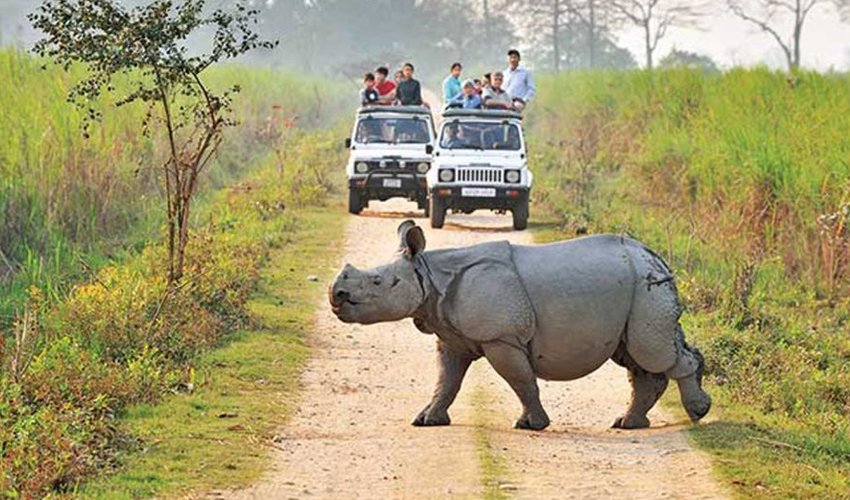
Kaziranga in Assam — a UNESCO World Heritage Site — offers the most distinctive family safari experience in India. Its landscape is unlike any other Indian park: vast Brahmaputra floodplain grasslands, with one-horned rhinoceroses grazing in herds like prehistoric cattle, Asian elephants moving through the tall grass, and wild water buffalo standing in the wetland margins.
Why it works for families:
Children respond to rhinoceroses with extraordinary enthusiasm. A one-horned rhino at close range — massive, armour-plated, utterly prehistoric in appearance — produces the same stunned silence that a tiger does, and Kaziranga offers rhino sightings on essentially every safari. There are approximately 2,600 rhinos in this single park; seeing multiple rhinos per safari is the norm, not the exception.
Kaziranga also offers elephant-back safaris in the early morning — a completely different experience from jeep safaris, approaching rhinos from the height and silence of an elephant’s back. For children who have never been on an elephant, this is unforgettable.
The cultural dimension adds to Kaziranga’s family appeal: Assam’s Bihu dance performances, the local cuisine (very different from North Indian food), and the experience of being genuinely off the tourist trail.
Age suitability: 6+ for jeep safaris; elephant-back safaris best for 8+ Getting there: Fly to Guwahati (3 hours from Delhi or Kolkata), then 4–5 hours by road. Plan as a standalone 3–4 night trip rather than a Golden Triangle extension — the distance warrants dedicated travel. Open: November to April (closed during monsoon flooding)
4. Bandhavgarh National Park — Best Tiger Sighting Rates for Any Age
Bandhavgarh in Madhya Pradesh has the highest tiger density of any Indian reserve and the highest per-safari tiger sighting rates — consistently around 75–85% during peak season. For families where “I want to see a tiger” is the non-negotiable request, Bandhavgarh delivers most reliably.
Why it works for families:
The high sighting rates reduce the patience required for a successful family safari. Children who might grow restless during a longer wait at Ranthambore are more likely to encounter wildlife quickly at Bandhavgarh. The park is also smaller and more compact than Corbett or Kanha — drives are shorter, and the core zones are accessible without very long forest tracks.
The Bandhavgarh Fort — a 2,000-year-old hilltop fortification accessible by jeep through the park’s core territory — adds a genuinely unique dimension that older children find fascinating. The drive to the fort passes through prime tiger territory, and the fort itself contains ancient cave paintings and rock-cut sculptures. This combination of wildlife and archaeology is unusual and engaging for children who might otherwise see another old fort as unremarkable.
Age suitability: 7+ recommended (the drives are slightly more demanding than Ranthambore) Getting there: Fly to Jabalpur (2 hours from Delhi), then 2 hours by road. Plan as a standalone 2–3 night trip. Best season: November to June; peak sightings March–May
5. Periyar Wildlife Sanctuary, Kerala — Best for Younger Children
For families with children under 7, or families looking for a gentler first wildlife experience, Periyar in Kerala offers something none of the tiger reserves can: boat safaris on Periyar Lake.
Instead of bumpy jeep tracks requiring silence and stillness, Periyar’s boat safari floats quietly through a forested lake where elephants, deer, wild boar, and otters come to drink at the water’s edge. The motion is smooth. The experience is relaxed. Children can point and exclaim without alarming a tiger. It’s the perfect introduction to Indian wildlife for young families.
Periyar is also surrounded by Kerala’s spice gardens, tea estates, and Ayurvedic culture — giving the trip a broader dimension beyond wildlife that keeps parents and teenagers engaged too.
Age suitability: All ages — the boat format works for even very young children Combine with: Kerala backwaters and Munnar hill station — making a natural 7–8 day South India family circuit. Best season: October to April
Choosing the Right Park for Your Family — Quick Guide
| Park | Best Age | Tiger Sighting | Key Family Draw | Combine With |
|---|---|---|---|---|
| Ranthambore | 6+ | Good (60–75%) | GT circuit, fort backdrop, lakes | Golden Triangle |
| Jim Corbett | 5+ | Good (55–70%) | Elephants, Himalayan scenery, birding | Delhi extension |
| Kaziranga | 6+ | Tiger + Rhino | One-horned rhinos, elephant safaris | Northeast India |
| Bandhavgarh | 7+ | Highest (75–85%) | Best sighting rates, fort | Standalone or Kanha |
| Periyar | All ages | Low (occasional) | Boat safaris, gentle, Kerala | Kerala circuit |
Family Safari Logistics — What Parents Actually Need to Know
Booking Safari Permits
Safari permits are booked through each park’s official government portal and open 90 days in advance. For family visits in October–March, popular core zones sell out quickly — particularly on weekends and school holiday dates.
Key booking rules for families:
- Children under 5 are typically free and don’t require a separate permit seat (verify with specific parks)
- Private jeep bookings (the whole vehicle, not individual seats) are essential for families — you need the flexibility to pause, reposition, or leave early if a child is struggling
- Always book a private jeep, never a shared canter, for family visits — see more on this below
Squid Travel India handles all permit bookings as part of our family safari packages, including monitoring the 90-day booking window on your behalf and securing the best zones for the dates.
Private Jeep vs Canter — For Families, This Is Non-Negotiable
Every family safari should be in a private jeep. Not a canter (open bus with 20 strangers), not a shared vehicle. A private jeep.
Here is why this matters specifically for families:
You control the pace. If your 6-year-old needs a toilet stop after 90 minutes, you can ask the driver. In a shared vehicle, you cannot.
You control the stopping. If a child spots something interesting — a monitor lizard, a flock of parakeets, a deer at the lake edge — your naturalist can stop and take time to explain it. In a shared canter, you keep moving.
You control the noise level. Other passengers in a shared vehicle may react to sightings in ways that disturb both the wildlife and your children’s concentration. A private jeep means your family sets the tone.
Your naturalist focuses entirely on your family. A good naturalist reads the children — pitching explanations at their level, drawing them into the tracking process, celebrating their own discoveries. This is not possible when managing 20 passengers.
The additional cost of a private jeep versus a canter seat is the single most worthwhile upgrade in any family safari booking. For our complete breakdown of vehicle options, see our India wildlife safari beginner’s guide.
Morning vs Evening Safari for Families
Morning safari wins, every time, for families.
Morning safaris run approximately 6:30–10:00 AM. The air is cool, children are fresh from sleep, animals are active in the early hours, and the light is beautiful for photography. For families with younger children, the morning session ends before the hottest part of the day.
Evening safaris run approximately 2:30–6:00 PM. The afternoon heat, combined with a post-lunch energy dip, makes this harder for younger children. Teenagers and adults often find evening safaris excellent — animals active again as temperatures drop, golden afternoon light for photography.
The recommendation: For families with children under 10, book two consecutive morning safaris. For families with teenagers, a morning + evening combination across two days gives maximum wildlife exposure and different light conditions.
What to Pack for a Family Safari
For every child in the jeep:
- Earth-toned clothing only — khaki, olive, tan, brown, dark green. No bright colours, no white. This is non-negotiable: bright clothing disrupts wildlife and reduces sighting quality for everyone.
- Layers for the early morning — 6:30 AM in October is 18–20°C in an open vehicle. A fleece or light down jacket for the first hour.
- Comfortable closed-toe shoes (not sandals — forest tracks are dusty and occasionally require a short walk at a safe stopping point).
- Personal water bottle — hydration during the safari is essential and no food/drink stops are made on track.
- Small snack — energy bar or fruit that can be eaten quietly if needed.
- Light scarf or buff for dust on the tracks.
For the family:
- Binoculars — the most underrated safari item. 8×42 compact binoculars convert distant shapes into real animals instantly. Even young children can use binoculars with guidance. Consider two pairs for families.
- Camera with zoom — phone cameras struggle at wildlife distances. If photography matters to your family, bring a camera with at least 200mm equivalent zoom.
- Sunscreen and hats — once the sun is up, the open jeep provides zero shade.
- Insect repellent — dawn and dusk, when safaris happen, are peak mosquito hours.
Preparing Your Children — The One Thing That Makes the Biggest Difference
The families who have the best safari experiences are not the ones with the most expensive lodges or the best zones. They’re the ones whose children arrived prepared.
Here’s what preparation looks like:
Two weeks before: Watch wildlife documentaries about India together. The BBC’s “Dynasties” tiger episode, “Tiger: A Camera Trap Chronicle” on Netflix, or any David Attenborough India episode. When children have seen what tigers look like in the wild, how they move, what alarm calls sound like, they arrive at the safari with a mental model that makes the real experience richer.
The night before: Explain the alarm call system. Tell them: “If the deer make a barking sound, it means a predator is nearby. You might hear this before we see anything. When our guide raises his hand, everyone goes completely quiet — even if we’re mid-sentence.” Make it a game: “Let’s see if you can spot the alarm call before the grown-ups.”
On the morning: Remind them of the quiet rule before the jeep enters the park gates. Frame it positively: “The quieter we are, the closer the animals let us get.”
During the safari: Give children a role. “You watch the left side of the track, I’ll watch the right.” “Listen for bird alarm calls.” Children who have a job are more engaged and more naturally quiet than children who are passive passengers.
After the safari: Talk about what they saw — not just the tiger if there was one, but the whole morning. The deer in the mist. The crocodile on the bank. The moment the forest went silent. Processing the experience verbally helps children understand what they experienced and builds genuine wildlife appreciation.
The Best Time of Year for a Family Safari
The best months for a family safari align with school holidays in both India and internationally.
October–November: The post-monsoon opening period is excellent for families. Parks reopen on October 1, forest conditions are beautiful, temperatures are comfortable, and the wildlife is moving freely after the monsoon rest. October half-term (UK) and any flexible school holiday fall perfectly within this window.
December–February: Peak season. Excellent wildlife visibility as vegetation thins, comfortable cool temperatures (ideal for children in open jeeps), and the maximum park infrastructure in operation. Christmas and February half-term are very popular family booking windows. Book 3–4 months in advance.
March–April: Good sighting rates — the best of the year at many parks — as water sources thin and animals concentrate around lakes and rivers. Easter holidays fall within this window. Temperatures are warming (32–38°C by late April) — morning safaris are fine but post-lunch outdoor time should be minimised.
Avoid May–June: Extreme heat (40–45°C) is genuinely dangerous for children in open jeeps. This is the one period we consistently advise against for family visits.
For the complete season guide across all major parks, read our best time to see tigers in India guide.
Combining Safari with the Golden Triangle — The Perfect Family India Trip
For families visiting India for the first time, combining the Golden Triangle with a Ranthambore safari creates the most complete and memorable India experience available.
The circuit works perfectly for families:
Delhi — Old Delhi’s rickshaw ride through Chandni Chowk, Red Fort, Humayun’s Tomb, and Qutub Minar. Children respond to the scale and energy of Old Delhi in a way that is different from any European city they’ve experienced.
Agra — The Taj Mahal, which genuinely impresses children of all ages. The scale of it, the white marble glowing in the morning light, the reflecting pool — it is simply extraordinary for children who have seen it on screens their whole lives. Read our one day Agra tour guide for how the day works.
Ranthambore — Two morning safaris. The tiger, if the forest allows. The elephants, the deer, the crocodiles certainly. The fort visible through the trees. The naturalist explaining the ecosystem to children who are genuinely listening.
Jaipur — Amber Fort’s elephant-era gateway and mirror palace. The City Palace with its peacocks in the courtyards. The Pink City’s markets. Children specifically love Jaipur — it feels like a fairy tale brought to life.
This Golden Triangle with Ranthambore itinerary is Squid Travel India’s most popular family format — typically 8 days, private throughout, with accommodation calibrated to family needs at every stop.
Accommodation — What Families Actually Need
What to Look For
Family rooms or interconnecting rooms: Essential. Confirm before booking that the property has this — “family room” means different things at different properties.
Swimming pool: Non-negotiable for families in October–April. Safari mornings are short and energetic; afternoons are hot and slow. A pool gives children the afternoon activity that makes the trip sustainable for parents.
Child-friendly dining: Most good wildlife lodges offer simple, familiar food alongside local cuisine — plain rice, bread, pasta — for children who haven’t yet developed adventurous palates. Confirm this when booking.
Lodge proximity to park gate: The closer the lodge to the gate, the less the pre-dawn drive to the safari entry. For families with young children who need sleep, the 6:30 AM departure is already early enough without a 45-minute vehicle transfer.
Recommended Family-Friendly Lodges
Ranthambore:
- Nahargarh Ranthambhore — the best family resort near the park. Enormous pool, family rooms, strong food, and excellent safari coordination. The lodge’s in-house naturalist team is experienced with children.
- SUJÁN Sher Bagh — luxury tented camp, higher price point but exceptional naturalist quality and intimate family service.
Jim Corbett:
- Jim’s Jungle Retreat — family-focused, good pool, adjacent to the park, well-organised safari logistics.
- The Corbett — luxury option with good family facilities and direct Bijrani zone access.
Kaziranga:
- Iora – The Retreat — the best family option in Kaziranga, with comfortable rooms, good food, and experienced guides for the boat safaris.
Frequently Asked Questions from Parents
Is a tiger sighting guaranteed?
No. Wildlife is wild. However, at Ranthambore and Bandhavgarh, sighting rates run 65–85% per safari session during peak season. Two safari sessions (two mornings) at either park gives most families at least one tiger encounter. Prepare children for the possibility of not seeing a tiger — the forest is extraordinary regardless — and they’ll be delighted whatever happens.
What if my child gets scared?
Indian wildlife safaris are genuinely safe in a vehicle. Tigers and other predators don’t associate jeeps with prey. The realistic fears are more about the pre-dawn cold, the dusty tracks, and the unfamiliar forest sounds — all of which children adjust to quickly. Brief children in advance on what they’ll hear (alarm calls, bird sounds, the jeep engine) and what they’ll see, and most initial anxiety dissipates before the first hour is over.
Are there toilet facilities on safari?
No designated facilities on track, though natural stops can be arranged in appropriate locations for genuine emergencies. Ensure children use the toilet before departure and consider portable travel toilet options for very young children.
Can I bring food and drinks?
Water and closed, non-crinkly snack containers are generally permitted. No food that produces wrappers, smells, or noise. Your lodge will prepare a packed breakfast or flask of chai for the early departure — this is the safari meal.
How do I explain the importance of silence to my children?
Frame it as a superpower, not a restriction: “The animals can hear everything. The quieter we are, the closer they let us come. Silence is how we earn the sighting.” Most children grasp this immediately and take considerable pride in their self-control.
Book Your Family Wildlife Safari with Squid Travel India
Squid Travel India has been running family wildlife safaris at Ranthambore, Jim Corbett, Bandhavgarh, and Kaziranga for over a decade. Our family packages are built specifically around children’s needs — private jeeps, experienced naturalists who know how to engage young visitors, accommodation with pools and family rooms, and itineraries paced for families rather than adults without children.
Every family booking includes:
- Private jeep for all safaris (never shared)
- Core zone permit bookings managed by us
- Naturalist experienced with children
- Family-appropriate accommodation
- Golden Triangle integration if required
- 24/7 support throughout
We’ve completed over 1,800 tours with a 98% satisfaction rate and TripAdvisor Travelers’ Choice recognition for 2024–25.
Plan your family wildlife safari with Squid Travel India → Call us: +91 9990812499
Family Safari Quick Reference
| Details | |
|---|---|
| Best age for safari | 8–12 (sweet spot); 6+ with management; 5 minimum |
| Best park for GT families | Ranthambore |
| Best tiger sighting rates | Bandhavgarh |
| Best for young children | Periyar (boat safari) |
| Best for elephants | Jim Corbett or Kaziranga |
| Best for rhinos | Kaziranga |
| Vehicle type | Private jeep — always |
| Best session | Morning (6:30 AM) |
| Safaris recommended | Minimum 2 (two mornings) |
| What to wear | Earth tones — khaki, olive, brown |
| Key item to pack | Binoculars |
| Best months for families | Oct–Feb (school holidays) |
| Avoid | May–June (extreme heat) |
| Advance booking needed | 6–8 weeks (Oct–Dec bookings) |
Squid Travel India is a New Delhi-based, award-winning tour operator specialising in Golden Triangle tours, wildlife safaris, Rajasthan packages, and South India and Kerala tours. Our family safari team has guided hundreds of families through India’s finest wildlife destinations.
Comment (0)