

October is the month Agra transforms.
The monsoon ends in late September. By the first week of October, the sky over the Taj Mahal clears to a deep blue that it will hold for the next six months. The Yamuna River, swollen through July and August, settles back into its banks. The gardens around the Taj Mahal — fed by months of rain — are at their most vivid green. And the temperature, which hit 40°C+ in May and June, has dropped to something genuinely comfortable.
If you are considering October for a Golden Triangle trip, the weather in Agra in October 2026 is one of the strongest arguments for it. This guide covers everything: temperatures hour by hour across the month, the monsoon exit timeline, crowd levels, the best time of day to visit the Taj Mahal and Agra Fort, what to pack, and how October compares to the rest of the year.
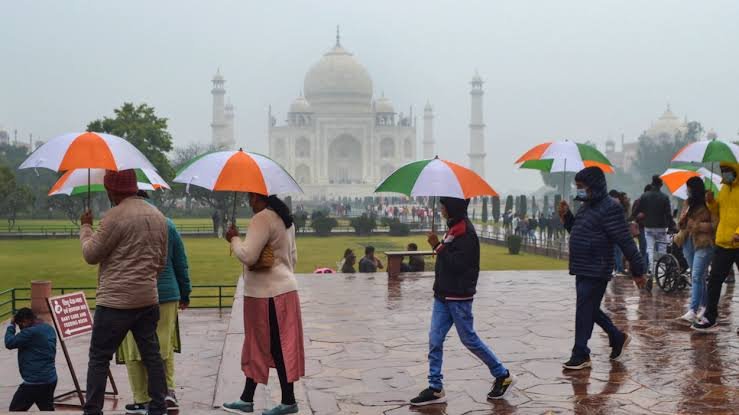
Agra Temperature in October 2026
October in Agra has two distinct halves. Early October is still post-monsoon warm — daytime highs around 34°C, humidity still elevated from the rains. By mid-October the heat drops noticeably, and by the last week of October you are in genuinely comfortable, classic North Indian winter-approach weather.
Early October (1–15 October)
| Time of Day | Temperature |
|---|---|
| Early morning (6–8 AM) | 22°C to 25°C |
| Morning (8–11 AM) | 26°C to 30°C |
| Midday (11 AM–2 PM) | 32°C to 34°C |
| Afternoon (2–5 PM) | 30°C to 33°C |
| Evening (5–7 PM) | 26°C to 29°C |
| Night (after 8 PM) | 22°C to 25°C |
Early October is warm by European and North American standards, but manageable — especially compared to Agra’s brutal April–June heat. Mornings are pleasant and evenings are comfortable. Midday is the only period that feels genuinely hot. An early start (Taj Mahal at sunrise, Agra Fort by 8 AM) means you finish the main sightseeing before 11 AM and avoid the hottest hours entirely.
Late October (16–31 October)
| Time of Day | Temperature |
|---|---|
| Early morning (6–8 AM) | 18°C to 21°C |
| Morning (8–11 AM) | 22°C to 27°C |
| Midday (11 AM–2 PM) | 29°C to 32°C |
| Afternoon (2–5 PM) | 27°C to 30°C |
| Evening (5–7 PM) | 22°C to 25°C |
| Night (after 8 PM) | 18°C to 21°C |
Late October is excellent. Mornings are fresh, afternoons warm but comfortable, evenings pleasant. This is the beginning of Agra’s prime season — the weather that will hold, cooling steadily, through November, December, and January.
Average October high: 32°C (early) → 28°C (late) Average October low: 23°C (early) → 18°C (late)
Does It Rain in Agra in October?
The monsoon in Agra typically ends in the last week of September. October is the transition month — predominantly dry, but with the residual possibility of a brief shower in the first two weeks.
Rainfall in Agra in October: Average 15mm for the entire month. In practice this usually means one or two brief afternoon showers in the first week of October, and then effectively nothing for the rest of the month.
What this means for you:
- If your Agra visit is in the first week of October, a light afternoon rain is possible but unlikely to disrupt sightseeing — Agra’s October showers are typically short and pass quickly.
- From mid-October onwards, rain risk is essentially zero.
- A light rain jacket or packable umbrella is worth having for early October. From 15 October, you will not need it.
Humidity: October starts at 60–70% humidity (post-monsoon residual) and drops to 40–50% by month end. The late October air is noticeably drier and more comfortable than the September and early October equivalent.
Sky and Light Conditions in October
This is one of October’s most important advantages for Agra sightseeing.
The Taj Mahal is a building that depends entirely on light. Its white Makrana marble changes colour throughout the day — and the quality of that light depends on the sky above it. Post-monsoon October skies are some of the clearest of the year. The monsoon has washed the dust and pollution out of the atmosphere. The result: a deep, saturated blue sky that makes the Taj Mahal’s white dome look exactly as it does in the best photographs you have ever seen of it.
Sunshine hours in Agra in October: 8 to 9 hours per day. Sunrise is approximately 6:05 AM on 1 October, shifting to 6:20 AM by 31 October. Sunset moves from approximately 6:00 PM at the start of the month to 5:35 PM by month end.
Photography note: October light — particularly the 7–10 AM window — is considered by photographers to be among the two or three best months of the year for Taj Mahal photographs. The low morning sun from the southeast, the clear sky, and the vivid green gardens combine to produce conditions that November and December do not quite replicate (those months have cleaner air but less verdant gardens and marginally harsher winter light).
The Taj Mahal Gardens in October
After four months of monsoon rain, the Taj Mahal’s formal gardens — the charbagh, the cypress-lined central path, the flowerbeds along the reflecting pool — are at peak condition in October. The grass is vivid green. The flowerbeds are in bloom. The cypress trees, which look thin and spare in May, have filled out.
This combination — the lush post-monsoon garden plus the newly clear sky plus the blue Yamuna River visible behind the mausoleum — makes October one of the finest months to see the Taj Mahal purely in terms of how it looks. The December–January version is cleaner and cooler, but the gardens are dry and brown by then. October has both the greenery and the clear sky simultaneously.
Crowds at the Taj Mahal in October 2026
October marks the start of Agra’s tourist season, but it is not yet peak season — that begins in November and runs through February.
Crowd level in early October: Moderate. Indian domestic tourism picks up around Dussehra (which falls on 2 October in 2026) and the Golden Week equivalent for Indian school holidays. Weekends in early October can be noticeably busy with domestic visitors.
Crowd level in late October: Building toward peak. International tourist numbers increase steadily through October as the Northern Hemisphere autumn/winter travel season begins. By the last week of October, the Taj Mahal is meaningfully busier than it was in September.
How to manage crowds in October:
- Arrive at the Taj Mahal at opening (approximately 6:05 AM in early October). The first 90 minutes are always the least crowded regardless of season.
- Visit Agra Fort on a weekday rather than a weekend — Fort visits are dominated by domestic visitors and weekends are significantly busier.
- Fatehpur Sikri at any time of day in October is relatively uncrowded compared to Agra itself.
Best Time of Day to Visit the Taj Mahal in October
Dawn — the moment the gates open — is the answer for every month, and October is no exception.
In October, the Taj Mahal gates open at approximately 6:00 AM. The morning light in October is extraordinary — the low-angle sun from the southeast hits the south face of the mausoleum in the first hour, and the post-monsoon clarity of the sky means the blue backdrop behind the white dome is deeper and richer than at any other time of year.
Recommended October Taj Mahal schedule:
- 6:00 AM: Enter through the East Gate (typically the shortest queue). Walk directly to the far end of the reflecting pool. Take your time. This is the view — the Taj framed by the watercourse and the cypress trees — at its finest.
- 6:00–7:30 AM: The forecourt and plinth with minimal crowds. Photograph freely.
- 7:30–8:30 AM: Climb to the plinth and enter the mausoleum. The interior is cool and quiet in early October mornings.
- 8:30 AM: Exit as the first tour buses arrive from Delhi. Your Taj Mahal experience is complete before the crowds begin.
Second-best time: 4:00–5:30 PM. The evening light in October is soft and golden. Most day-trippers have left. Ticket lines have disappeared. The October sunset at the Taj Mahal — around 5:45 PM — paints the marble amber for 20 minutes before the gates close.
Best Time of Day to Visit Agra Fort in October
Agra Fort is best visited in the morning — 8:00 AM to 10:30 AM — immediately after the Taj Mahal.
The sandstone of Agra Fort glows in the morning light. The Musamman Burj view of the Taj Mahal (across the Yamuna River from the tower where Shah Jahan died as a prisoner) is best in the morning when the mausoleum catches eastern light.
In October, the temperature inside Agra Fort’s stone corridors rises quickly after 11 AM. Completing your fort visit before midday means you avoid the combined heat of the sun and the sandstone’s thermal mass.
Full details on Agra Fort: Agra Fort Complete Guide
Remember: both the Taj Mahal and Agra Fort are closed on Fridays. If your Agra day falls on a Friday, use the day for Fatehpur Sikri, Itimad-ud-Daulah, and Mehtab Bagh — all of which remain open. Full details: Taj Mahal Friday Closure Guide
What to Pack for Agra in October 2026
Early October (1–15 October)
Essential:
- Light, breathable clothing — linen or moisture-wicking fabric for the warm midday hours
- Sun protection: sunscreen SPF 50+, sunglasses, a wide-brim hat or cap — the October Agra sun between 10 AM and 3 PM is strong
- Comfortable closed-toe walking shoes — Agra’s monuments involve long walks on uneven sandstone, marble, and gravel
- A light rain jacket or packable umbrella — low probability but possible in the first week of October
What you don’t need:
- Heavy layers — even at 6 AM in early October, 23°C is T-shirt temperature
- Insect repellent — mosquitoes reduce significantly after monsoon ends, though a light repellent for evenings near the Yamuna is sensible
Late October (16–31 October)
Essential:
- Light layers — a light fleece or long-sleeve shirt for the 18–21°C early mornings
- Sun protection still required for the 10 AM–3 PM window
- No rain gear needed from mid-October
Useful:
- A light scarf or shawl — for temple and mosque entry (covering shoulders and head) and for the fresh late-October evenings
October 2026 Events Near Agra
Dussehra — 2 October 2026
Dussehra, marking the victory of Ram over Ravana, is celebrated across North India. In Agra, large Ravana effigies are burned at various grounds around the city on the evening of 2 October. This is a spectacular, chaotic, joyful Indian festival night. If your Agra visit overlaps with 2 October, the Dussehra celebrations are worth watching — they run from late afternoon into the night.
Travel note: Dussehra evening brings large crowds into central Agra. Traffic is heavy. Plan your monument visits for the morning of 2 October and enjoy the evening celebrations as an add-on.
Diwali — 20 October 2026
Diwali falls on 20 October 2026. Agra celebrates with diyas (oil lamps), fireworks, and the city’s rooftops and streets lit up from sunset onwards. The Taj Mahal itself is closed to visitors on Diwali night (night viewing is suspended on Diwali due to firework proximity concerns), but the view of Diwali lights from Mehtab Bagh — the garden directly across the Yamuna from the Taj — is extraordinary. The illuminated Taj Mahal reflected in the Yamuna, with fireworks in the background, is one of the most photographed Diwali scenes in India.
Booking note: Hotels in Agra sell out quickly around Diwali 2026. If your dates overlap with 18–22 October, book accommodation well in advance.
Full Diwali 2026 travel guide: Diwali 2026 Travel Guide
Agra in October vs Other Months
| Month | Temp Range | Rain | Sky | Verdict |
|---|---|---|---|---|
| January | 8°C–22°C | None | Clear (fog risk) | ⭐⭐⭐⭐⭐ Peak |
| February | 10°C–25°C | None | Clear | ⭐⭐⭐⭐⭐ Excellent |
| March | 16°C–30°C | Trace | Clear | ⭐⭐⭐⭐ Very good |
| April | 22°C–37°C | None | Hazy | ⭐⭐⭐ Warm — mornings only |
| May | 28°C–44°C | None | Hazy | ⭐ Avoid |
| June | 30°C–42°C | Monsoon | Overcast | ⭐ Avoid |
| July | 28°C–37°C | Heavy | Overcast | ⭐ Avoid |
| August | 27°C–35°C | Heavy | Overcast | ⭐ Avoid |
| September | 25°C–34°C | Tapering | Improving | ⭐⭐ Manageable late month |
| October | 18°C–34°C | Trace (early) | Excellent | ⭐⭐⭐⭐⭐ Excellent — especially late month |
| November | 12°C–28°C | None | Clear | ⭐⭐⭐⭐⭐ Excellent |
| December | 8°C–23°C | None | Clear (fog risk) | ⭐⭐⭐⭐⭐ Peak |
October and November are closely matched. October has the advantage of lush post-monsoon gardens and Diwali / Dussehra festival atmosphere. November has slightly cooler temperatures and even lower humidity. Both are strong months — choosing between them often comes down to whether you want to overlap with Diwali (October) or the quiet post-festival clarity of November.
Agra Weather October vs November vs December
The three months of Agra’s prime season each have a distinct character.
October: Post-monsoon green. Clear skies returning. Warm days (early), pleasant days (late). Festival season — Dussehra and Diwali. Gardens at peak lushness. Crowds building but not yet peak.
November: The sweet spot. Cool mornings (10–14°C), warm afternoons (26–28°C), no rain, no fog, no heat. The garden greenery fades but the sky stays pristine. Indian tourist traffic eases after Diwali. International visitors arriving steadily. Generally considered the most comfortable month.
December: The coolest month. Mornings can be 7–9°C — jacket essential for the 6 AM Taj entry. Fog begins to appear in the second half of December and becomes more frequent through January. The famous January Taj Mahal fog that traps travellers in Agra for an extra day begins here. Two nights in Agra recommended from mid-December onwards for fog contingency.
How to Get to Agra in October 2026
From Delhi: Agra is 230km from Delhi. The Gatimaan Express (160 km/h, 1 hour 40 minutes) is the fastest option — departing Hazrat Nizamuddin at 8:10 AM and returning from Agra Cantt at 5:50 PM, making it a practical day-trip rail option. The Shatabdi and other express trains take 2 to 2.5 hours. By road (Yamuna Expressway), the journey takes 2.5 to 3.5 hours depending on Delhi traffic.
From Jaipur: Jaipur to Agra is 240km — approximately 4 to 5 hours by road. No direct express train; most travellers on the Golden Triangle drive between Jaipur and Agra.
On a Golden Triangle tour: Delhi → Agra → Jaipur (or the reverse) is the standard circuit. Most private tours cover it in 6 to 8 days with one or two nights in Agra. In October, the comfortable weather means you are not racing the heat — a leisurely pace through all three cities is entirely manageable.
Frequently Asked Questions
What is the weather like in Agra in October 2026?
October in Agra starts warm (30–34°C highs in the first two weeks) and becomes very pleasant by the end of the month (27–30°C highs, 18–21°C lows). Post-monsoon clear skies from the start of October. Minimal rain from mid-October onwards.
Is October a good time to visit the Taj Mahal?
Yes — October is one of the best months. The sky is clear and deep blue (the monsoon has cleaned the atmosphere), the Taj Mahal gardens are at their most vivid green, temperatures are comfortable especially in the mornings, and the crowds are moderate (not yet peak season). Late October is particularly good.
Does it rain in Agra in October?
Very little. Average rainfall for the entire month is 15mm — typically one or two brief showers in the first week, then effectively dry for the rest of October. From mid-October, rain risk is essentially zero.
Is Diwali a good time to visit the Taj Mahal?
Diwali falls on 20 October in 2026. The Taj Mahal itself does not do special night lighting for Diwali (night viewing is suspended due to fireworks). But Agra during Diwali week is atmospheric and festive. The view of Diwali celebrations from Mehtab Bagh across the Yamuna from the Taj is spectacular. Book hotels well in advance — Agra sells out around Diwali.
What should I wear at the Taj Mahal in October?
Light, breathable clothing for the midday hours. A light layer for the early morning entry (6 AM temperatures of 20–23°C in October). Closed-toe comfortable shoes for the long monument walks. Sunscreen and sunglasses are essential — October sun between 10 AM and 3 PM is strong. Modest clothing (covered shoulders and knees) for entry to the mosque areas.
Is October better than November for visiting Agra?
It depends on priorities. October has lush green gardens, Diwali festival atmosphere, and post-monsoon freshness. November has cooler temperatures, lower humidity, and no festival crowds. Both months are excellent — October is marginally better for photography (greener gardens, same clear sky), November is marginally better for physical comfort (cooler all day).
Plan Your October Agra Visit with Squid Travel India
October is one of our busiest months for Golden Triangle tours. We build private itineraries that structure your Agra time around the 6 AM Taj Mahal entry, the Agra Fort morning, and the Fatehpur Sikri afternoon — with Diwali activities built in if your dates overlap.
Every tour is private. Your own licensed guide. Your own vehicle. No shared groups, no rushed timings.
Contact us with your October 2026 dates. We will send a full itinerary and pricing within 24 hours.
Also worth reading:
- Best Time to Visit Agra and the Taj Mahal 2026
- Agra Fort Complete Guide
- Taj Mahal Friday Closure: What You Need to Know
- Diwali 2026 Travel Guide
- Golden Triangle Tour from Delhi
- India in January 2027
- Golden Triangle Tour Cost 2026
📞 Call / WhatsApp: +91 9990812499 📧 Email: Squidtravelindia@gmail.com 🌐 Visit: squidtravelindia.com
1,800+ trips completed | 98% happy clients | TripAdvisor Travelers’ Choice 2024–2025
Last updated: September 2026.

Comment (0)