

October is the moment Agra exhales.
For four months, the city has been through the summer heat and then the monsoon — 45°C afternoons in May, heavy August rains that fill the Yamuna and turn the Taj Mahal’s gardens lush and green. By the time October arrives, all of that is behind it. The monsoon has retreated. The air is clean. The marble of the Taj Mahal, washed by months of rain, is at its most luminous. And the city, having endured the long hot year, settles into its finest season.
October sits at the exact beginning of the window that most experienced India travellers specifically travel for. It is not yet peak season — the December and January crowds haven’t arrived. But the conditions that make peak season worth it are already here: clear skies, comfortable mornings, and that specific post-monsoon quality of light that makes every sandstone fort and white marble monument look exactly as they do in the photographs that inspired you to come.
This is the complete guide to visiting Agra in October 2026.
Agra Weather in October 2026 — What to Actually Expect
Understanding Agra’s October weather requires separating the numbers from the experience. The numbers show a month that is still warm. The experience is significantly more manageable than those numbers suggest.
Temperature
Agra in October averages daytime highs near 36°C and lows around 15°C, with a mean temperature of about 25.6°C. In practical terms:
- Early October (1st–10th): Highs of 34–36°C in the afternoon. Mornings are warm — around 22–24°C at the 6:30 AM Taj Mahal gate opening. The heat is real in the middle of the day but the post-monsoon air is drier than August and September, which changes how it feels on the skin.
- Mid-October (11th–20th): Temperatures begin their steady downward trend. Afternoon highs drop toward 32–33°C. Evenings cool noticeably — 18–20°C by 7 PM, which makes rooftop restaurant dinners genuinely pleasant. The Dussehra atmosphere (October 2) has settled into a post-festival warmth that fills Indian cities with a particular contentment.
- Late October (21st–31st): The best week of the month. By the 15th of October, sunrise is at 6:17 AM and sunset at 5:50 PM. Morning temperatures at gate opening drop to 18–20°C — cool enough that a light layer is welcome for the first hour at the Taj. Afternoons are 28–31°C. Evenings fall to 15–17°C. This is Agra at the beginning of its long, beautiful winter.
Rainfall
October brings around 23 mm of rainfall across just one rainy day on average — one of the driest months of the year. The monsoon has retreated and October is effectively rain-free. That single rainy day could fall anywhere in the month or not at all. Pack a compact umbrella as a precaution and forget about it.
Sunshine
October delivers about 290 hours of sunshine — the clear skies make Agra even more beautiful. That’s 9–10 hours of bright sun per day. The post-monsoon atmosphere produces the deep blue skies and sharp air clarity that make the Taj Mahal photography look its best. The haze that can soften views in summer is gone. The fog that arrives in December hasn’t yet appeared. October skies in Agra are as clean as they get.
Humidity
Humidity sits at around 49% in October — dramatically lower than the 80–90% of the monsoon months. This is the most important practical number in the weather picture. 35°C at 49% humidity feels completely manageable. The same temperature at 85% humidity (as August produces) is genuinely difficult. October’s dryness transforms the experience of outdoor sightseeing.
October vs September vs November — The Honest Comparison
| September | October | November | |
|---|---|---|---|
| Avg high temp | 33–35°C | 28–36°C | 22–28°C |
| Avg low temp | 24–26°C | 15–21°C | 10–13°C |
| Humidity | 70–80% | 49% | 35–45% |
| Rain days | 8–10 | 1 | 0 |
| Sky clarity | Variable | Excellent | Excellent |
| Taj gardens | Lush green | Lush green | Transitioning |
| Crowds | Very low | Low–moderate | Building |
| Hotel prices | Off-peak | Shoulder | Peak |
| Taj marble clarity | Post-monsoon fresh | Post-monsoon best | Excellent |
October’s sweet spot is clear: better weather than September, better landscape than November, lower crowds than November, and the specific advantage of the post-monsoon marble at its freshest and most luminous.
The Taj Mahal in October — Why This Month Is Special
The Taj Mahal in October has a character that photographers specifically travel for and that most visitors who come only in December or January never experience.
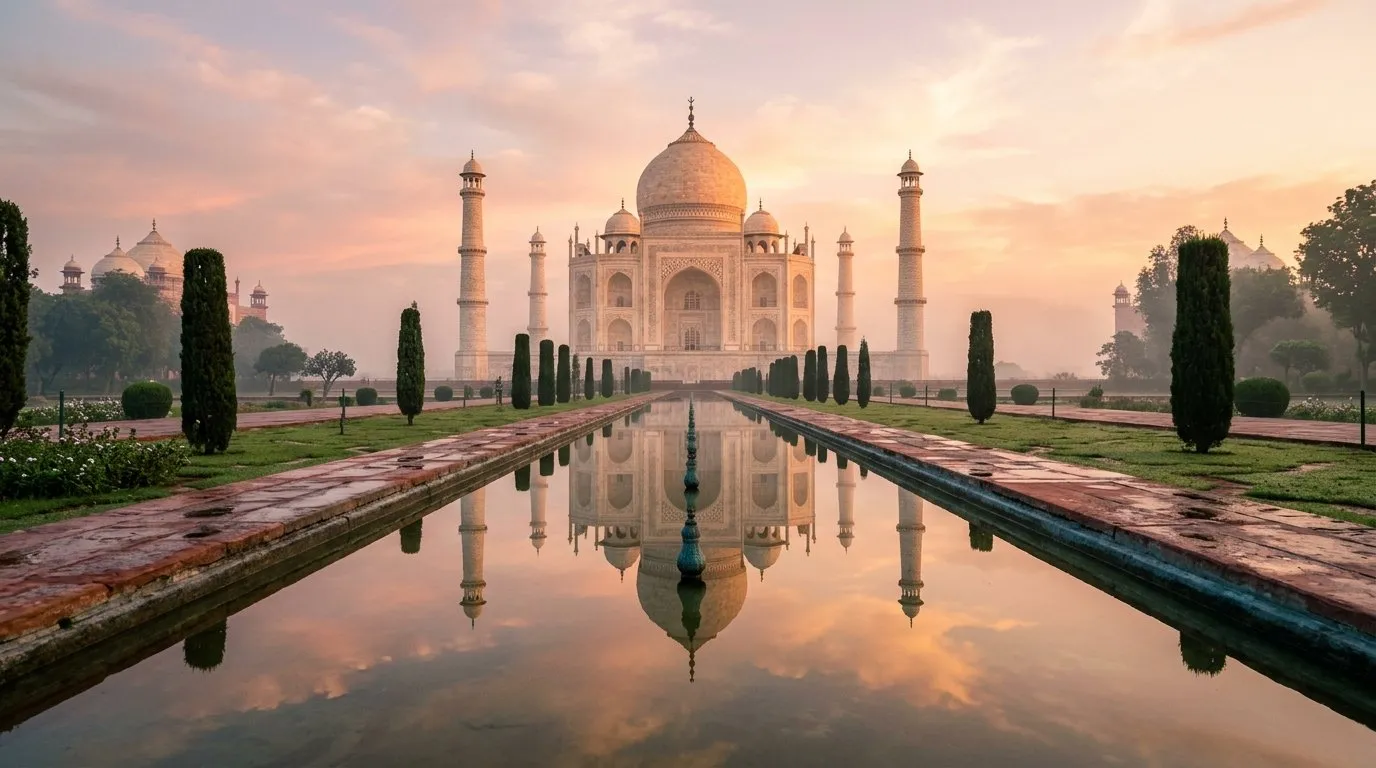
The reason is the post-monsoon marble. Four months of monsoon rainfall effectively power-washes the Taj Mahal’s white Makrana marble — flushing accumulated pollution, dust, and atmospheric deposits that build up through the dry months. In October, the marble is at its annual cleanest and brightest. Combined with the October blue sky — deep and saturated after months of monsoon cloud — the visual contrast between white marble and blue sky is as sharp as it gets anywhere in the year.
The Taj gardens are at their annual peak in October. The cypress trees that line the central reflecting pool are full and deep green from the monsoon rains. The grass between the pathways is alive and lush. The flower beds are blooming. By December, the gardens begin to dry and the grass yellows. October is the one month when the monument and its gardens are simultaneously at their best.
Crowds in October: Significantly lower than November, December, and January. The international tour groups that dominate the winter season are mostly still planning their trips. The Taj Mahal at 6:15 AM on a Tuesday in October is a very different experience from the same monument at 8 AM on a Saturday in January.
Gate opening time: The Taj Mahal opens 30 minutes before sunrise. Sunrise in mid-October falls at approximately 6:17 AM — so gates open around 5:47–6:00 AM. Arrive at this time and you have the first 60–90 minutes with dramatically fewer crowds and the best light of the day.
Closed every Friday — this applies year-round. October 2026 Fridays: October 2, 9, 16, 23, 30. Never plan your Taj visit on a Friday.
Full moon moonlight viewing: The October 2026 full moon falls on October 6. The moonlight viewing tour — open on the full moon and two nights before and after — offers one of Agra’s most extraordinary experiences. October averages 25 mm rainfall and 53% relative humidity — the October full moon in clear post-monsoon air produces exceptional moonlight clarity. Book the moonlight viewing ticket at the ASI office in advance; it sells out fast.
For the complete breakdown of Taj Mahal entry fees, timings, and how to book tickets, read our Taj Mahal tickets and entry fee guide. For the full October-specific Taj Mahal experience — photography tips, best viewpoints, and the October vs other months comparison — see our Taj Mahal in October 2026 guide.
Things to Do in Agra in October
Taj Mahal at Sunrise
Non-negotiable. October’s pre-dawn air at 18–22°C makes the early start a pleasure rather than a duty. Arrive at gate opening. Walk the full complex unhurried. Stand at the far end of the reflecting pool in the golden hour light. Go inside the mausoleum. Return to the garden perimeter for the side angles most visitors miss. Budget 2.5 hours minimum.
Agra Fort
Ten minutes from the Taj Mahal, Agra Fort is a UNESCO World Heritage Site and one of the most historically rich monuments in India. Built primarily by Akbar in 1565 and expanded by Shah Jahan, the fort contains palaces, audience halls, and the Musamman Burj — the octagonal tower where the imprisoned Shah Jahan spent his final years gazing at the Taj he built for his wife.
October is an excellent month for Agra Fort. The red sandstone glows deeply in the October light. The fort’s elevated Yamuna-facing terraces provide the city’s best elevated view of the Taj — particularly striking in October’s clear post-monsoon air when the marble appears almost luminously white against the blue sky. Temperature inside the fort’s covered sections is comfortable throughout the day.
Visit in the morning, after the Taj Mahal, when the light is still working in your favour. Allow 1.5–2 hours. Entry: ₹35 (Indian) / ₹550 (Foreign). Closed Fridays.
Mehtab Bagh at Sunset
The Moonlight Garden, directly across the Yamuna from the Taj, delivers October’s finest sunset view. The full river — still running high from the monsoon — reflects the monument, and the late afternoon light turns the marble warm amber before fading to silver. This view is widely considered by photographers to be the finest available angle of the Taj Mahal, and in October the Yamuna has enough volume to make the reflection full and complete.
Arrive 90 minutes before sunset. The garden is almost always quiet on weekday afternoons in October. Entry: ₹30 (Indian) / ₹300 (Foreign).
Fatehpur Sikri
37 kilometres southwest of Agra, Akbar’s abandoned 16th-century capital is best experienced in October. The largely outdoor complex — built entirely in red sandstone — is comfortable to explore thoroughly in October’s temperature range. Early October mornings produce warm, directional light that catches the sandstone’s deep colour and throws the carved reliefs into sharp relief. By December, the fort’s stone radiates cold; in October it radiates a comfortable warmth.
The Buland Darwaza, the Sheikh Salim Chishti Tomb, the Diwan-i-Khas with its extraordinary central pillar, and the Panch Mahal five-storey pavilion — all are best experienced when you’re not rushing through because of heat or cold. October gives you time with each of them.
Allow 2–2.5 hours. Entry: ₹40 (Indian) / ₹610 (Foreign). Open daily.
Itmad-ud-Daulah (Baby Taj)
The first Mughal monument to use pietra dura — the stone inlay technique later perfected in the Taj Mahal — the Baby Taj is one of Agra’s most architecturally significant and least crowded monuments. In October, the directional morning light brings out the colour and depth of the semi-precious stone inlay (lapis lazuli, malachite, jasper, cornelian) in a way that flat midday light never does.
Almost always uncrowded. Allow 45 minutes to an hour. Entry: ₹20 (Indian) / ₹310 (Foreign). Closed Fridays.
Akbar’s Tomb at Sikandra
Ten kilometres north of Agra, Akbar’s Tomb is architecturally unique — a five-storey red sandstone mausoleum with no dome, unlike any other Mughal tomb in India. The surrounding gardens are large, formally planted, and populated by deer and langur monkeys. On early October mornings, before 9 AM, the entire complex is practically deserted.
October’s comfortable temperatures make the outdoor garden exploration genuinely pleasant — something that summer heat makes difficult and December cold occasionally discourages. The deer in the garden are particularly active in the cool October mornings.
Allow 1–1.5 hours. Entry: ₹30 (Indian) / ₹310 (Foreign). Closed Fridays.
Hidden Agra — Beyond the Main Circuit
October’s comfortable temperatures and lower crowds make it the best month to explore Agra’s lesser-known sites — the places that genuinely experienced travellers know about and most first-time visitors miss entirely.
Chini Ka Rauza — the tilework tomb of Shah Jahan’s prime minister, with surviving patches of Persian-style glazed tile in deep blue and turquoise. Free entry, almost always empty. 1.5 km north of Itmad-ud-Daulah.
Ram Bagh — the oldest surviving Mughal garden in India, laid out by Emperor Babur in 1528. On the Yamuna’s east bank, with riverside pavilions and the atmosphere of genuine antiquity. Rarely visited.
Kinari Bazaar — Agra’s wedding market in the old city lanes. The pre-Diwali shopping energy in October makes this market more alive than at almost any other time of year. Gold and silver embroidery, petha sweets, ritual accessories — this is Agra as an actual living city, not a museum.
For a complete guide to all of Agra’s hidden sites, read our hidden gems of Agra guide.
Dussehra in Agra — October 2, 2026
The very beginning of October brings Dussehra — the festival marking Lord Rama’s victory over the demon Ravana — and Agra celebrates it enthusiastically.
On Dussehra evening (October 2), enormous stuffed effigies of Ravana, Kumbhakarna, and Meghnath are burned in parks and grounds across the city. The burning is dramatic — the effigies stand 40–50 feet tall and are stuffed with fireworks that cascade as they fall. The event is free, draws enormous local crowds, and is one of those Indian festival experiences that completely surpasses expectations.
The Taj Mahal is closed on October 2 (a Friday this year) — which makes Dussehra an excellent Agra day even for visitors who can only spend one day in the city. Spend the day at Fatehpur Sikri, Akbar’s Tomb, Itmad-ud-Daulah, and the old city markets. Watch the Dussehra burning in the evening.
The Navratri festival that precedes Dussehra (September 25 – October 3) adds further festive energy to the city — Garba dance events in neighbourhoods and temples, and the specific atmosphere of a city in celebration.
Diwali Build-Up — Late October
Diwali 2026 falls on November 8 — just beyond October’s end. But from approximately October 20 onward, the build-up is visible and increasingly palpable in Agra.
Sweet shops begin producing and displaying Diwali mithai. Clay diya makers set up stalls throughout the old city. The markets begin their pre-festival shopping energy. The lanes around Kinari Bazaar, always busy, take on the specific intensity of a city preparing for its greatest celebration.
Visiting Agra in the last week of October gives you the Diwali atmosphere — the decoration, the colour, the festive excitement — without the Diwali crowds and prices that arrive in the first week of November. It is arguably the most atmospheric version of late-season Agra available.
To plan around Diwali itself, read our complete Diwali 2026 travel guide.
Where to Eat in Agra in October
October’s comfortable evenings make Agra’s rooftop restaurants — with Taj Mahal views — genuinely pleasurable rather than cold (December) or hot (summer). A shortlist:
Esphahan at Oberoi Amarvilas — Agra’s finest dining room, with the Taj Mahal visible from every table. Dinner here in October, with the monument glowing in the distance and the temperature a comfortable 22°C, is one of the Golden Triangle’s great experiences. Book ahead — it fills fast in October.
Pinch of Spice — consistently excellent North Indian cuisine in comfortable surroundings. The go-to reliable mid-range option for a full Mughlai dinner.
Bon Barbecue on Fatehabad Road — a spread of kebabs and grills in a relaxed outdoor setting. October evenings are ideal for outdoor dining.
Petha — don’t leave Agra without buying a box. Agra’s famous crystallised pumpkin sweet comes in dozens of varieties. Panchhi Petha near Agra Fort has been producing it since 1956. In the Diwali run-up, the sweet shops in the old city stock the full seasonal range.
Getting to Agra in October
From Delhi
The Yamuna Expressway — 233 kilometres, 3 to 3.5 hours — is at its best in October. No monsoon waterlogging, no summer heat haze on the road, clean visibility throughout. An early morning private car departure (5:00–5:30 AM) puts you at the Taj Mahal gate before opening for a sunrise visit that is among the finest October experiences anywhere in India.
The Gatimaan Express from Hazrat Nizamuddin departs at 6:10 AM and reaches Agra Cantt in under 2 hours — an excellent alternative for solo travellers and couples who prefer rail. For the complete transport comparison and distance breakdown, read our Delhi to Agra distance and travel guide.
From Jaipur
Jaipur to Agra is 235 kilometres — 4 to 4.5 hours by road via NH-21. The natural route includes Fatehpur Sikri as a stop on the way, making the journey itself an itinerary addition rather than dead travel time. This is the return leg of the classic Golden Triangle tour direction — Delhi → Agra → Ranthambore → Jaipur — or the reverse depending on your routing.
The Golden Triangle in October — Agra’s Context
Agra in October doesn’t exist in isolation. It is one corner of the Golden Triangle tour that covers Delhi, Agra, and Jaipur — India’s most popular travel circuit. October is the finest month to do all three simultaneously, and Agra benefits from its position at the circuit’s emotional heart.
Delhi in October: Post-monsoon air clarity at its best. Dussehra on October 2 adds a festive dimension. The pre-Diwali energy builds through the month.
Agra in October: Taj Mahal at post-monsoon peak. Lush gardens. Manageable crowds. The October full moon for the moonlight tour.
Jaipur in October: Amber Fort in golden post-monsoon light. City Palace with peacocks in the courtyard. Pre-Diwali Johari Bazaar illuminations beginning in the final week.
Adding Ranthambore — which opens October 1 — creates the most complete version of this circuit: three UNESCO sites, the world’s most famous monument, and a Bengal tiger safari in a single 8–10 day trip. For more on Ranthambore in October, read our complete Ranthambore October guide.
The full October Golden Triangle — why every element of the circuit works in this month and how to structure the days — is covered in our Golden Triangle in October 2026 guide.
Practical Tips for Agra in October
What to Wear
Early October (1st–15th): Lightweight breathable clothing — cotton or linen — for the warm afternoons. A light layer for the 6 AM gate opening (22–24°C at dawn). Sunscreen, sunglasses, and a hat for outdoor sightseeing between 9 AM and 3 PM.
Late October (16th–31st): Add a light jacket or fleece for mornings and evenings. The 6 AM temperature drops to 18–20°C and evenings fall to 15–17°C. Days are comfortable in light clothing but the temperature swings between early morning and mid-afternoon are significant.
For Fatehpur Sikri: Comfortable walking shoes. The complex is large and entirely outdoors — the October morning temperatures make it ideal, but the midday sun is still strong.
Timings to Know
- Taj Mahal gate opening: ~5:47–6:15 AM (30 min before sunrise)
- Taj Mahal closes: 30 min before sunset (~5:20–5:50 PM depending on date)
- Taj Mahal closed: Every Friday + October 2 (Dussehra falls on Friday)
- Agra Fort hours: Sunrise to sunset, closed Fridays
- Fatehpur Sikri: Sunrise to sunset, open all days
- Mehtab Bagh: Sunrise to sunset, open all days
How Many Days Do You Need?
One day: Taj Mahal at sunrise + Agra Fort + Mehtab Bagh at sunset. Covers the essential circuit. Possible as a day trip from Delhi — depart 5 AM, back by 9–10 PM. See our one day Agra tour from Delhi guide.
Two days: Everything above plus Fatehpur Sikri, Itmad-ud-Daulah, and the old city. The right amount of time to actually experience Agra rather than check it off.
Three days: The complete Agra — all major monuments, hidden sites (Chini Ka Rauza, Ram Bagh, Akbar’s Tomb), old city markets, and two sunrise Taj visits. For a structured 3-day plan, read our 3 days in Agra itinerary.
Advance Booking
October is not yet peak season, so advance booking is less critical than December or January. That said:
- Taj Mahal tickets: Book 48–72 hours ahead on weekends to be safe. Weekday visits in October rarely sell out.
- Moonlight viewing (October 4–8, around the full moon): Book through the ASI office — sells out fast.
- Accommodation: Book 3–4 weeks ahead for quality properties near the Taj. Good hotels in Tajganj area fill on October weekends.
- Fatehpur Sikri entry: No advance booking required.
Agra in October — Is It Worth It?
The short answer is yes — emphatically yes.
October sits in the sweet spot that experienced India travellers specifically target: the weather is already excellent, the landscape is at its most lush, the marble is freshest, the crowds are lower than November or December, and the accommodation is cheaper than peak season. The festival energy of Dussehra and the pre-Diwali build-up add a cultural dimension that no other month quite produces.
The one honest caveat: early October afternoons (1st–10th) are warm — 34–36°C — and sightseeing between 11 AM and 3 PM requires respect for the heat. Mornings and evenings are the sightseeing windows. That’s the trade-off. Most experienced travellers consider it a small one.
Book Your October Agra Trip with Squid Travel India
Squid Travel India runs one day Agra tours from Delhi and multi-day Agra itineraries year-round, with October being one of our busiest and most rewarding months. Every booking includes private AC transport, a licensed guide, advance Taj Mahal and fort entry bookings, and hotel recommendations or reservations.
We’ve completed over 1,800 tours with a 98% satisfaction rate and TripAdvisor Travelers’ Choice recognition for 2024–25.
Plan your October Agra trip with Squid Travel India → Call us: +91 9990812499
Agra in October — Quick Reference
| Details | |
|---|---|
| Temperature (early Oct) | 22–36°C (day), 20–24°C (early morning) |
| Temperature (late Oct) | 15–31°C (day), 15–18°C (early morning) |
| Humidity | ~49% — comfortable and dry |
| Rain days | ~1 (effectively none) |
| Sunshine hours | 290 hours / month (~9–10 hrs/day) |
| Taj Mahal gate opening | ~5:47–6:15 AM (shifts through month) |
| Taj closed days | Every Friday |
| Oct 2026 Fridays | Oct 2, 9, 16, 23, 30 |
| Dussehra 2026 | October 2 (Friday — Taj closed) |
| Full moon / moonlight tour | October 6 |
| Diwali build-up starts | ~October 20 |
| Diwali 2026 | November 8 (just beyond October) |
| Crowds | Low–moderate (below Nov/Dec) |
| Hotel prices | Shoulder — below peak |
| Best week | October 15–25 |
| What to wear | Light cotton + jacket for mornings |
Squid Travel India is a New Delhi-based, award-winning tour operator specialising in Golden Triangle tours, Rajasthan packages, and Agra day tours from Delhi.
Comment (0)