

India has been pulling British travellers in for decades, and for good reason. The history is layered, the food is extraordinary, the colours are unlike anywhere else in the world, and the sheer variety of experiences packed into a relatively small geography makes it one of the most rewarding destinations on earth. If you are planning your first trip to India from the UK, or returning after years away, the Golden Triangle is still the best place to begin. Delhi, Agra and Jaipur together cover everything that makes northern India so compelling — Mughal grandeur, Rajput palaces, street food that will ruin you for everything back home, and of course the Taj Mahal, which genuinely does stop you in your tracks the first time you see it.
This guide is written specifically for travellers booking from the UK. It covers the best flights from London and other British cities, the right time of year to go, what everything costs in pounds, how to handle the e-visa, and a set of itineraries that work whether you have five days or two full weeks. Read it once and you will know exactly what you are doing before you land.
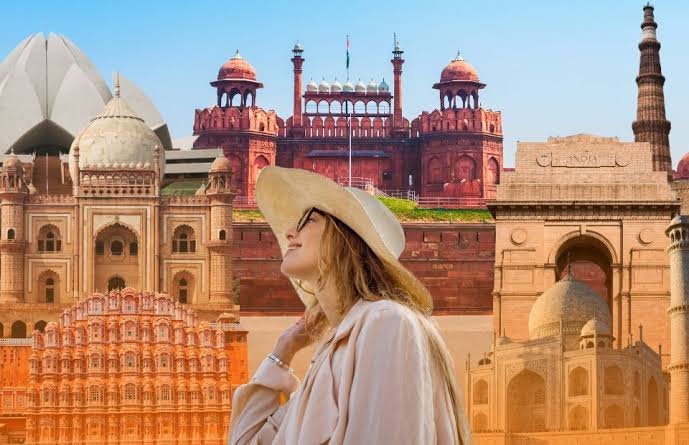
Why British Travellers Choose the Golden Triangle
The Golden Triangle is not a marketing invention. It is a genuinely logical circuit — Delhi, Agra and Jaipur form a rough triangle of about 230 kilometres on each side, and the three cities connect easily by road or rail. You fly into Delhi, spend a couple of days there, drive or train down to Agra to see the Taj Mahal, then cross into Rajasthan to spend time in Jaipur before flying home. The whole thing can be done comfortably in seven nights, and you can stretch it to ten or twelve if you want to slow down and actually absorb it.
For British travellers specifically, there are a few things that make the Golden Triangle particularly comfortable. The historical connection between Britain and India means English is widely spoken across all three cities, especially at hotels, heritage sites and restaurants that cater to international visitors. The infrastructure for tourism is well established — there are excellent hotels at every price point, reliable train connections, and a growing number of private tour operators who handle all the logistics for you. India can be overwhelming in parts, but the Golden Triangle has been welcoming foreign visitors long enough that the experience is relatively smooth.
The food is another draw. Northern Indian cuisine — the rich dals, the tandoori dishes, the biryanis, the street chaat — is better in its home region than anywhere you have tasted it in the UK, however good your local Indian restaurant might be. Eating your way through Delhi’s Chandni Chowk or sitting down to a proper Rajasthani thali in Jaipur are experiences that stay with you for years.
Flights from the UK to Delhi
This is one of the great advantages of booking a Golden Triangle tour from the UK. London has better air connections to Delhi than almost any other English-speaking city in the world, and flight times are short by international standards.
From London Heathrow, Air India operates a direct flight to Indira Gandhi International Airport in Delhi that takes around eight hours and forty minutes. The route is one of the most established between the two countries, running daily, and Air India’s direct service is genuinely one of the most convenient ways to get to northern India. British Airways also operates direct flights from Heathrow to Delhi, typically in a similar flight time. Both airlines run modern aircraft on this route, and the direct option is worth paying a modest premium for — avoiding a connection through Dubai or Doha saves several hours of travel time and takes the stress out of tight layover windows.
If you are flying from outside London, connections through Heathrow are the most common option, though you can also route through Amsterdam on KLM, through Frankfurt on Lufthansa, or through the Gulf hubs on Emirates, Qatar Airways or Etihad. Qatar Airways and Emirates in particular have strong connections from regional UK airports — Birmingham, Manchester, Edinburgh and Glasgow all have good routing options through Doha and Dubai respectively. The total travel time from a regional UK city via a Gulf hub typically comes to between eleven and fourteen hours gate-to-gate depending on layover length.
On price, direct London Heathrow to Delhi flights in economy typically range from around £450 to £700 return booked a few months in advance. Booking during sale periods or well in advance can bring this down to £380–£450. Business class on the direct Air India or British Airways service runs from around £1,800 to £2,800 return and is genuinely worth considering if you can stretch to it for a special trip — arriving in Delhi having slept properly on an overnight flight makes the first day significantly more pleasant. Gulf carrier connections are often cheaper than direct options, particularly from regional airports, and can come in at £350–£550 return in economy with decent layover times.
The key tip for UK travellers: book your return flight from Delhi rather than Jaipur even if Jaipur is your last stop. Flying Jaipur to Delhi is a short internal hop (around an hour), domestic Indian flights are inexpensive, and routing your international ticket through Delhi gives you far more flight options and usually a better fare. Alternatively, some travellers fly out of Jaipur directly — it does have international connections via Delhi — but the onward connections are more limited.
Indian e-Visa for UK Citizens
UK citizens can apply for an Indian e-Visa online without visiting an embassy or collecting a physical stamp. The process is straightforward and the visa is issued digitally, meaning you simply show it at the airport.
The Tourist e-Visa for UK citizens costs around $25 USD (payable by card in the online application) and is typically valid for 365 days from the date of issue, with multiple entries permitted and a maximum stay of 90 consecutive days. You apply at the official Indian government e-Visa portal, fill in the form, upload a photograph and a scan of your passport’s photo page, pay the fee, and receive an approval email — usually within 72 hours, sometimes faster. Print the approval email or save it to your phone; you will need to show it at check-in and on arrival.
A few practical points for UK applicants: make sure your passport has at least six months of validity remaining beyond your date of travel, and at least two blank pages for entry stamps. Apply at least four or five days before you fly to give processing time a comfortable buffer. The e-Visa is processed by the Government of India and the official website is the only place to apply — there are many third-party sites that charge significantly more and offer no additional service.
Best Time to Visit from the UK
For British travellers, the timing of an India trip is often shaped by when you can get away from work, and fortunately the best months for the Golden Triangle align well with the UK holiday calendar.
October through March is the ideal travel window for northern India. The monsoon ends in late September, and from October the weather cools progressively. October itself is still warm — daytime temperatures in Delhi hover around 30–33°C — but evenings are comfortable and the crowds have not yet arrived in force. November and December are arguably the finest months in the region: mild days in the mid-twenties, cool evenings, clear skies, and low humidity. January is cooler still, occasionally dipping to single figures overnight in Jaipur, but daytime temperatures are pleasant and the light is beautiful. February and early March offer warm, spring-like conditions with flowers in bloom and festivals beginning.
For UK travellers, the school half-terms and Christmas holiday period align almost perfectly with the best travel months. A Christmas and New Year trip to the Golden Triangle is genuinely spectacular — the weather in late December is at its most comfortable, the cities feel celebratory, and the Taj Mahal in early morning winter light is among the most beautiful things you will ever see. One critical note on timing: the Taj Mahal is closed every Friday without exception. If your Agra day falls on a Friday, you must rearrange by a day. December 25, 2026 is a Friday — the Taj Mahal will be closed on Christmas Day this year, so anyone planning a Christmas-week trip needs to plan their Agra visit for the 24th or 26th.
The summer months from April through June bring extreme heat to northern India — Delhi regularly exceeds 42–45°C in May and June — and are not recommended unless you are an experienced India traveller who knows what to expect. July through September is the monsoon season, which brings heavy rain and high humidity. Some travellers enjoy the lush green countryside during monsoon, and prices drop significantly, but the heat and rain together make it a more challenging experience.
For most British travellers, the October-to-February window is the sweet spot, and booking during the UK school Christmas or February half-term holidays means you are already in the best travel season.
What Does a Golden Triangle Tour from the UK Cost?
Understanding the full cost of a trip helps with planning, and the Golden Triangle is one of the more straightforward parts of India to budget for.
Flights are the largest single expense. As discussed above, economy return flights from London run from around £380 to £700, with regional connections adding £30–£100 on top. Budget £500 as a working figure for a well-timed economy booking from London, or £550–£650 from a regional UK airport with a Gulf connection.
Hotels vary enormously. At the budget end, comfortable guesthouses and mid-range hotels in all three cities run from £30 to £60 per night for a double room, and the quality is generally very good — India’s hospitality industry has raised its game considerably at this price point. The mid-range sweet spot for most British travellers is £70 to £120 per night, which buys you a genuinely nice hotel — often a heritage property or a well-designed boutique — with reliable wifi, a good breakfast and usually a swimming pool. At the luxury end, Delhi, Agra and Jaipur all have outstanding five-star properties. The Oberoi Amarvilas in Agra, which has views of the Taj Mahal from every room, runs from around £600 per night. The Rambagh Palace in Jaipur, a former royal residence, is in a similar price range. Luxury travel in India at these properties is exceptional value compared to equivalent hotels in Europe.
Internal transport within the Golden Triangle is inexpensive. A private car with a driver for the Delhi-Agra leg (around 230 kilometres, three to four hours) typically costs £35 to £60 depending on the car. Delhi to Jaipur by private car is a similar distance and cost. The Gatimaan Express train from Delhi to Agra is a fast, comfortable and scenic option that takes about one hour and forty minutes and costs around £5 to £8 in air-conditioned second class.
Entry fees are modest. The Taj Mahal entry fee for foreign nationals is currently 1,100 INR (around £10). Agra Fort, also in Agra, costs around £5 for foreign visitors. Amber Fort in Jaipur is around £8. Most other sites are in the £2 to £5 range.
Food and drink is extremely good value. A full meal at a mid-range restaurant — the sort of place you would happily return to — costs £5 to £10 per person including a soft drink or a lassi. Even at nice restaurants catering to foreign visitors, it is rare to spend more than £15 to £20 per person with a full dinner and drinks. Street food is extraordinary and largely safe if you stick to busy stalls and cooked-to-order items — budget £1 to £3 for a proper street food meal in Chandni Chowk or the markets of Jaipur.
All-in budget for a 7-night Golden Triangle trip from the UK (economy flights, mid-range hotels, private transport, all entry fees, food and spending money): approximately £1,400 to £1,900 per person. With a guided private tour operator handling logistics, add £200 to £400 for their fee depending on the level of service. Budget travellers staying in good guesthouses can do it for £1,100 to £1,300 all-in. Luxury travellers at five-star properties should budget £3,500 to £5,000 per person including flights.
Delhi: Two Days in the Capital
Most international flights from the UK arrive in Delhi in the morning or early afternoon. After a roughly nine-hour flight from London you will be wide awake and, assuming you slept on the plane, ready to explore. Use your arrival afternoon to get oriented — check into your hotel, eat something, walk around your neighbourhood and simply absorb the city. Delhi is enormous and chaotic and full of life, and the initial sensory overload is part of the experience.
Old Delhi is the heart of the historic city and the place to spend your first full day. Start at the Red Fort, the vast Mughal citadel built by Emperor Shah Jahan — the same emperor who built the Taj Mahal — in the seventeenth century. The red sandstone walls stretch for two kilometres around the complex, and inside there are palaces, gardens, a mosque and pavilions that give you a strong sense of the scale of Mughal power at its peak. From the Red Fort, walk or take a cycle rickshaw into Chandni Chowk, the medieval market street that has been running continuously since the 1650s. The lanes branching off Chandni Chowk are specialised by trade — one lane for spices, another for textiles, another for silver, another for sweets — and walking through them is among the most vivid urban experiences in the world. Eat breakfast or lunch at one of the legendary Chandni Chowk establishments: Paranthe Wali Gali for stuffed flatbreads, Natraj for dahi bhalle, or simply follow your nose into whatever is drawing a queue.
In the afternoon, visit Jama Masjid, the great mosque built by Shah Jahan in 1656, one of the largest in India. Climb the southern minaret if it is open — the view across Old Delhi from the top, with the Red Fort in one direction and the sprawl of the city in every other, is one of the best vantage points in the capital.
Your second day in Delhi can be spent in New Delhi, the ceremonial capital planned by Edwin Lutyens and Herbert Baker and built in the 1920s and 1930s. Humayun’s Tomb, a UNESCO World Heritage Site, is a spectacular Mughal mausoleum that directly influenced the design of the Taj Mahal and is far less visited than its more famous descendant — you can often have it nearly to yourself. Qutub Minar, a 73-metre sandstone tower built in the twelfth century, is the tallest brick minaret in the world and surrounded by the ruins of Delhi’s earliest Islamic monuments. India Gate is worth a walk in the late afternoon when the light softens and families come out to sit on the lawns.
For dinner in Delhi, the Hauz Khas Village neighbourhood has excellent restaurants in a bohemian setting built around a medieval reservoir and madrasa ruins. Khan Market is the preferred dining and shopping area for Delhi’s expat and upper-middle-class crowd and has some very good restaurants.
Agra: The Taj Mahal and What Else to See
Agra is around 230 kilometres south of Delhi — three to four hours by road, one hour forty minutes by the Gatimaan Express train. Most visitors do Agra as a one-night or two-night stop, which is enough time to see the main sites without rushing.
The Taj Mahal needs no introduction but deserves an honest description of what to expect. It is, without question, one of the most beautiful buildings ever made. The proportions are so precise, the white marble so luminous, and the surrounding garden so perfectly designed that the whole thing looks slightly unreal — like a scale model of itself rather than a building that real human beings constructed. Shah Jahan built it as a mausoleum for his wife Mumtaz Mahal, who died in 1631, and it took twenty-two years and the labour of twenty thousand craftsmen to complete. Whatever your expectations, the Taj Mahal tends to exceed them.
The best time to visit is sunrise. The Taj opens at six in the morning in summer and six-thirty in winter, and the first hour is by far the most beautiful — the light changes every few minutes as the sun rises and the marble shifts from pale pink to white to gold, and the crowds are smaller than they will be by nine or ten. Staying in an Agra hotel for one night and arriving at the gates at opening time is the best way to experience it. Bring a warm layer in winter — November and December mornings in Agra can be quite cold and the wait outside the gate before opening is worth it.
The Taj Mahal is closed every Friday. This is non-negotiable and applies regardless of festivals, seasons or special circumstances. If your Agra day falls on a Friday, move it.
Agra Fort, a UNESCO World Heritage Site about two kilometres from the Taj Mahal, is often overlooked by visitors who run out of time after the Taj. That is a mistake. The fort is a vast complex of palaces, courtyards and halls built by the Mughal emperors over several generations, and Shah Jahan himself spent his final years imprisoned here by his son Aurangzeb — there is a famous tower from which he could look out across the river towards the Taj Mahal and the tomb of his beloved wife. The fort takes two to three hours to explore properly and gives the Mughal period a depth and texture that the Taj Mahal alone cannot provide.
Mehtab Bagh, a garden directly across the Yamuna River from the Taj Mahal on the opposite bank, is one of Agra’s best secrets. At sunset, the Taj turns a deep warm gold, and the view from Mehtab Bagh across the river, with no crowds and no entry queue, is arguably better than the view from inside the Taj complex itself. Worth an hour of your time on any evening in Agra.
Jaipur: The Pink City of Rajasthan
Jaipur is around 240 kilometres west of Agra — four to five hours by road, or a short flight if you are connecting onward — and the transition from Uttar Pradesh into Rajasthan is immediately apparent. The landscape changes, the architecture changes, and the pace of life has a different rhythm. Jaipur is the capital of Rajasthan and one of India’s most architecturally distinctive cities, built on a planned grid in the eighteenth century by Maharaja Jai Singh II and famous for the rose-pink colour of its old city buildings, which gives it the nickname the Pink City.
The Amber Fort, around eleven kilometres from the city centre, is the most impressive monument in Jaipur and one of the finest examples of Rajput military architecture in India. It sits on a ridge above the Aravalli hills with a lake below and the city spread out in the distance, and approaching it on foot or by jeep up the cobbled path, past elephants and the faint scent of incense, feels genuinely cinematic. The fort is a complex of interconnected palaces, halls and gardens built over several centuries, with intricate mirror work, elaborate frescoes and an extraordinarily beautiful private audience hall called the Sheesh Mahal — the Palace of Mirrors — where candlelight was once reflected in thousands of tiny glass inlays in the walls and ceiling.
The City Palace in the heart of Jaipur’s old city is still partly occupied by the Jaipur royal family and is a working museum of Rajput court life. The Jantar Mantar observatory next door, built by Maharaja Jai Singh in the early eighteenth century, is a UNESCO World Heritage Site — a collection of enormous stone astronomical instruments that were used to track the movements of the sun, moon and stars with surprising precision centuries before telescopes arrived in India. The largest sundial in the world is here, accurate to two seconds.
Hawa Mahal, the Palace of Winds, is Jaipur’s most photographed building and worth seeing from the outside even if you do not go in — the five-storey honeycomb facade of 953 small windows was built so the women of the royal household could watch street life and royal processions without being seen from below. The best views are from the tea stalls directly across the narrow street in the early morning.
Spend at least one evening in Jaipur’s markets. The old city’s bazaars are among the finest in Rajasthan — Johari Bazaar for jewellery and gems, Bapu Bazaar for textiles and block-printed fabrics, and Tripolia Bazaar for brass and copper work. Jaipur is the place to buy in India if you are buying anything at all — the craftsmanship is outstanding, the selection is enormous, and prices, while no longer as low as they once were, are still remarkable by British standards.
Itinerary Options for UK Travellers
5 nights / 6 days — the essential circuit
This is the minimum to see the Golden Triangle properly without feeling rushed. Fly into Delhi on day one, spend days two and three in Delhi covering Old Delhi and Humayun’s Tomb. Transfer to Agra on day four — morning at Agra Fort, evening at Mehtab Bagh. Day five: Taj Mahal at sunrise, then drive to Jaipur. Day six: Amber Fort and the old city, then back to Delhi by road or a short flight for your evening return flight to London. This works particularly well if you can get an overnight flight home from Delhi — you maximise the days on the ground.
7 nights / 8 days — the comfortable pace
Two nights in Delhi, two nights in Agra, three nights in Jaipur. This is the most popular length for British visitors and gives you enough time to explore each city without feeling you are constantly on the move. In Agra you have time for the Taj at sunrise on day one and Agra Fort plus Mehtab Bagh on day two. In Jaipur the extra night lets you do Amber Fort properly, spend a full day in the city, and have a relaxed last evening in the markets before heading back to Delhi.
10 nights / 11 days — with Varanasi extension
For travellers who want to go beyond the triangle, adding Varanasi to the end of the circuit is the most rewarding extension. Varanasi is one of the oldest continuously inhabited cities in the world, a sacred city on the Ganges where Hindu pilgrims come to bathe in the river and where the evening Ganga Aarti ceremony — a fire ritual on the river bank performed by priests as the sun sets — is one of the most extraordinary spectacles in India. Fly Delhi-Varanasi or take an overnight train from Agra. Spend two nights there, then fly Varanasi-London via Delhi. The contrast between the Mughal grandeur of the Golden Triangle and the ancient, sacred energy of Varanasi gives the trip a depth that is hard to forget.
14 nights / 15 days — Delhi, Agra, Jaipur, Udaipur
For travellers with two full weeks, continuing south through Rajasthan to Udaipur is the classic extension. Udaipur, built around a lake with white palace walls rising from the water, is consistently rated one of the most romantic cities in the world. The City Palace complex in Udaipur is vast, the lake views are extraordinary, and the slower, more intimate pace after the intensity of Delhi and Jaipur feels like a natural wind-down before the flight home. Fly Udaipur to Delhi for the return, or connect via Mumbai.
Getting Around the Golden Triangle
Private car with a driver is the most common and most comfortable way for British visitors to travel between the three cities. Most tour operators include this, and if you are booking independently, hiring a driver for the duration of the trip (typically called a “driver + car” package) means one person looks after all the transfers, knows the roads and the parking situations at the monuments, and can stop wherever you want along the way. Cost for a full seven-day driver hire with a modern air-conditioned car runs around £200 to £300 for the whole trip — shared across two or more people, this is very reasonable.
Train travel is a good option for the Delhi-Agra leg. The Gatimaan Express, India’s fastest train, covers the route in one hour forty minutes, is comfortable and air-conditioned, and the journey through the Yamuna plains is pleasant. Book tickets in advance at the official IRCTC website or through your tour operator — popular trains on this route sell out, particularly in peak season.
Internal flights between the three cities are short (under an hour for any leg) and inexpensive — typically £30 to £60 per person booked in advance on IndiGo or Air India. The trade-off is the airport time: Delhi, Agra and Jaipur airports all require arriving 75 to 90 minutes before departure, so a 45-minute flight can consume three to four hours of your day once you factor in transfers and waiting. For most travellers, the private car is the better option for the distances involved.
Practical Information for UK Travellers
Currency is the Indian Rupee (INR). As of 2026, one pound sterling buys approximately 105 to 110 INR. ATMs are widely available in all three cities and accept UK debit and credit cards. Inform your bank before travelling, and carry some cash for markets, rickshaws and street food — card payments are increasingly common but not universal.
Time zone: India Standard Time is UTC+5:30, which means IST is four and a half hours ahead of GMT in winter and three and a half hours ahead during British Summer Time. A useful rule of thumb: if it is noon in London in January, it is 5:30 PM in Delhi.
Power: India uses 230V with Type C and Type D plugs. UK three-pin plugs do not fit Indian sockets, so bring a universal travel adapter. Most hotels in the Golden Triangle will also have Type C sockets alongside the Indian plugs, but having your own adapter avoids any uncertainty.
Mobile connectivity: An Indian SIM card is extremely inexpensive and provides excellent 4G coverage across all three cities. Buy one on arrival at Delhi airport from Airtel or Jio — bring a copy of your passport and e-Visa. A tourist SIM with 1.5GB of data per day for 28 days costs around £5 to £8 and makes navigation, translation apps and staying in touch with home very easy.
Health: No vaccinations are currently required to enter India from the UK, though your GP may recommend hepatitis A and typhoid vaccinations as precautions for travel in the region. Take a basic travel medical kit including rehydration salts. Travel insurance with medical cover is strongly recommended — buy it before you leave the UK.
Dress: The Golden Triangle is a relatively conservative region. For visiting mosques, temples and the Taj Mahal, both men and women should have covered shoulders and knees. A light scarf or shawl is useful to have in your bag.
Booking Your Golden Triangle Tour from the UK
There are two main approaches: booking independently or booking through a specialist India tour operator.
Independent booking works well if you are an experienced traveller, comfortable with logistics, and happy to manage your own itinerary. You book flights directly, use a hotel booking site for accommodation, hire a local driver through the hotel or a local agency, and buy attraction tickets at the gate or through the official booking apps. This approach gives you maximum flexibility and is usually the most economical.
Booking through a specialist tour operator is the better option if this is your first trip to India, if you want a guide at each site, or if you want everything handled. A reputable India-focused operator based in the UK will arrange airport transfers, hotels, guided tours, internal transport and logistics — you simply show up and follow the itinerary. Prices for a guided seven-night Golden Triangle tour from the UK booked through a specialist operator typically run from around £1,800 to £2,800 per person including flights, depending on the hotel level. Booking directly with a Delhi-based private tour operator like Squid Travel India is another excellent option — you get the same quality of service, a locally-expert team that knows the sites intimately, and often a better price than the UK-based packaged alternatives.
The key questions to ask any operator: Do they use private vehicles or shared transfers? Are guides included at all three cities or just one? What is the hotel cancellation policy if plans change? Are Taj Mahal entry tickets included? A good operator answers all of these clearly before you book.
A Few Things No One Tells You Before You Go
The Taj Mahal is more crowded than most photographs suggest. By nine in the morning on any weekend in peak season, the main viewing platform in front of the building can be genuinely packed. The solution is simple: arrive at opening time. The gate opens at six or six-thirty depending on the season, and the first ninety minutes are a completely different experience from the mid-morning rush.
Delhi traffic is not like London traffic. It is louder, denser, more creative and occasionally bewildering to first-time visitors. Leave extra time for any road journey in and around Delhi, particularly in the morning and evening rush hours, and treat the ride as part of the experience rather than something to endure.
Bargaining is expected in markets but not in restaurants, hotels or fixed-price shops. In Jaipur’s bazaars, a starting offer of roughly half the quoted price is a reasonable opening position. The interaction is usually good-natured and skilled traders enjoy the process. Avoid buying anything from touts outside the Taj Mahal — they are persistent and the goods are universally overpriced.
India can be noisy, crowded and intense, and it can also be serene, beautiful and unexpectedly moving. The Golden Triangle has a way of getting under your skin in a manner that much more comfortable destinations do not. Most British travellers who do the trip once find themselves thinking about going back within months of returning home.
Final Word
A Golden Triangle tour from the UK is one of the easiest international trips you can make. You fly direct from London to Delhi in under nine hours, the e-visa takes minutes to apply for, English is spoken everywhere you need it to be, and the three cities are connected easily. In seven to ten days you will see some of the greatest architecture in human history, eat food that is simply better than anything available at home, and travel through a country that is full of surprises.
The practical details — flights, costs, timing, what to see — are all covered above. What we cannot quite put into words is the feeling of standing in front of the Taj Mahal at sunrise on a cold December morning, with the mist still sitting on the Yamuna behind it and the marble glowing in the early light. You have to go and see that for yourself.
Squid Travel India specialises in private Golden Triangle tours for international visitors. If you would like a custom itinerary built around your travel dates, group size and interests, get in touch and we will have a proposal back to you within 24 hours.

Comment (1)