Three of India's most iconic cities. One unforgettable journey. Everything you need to plan your Golden Triangle trip — from first-time itineraries to expert tips that make the difference.
The Golden Triangle is India's most travelled tourist circuit, linking three of the country's most historically significant cities — Delhi, Agra, and Jaipur — in a rough triangle across the northwestern plains. The three cities sit approximately 200–250 kilometres apart from each other, making the circuit conveniently driveable, and together they represent the heartland of India's Mughal and Rajput heritage: the great monuments of the Delhi Sultanate and Mughal Empire, the Taj Mahal at Agra, and the palace-studded pink city of Jaipur.
For international travellers visiting India for the first time, the Golden Triangle serves as the perfect introduction to the subcontinent. It is compact enough to cover in a week, rich enough to fill a fortnight, and anchored by sites — the Taj Mahal above all — that rank among the greatest human achievements anywhere on earth. More than any other India itinerary, it reliably delivers the experience most travellers picture when they imagine India: the red sandstone grandeur of Mughal architecture, the chaos and colour of an Indian bazaar, the scent of marigolds at a temple gate, the sight of the Taj Mahal rising from the morning mist.
The circuit is straightforward to navigate and extremely well set up for international visitors. Good hotels exist at every price point, guides of genuine quality operate across all three cities, and the road connecting them — National Highway 48 from Delhi to Jaipur, and the Yamuna Expressway from Delhi to Agra — is among India's best-maintained highway infrastructure. A Golden Triangle tour requires no particular India experience to enjoy. It simply requires showing up.
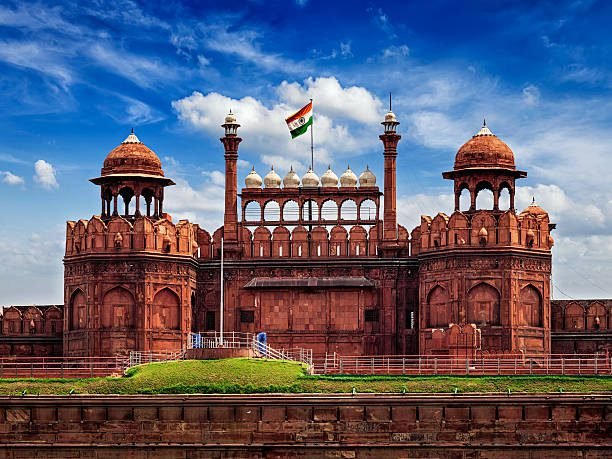
India's capital. 3,000 years of layered history from Qutab Minar to India Gate.
2 nights recommended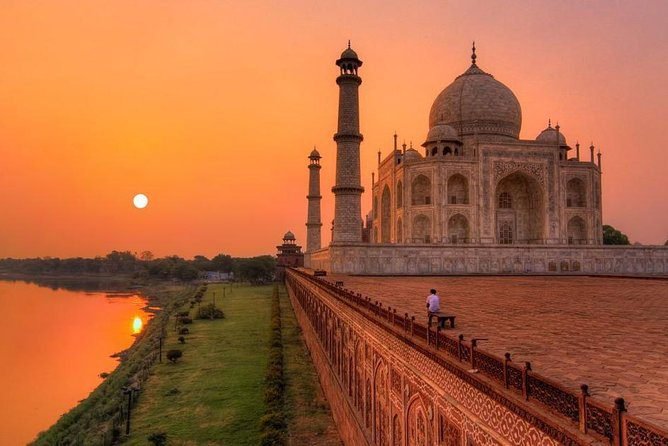
Home of the Taj Mahal — the world's greatest monument to love.
1–2 nights recommended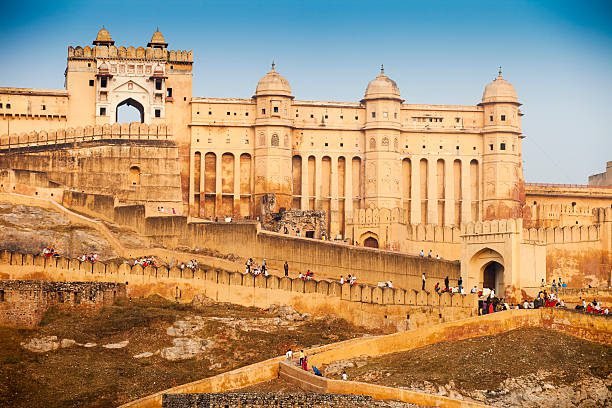
The Pink City — Rajput palaces, vibrant bazaars and Rajasthani cuisine.
2–3 nights recommendedDelhi is not one city but eight — a series of capital cities built on top of one another across three millennia, each leaving its ruins and monuments scattered across the modern metropolis. The old Mughal capital of Shahjahanabad, the British-built imperial city of New Delhi, the medieval fortress-city of Lal Kot, and the gleaming glass towers of Gurgaon and Noida all exist simultaneously, separated by flyovers and traffic jams, and the sum of the parts is one of the most historically dense urban environments on earth.
For a Golden Triangle traveller, Delhi typically means two full days of sightseeing, though the city rewards those who stay longer. The must-see monuments cluster in two groups: Old Delhi and New Delhi. In Old Delhi, the Red Fort — the great sandstone palace built by Shah Jahan in 1639 — anchors a neighbourhood of Mughal-era lanes, spice markets, and the magnificent Jama Masjid, India's largest mosque. The streets of Chandni Chowk, once the wealthiest marketplace in the Mughal world, remain one of the most sensory urban experiences available to any traveller anywhere — chaotic, aromatic, loud, and overwhelmingly alive.
New Delhi belongs to a different architectural grammar entirely. The broad Lutyens-designed boulevards, the India Gate war memorial, Humayun's Tomb — the Mughal garden mausoleum that directly inspired the design of the Taj Mahal and predates it by a century — and the Qutab Minar, a 73-metre minaret built in 1193 and still the tallest brick minaret in the world, spread across the southern half of the city. A good Delhi guide can cover the major monuments in two days while leaving time for the city's excellent restaurant scene, its craft markets at Dilli Haat, and the remarkable diversity of neighbourhoods that give Delhi its personality.
Humayun's Tomb at dawn before the crowds arrive is one of Delhi's underrated great experiences — the garden geometry, the Persian-influenced dome, the morning light on the red sandstone and white marble inlay will recalibrate your expectations for everything you see later on the circuit. The Qutab Minar complex, often rushed in group tours, deserves two unhurried hours — the Iron Pillar that has stood in the courtyard for 1,600 years without rusting is one of the most quietly extraordinary objects in India. And at least one meal in Connaught Place or Khan Market, Delhi's most international restaurant precincts, will show you a side of the city that the monuments alone cannot.
Agra is a city that exists, in the global imagination, almost entirely because of a single building. The Taj Mahal is not merely a famous monument — it is one of the most potent symbols of human love and ambition that any civilisation has ever produced, and the experience of standing before it for the first time, whatever expectations you arrive with, is consistently described by visitors as something that exceeds them. Photographs do not prepare you for the scale. Standing in its presence, you understand why the Mughal emperor Shah Jahan described it as "a teardrop on the cheek of eternity."
The Taj Mahal was built between 1632 and 1653 as a mausoleum for Shah Jahan's favourite wife, Mumtaz Mahal, who died in childbirth. It drew craftsmen and calligraphers from Persia, Central Asia, and across the Mughal empire. The white Makrana marble changes colour through the day — pale grey at dawn, glowing rose at sunrise, brilliant white at noon, warm amber at sunset, and silver under a full moon. Each shade reveals different details in the pietra dura inlay work — semi-precious stones set into the marble in floral patterns of extraordinary precision. No single visit captures all of it, which is why many travellers who spend two nights in Agra visit at sunrise and again at sunset.
Critical planning note: The Taj Mahal is closed every Friday without exception. If your itinerary places you in Agra on a Friday, you will not be able to visit. Always confirm your Agra day falls Sunday through Thursday when booking your Golden Triangle tour.
Agra Fort, a 15-minute drive from the Taj Mahal, is the other essential Agra monument and is significantly undervisited relative to its scale and significance. The great red sandstone fort — begun by Akbar in 1565 and expanded by Jahangir and Shah Jahan — contains within its walls a city of Mughal palaces, audience halls, mosques, and gardens. The Khas Mahal and the Sheesh Mahal (mirror palace) are architectural masterpieces in their own right, and from the fort's ramparts you can see the Taj Mahal across the Yamuna River in the exact line of sight Shah Jahan gazed from when he was imprisoned here by his son Aurangzeb in his final years. That view carries its own particular weight.
Fatehpur Sikri, 40 kilometres from Agra, is a detour that rewards travellers with an extra half-day. The ghost city — Akbar's capital, built in 1571 and abandoned just 14 years later, reportedly because the water supply failed — stands almost perfectly preserved in red sandstone, a complete Mughal administrative capital frozen in the moment of its desertion. It is one of the most hauntingly atmospheric sites in India.
Jaipur is the capital of Rajasthan and the third point of the Golden Triangle, and in many ways it is the most visually exuberant of the three cities. Where Delhi overwhelms with scale and Agra concentrates its power into a single transcendent monument, Jaipur spreads its pleasures more generously — across a walled old city painted in the distinctive terracotta pink that gave it its name, a series of hilltop forts and palaces that overlook the city from the Aravalli Hills, and a bazaar culture that is among the most vibrant in India.
The Amber Fort, nine kilometres outside the city, is Jaipur's landmark monument and one of the finest examples of Rajput military architecture in existence. The fort rises in tiers from the Maota Lake, its walls climbing the hillside in a series of fortified gates, courtyards, and audience halls that eventually give way to the Sheesh Mahal — the Hall of Mirrors — where hundreds of thousands of tiny mirror fragments set into the ceiling and walls reflect a single flame into a galaxy of light. The elephant gate, the Diwan-i-Aam, and the views from the ramparts across the lake and the surrounding hills make Amber Fort a two-hour minimum experience, not a forty-minute drive-by.
Within the walled old city, the Hawa Mahal — the Palace of Winds, with its honeycomb facade of 953 windows designed to allow the royal women to observe street life unseen — is Jaipur's most photographed landmark and takes about 45 minutes to visit properly. The City Palace complex, still partially occupied by the Jaipur royal family, contains museums of royal artefacts and textiles, and its inner courtyard is one of the city's most photogenic spaces. Jantar Mantar, the extraordinary 18th-century astronomical observatory built by Maharaja Sawai Jai Singh II — a collection of massive masonry instruments that can predict solar and lunar eclipses and track celestial bodies with remarkable accuracy — is a UNESCO World Heritage Site and one of the most original scientific monuments in the world.
Jaipur's bazaars are a world apart from anything else on the Golden Triangle circuit. Johari Bazaar for jewellery and gemstones — Jaipur is India's gemstone cutting and trading capital — Bapu Bazaar for textiles and block-printed fabrics, and the lanes around the Hawa Mahal for lacquerware and blue pottery all offer shopping that is genuinely craft-led rather than tourist-targeted, and considerably more rewarding than the government emporiums that group tours typically stop at.
The right Golden Triangle itinerary depends on how much time you have, how deeply you want to explore each city, and whether you plan to extend the circuit into Rajasthan or add additional destinations. Below are three battle-tested formats that work consistently well for international travellers.
The shortest format that does justice to all three cities without feeling rushed. Best for travellers with limited annual leave or those combining the Golden Triangle with another India destination.
The standard that most international first-timers choose. Adds breathing room in every city, includes a full Fatehpur Sikri visit, and allows a proper evening in each location rather than arriving late and leaving early.
The most recommended format for travellers with two weeks. Adds Ranthambore (tiger safari), Pushkar, Jodhpur, and/or Udaipur to the classic circuit, creating an end-to-end Rajasthan experience that remains the finest single-loop India journey available to international visitors. Ends in Delhi or Udaipur depending on flight routing.
The Golden Triangle sits in India's northwestern plains, which experience a strongly continental climate — hot summers, a monsoon season from late June through September, and pleasantly cool winters from October through February. The timing of your visit significantly affects both comfort and the quality of your experience, particularly in Agra where haze can reduce visibility of the Taj Mahal in peak winter months.
Temperatures 10–25°C. Clear skies, comfortable sightseeing. Delhi and Jaipur at their best. Book hotels 3–4 months ahead. December–January fog in Agra can occasionally reduce Taj Mahal visibility.
Shoulder months with fewer crowds. September tail end of monsoon — occasional showers but lush and green. March warming up but still comfortable. Good value on accommodation.
Delhi regularly exceeds 45°C in May–June. Sightseeing is possible early morning only. Genuinely unpleasant for most international visitors. Not recommended.
Heavy rains, humidity, and flooding possible. The Taj Mahal in rain has its own beauty. Significant discounts on hotels. Only for experienced India travellers who don't mind heat and unpredictability.
November is widely considered the single best month for the Golden Triangle. Temperatures in Delhi and Jaipur are ideal — warm days around 25–28°C, cool evenings — the post-monsoon dust has settled, visibility is good for Taj Mahal photography, and the festival season (Diwali typically falls in October–November) adds colour and energy to all three cities. If you can choose any month, choose November.
The Golden Triangle can be experienced at almost any budget, from backpacker hostels and overnight trains to the most expensive luxury hotels in India. For most international travellers booking a guided private tour, the following ranges apply to land costs — hotels, guide, transport, and monument entry fees — excluding international flights.
Monument entry fees for international visitors are worth budgeting separately. The Taj Mahal charges ₹1,300 (approximately $16) for international visitors; Agra Fort ₹650; Amber Fort ₹200; Red Fort ₹600. A complete Golden Triangle circuit will cost approximately $60–$80 per person in entry fees at current rates. A good private operator will include all entry fees in your package price, saving you the queuing and cash-handling at each site.
Tipping your guide and driver is expected and meaningful — a standard $10–$15 per day per person for your guide and $6–$8 per day for your driver is appropriate at the mid-range private level. Budget $120–$180 in tips for a 9-night tour for two people.
The vast majority of international visitors to the Golden Triangle book a private guided tour rather than a group departure, and for good reason. The Golden Triangle's geography is compact enough that a private vehicle and dedicated guide gives you full flexibility without the logistical complexity that makes private travel harder in less-visited parts of India. You can spend an extra hour at Humayun's Tomb because you are genuinely moved by it. You can skip the government emporium shopping stop your group tour insists on. You can change your dinner reservation because your guide knows which restaurant is better on a Tuesday. None of this sounds dramatic, but over seven or eight days it produces a qualitatively different experience.
Group tours make sense for solo travellers who want companionship, for travellers on a strict budget who want maximum coverage, and for those who strongly prefer not making any decisions. For families, couples, and anyone with specific interests — food, architecture, photography, history — private is consistently the better choice, and the price gap between a quality private India-based operator and a comparable group tour from a Western company is smaller than most travellers expect.
The three cities of the Golden Triangle are connected by road and rail, with domestic flights available between Delhi and Jaipur as an alternative to the road transfer.
Road is the most flexible and commonly used option for touring travellers. Delhi to Agra via the Yamuna Expressway takes approximately 3–3.5 hours and offers a smooth, fast highway. Agra to Jaipur via the Fatehpur Sikri road takes 4–4.5 hours and passes through rural Rajasthan countryside that is itself worth the journey. Delhi to Jaipur via NH48 takes 5–5.5 hours. All three legs are comfortably done in a private AC vehicle with a driver who knows the route.
The Gatimaan Express train between Delhi Hazrat Nizamuddin and Agra Cantt is India's fastest train service on this route, covering 188 kilometres in 100 minutes. It operates twice daily and is significantly quicker and more comfortable than road on the Delhi-Agra leg. Pre-booking is essential — the train is popular with both tourists and business travellers and fills up weeks in advance during peak season.
Domestic flights between Delhi and Jaipur take approximately 50 minutes and operate multiple times daily on IndiGo, Air India, and SpiceJet. They are a practical alternative to the 5-hour road transfer if you're short on time, though the road journey through Rajasthan countryside is itself worthwhile if you have it.
The Golden Triangle is the ideal foundation for a longer India journey, and Jaipur's position as the gateway to Rajasthan makes it the natural jumping-off point for an extended circuit. The most popular extensions, in order of distance from Jaipur, are Ranthambore National Park (3 hours — India's best tiger safari destination), Pushkar (2 hours — the only Brahma temple in India, camel fair in November), Jodhpur (6 hours — the Blue City, Mehrangarh Fort), Jaisalmer (10 hours or fly — the desert fort city and Thar camel safaris), and Udaipur (6 hours — the most romantic city in India).
Varanasi, India's holiest city on the Ganges, is a four-hour flight or overnight train from Delhi and works as an extension before or after the Golden Triangle rather than as part of the circuit itself. For travellers who want to combine the iconic Mughal heritage of the north with the spiritual life of the Ganges, a Delhi–Agra–Jaipur–Varanasi itinerary covering 12–14 nights is one of the finest India journeys available.
We're a Delhi-based private tour operator specialising in personalised India journeys for international visitors. No group tours, no cookie-cutter itineraries — just expert guides and a trip built around you.
Start Planning →Tell us your dates, your group size, and how long you have. We'll build the right itinerary — whether it's a focused 7-day circuit or a full Rajasthan extension.