

Most people give Agra a single day. They rush through the Taj Mahal, glance at the fort, and leave by evening — carrying photos but missing the city entirely.
Three days is a different experience altogether.
With three days in Agra, you don’t just see the monuments — you understand them. You watch the Taj Mahal in morning light on Day 1 and again at sunset on Day 3. You discover that Agra Fort is a self-contained world of palaces and courtyards that deserves two hours of unhurried wandering. You make the drive to Fatehpur Sikri, the abandoned Mughal capital that most day-trippers never reach. And you find the quiet corners — Mehtab Bagh, Itmad-ud-Daulah, the old bazaars of Kinari and Sadar — that turn a sightseeing trip into a genuine experience of Mughal India.
This is Squid Travel India’s definitive 3-day Agra itinerary. Every stop is sequenced for minimum travel time, maximum experience, and the best light for photography. Whether you’re visiting as part of a Golden Triangle tour or making a standalone trip from Delhi, this plan works.
Before You Arrive — Essential Agra Planning Notes
Best time to visit: October to March. The weather is cool and clear, the light is excellent for photography, and the monuments are at their most visually striking. February is particularly good — Taj Mahotsav (February 18–27) brings cultural performances and crafts to the city.
Avoid: Friday visits to the Taj Mahal and Fatehpur Sikri — both are closed to tourists on Fridays. Plan your itinerary accordingly.
Getting there from Delhi: Private car on the Yamuna Expressway (3–3.5 hours) or Gatimaan Express train (under 2 hours from Hazrat Nizamuddin). For a 3-day trip, a private car with a driver is the most practical option — you’ll need local transport throughout.
Where to stay: The Tajganj area (immediately around the Taj Mahal) is ideal for access, especially for sunrise visits. For a luxury experience, the Oberoi Amarvilas — located 600 metres from the Taj with views of the monument from every room — is genuinely one of the finest hotel experiences in India.
Book tickets in advance: Taj Mahal sunrise slots sell out, especially October to March. Book at least 48 hours ahead via the official ASI portal.
Day 1 — The Taj Mahal, Agra Fort & Mehtab Bagh at Sunset
The first day is built around the monument you came here for. But the sequencing matters — and most visitors get it wrong.
5:30 AM — Taj Mahal at Sunrise
Arrive at the East Gate or West Gate at or just after opening. This is the most important hour of your entire Agra trip.
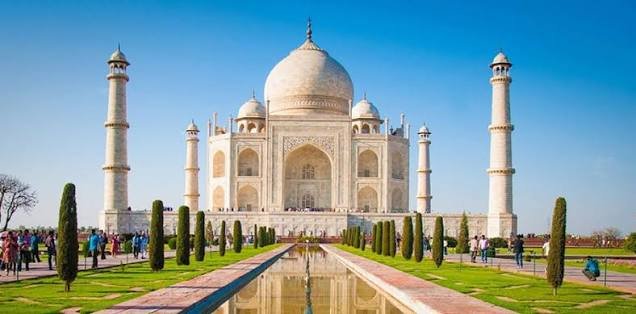
The Taj Mahal at sunrise is genuinely unlike any other time of day. The marble catches the first light with a soft blush of pink and gold that shifts slowly as the sun climbs. The reflecting pool, still and glassy in the morning quiet, mirrors the dome almost perfectly. Crowds are a fraction of what they’ll be by 9 AM. There is space to stand, to be still, to actually absorb what you’re looking at.
The Taj Mahal complex contains more than most people realise. Beyond the main mausoleum, the flanking mosque on the west and the jawab (answer building) on the east are architectural masterpieces in their own right. Walk the full width of the platform. Go inside the main chamber — the marble screens (jalis), the acoustic echo, the paired cenotaphs of Shah Jahan and Mumtaz Mahal — all of it earns the ₹200 mausoleum add-on. Go to the far end of the reflecting pool for the iconic symmetrical photograph, then work your way around the sides of the garden for angles most visitors miss.
Budget 2 to 2.5 hours here. Don’t rush — you won’t get this morning back.
Entry fee: ₹50 (Indian) / ₹1,100 (Foreign) + ₹200 mausoleum supplement for all nationalities. Children under 15 free. Closed: Every Friday.
8:30 AM — Breakfast Near the Taj
By the time you exit, you’ll have earned a proper breakfast. Head to one of the hotels or cafés near the East Gate — Saniya Palace Hotel’s rooftop is a reliable choice with Taj views — or return to your hotel if you’re staying nearby.
10:00 AM — Agra Fort
A 10-minute drive from the Taj Mahal, Agra Fort is UNESCO-listed and one of the most underrated monuments in North India. Built primarily by Emperor Akbar in 1565 and later expanded by Shah Jahan, the fort’s 2.5-kilometre red sandstone perimeter encloses an entire Mughal world.
Key highlights inside:
Diwan-i-Am (Hall of Public Audience) — the vast open courtyard where Akbar and later emperors dispensed justice and addressed their subjects. The scale is extraordinary.
Diwan-i-Khas (Hall of Private Audience) — the more intimate chamber where Shah Jahan would meet nobles and dignitaries. The marble alcoves and inlay work are exquisite.
Jahangir’s Palace — the largest residential structure inside the fort, built for Emperor Akbar’s son. A rare example of Akbar-era palatial architecture.
Musamman Burj — the octagonal marble tower overlooking the Yamuna where Shah Jahan spent the last eight years of his life as a prisoner of his own son Aurangzeb, gazing across the river at the Taj Mahal he had built for his wife. From the tower’s windows, the Taj is framed perfectly in the distance — one of the most poignant views in India.
Budget 1.5 to 2 hours. A guide is recommended here — the fort’s history is dense, layered, and far more interesting than what surface-level reading reveals.
Entry fee: ₹35 (Indian) / ₹550 (Foreign). Open sunrise to sunset, closed Fridays.
12:30 PM — Lunch in Agra
Agra’s food scene is anchored in Mughlai cuisine — rich curries, slow-cooked kebabs, and breads made in tandoors. A few reliable options for a midday meal:
Esphahan at Oberoi Amarvilas — if you want to splurge on a lunch with a direct view of the Taj Mahal from your table. One of the finest dining experiences in India at any price point.
Pinch of Spice — consistently excellent North Indian food in comfortable surroundings. Recommended by travellers across the board.
Mama Chicken Mama Franky — a beloved local institution for grilled and Mughlai street-style food without the tourist markup.
Before you leave for the afternoon, make a note to pick up petha before you leave Agra. This crystallised pumpkin sweet is the city’s most famous food export, sold everywhere and genuinely delicious. Panchhi Petha near Agra Fort is considered the best source.
2:30 PM — Itmad-ud-Daulah (Baby Taj)
Often called the Baby Taj, Itmad-ud-Daulah is the tomb of Mirza Ghiyas Beg — the grandfather of Mumtaz Mahal and chief minister under Emperor Jahangir. Built by Nur Jahan between 1622 and 1628, it was the first Mughal structure to use pietra dura — precious and semi-precious stone inlay work in marble — the same technique later used, at far greater scale, in the Taj Mahal.
Architecturally, it’s a direct predecessor to the Taj. Historians call it a draft — you can see the same impulse toward marble, inlay, symmetry, and riverfront placement, executed at a smaller and more intimate scale. It’s less crowded than any of the major monuments, which makes the experience more contemplative and the photography cleaner.
Budget 45 minutes to an hour.
Entry fee: ₹20 (Indian) / ₹310 (Foreign). Open sunrise to sunset.
4:30 PM — Mehtab Bagh at Sunset
End your first day at Mehtab Bagh — the Moonlight Garden — directly across the Yamuna River from the Taj Mahal.
Originally built by Emperor Babur and later restored, Mehtab Bagh was designed as the ideal vantage point for viewing the Taj at sunset and on full moon nights. The garden is arranged in the classic charbagh (four-quadrant) layout. From its northern edge, you have an unobstructed view of the Taj Mahal across the Yamuna — the full silhouette against the evening sky, with the river in the foreground.
It’s a completely different perspective from anything you see inside the Taj complex. The monument appears more distant, more complete, and — in the shifting warm tones of late afternoon light — extraordinarily beautiful.
There is also a compelling historical footnote here: Shah Jahan is said to have planned a black marble mausoleum for himself in these very gardens, as a mirror image of the white Taj across the river. Whether this is true or legend is still debated, but standing in Mehtab Bagh at sunset, looking at the Taj, it’s easy to believe it.
Budget 45 minutes to an hour. It’s significantly less crowded than the Taj.
Entry fee: ₹30 (Indian) / ₹300 (Foreign). Open sunrise to sunset.
Evening — Dinner and the Old City
End the evening in Agra’s old city around Kinari Bazaar. This is where the city lives — textile shops, street food stalls, chai wallahs, the constant activity of a Mughal-era trading street still doing business. Worth a slow evening walk even if you’re not shopping.
For dinner, Dasaprakash near Gwalior Road is a South Indian vegetarian institution in Agra — surprisingly excellent, and a good change of pace from Mughlai. Alternatively, return to Pinch of Spice for a relaxed sit-down dinner.
Day 2 — Fatehpur Sikri & The Jama Masjid
Day 2 takes you out of Agra city to one of the most remarkable sites in North India, then back for an afternoon in the heart of the old city.
8:00 AM — Drive to Fatehpur Sikri
Fatehpur Sikri is 37 kilometres southwest of Agra — roughly 45 minutes to an hour by road. Leave by 8 AM to arrive with the morning light in your favour and before the day-tripper coaches.
Fatehpur Sikri was Emperor Akbar’s imperial capital, built from scratch between 1569 and 1585 on a rocky ridge above the plains. It is one of the best-preserved examples of Mughal urban planning in the world — an entire capital city, completed and then abandoned within 14 years due to a water supply problem, left intact in red sandstone as Akbar moved his court back to Agra and Lahore.
It was designated a UNESCO World Heritage Site in 1986.
What to see inside:
Buland Darwaza — the great gateway, built to commemorate Akbar’s victory over Gujarat, standing 54 metres tall. One of the largest gateways ever constructed. The inscription above its arch is worth reading: “The world is a bridge — pass over it, but build no house upon it.”
Jama Masjid — one of the largest mosques in India, built between 1571 and 1572. The courtyard is vast and serene. Inside is the Tomb of Sheikh Salim Chishti, the Sufi saint whose blessing Akbar sought before the birth of his heir Prince Salim (later Emperor Jahangir). The tomb is a masterpiece of white marble filigree — the jali screens are among the most delicate stone carving in Mughal architecture.
Diwan-i-Khas — the Hall of Private Audience, famous for its singular central pillar that branches into an elaborate stone platform at the top where Akbar would sit, connected to the four corners of the room by aerial walkways. Architecturally like nothing else in Mughal India.
Panch Mahal — a five-storey open pavilion that diminishes in size with each floor, creating a stepped pyramid effect. No walls — just columns and latticed screens — believed to have been used by the women of the court for catching the breeze and watching the courtyard below.
Diwan-i-Am — the Hall of Public Audience, a large open courtyard flanked by colonnaded pavilions where Akbar would hear petitions and address his subjects.
Budget 2 to 2.5 hours for Fatehpur Sikri. The scale of the complex is larger than most visitors expect.
Entry fee: ₹40 (Indian) / ₹610 (Foreign). Open every day from sunrise to sunset.
11:30 AM — Drive Back to Agra
Return to Agra. Use the drive to recover and have a snack from a roadside dhaba if you skipped breakfast.
1:00 PM — Lunch
Midday on Day 2 is a good time to try Agra’s street food rather than a sit-down restaurant. The lanes around the Taj’s East Gate and the Shahganj market area are full of local vendors. Look for bedai with aloo sabzi (a local breakfast dish that Agra eats at all hours), petha in its various forms, and jalebi fresh from the kadhai.
Alternatively, The Sheroes Hangout Café near the Taj’s East Gate is worth visiting — a café staffed entirely by acid attack survivors, excellent chai, and a powerful message.
2:30 PM — Jama Masjid, Agra
Not to be confused with Fatehpur Sikri’s Jama Masjid — Agra has its own, built by Shah Jahan’s daughter Jahanara Begum between 1643 and 1648. It’s one of the city’s most beautiful and least-visited monuments, sitting in the heart of the old city near the railway station.
The mosque is built entirely in red sandstone with marble striping, and its three domes are distinctively onion-shaped with zigzag inlay patterns. The courtyard is large and quiet on weekday afternoons — a meditative contrast to the busier monuments.
Non-Muslims may visit the outer courtyard freely; entry into the prayer hall may be restricted during prayer times.
3:30 PM — Sadar Bazaar and Shopping
Spend the late afternoon in Sadar Bazaar — Agra’s main commercial street for visitors, but not purely a tourist trap. It’s where the city’s genuine craft economy operates.
Marble inlay work is Agra’s most famous craft. The pietra dura technique — precious and semi-precious stone inlay in white marble — has been practiced here since Mughal times, brought by Persian artisans who worked on the Taj Mahal. Decorative boxes, coasters, trays, tabletops, and larger architectural pieces are all made locally. Quality varies enormously — the best workshops use genuine lapis lazuli, malachite, and cornelian; lesser ones use paint or synthetic stone. Your guide can point you to verified artisans.
Leather goods — Agra is also known for its leather industry. Shoes, bags, and belts made in the city’s workshops are sold throughout Sadar Bazaar.
Carpets — the Agra carpet tradition dates to the Mughal period when Persian weavers were brought to the city. If you’re interested in handknotted rugs, Agra is one of the best places in India to buy them directly.
Budget 1 to 1.5 hours here.
5:30 PM — Agra Fort at Dusk (External View)
If you didn’t quite get your fill of Agra Fort on Day 1, the external view from the Yamuna-side embankment in the late afternoon is worth a few minutes. The red sandstone glows deeply at this hour. Photographers will want to position themselves near the riverside for the fort-and-river composition.
Evening — Dinner
Day 2 dinner recommendation: Bon Barbecue on Fatehabad Road — a reliable choice for a spread of kebabs, grills, and North Indian staples in comfortable surroundings. A good option if your group wants a relaxed, unhurried meal after a long day of travel.
Day 3 — Akbar’s Tomb, Mehtab Bagh Revisited & The Taj at Sunset
The final day is quieter and more contemplative. One major monument in the morning, the old city in the afternoon, and a farewell to the Taj at sunset.
8:00 AM — Akbar’s Tomb at Sikandra
Sikandra is 10 kilometres north of Agra on the Mathura Road — 20 to 25 minutes by car. Akbar’s Tomb is the mausoleum of the greatest Mughal Emperor, built between 1600 and 1613. Akbar began construction himself before his death in 1605; his son Jahangir completed it.
The tomb is architecturally unique — unlike the single-dome mausoleum style of the Taj, Akbar’s tomb is a five-storey structure with a flat roof, blending Hindu, Islamic, Buddhist, Jain, and Christian architectural motifs in a way that reflects Akbar’s famous philosophy of universal tolerance. The gate itself, the southern Buland Darwaza-style entrance, is extraordinary.
The gardens are large and populated by deer and monkeys — more wildlife than you’d expect from a royal tomb. The interior is comparatively austere — the original cenotaph in the upper chamber is white marble; the actual burial vault is in the basement below.
It’s one of Agra’s most significant monuments and one of its least crowded. On a weekday morning you may have it nearly to yourself.
Budget 1 to 1.5 hours.
Entry fee: ₹30 (Indian) / ₹310 (Foreign). Open sunrise to sunset, closed Fridays.
10:00 AM — Sur Sarovar Bird Sanctuary (Optional)
On the road back from Sikandra, the Sur Sarovar Bird Sanctuary (also called Keetham Lake) is worth a 45-minute stop if your group has any interest in birdwatching or nature. The sanctuary hosts over 165 bird species and is particularly active during winter months when migratory birds arrive. It also houses the Wildlife SOS Bear Rescue Centre, which rehabilitates sloth bears rescued from the bear-dancing trade.
This is an optional stop — skip it if you’d prefer more time in the old city.
11:30 AM — Back in Agra — Chini Ka Rauza
An almost completely overlooked monument, Chini Ka Rauza sits on the Yamuna’s east bank between Itmad-ud-Daulah and the city. It’s the tomb of Allama Afzal Khan Mullah, a Persian poet who served as Shah Jahan’s prime minister, built around 1635.
The name means “China Tomb” — a reference to the Chinese and Persian glazed tile work that once covered the exterior in vibrant blue, green, and yellow geometric patterns. Much of the original tile has eroded or been removed over centuries, but patches survive, and the remaining tilework is among the most vivid and unusual surface decoration of any Mughal monument in Agra.
Entry is free. Almost no one is ever here. It takes 20 minutes and is the kind of discovery that makes travellers feel like they’ve found something real.
1:00 PM — Final Lunch in Agra
Use the last lunch to try something you haven’t yet. Karim’s near the Taj is a good option for Mughlai classics — mutton curry, seekh kebabs, naan. Or, for something lighter, the cafés near Mehtab Bagh serve decent thalis and snacks.
Use the meal to buy any last-minute petha and handicrafts — the shops near the Taj’s East Gate have the widest selection.
3:00 PM — Taj Mahal at Sunset
Your last afternoon — go back to the Taj.
You’ve already seen it at sunrise on Day 1. Seeing it again at sunset on Day 3 is a completely different experience. The light comes from the west, warming the marble in deep amber and gold tones. Shadows deepen across the carved reliefs. The crowd is thinner than midday but still present — arrive by 3:00–3:30 PM to find a good position before the last hour rush.
Or, instead of re-entering the complex, take this final sunset from Mehtab Bagh across the river. The full view of the Taj silhouetted against the evening sky, with the Yamuna between you and the monument, is the photograph that most Agra visitors never get — because they’ve already left.
Whichever vantage point you choose, stay until the light fades. The Taj Mahal in the last minutes of daylight, when the marble turns from gold to pale silver, is one of those sights you’ll carry with you for the rest of your life.
Evening — Departure or Final Night
If you’re departing Agra for Delhi this evening, the Yamuna Expressway is generally clear after 7 PM and you’ll be back in Delhi by 10:30–11:00 PM. The Gatimaan Express returns at 5:50 PM if you’re taking the train.
If you have one more night, spend the evening at leisure. Agra’s rooftop restaurants near the Taj offer long, slow dinners with monument views — the best possible way to end three days in one of the world’s great cities.
3-Day Agra Itinerary — At a Glance
| Day | Morning | Afternoon | Evening |
|---|---|---|---|
| Day 1 | Taj Mahal at sunrise | Agra Fort | Itmad-ud-Daulah → Mehtab Bagh at sunset |
| Day 2 | Fatehpur Sikri | Jama Masjid + Sadar Bazaar shopping | Dinner on Fatehabad Road |
| Day 3 | Akbar’s Tomb at Sikandra | Chini Ka Rauza + final lunch | Taj Mahal / Mehtab Bagh at sunset |
Entry Fees — Quick Reference
| Monument | Indian | Foreign | Closed |
|---|---|---|---|
| Taj Mahal (garden only) | ₹50 | ₹1,100 | Fridays |
| Taj Mahal (+ mausoleum) | ₹250 | ₹1,300 | Fridays |
| Agra Fort | ₹35 | ₹550 | Fridays |
| Itmad-ud-Daulah | ₹20 | ₹310 | Fridays |
| Mehtab Bagh | ₹30 | ₹300 | Open daily |
| Fatehpur Sikri | ₹40 | ₹610 | Open daily |
| Akbar’s Tomb, Sikandra | ₹30 | ₹310 | Fridays |
| Chini Ka Rauza | Free | Free | Open daily |
Tips for Getting the Most from 3 Days in Agra
Avoid Fridays for the Taj, Agra Fort, and Itmad-ud-Daulah. All three are closed. If your itinerary includes a Friday, schedule Fatehpur Sikri that day (it follows a different closure pattern — verify before you go).
Carry your passport at all times. Foreign nationals need original documents for monument entry. A photocopy is not accepted.
Start every day early. Agra’s monuments are best in the first two hours after opening — fewer crowds, cooler air, better light. Mornings here are genuinely magical. Afternoons in summer are brutally hot.
Hire a licensed guide for the Taj Mahal and Agra Fort. The monuments are far richer with context. Squid Travel India’s guides are licensed, English-speaking, and know both the historical detail and the practical layout — where to stand, when to move, which angles most people miss.
Drink water constantly. Even in winter, a full day of outdoor sightseeing is physically demanding. Dehydration compounds fatigue quickly.
Don’t overpack your days. The temptation with a 3-day itinerary is to squeeze everything in. Resist it. The Taj Mahal at sunrise, unhurried, is worth more than five rushed monuments in a single afternoon.
Book Your 3-Day Agra Trip with Squid Travel India
Squid Travel India runs customised Agra itineraries as standalone trips and as part of Golden Triangle tours covering Delhi, Agra, and Jaipur.
Every booking includes private AC transport, a licensed English-speaking guide, advance monument ticket bookings, and hotel recommendations or reservations at every price point — from mid-range Tajganj guesthouses to the Oberoi Amarvilas.
We’ve completed over 1,800 tours with a 98% satisfaction rate and TripAdvisor Travelers’ Choice recognition for 2024–25. Agra is at the heart of everything we d

Comments (3)