

Most visitors arrive in Agra with a single image in mind: the Taj Mahal rising in white marble above the Yamuna River at dawn. And yes — the Taj Mahal is everything you have heard it is and more. It is genuinely one of the most moving, most beautiful things ever built by human hands, and no photograph adequately prepares you for the reality of standing in front of it.
But here is what most tourists never discover: the Taj Mahal is only the beginning of Agra.
This city was the capital of the greatest empire in Indian history for over a century. The Mughal emperors who built their world here — Akbar, Jehangir, Shah Jahan, Aurangzeb — did not build one monument. They built an entire civilisation in stone and marble, and its remains are scattered across Agra in a density that makes the city, architecturally, one of the most extraordinary places on earth.
Agra holds the unique distinction of being the only city in India with three UNESCO World Heritage Sites: the Taj Mahal, Agra Fort, and Fatehpur Sikri. Add to these the Baby Taj, Mehtab Bagh, Akbar’s Tomb, and a handful of genuinely extraordinary lesser-known sites, and you have a city that rewards 2 to 3 days of proper exploration rather than the rushed half-day most Golden Triangle itineraries allow.
This is your complete guide to the top 10 tourist places to visit in Agra in 2026 — beyond the Taj Mahal, in order of priority, with entry fees, opening hours, insider tips, and the honest advice that makes the difference between a forgettable day trip and a genuinely memorable experience.
Save Money First: The ADA Toll Tax Explained
Before we begin, one piece of practical information that will save every foreign visitor money.
Foreign tourists visiting Agra monuments pay an ADA toll tax called Pathkar of ₹500. This toll is shared across all monuments — purchase a ₹500 ADA ticket at the Taj Mahal, Agra Fort, Fatehpur Sikri, Akbar’s Tomb, or Itmad-ud-Daulah, and you do not pay the toll again at any other monument on the same day. It is a single-day pass, not a per-monument charge.
On Fridays, the ADA waives this toll entirely, making Friday visits genuinely cheaper for foreign tourists. Indian nationals and SAARC/BIMSTEC visitors do not pay this toll at all.
Keep your ADA ticket stub when visiting the first monument of the day and present it at every subsequent monument.
1. Agra Fort — The Mughal Empire’s Most Powerful Citadel
Distance from Taj Mahal: 2.5 km Entry Fee: ₹50 (Indian) | ₹610 (Foreign) Opening Hours: Sunrise to sunset | Closed Fridays Time Needed: 2 to 3 hours Best Time: Morning, 9 to 11 AM
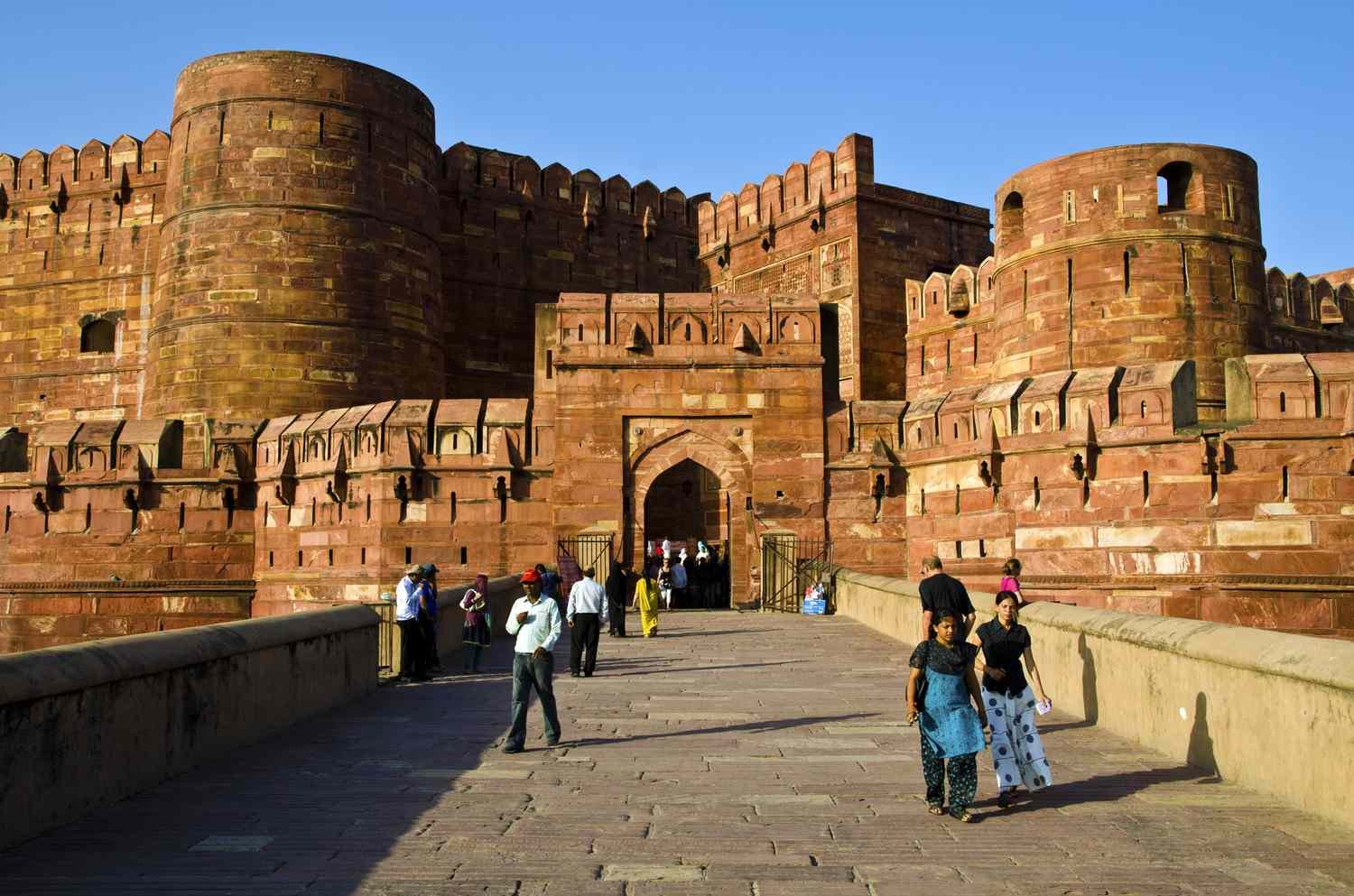
If the Taj Mahal is Agra’s most romantic monument, Agra Fort is its most powerful. A UNESCO World Heritage Site enclosed by 2.5-km-long walls of deep red sandstone rising 21 metres above the Yamuna River, the fort is simultaneously a military fortress and a royal palace of extraordinary refinement — and the combination is what makes it so compelling.
Construction began under Akbar in 1565 and continued under his successors Jehangir and Shah Jahan, each leaving their own architectural mark. The result is a complex that shifts between eras and styles as you move through it — from Akbar’s sturdy red sandstone military architecture to Shah Jahan’s delicate white marble palace pavilions that seem almost weightless by contrast.
What to see inside:
Diwan-i-Aam (Hall of Public Audience) is the vast colonnaded hall where the Mughal emperor held court for thousands of subjects. The raised marble throne alcove, set with pietra dura inlay work, is exquisite.
Diwan-i-Khas (Hall of Private Audience) is where the emperor met his nobles. The two thrones — one of white marble, one of black slate — sit on a terrace overlooking the Yamuna with a view of the Taj Mahal in the distance.
Sheesh Mahal (Hall of Mirrors) has walls and a ceiling covered in thousands of tiny convex mirror fragments. By candlelight, which your guide can arrange, the effect is extraordinary.
Musamman Burj (Octagonal Tower) is perhaps the most poignant spot in all of Agra. This exquisite white marble tower overlooks the Yamuna directly toward the Taj Mahal. This is where Shah Jahan spent the last 8 years of his life imprisoned by his son Aurangzeb — reportedly gazing at the tomb he built for his queen until he died in 1666.
Squid Travel Tip: Hire an official government-approved guide at the Amar Singh Gate entrance. At ₹300 to ₹500 for a 2-hour tour, a good guide transforms Agra Fort from a collection of old buildings into one of history’s great stories. The human context — the imprisonments, the betrayals, the extraordinary love story that produced the Taj — makes everything you see far more meaningful.
2. Fatehpur Sikri — The Abandoned Imperial City
Distance from Agra: 40 km | 1-hour drive Entry Fee: ₹40 (Indian) | ₹550 (Foreign) | Children under 15: Free Opening Hours: 6 AM to 6 PM daily | Closed Fridays for non-Muslim visitors Time Needed: 2 to 3 hours Best Time: Early morning or late afternoon
Fatehpur Sikri is one of the most extraordinary places in India. For 14 years — from 1571 to 1585 — it was the capital of the entire Mughal Empire, home to Akbar’s court, his wives, his artists, his philosophers, and the thousands of people who served them. Then, for reasons historians still debate — most likely water scarcity and military logistics — Akbar simply abandoned it and moved to Lahore. He never returned.
The result is a perfectly preserved Mughal imperial city frozen in time for over 400 years. The palaces, the courthouses, the royal apartments, the audience halls, and the great mosque all stand almost exactly as Akbar left them. Walking through Fatehpur Sikri feels genuinely different from any other monument in Agra because it is not a single building but an entire urban complex — the size and ambition of what Akbar built in just 14 years is staggering.
What to see:
Buland Darwaza (Gate of Victory) stands at 54 metres — the highest gateway in the world. Built to commemorate Akbar’s conquest of Gujarat, it dwarfs everything around it. Standing beneath it and looking up at the calligraphy carved across its surface is genuinely humbling.
Tomb of Sheikh Salim Chishti inside the Jama Masjid compound is the white marble tomb of the Sufi saint who blessed Akbar with an heir. Its marble screen walls, carved with intricate geometric patterns, are extraordinary works of craft. Thousands of pilgrims still tie threads to the screens and pray for children.
Diwan-i-Khas features the famous central pillar — a single carved column that branches into an ornate capital supporting four walkways radiating to the corners of the room. Akbar reportedly sat on a central platform atop the pillar and summoned advisors from each walkway, hearing different arguments from four directions simultaneously.
Panch Mahal is a five-storey open pavilion of tapering columns, each floor smaller than the one below, rising like a wedding cake above the palace complex. The views from the top across the entire Fatehpur Sikri complex are spectacular.
Jodha Bai’s Palace is the largest private palace in the complex, built for Akbar’s Hindu Rajput wife. The combination of Rajput and Mughal architectural elements — Hindu brackets, temple-style columns, Islamic arches — makes it one of the most architecturally interesting structures in the complex.
Squid Travel Tip: Arrive early to avoid both the heat and the persistent souvenir sellers near the entrances. The site is genuinely best experienced in the first two hours after opening. Children under 15 enter free.
3. Itmad-ud-Daulah’s Tomb — The Baby Taj
Distance from Taj Mahal: 4 km Entry Fee: ₹30 (Indian) | ₹310 (Foreign) Opening Hours: Sunrise to sunset Time Needed: 45 minutes to 1 hour Best Time: Morning
Often referred to as the Baby Taj, the Tomb of Itmad-ud-Daulah is one of Agra’s most beautiful and most undervisited monuments. Built between 1622 and 1628 by Empress Nur Jahan for her father Mirza Ghiyas Beg — who had risen from a Persian refugee to become Jehangir’s chief minister — the Baby Taj was the first Mughal building constructed entirely of white marble and the first to use pietra dura inlay at this scale.
Both of these innovations were later taken to their ultimate expression in the Taj Mahal, built two decades later. In this sense, the Baby Taj is not merely a precursor to the Taj Mahal — it is the laboratory where the techniques and aesthetic vocabulary of the Taj Mahal were first worked out.
The building itself is exquisite and intimate — far smaller than the Taj, more human in scale, and extraordinarily detailed. Every surface is inlaid with pietra dura: wine cups, flowers, cypress trees, and geometric patterns set with jasper, topaz, cornelian, and lapis lazuli. Looking closely at any panel, the precision of the inlay work is breathtaking.
Because the Baby Taj receives a fraction of the Taj Mahal’s visitors, you can often have the gardens and corridors almost entirely to yourself — a meditative, unhurried experience that is genuinely rare in Agra.
Squid Travel Tip: The Baby Taj sits on the east bank of the Yamuna River. From the garden facing the tomb, the Taj Mahal is visible on the opposite bank in the distance — a remarkable perspective that most visitors never see. Come in the early morning for the best light on the white marble.
4. Mehtab Bagh — The Best View of the Taj Mahal You Have Never Heard Of
Distance from Taj Mahal: 1.5 km directly across the Yamuna Entry Fee: ₹30 (Indian) | ₹300 (Foreign) Opening Hours: Sunrise to sunset daily Time Needed: 45 minutes to 1 hour Best Time: Sunset from October to March | Sunrise year-round
Here is a secret that experienced Agra travellers know and most first-timers discover too late: the best view of the Taj Mahal is not from inside the Taj Mahal complex. It is from Mehtab Bagh — the Mughal garden directly across the Yamuna River — also known as the Moonlight Garden.
From Mehtab Bagh, the Taj Mahal sits perfectly framed against the sky, reflected in the long rectangular pool that Shah Jahan designed for precisely this purpose. The garden was originally conceived as a mirror garden to the Taj — a cool retreat on the northern bank from which the emperor could view his great creation reflected in both the Yamuna and the garden’s central pool.
The Archaeological Survey of India has beautifully restored Mehtab Bagh, and what you find today is a peaceful, largely crowd-free garden with one of the greatest views in India at its far end. In the late afternoon of October to March, when the sun is low and golden and the Yamuna catches the light, the Taj Mahal seen from Mehtab Bagh is arguably more beautiful than from anywhere inside its own complex.
Squid Travel Tip: If you visit the Taj Mahal at sunrise, come to Mehtab Bagh at sunset on the same day. The two visits bookend your Agra experience — the Taj in the best light of both morning and evening, from opposite sides of the river, in completely different moods. No other pairing in Agra comes close.
5. Akbar’s Tomb, Sikandra — The Emperor’s Magnificent Resting Place
Distance from Agra city centre: 10 km Entry Fee: ₹30 (Indian) | ₹310 (Foreign) Opening Hours: Sunrise to sunset | Closed Fridays Time Needed: 1 to 1.5 hours Best Time: Morning
Emperor Akbar — the greatest of all the Mughal rulers, the man who built Fatehpur Sikri and Agra Fort and expanded the empire to cover nearly the entire Indian subcontinent — lies buried at Sikandra, 10 km from Agra on the Delhi road. His tomb is enormous, idiosyncratic, and deeply undervisited.
Akbar began designing his own tomb during his lifetime — a characteristic act of self-determination by an emperor who was never content to leave decisions to others. The result is a structure unlike anything else in Mughal architecture: a five-tiered pyramidal building that blends Hindu, Buddhist, Jain, Christian, and Islamic architectural elements, reflecting the syncretism of Akbar’s Din-e-Ilahi philosophy that attempted to unite all of India’s religions.
The approach through the main gateway leads through a large garden of freely roaming deer — blackbuck and spotted deer graze calmly through the grounds, completely untroubled by visitors. It is one of the most unexpectedly lovely approaches to any monument in India.
Inside the tomb, Akbar’s cenotaph sits in a vaulted hall of extraordinary height. The acoustics in this space are remarkable — sound reverberates for several seconds, and the effect in the cool darkness is deeply atmospheric.
Squid Travel Tip: Ask the custodians to demonstrate the acoustic effect in the central hall. They will call out a single syllable and let the reverberation fill the space — one of those small, memorable experiences that no guidebook prepares you for. The deer in the garden are equally worth your time — bring a camera with a decent zoom.
6. Chini Ka Rauza — Agra’s Most Overlooked Masterpiece
Distance from Taj Mahal: 3 km Entry Fee: Free Opening Hours: Sunrise to sunset Time Needed: 30 minutes Best Time: Morning
Chini Ka Rauza — literally China Tomb — is one of the most criminally overlooked monuments in Agra. Most visitors drive past it without knowing it exists. This is a genuine mistake.
Built as a tomb for Afzal Khan, the Persian poet and scholar who served as Shah Jahan’s prime minister, Chini Ka Rauza was constructed in the 1630s and decorated with something unique in Mughal architecture: an exterior covering of glazed tilework in brilliant blues, greens, yellows, and whites — an artistic tradition brought directly from Persia and found nowhere else in the Agra region.
The tiles have faded considerably over centuries of neglect, but what remains is extraordinary — geometric and floral patterns in vivid colour covering the dome and arched exterior, creating a building that looks completely unlike anything else in the Mughal canon. The interior ceiling is painted in intricate botanical and calligraphic patterns of exceptional delicacy.
Because almost no tour groups visit Chini Ka Rauza, you will likely have the tomb almost entirely to yourself. The grounds are shaded and peaceful, and the contrast between this jewel-like tiled monument and the white marble grandeur of the Taj and Baby Taj nearby is genuinely striking.
Squid Travel Tip: Chini Ka Rauza is free to enter and sits 3 km from the Taj Mahal on the Yamuna riverbank — easily combined with a visit to Mehtab Bagh and the Baby Taj on the same afternoon. Three extraordinary monuments in a 2-hour circuit, one of them completely free, and almost no crowds at any of them.
7. Ram Bagh — India’s Oldest Surviving Mughal Garden
Distance from Taj Mahal: 4 km Entry Fee: ₹25 (Indian) | ₹200 (Foreign) Opening Hours: Sunrise to sunset Time Needed: 30 to 45 minutes Best Time: Morning
Ram Bagh is quietly and without fanfare one of the most historically significant gardens in India — and almost nobody visits it.
Built around 1528 by Emperor Babur, the founder of the Mughal dynasty, Ram Bagh is the oldest surviving Mughal garden in India. The Mughal garden tradition — the formal char-bagh or four-quartered garden divided by water channels, planted with fruit trees and fragrant flowers, designed as a vision of paradise on earth — began here on the banks of the Yamuna in Agra.
Every Mughal garden you have ever seen or read about — the Taj Mahal gardens, the Shalimar Bagh in Kashmir, the gardens of Lahore — traces its design lineage back to this garden. Babur himself was temporarily buried here before his remains were moved to Kabul.
The garden today is peaceful, beautifully maintained, and offers a lovely walk among old trees and water channels with river views from its pavilions.
Squid Travel Tip: Ram Bagh is ideal as a quiet 30-minute stop combined with the Baby Taj and Mehtab Bagh on an afternoon Yamuna-bank circuit. It is rarely crowded and offers one of the most genuinely peaceful experiences available anywhere in Agra.
8. Jama Masjid Agra — The City’s Magnificent Friday Mosque
Distance from Agra Fort: 500 metres Entry Fee: Free Opening Hours: Open to visitors outside prayer times Time Needed: 30 minutes Best Time: Morning
Agra’s Jama Masjid — built by Shah Jahan in 1648 and dedicated to his daughter Jahanara Begum — is one of the most beautiful mosques in India and one of the least visited major monuments in the city. Most tour groups heading to Agra Fort overlook it entirely, which is a significant oversight.
The mosque rises from a high plinth in a bustling market area, its three marble domes striped in red and white in a pattern unique to this building. The vast sandstone courtyard — capable of holding thousands of worshippers — has a serene, unhurried quality that contrasts beautifully with the commercial energy of the lanes around it.
The interior of the main prayer hall is coolly beautiful: carved sandstone arches, an intricate mihrab or prayer niche of white marble, and pietra dura panels of exceptional quality.
Squid Travel Tip: Remove your shoes before entering and dress modestly — covered shoulders and knees for both men and women. The mosque is an active place of worship and visitors are welcome but should behave with appropriate respect. The views from the mosque’s entrance steps down into the chaotic, colourful market streets below are excellent and worth pausing for.
9. Kinari Bazaar and Sadar Bazaar — Shopping in Agra’s Historic Heart
Distance from Taj Mahal: 3 km Entry Fee: Free Opening Hours: 10 AM to 8 PM | Most shops closed Sundays Time Needed: 1 to 2 hours Best Time: Late morning or late afternoon
No visit to Agra is complete without time in its historic bazaars — and most tourists, rushing between monuments on tight itineraries, miss them entirely.
Kinari Bazaar, located near the Jama Masjid in the old city, is one of Agra’s most atmospheric traditional markets. Its narrow lanes — impossibly crowded, fragrant with incense and street food, hung with sequined fabrics and metalwork — have been trading since the Mughal era. It specialises in zari or gold and silver thread embroidery, bridal wear, and intricate gold ribbon trim used in traditional Mughal dress.
Sadar Bazaar, near the Taj Mahal’s eastern gate, is the more tourist-friendly option. This is where to buy Agra’s famous marble pietra dura handicrafts — boxes, plates, and decorative panels inlaid with semi-precious stones in the exact technique used to decorate the Taj Mahal. Agra’s marble inlay tradition is centuries old and still practiced by craftsmen whose families have worked the stone for generations.
What to buy in Agra: Marble pietra dura items such as boxes, coasters, plates, and frames. Leather footwear, since Agra is India’s shoe-making capital. Petha — the translucent sweet made from ash gourd that is unique to Agra and comes in dozens of varieties including saffron, rose, and paan. Zardozi embroidered textiles and miniature paintings on marble.
Squid Travel Tip: The marble souvenirs sold right outside the Taj Mahal entrances are overwhelmingly low-quality mass-produced items. For genuine quality pietra dura marble work, go to the workshops in the Kinari Bazaar area where craftsmen actually make the pieces. Watch them work — they will gladly demonstrate the technique. The quality difference is immediately obvious.
10. Mohabbat The Taj — An Evening Show Worth Every Rupee
Location: Near the Taj Mahal western gate Entry Fee: ₹700 to ₹1,500 depending on seat category Timing: Evening shows — check current schedule on arrival Time Needed: 1.5 hours Best Time: Any evening during your Agra stay
For your last evening in Agra — after the monuments have closed and the Taj Mahal is sealed for the night — there is one more extraordinary experience that most tourists never discover.
Mohabbat The Taj is a live theatrical spectacular that tells the story of how the Taj Mahal was built: the love story of Shah Jahan and Mumtaz Mahal, the 22 years of construction, the 20,000 craftsmen, the political intrigues, and the final tragedy of the emperor’s imprisonment and his years gazing at the tomb he built for his queen.
Performed in a purpose-built amphitheatre with the original Taj Mahal gate as a backdrop, the show combines classical dance, live music, elaborate Mughal-era costumes, and dramatic staging to create an evening that contextualises everything you have seen during the day. For many visitors, it becomes the emotional highlight of their entire Agra trip — not the Taj itself, but the story behind it, told with genuine artistry.
Squid Travel Tip: Book tickets in advance, particularly during peak season from October to March. Squid Travel India includes Mohabbat The Taj in our premium Agra itineraries for guests who want more than a standard monument visit.
Bonus: Sheroes Hangout Café — A Visit With Purpose
Distance from Taj Mahal: 1 km Entry Fee: None — spend on food and drinks inside Opening Hours: 10 AM to 8 PM Time Needed: 45 minutes
Sheroes Hangout is not a historical monument and it will not appear on any list of Mughal sites. But it is one of the most meaningful places you can visit in Agra, and we include it in every itinerary we build for guests who want their travel to stand for something.
Sheroes Hangout is a café run entirely by acid attack survivors — women who were disfigured by acid attacks and who have reclaimed their lives, their confidence, and their voices through this remarkable space. The café serves good food and excellent chai, employs the survivors with dignity and fair wages, and functions as an awareness centre for acid attack victim support in India.
The women who work here are not victims displaying their suffering for visitors. They are businesswomen running a café, hosting customers, and choosing every day to live with extraordinary courage. A visit here — a cup of chai, a meal, a purchase of their handicrafts — is a small but genuine act of support for something that matters deeply.
Squid Travel Tip: This is particularly recommended for groups travelling with teenage children. The conversations that happen after a visit to Sheroes Hangout — about violence, survival, dignity, and courage — are often the ones that stay with young travellers the longest of anything they see on their entire India trip.
How to Plan Your Time in Agra
If You Have 1 Day
- 5:30 AM — Taj Mahal at sunrise (2 hours)
- 8:00 AM — Breakfast near Taj Ganj
- 10:00 AM — Agra Fort (2 hours)
- 12:30 PM — Lunch
- 2:00 PM — Baby Taj / Itmad-ud-Daulah (1 hour)
- 3:30 PM — Mehtab Bagh for sunset Taj view (45 minutes)
- Evening — Sadar Bazaar, Petha tasting, depart
If You Have 2 Days
Day 1: Taj Mahal sunrise → Agra Fort → Baby Taj → Mehtab Bagh sunset
Day 2: Fatehpur Sikri morning → Akbar’s Tomb afternoon → Kinari Bazaar → Mohabbat The Taj evening
If You Have 3 Days
Add Chini Ka Rauza, Ram Bagh, Jama Masjid, Sheroes Hangout, and a day trip to Mathura and Vrindavan — Krishna’s birthplace 45 km away, with extraordinary temples, colour, and atmosphere that is completely different from anything else in the Agra region.
Agra Tourist Places — Quick Reference (2026)
| Place | Distance from Taj | Entry (Foreign) | Best Time | Highlight |
|---|---|---|---|---|
| Agra Fort | 2.5 km | ₹610 | 9–11 AM | Musamman Burj prison tower |
| Fatehpur Sikri | 40 km | ₹550 | Early morning | Buland Darwaza, Diwan-i-Khas |
| Baby Taj | 4 km | ₹310 | Morning | Pietra dura inlay detail |
| Mehtab Bagh | 1.5 km | ₹300 | Sunset | Taj Mahal reflection in pool |
| Akbar’s Tomb | 10 km | ₹310 | Morning | Deer garden, acoustic hall |
| Chini Ka Rauza | 3 km | Free | Morning | Persian blue tilework |
| Ram Bagh | 4 km | ₹200 | Morning | India’s oldest Mughal garden |
| Jama Masjid | 3 km | Free | Morning | Striped marble domes |
| Kinari Bazaar | 3 km | Free | Late morning | Marble crafts, Petha sweets |
| Mohabbat The Taj | 0.5 km | ₹700–₹1,500 | Evening | Taj Mahal love story show |
Practical Tips for Your Agra Visit (2026)
Getting to Agra from Delhi: The Gatimaan Express — India’s fastest train — covers the 200 km between Delhi Hazrat Nizamuddin and Agra Cantonment in approximately 100 minutes. By road, the Yamuna Expressway makes the drive approximately 3 to 3.5 hours.
Getting around Agra: Pre-paid auto-rickshaws, e-rickshaws, and app-based cabs like Ola and Uber are widely available. For a full-day monuments circuit, booking a private car with driver for the day at ₹1,500 to ₹2,500 is the most comfortable and time-efficient option. Squid Travel India provides private air-conditioned vehicles as standard for all Agra itineraries.
What to eat in Agra: Petha is Agra’s most famous food — the translucent ash gourd sweet comes in dozens of varieties including original, saffron, rose, and kesar paan. Bedai is the classic Agra breakfast — deep-fried bread with spiced lentil curry. Street biryani near Kinari Bazaar is excellent. For a sit-down meal, Pind Balluchi near Fatehabad Road is consistently reliable.
Best time to visit Agra: October to March is ideal — cool temperatures, clear skies, and the best light for photography. The Taj Mahal at sunrise in November or December, when a faint mist rises from the Yamuna and the white marble glows in the first golden light, is one of the great visual experiences in India. Avoid May and June when temperatures regularly exceed 45°C.
Explore Agra Properly with Squid Travel India
Most visitors to Agra spend four rushed hours at the Taj Mahal and drive away. They miss two UNESCO World Heritage Sites, a dozen extraordinary monuments, centuries of Mughal history, and a city that deserves — and rewards — far more time than the typical Golden Triangle itinerary allows.
At Squid Travel India, our Agra itineraries are built around depth rather than speed. Expert local guides who know every room of Agra Fort and every stone of Fatehpur Sikri. Private air-conditioned transport throughout. Carefully timed visits that put you in the right place at the right light. And the flexibility to spend more time wherever the experience moves you.
Whether you want a single day in Agra done properly, a 2-night deep dive into the full Mughal heritage, or an Agra extension added to your Golden Triangle or Rajasthan itinerary — our team will build the right plan for you.
WhatsApp / Call: +91 9990812499 Email: squidtravelindia@gmail.com Explore Agra Tour Packages: squidtravelindia.com
The Taj Mahal will take your breath away. What you discover beyond it will bring you back.
Comment (0)