

By Squid Travel India | Updated: July 2026 | 16 min read
Written by the travel experts at Squid Travel India — a New Delhi-based tour operator with years of first-hand experience guiding visitors across Spiti Valley in every season. TripAdvisor Travellers’ Choice Award, 2024–2025.
Spiti Valley does not ease you in gently.
The moment you cross into it — whether through the gorges of Kinnaur from the Shimla side or over the 4,551-metre Kunzum Pass from Manali — the landscape changes completely. Rust-coloured mountains rise from a cold desert floor. The Spiti River runs impossibly blue through a valley too wide and too silent for the scale to feel real. Ancient monasteries cling to clifftops above villages where life has changed remarkably little in a thousand years.
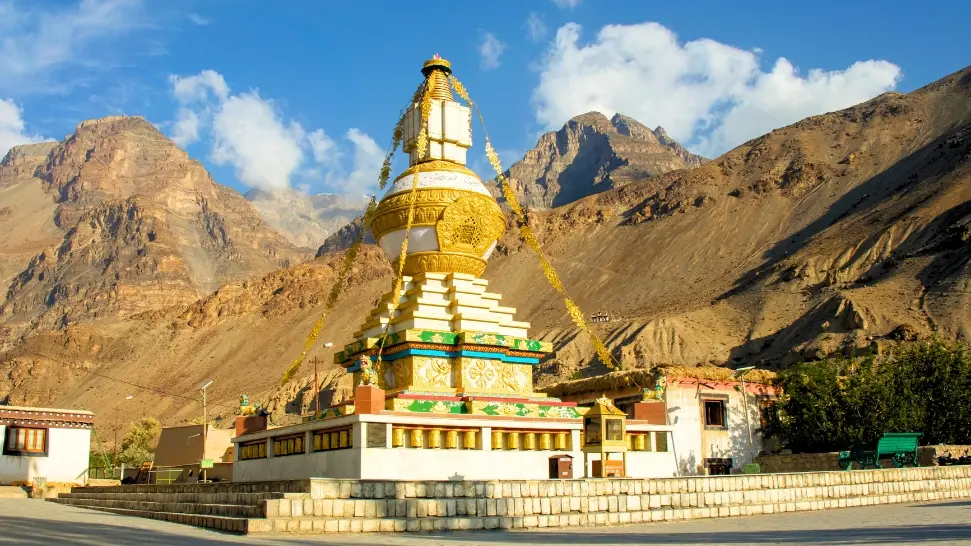
Spiti is not a destination you stumble upon. The roads are long, the altitude is real, and the journey demands intention. What it gives back in return — monasteries, glacial lakes, fossil villages, high-altitude passes, and a stillness you cannot find anywhere else in India — is proportionate to the effort.
This is the complete guide to every place worth visiting in Spiti Valley in 2026 — with exact locations, what to expect, the best time to visit each place, and how to organise your days so you see everything that matters without wasting a single one.
Quick Reference: Best Places to Visit in Spiti Valley
| Place | Type | Altitude | Best Season | Time Needed |
|---|---|---|---|---|
| Kaza | Town / Base | 3,800 m | May–October | 1–2 days |
| Key Monastery | Monastery | 4,166 m | June–October | 2–3 hours |
| Kibber Village | Village | 4,270 m | June–October | 2–3 hours |
| Chicham Bridge | Bridge / Viewpoint | 4,350 m | June–October | 1 hour |
| Langza | Village | 4,400 m | June–October | 3–4 hours |
| Hikkim | Village | 4,440 m | June–October | 1–2 hours |
| Komic | Village | 4,513 m | June–October | 1–2 hours |
| Chandratal Lake | Lake | 4,300 m | June–October | Half day |
| Tabo Monastery | Monastery | 3,280 m | May–October | 3–4 hours |
| Dhankar Monastery | Monastery | 3,894 m | June–October | 3–4 hours |
| Dhankar Lake | Lake | 4,100 m | June–October | Half day |
| Pin Valley | National Park / Village | 3,700–4,700 m | June–October | Full day |
| Mudh Village | Village | 3,800 m | June–October | Half day |
| Kunzum Pass | Mountain Pass | 4,551 m | Mid-June–October | 1–2 hours |
| Losar | Village | 4,079 m | Mid-June–October | 1 hour |
| Nako | Village / Lake | 3,662 m | May–October | Half day |
| Gue | Village | 3,800 m | June–October | 2–3 hours |
PART 1: THE ESSENTIALS — Places Every Spiti Visitor Must See
1. Kaza — The Heart of Spiti
Altitude: 3,800 metres
Type: Main town, base for all Spiti sightseeing
Best time: May to October
Time needed: 1–2 days (as base)
Every Spiti trip runs through Kaza. It is the district headquarters of Spiti, the largest settlement in the valley, and the logistical centre for everything else on this list. From Kaza, most of Spiti’s major attractions are within a 1–2 hour drive.
At 3,800 metres, Kaza is your acclimatisation stop — and that function deserves to be taken seriously. Spend your first 24–48 hours here before heading to the higher villages and passes. Walk slowly. Drink water constantly. Eat light. Skip the alcohol completely for the first two days. Altitude sickness at 4,500 metres (where several of the top attractions sit) is significantly worse if you have not acclimatised properly in Kaza first.
Beyond its practical function, Kaza is worth exploring in its own right. The town divides into two parts — old Kaza, a traditional mud-brick settlement on the ridge above, and new Kaza, the more developed commercial area below. The local market sells traditional Tibetan clothes, jewellery, and handwoven goods alongside the basic supplies that every traveller needs. Several excellent small cafes serve thukpa (Tibetan noodle soup), butter tea, tsampa (roasted barley flour), and surprisingly good coffee. The views from the upper part of old Kaza across the valley and to the Spiti River below are outstanding — particularly at sunset.
Do not miss: The old village of Kaza above the main market, the local market for Tibetan handicrafts, and a meal of thukpa and butter tea at one of the small family-run restaurants.
2. Key Monastery (Ki Gompa) — The Icon of Spiti
Altitude: 4,166 metres
Distance from Kaza: 14 km
Type: Active Buddhist monastery
Best time: June to October
Time needed: 2–3 hours
Entry fee: Free (donations appreciated)
Key Monastery is the largest, most famous, and most visually striking monastery in Spiti Valley. Perched dramatically on a hilltop above the Spiti River, it has stood here for over a thousand years — rebuilt repeatedly after invasions, earthquakes, and fires, and always rebuilt on the same clifftop site.
The monastery is home to over 300 monks and continues to function as an active centre of Buddhist learning. This matters: you are visiting a working monastery, not a museum. Monks live here, study here, and practise here. The prayer halls, the thangka paintings, the ancient scriptures, and the weapons and armour dating back centuries are not exhibits — they are part of a living tradition.
The approach to Key Monastery from the road below is one of the most photographed sequences in all of Himachal Pradesh. As you climb, the gompa rises above you in layers of whitewashed and ochre walls, stacked against the bare brown mountain behind it. In the early morning, the eastern light catches the walls and turns them golden. At sunset, the entire structure glows against a darkening sky. Both are worth experiencing if your schedule allows.
The interior prayer halls contain extraordinary thangka paintings — large silk Buddhist paintings depicting deities, mandalas, and scenes from the life of the Buddha. Many are centuries old. The rooftop offers a panoramic view across the Spiti Valley that alone justifies the climb.
Insider tips:
- Arrive before 9:00 AM. Most visitors arrive between 10:00 AM and 2:00 PM. Early morning gives you the monastery in near-silence, the best light, and the experience of watching the monks begin their daily prayers.
- Remove shoes before entering any prayer hall.
- Photography is permitted in the exterior areas. Always ask before photographing inside prayer halls or during ceremonies.
- Key Monastery combines perfectly with Kibber Village and Chicham Bridge on the same day — all three are within a short drive of each other above Kaza.
3. Kibber Village — Where People Actually Live
Altitude: 4,270 metres
Distance from Kaza: 16 km
Type: High-altitude village
Best time: June to October
Time needed: 2–3 hours
Kibber sits at 4,270 metres and gives you something that most sightseeing stops in Spiti do not: a real, functioning village where people live year-round in conditions that most visitors find genuinely hard to imagine.
The village is connected to Kaza by road and to the dramatic Chicham Bridge by a short drive. The mud-brick houses of Kibber, built in the traditional Spitian style with flat roofs stacked with winter firewood, blend so naturally into the brown mountain behind them that from a distance the village and the cliff appear to be the same thing.
Walking through Kibber takes you past houses, small Buddhist shrines, prayer wheels, and the occasional yak or goat navigating the narrow lanes. The local monastery — Kibber Monastery — is small but active, and the resident monks are generally welcoming to respectful visitors.
The landscape around Kibber is among Spiti’s finest. The valley falls away below, the Spiti River glints far down, and the surrounding peaks — bare, brown, and enormous — frame a view that no photograph fully captures.
Insider tips:
- Kibber is best visited as part of a Key Monastery–Kibber–Chicham circuit from Kaza. Allow a full half-day for all three.
- Snow leopards have been sighted in the hills around Kibber in winter (December–February) — this is one of the better locations for sightings from Kaza.
- The road from Key Monastery up to Kibber is one of the most scenic drives in the valley. Do not rush it.
4. Chicham Bridge — Asia’s Highest Suspension Bridge
Altitude: 4,350 metres
Distance from Kaza: 18 km (via Kibber)
Type: Bridge / viewpoint
Best time: June to October
Time needed: 1 hour
Chicham Bridge connects the village of Kibber to the village of Chicham across a dramatic gorge that drops approximately 150 metres to the Spiti River below. Until the bridge was built in 2017, the residents of Chicham were effectively cut off from Kibber and Kaza during the winter months — a fact that puts the bridge’s significance in sharp human relief.
The bridge itself is a straightforward suspension structure — not visually spectacular in isolation. What makes it extraordinary is the setting: the gorge drops vertically below you, the opposing cliff face is just metres away, and the Spiti River is a thin blue line far beneath your feet. Walking across, the combination of exposure and altitude gives most visitors a significant adrenaline charge.
The viewpoint from the Kibber side, looking across at the bridge with the gorge and valley beyond, is one of Spiti’s most dramatic photographs.
Insider tips:
- The bridge is freely accessible at any time.
- Walk across rather than just photographing from the edge — the crossing itself is the experience.
- Chicham village on the far side is a tiny, quiet settlement worth a short walk through after crossing.
5. Langza — The Fossil Village
Altitude: 4,400 metres
Distance from Kaza: 20 km
Type: Village / fossil site / Buddhist statue
Best time: June to October
Time needed: 3–4 hours
Langza is one of Spiti’s most distinctive and memorable stops — a small village at 4,400 metres defined by two extraordinary things: a towering golden Buddha statue at the village edge gazing serenely across the valley, and a geological secret buried in the ground at your feet.
The Buddha statue stands against the open sky with the brown Himalayan peaks behind it. At sunset, the golden stone catches the fading light and the statue seems to glow from within. This is one of Spiti’s most iconic photographic images — and in person it is more striking than any photograph suggests.
The geological secret is this: Langza sits on what was once the floor of the ancient Tethys Ocean, 450 million years ago. When the Indian tectonic plate collided with the Eurasian plate and pushed the Himalayas skyward, the ocean floor was lifted with it. The fossils of marine creatures — ammonites, corals, and sea shells — remain in the rock and soil at 4,400 metres, millions of years after the ocean that made them disappeared. Local children often collect and sell ammonite fossils at the village edge for a few hundred rupees. They are genuine, and extraordinary to hold — a 450-million-year-old ocean creature in your hand on a Himalayan mountaintop.
Insider tips:
- Langza, Hikkim, and Komic are best visited as a single circuit from Kaza — all three in one morning or afternoon.
- Arrive at Langza for the golden hour before sunset and the Buddha statue will be at its most photogenic.
- Do not remove fossils from the landscape — buy from local sellers if you want to take one home.
- The village has a small monastery worth visiting before or after the Buddha statue.
6. Hikkim — The World’s Highest Post Office
Altitude: 4,440 metres
Distance from Kaza: 22 km
Type: Village / unique experience
Best time: June to October
Time needed: 1–2 hours
Hikkim is home to one of the most unusual postal claims in the world: the highest post office on earth, operating at 4,440 metres. It is a small, unremarkable building by any conventional standard — but what it represents, and what you can do there, makes it one of Spiti’s most visited stops.
The post office is open on weekdays during the season (June–October). You can write a postcard, buy stamps, and post it from Hikkim — and your postcard will be franked with the Hikkim postmark, one of the most unusual postmarks available anywhere in India. For many travellers, a postcard from the world’s highest post office to someone at home becomes one of the more memorable souvenirs of the entire trip.
The village around the post office is small and quiet. The views across the valley and toward Key Monastery (visible from certain angles above the village) are outstanding.
Insider tips:
- Bring postcards from Kaza or Langza — the post office sells stamps but may not always have a good supply of cards.
- The postmaster is generally happy to chat and is accustomed to international visitors. Respect his time and working environment.
- Hikkim sits between Langza and Komic on the circuit from Kaza — do all three in sequence.
7. Komic — One of the World’s Highest Villages
Altitude: 4,513 metres
Distance from Kaza: 27 km
Type: High-altitude village / monastery
Best time: June to October
Time needed: 1–2 hours
Komic sits at 4,513 metres — one of the highest motorable villages in the world, accessible by a road that climbs to altitudes where the air is noticeably, physically thin. The village has a small resident population that has lived at this altitude for generations, with an adaptability to the cold desert conditions that visitors find difficult to fully comprehend from the comfort of a few days’ visit.
The Tangyud Monastery in Komic is active and worth visiting — a small but atmospheric gompa with resident monks and interiors containing traditional Tibetan Buddhist murals and statues. The monastery’s rooftop affords a 360-degree view of the high-altitude landscape that is extraordinary in its scale and emptiness.
The landscape around Komic has a different quality to lower Spiti — more exposed, more elemental, and completely silent except for the wind. At this altitude, even a short walk leaves most visitors slightly breathless. Take it slowly.
Insider tips:
- Komic is the final stop on the Langza–Hikkim–Komic circuit and the highest. Do Komic last to allow for gradual altitude increase through the morning.
- The road to Komic requires a high-clearance vehicle. Do not attempt in a sedan.
- Sunset from Komic — looking back down toward Kaza and the Spiti River valley — is one of the finest in the entire region.
PART 2: THE MUST-SEE MONASTERIES
8. Tabo Monastery — The Ajanta of the Himalayas
Altitude: 3,280 metres
Distance from Kaza: 47 km (on the Shimla–Kinnaur approach road)
Type: Monastery / UNESCO Tentative List site
Best time: May to October
Time needed: 3–4 hours
Entry fee: ₹50 for foreign nationals
Tabo Monastery is over 1,000 years old. Founded in 996 CE, it is one of the oldest continuously functioning Buddhist monasteries in the world — and its murals, sculptures, and thangkas are among the finest surviving examples of early Indo-Tibetan Buddhist art anywhere on earth.
The Dalai Lama has referred to Tabo as “the most important monastery in the world” for the preservation of early Buddhist art. The main prayer hall — the Assembly Hall — contains clay sculptures and murals in such extraordinary condition that art historians compare them directly to the Ajanta Caves of Maharashtra. The level of detail, the quality of colour preservation after more than a thousand years, and the artistic sophistication of the work are genuinely remarkable.
The monastery complex includes nine temples, four stupas, and a set of meditation caves cut into the cliff face above the monastery — used by monks for extended solitary retreat. The caves themselves are accessible and the experience of sitting inside one, looking out across the valley, is quietly extraordinary.
Tabo sits on the Spiti River at 3,280 metres — lower than Kaza and most of the high-altitude villages — which makes it a natural first stop for travellers arriving from the Shimla–Kinnaur side. Many visitors spend a full day or even two nights in Tabo before continuing to Kaza.
Insider tips:
- Photography restrictions apply inside the main prayer halls — follow the monastery’s guidelines carefully. The murals are fragile and irreplaceable.
- The meditation caves above the monastery require a short steep climb but are completely accessible. Early morning visits offer the best light inside the caves.
- Tabo village has several good guesthouses and homestays. Spending a night here — rather than rushing through — allows you to see the morning puja and explore the caves at leisure.
- A small café beside the monastery serves excellent chai and simple meals.
9. Dhankar Monastery and Dhankar Lake
Altitude: 3,894 metres (monastery) / 4,100 metres (lake)
Distance from Kaza: 34 km
Type: Monastery / lake / viewpoint
Best time: June to October
Time needed: 3–4 hours (monastery) + 1.5 hours (lake trek)
Dhankar Monastery occupies one of the most dramatically positioned sites of any building in India. Perched on a crumbling mud cliff at the confluence of the Spiti and Pin rivers, the monastery appears to grow directly from the rock — its mud and stone walls indistinguishable from the cliff beneath them until you are close enough to see the windows.
This was once the royal seat of the Nono — the king of Spiti. The old fort-monastery dates back over 1,000 years and is so structurally fragile that parts of it are actively crumbling into the valley below. A newer monastery has been built a short distance above, but the old structure — abandoned but accessible — is the more atmospheric and more extraordinary of the two.
The views from Dhankar are among Spiti’s finest. The confluence of two rivers visible far below, the Pin Valley stretching away to the south, and the barren mountain ridges in every direction create a panorama of extraordinary scale.
Above the monastery, a 45-minute uphill walk leads to Dhankar Lake — a small glacial lake sitting in a bowl of arid ridges at 4,100 metres. The lake is still and dark, completely without sound except the wind, and surrounded by a landscape so elemental that it is hard to believe you walked here from a road. The walk is straightforward and the reward is significant.
Insider tips:
- Visit the old monastery first, then the new one, then do the lake trek. This is the most logical sequence.
- The lake trek is straightforward but the altitude makes it tiring — go slowly and carry water.
- Visit in the late afternoon for the best light on the monastery and the valley below.
- The road from the main highway up to Dhankar requires a high-clearance vehicle for the final stretch.
10. Kungri Monastery — Pin Valley’s Ancient Gompa
Altitude: 3,700 metres
Distance from Kaza: 42 km (via Pin Valley)
Type: Monastery
Best time: June to October
Time needed: 1–2 hours
Entry fee: Free
Kungri Monastery sits in the Pin Valley and holds the distinction of being the second oldest monastery in Spiti Valley, founded in 1330. It follows the Nyingmapa school of Tibetan Buddhism — making it unique among Spiti’s monasteries, which are predominantly of the Gelugpa school.
The monastery’s architecture is more intimate and less dramatic than Key or Dhankar — but the interior murals and the age of the structure give it a quiet power that more visited sites sometimes lack. Because Kungri sits off the main Kaza sightseeing circuit, it sees far fewer visitors than Key or Tabo, and that solitude is part of its appeal.
PART 3: THE NATURAL WONDERS
11. Chandratal Lake — The Moon Lake
Altitude: 4,300 metres
Distance from Kaza: 73 km (via Kunzum Pass or Batal)
Type: High-altitude lake
Best time: June to early October
Time needed: Half day (including 3 km trek from parking)
Entry fee: ₹150 per person (HPTDC conservation fee)
Chandratal is Spiti’s most famous natural landmark and one of the most beautiful lakes in India. The crescent-shaped glacial lake sits at 4,300 metres in a bowl of bare mountains above the Chandra River. The water is an extraordinary deep turquoise — a colour that shifts with the light from pale mint green to deep cerulean to dark indigo as clouds pass overhead — and so clear that the lake floor is visible several metres down.
Chandratal is accessible from June to early October, when the road via Kunzum Pass or the approach from Batal is clear of snow. There is no motorable road directly to the lake — you park at the end of the accessible road and walk approximately 3 kilometres on a flat, well-marked trail to reach the water. The walk takes 45 minutes to an hour at this altitude.
Camping at Chandratal is among the finest experiences available anywhere in the Himalayas. Waking before dawn, the lake surface is completely still and perfectly reflective — the stars, the mountains, and the moon (on clear nights) mirror in the water below. As the sun rises, the mountains on the eastern bank are lit pink and orange before the lake itself catches the light. The sequence of colours across the first hour of the morning is extraordinary and changes faster than most cameras can track.
Insider tips:
- Camp overnight if at all possible — the dawn light and the night sky over Chandratal are the primary reasons to come. Day trips from Kaza miss both.
- Authorised camping zones are designated around the lake — do not set up camp outside them.
- No plastic is permitted in the Chandratal area. Carry a reusable water bottle and pack out everything you bring in.
- Cross streams on the approach trail before 10:00 AM — snowmelt makes them significantly deeper by afternoon.
- The route via Kunzum Pass from Kaza allows you to combine Chandratal with the Kunzum Pass viewpoint on the same day.
12. Kunzum Pass — The Gateway Between Two Worlds
Altitude: 4,551 metres
Distance from Kaza: 77 km
Type: High mountain pass
Best time: Mid-June to October
Time needed: 1–2 hours
Entry fee: Free
Kunzum Pass is the threshold between Lahaul and Spiti — and crossing it in either direction is one of the defining moments of any Spiti journey. At 4,551 metres, it is one of the highest motorable passes in India, open only from mid-June to mid-October depending on the year’s snowfall.
At the top of the pass stands the Kunzum Devi Temple — a small stone shrine where travellers traditionally circumambulate before continuing their journey as an act of gratitude and protection. The ritual is simple, genuine, and moving in context: before you, the road drops away toward Lahaul and the green mountains of Manali. Behind you, Spiti’s brown desert valley stretches back toward Kaza. The contrast between the two worlds on either side of the pass is dramatic and immediate.
The views from Kunzum La across to the glaciers and back down toward Chandratal are some of the most open mountain views available anywhere in India. On a clear day, peaks of 6,000 metres and above are visible in multiple directions.
13. Pin Valley National Park — Snow Leopard Country
Altitude: 3,700 to 4,700 metres
Distance from Kaza: 25–50 km
Type: National park / wildlife
Best time: June to September (wildlife) / December to February (snow leopard)
Time needed: Full day minimum
Entry fee: ₹50 for Indian nationals / ₹650 for foreign nationals
Pin Valley branches south from the main Spiti Valley at Attargo village and runs for approximately 50 kilometres into the mountains. The Pin River runs through it, fed by glaciers at the southern end. The valley is a national park — home to the snow leopard, the Himalayan ibex, the red fox, the Himalayan wolf, and over 120 species of birds including the golden eagle.
In summer (June to September), the lower Pin Valley is green with wildflowers and the ibex are visible on the ridgelines above. The Pin Valley road runs as far as Mudh Village — the highest accessible village in the valley at 3,800 metres — and from Mudh several outstanding treks begin, including the famous Pin–Parvati Pass trek that crosses into the Kullu Valley on the other side.
In winter (December to February), the snow leopard descends from its glacial habitat to lower elevations in search of prey — particularly the ibex and the blue sheep (bharal) that winter in the valley. Pin Valley is one of the best locations in India for snow leopard sightings, though even in winter they require patience, time, and luck. Specialist wildlife photography expeditions to Pin Valley in winter are a growing niche for serious wildlife travellers.
Insider tips:
- Hire a local guide from Kaza or Mudh for any wildlife-focused visit — they know the terrain and the animals’ patterns.
- The Kungri Monastery sits inside Pin Valley and combines naturally with a Pin Valley day trip.
- For the snow leopard specifically, plan for a minimum of 5–7 days in winter with a specialist operator — a one-day visit rarely yields sightings.
- The road to Mudh is rough and requires a high-clearance vehicle.
PART 4: OFF THE BEATEN TRACK — Hidden Gems
14. Gue Village and the 500-Year-Old Mummy
Altitude: 3,800 metres
Distance from Kaza: 68 km (via Tabo)
Type: Village / unusual heritage site
Best time: May to October
Time needed: 2–3 hours
Gue is a small village near the Indo-Tibetan border in the Hangrang Valley, about 20 kilometres east of Tabo on the road toward the Sumdo border. It is not on the main Spiti circuit but is worth a significant detour for a single extraordinary reason: the naturally preserved mummy of a Tibetan Buddhist monk, dating back approximately 500 years.
The mummy — seated in a meditation posture, remarkably intact — was discovered in 1975 following an earthquake that exposed the burial chamber. It is now housed in a small purpose-built chamber in Gue village and is considered by local Buddhists to be the preserved body of Sangha Tenzing, a monk who is said to have willingly allowed himself to be buried alive in meditation.
The experience of standing before a 500-year-old mummy in a remote Himalayan village — in a chamber with no other visitors, in near-complete silence — is unlike anything else on the Spiti circuit. It is not macabre. It is deeply strange and deeply moving.
Insider tips:
- Gue requires a dedicated half-day detour from Tabo or the Shimla–Kinnaur approach route.
- The village is close to the Indo-Tibetan border — carry your Inner Line Permit.
- The approach road requires a high-clearance vehicle.
- Visit respectfully — this is an active religious site for the local community, not a tourist exhibit.
15. Nako Village and Nako Lake
Altitude: 3,662 metres
Distance from Kaza: 110 km (on the Shimla–Kinnaur approach road)
Type: Village / lake
Best time: May to October
Time needed: Half day
Nako sits on the Shimla–Kinnaur approach route to Kaza, making it a natural overnight stop for travellers entering or exiting Spiti from the east. The village is built on a shelf above the Spiti River with a small lake at its centre — Nako Lake — surrounded by willow trees that in autumn turn a brilliant yellow against the brown desert mountains.
The 1,000-year-old Nako Monastery beside the lake is one of the finest early Buddhist art sites on the Kinnaur–Spiti route, with murals and sculptures comparable in quality to Tabo. The village itself — its traditional houses, its lanes, its farming terraces — is one of the most photogenic in all of Spiti.
Most travellers pass through Nako in transit. Spending a night here, walking the lake circuit at sunset and visiting the monastery in the morning quiet, transforms it from a roadside stop into one of the more memorable places on the entire route.
16. Losar — First and Last Village
Altitude: 4,079 metres
Distance from Kaza: 55 km (toward Kunzum Pass)
Type: Village
Best time: Mid-June to October
Time needed: 1 hour
Losar is the last village in Spiti before the Kunzum Pass and the first village travellers reach when entering Spiti from the Manali side. It is small, quiet, and photogenic — a cluster of traditional mud-brick houses in a wide valley, with the Chandra River visible in the distance and the pass road climbing steeply beyond.
Most visitors pass through Losar without stopping. Those who do stop find a welcoming community with a handful of basic homestays and a small monastery. As a photography subject — the village against the open valley, the prayer flags snapping in the wind, the vast emptiness beyond — Losar is one of Spiti’s most underrated subjects.
17. Mudh Village — End of the Road in Pin Valley
Altitude: 3,800 metres
Distance from Kaza: 42 km (via Pin Valley road)
Type: Village / trekking base
Best time: June to September
Time needed: Half day (or overnight for trekkers)
Mudh is the last village accessible by road in the Pin Valley and the starting point for the Pin–Parvati Pass trek — one of the most demanding and most spectacular high-altitude treks in Himachal Pradesh. The trek crosses the Pin–Parvati Pass at 5,319 metres and descends into the Parvati Valley in Kullu, connecting two completely different ecological and cultural worlds.
For non-trekkers, Mudh Village is worth visiting for the drive through Pin Valley alone — the road follows the Pin River through a valley that feels increasingly remote with every kilometre, until Mudh appears as a cluster of traditional houses at the road’s end with nothing beyond but glaciers and sky.
Overnight homestays in Mudh are basic but genuine — sleeping in a Spitian family home at the end of a remote valley, with the glacier visible above and complete silence after dark, is one of Spiti’s most authentic experiences.
PART 5: HOW TO ORGANISE YOUR SPITI SIGHTSEEING
Suggested Day Plans from Kaza
Day 1 in Kaza: Acclimatise — do not rush
Morning: Walk the old village of Kaza. Explore the local market. Eat at a local restaurant. Afternoon: Rest. Hydrate. Short walk only — no high altitude. Evening: Early dinner and early sleep.
Day 2: Key Monastery — Kibber — Chicham Bridge
Depart Kaza before 9:00 AM. Key Monastery first (2–3 hours). Drive up to Kibber (45 minutes). Chicham Bridge (30 minutes). Return to Kaza by 2:00–3:00 PM.
Day 3: Langza — Hikkim — Komic Circuit
Depart by 9:00 AM. Langza first (2 hours). Hikkim post office (1 hour). Komic (1 hour). Return to Kaza by 2:00 PM. Evening rest — you have been at 4,500 metres all day.
Day 4: Dhankar Monastery and Lake
Depart by 8:00 AM toward Attargo. Dhankar village road turns left (signed). Monastery first (2 hours). Lake trek (1.5 hours up and down). Return to Kaza by 3:00 PM.
Day 5: Pin Valley — Kungri Monastery — Mudh Village
Full day. Depart by 8:00 AM. Drive Pin Valley road to Mudh (1.5 hours). Walk the village (1 hour). Kungri Monastery on the way back (1 hour). Return to Kaza by 3:00 PM.
Day 6: Chandratal Lake
Depart by 7:00 AM via Kunzum Pass road. Kunzum La (1 hour at pass). Continue to Chandratal parking (2 hours from Kaza). Walk to lake (45 minutes). Spend 2–3 hours at the lake. Return to Kaza via the same route or continue to Manali if exiting that way.
On the Shimla–Kinnaur approach:
Tabo Monastery and Nako Village are on the road between Kinnaur and Kaza. Plan a night in Tabo and a night in Nako, arriving in Kaza on Day 3 of your journey from Shimla.
Practical Notes for Every Visitor
Permits: Indian nationals do not need a permit for the main Spiti Valley. Foreign nationals require a Protected Area Permit (PAP), obtainable from the Sub-Divisional Magistrate office in Rekong Peo (on the Shimla route) or in Manali. For restricted border areas including Nako and Gue, Indian nationals also need an Inner Line Permit. Your Squid Travel India tour manager handles all permit arrangements for international visitors.
Vehicles: A high-clearance SUV or 4×4 is required for the interior roads to Langza, Hikkim, Komic, Dhankar, and Pin Valley. The main Kaza–Tabo highway is manageable in a standard vehicle but the sideroads are not.
Cash: There is one ATM in Kaza, which is unreliable. Carry sufficient cash from Shimla or Manali for your entire Spiti stay. Most guesthouses and restaurants are cash-only.
Altitude rules: Above 4,000 metres, go slowly, drink 3–4 litres of water daily, skip alcohol for the first 3 days, and descend immediately if you experience severe headache, vomiting, or confusion. These are symptoms of serious altitude sickness, not discomfort to push through.
Photography: Most monasteries permit exterior photography freely. Always ask before photographing inside prayer halls or during ceremonies. Never photograph monks or local people without asking permission. At Chandratal, follow the no-plastic rules strictly.
Frequently Asked Questions: Places to Visit in Spiti Valley
Q: How many days do I need to see all the main places in Spiti Valley?
A: A minimum of 7 days from Delhi allows you to cover the essentials — Kaza, Key Monastery, Kibber, the Langza–Hikkim–Komic circuit, Dhankar, and a day in Pin Valley. 10 days is better and allows you to add Chandratal Lake, Tabo, and Nako without rushing. For Gue and the full circuit at a comfortable pace, 12 days is ideal.
Q: Which is the most beautiful place in Spiti Valley?
A: Most experienced Spiti travellers name Chandratal Lake as the single most beautiful sight — the colour of the water, the setting, and the silence are extraordinary. Key Monastery at sunrise and Dhankar at sunset are close contenders.
Q: Can I visit all the places in Spiti Valley without a guide?
A: The main sightseeing circuit — Key, Kibber, Langza, Hikkim, Komic, Dhankar, Chandratal — is accessible independently with a good vehicle and offline maps. Pin Valley and Gue benefit from a local guide who knows the terrain and road conditions. For snow leopard wildlife expeditions in winter, a specialist guide is essential.
Q: What is the most underrated place in Spiti Valley?
A: Gue village and its 500-year-old mummy is the most unusual and most frequently skipped place on the Spiti circuit — largely because it requires a dedicated detour from the main route. Nako Village is similarly underrated by travellers who pass through without stopping.
Q: Is Chandratal Lake worth the effort to reach?
A: Without question — it is worth every kilometre of rough road. Camp overnight if at all possible. The dawn on the lake is one of the finest natural sights available anywhere in India.
Q: Are the places in Spiti Valley accessible in winter?
A: Most are not — the high-altitude villages, Chandratal, Kunzum Pass, and Pin Valley are all inaccessible from November to May. Tabo and Nako on the Shimla–Kinnaur route remain accessible in winter. Kaza and Key Monastery are reachable in winter via the Shimla route with the right vehicle and driver.
Q: How far is Key Monastery from Kaza?
A: 14 kilometres from Kaza — approximately 25–30 minutes by road.
Plan Your Spiti Valley Trip with Squid Travel India
Spiti Valley rewards those who plan it properly — and the places listed in this guide deserve more than a rushed drive-by. Every monastery, every village, every lake, and every pass has a story and a character that only reveals itself when you slow down enough to receive it.
At Squid Travel India, every Spiti Valley itinerary is built around proper acclimatisation schedules, vehicle selection for interior roads, pre-arranged permits for international visitors, and accommodation booked in advance in properties we have personally verified. We do not rush the circuit and we do not skip the places that matter.
Whether you are planning a first Spiti trip in September, a winter snow leopard expedition in January, or a complete circuit combining both routes — contact us to start building your Spiti Valley itinerary.

Comment (0)