from 0 review
3
Daily Tour
1 person
English, Espanol, Francais, Japanese, Spanish, Vietnamese
Most visitors to India see the Golden Triangle — Delhi, Agra, and Jaipur — and leave wondering what Rajasthan’s lesser-known corners feel like.
This itinerary answers that question.
The Best of India Tour extends the classic Golden Triangle deeper into Rajasthan — through a 17th-century royal hunting lodge in Narlai, a leopard safari at dawn, a stop at one of India’s greatest Jain temples, and finally Udaipur, the City of Lakes, widely considered the most romantic city in India.
Eight UNESCO World Heritage Sites. A sunrise at the Taj Mahal. A heritage haveli stay in rural Rajasthan. An evening boat ride on Lake Pichola with the Lake Palace floating before you. And three extension options — Varanasi, Kerala, or a clean return to Delhi — depending on how much time you have.
This is India done properly.
Duration: 9 to 14 nights depending on your chosen extension Destinations: Delhi, Agra, Jaipur, Rawla Narlai, Udaipur — plus optional Varanasi or Kerala Style: Private, fully customizable, luxury Best time: September to March
The standard Golden Triangle ends in Jaipur and turns around. This one does not.
Continuing south from Jaipur into central Rajasthan adds two things that no amount of time in Delhi, Agra, or Jaipur can replicate: the experience of rural Rajasthan — where the tourist trail genuinely ends — and Udaipur, which is categorically different from the other three cities.
Rawla Narlai is the pivot point. This 17th-century royal hunting lodge, set among dramatic granite boulders in an agricultural village, is where the trip slows down and becomes something more than sightseeing. The leopard safari at dawn through the rocky hills. The guided village walk at dusk. The breakfast in a haveli courtyard with nothing but birdsong and the smell of wood smoke. This is where international travellers — even those who have been to India before — find something they were not expecting.
Udaipur, reached via the extraordinary Ranakpur Jain Temple, then delivers the finest ending available to any India itinerary. The palace reflected in the lake. The boat gliding past the floating Lake Palace as the sky turns rose and gold. A dinner above the old city with the lights of the ghats below. It is one of those travel moments that stays with you for years.
Your Best of India Tour begins the moment you land at Indira Gandhi International Airport.
Your private driver meets you at arrivals and transfers you directly to your hotel — no queues, no navigation, no first-day stress. Check in, breathe, and allow yourself this day to rest. Long-haul travel to India is genuinely disorienting, and the travellers who have the best India trips are always the ones who respect the arrival day rather than trying to squeeze sightseeing into it.
If you arrive with energy to spare, Connaught Place — Delhi’s grand colonial-era commercial centre — is a ten-minute drive from most central hotels. The wide colonnaded walkway, well-lit restaurants, and unhurried evening pace make it an excellent gentle first taste of the city. The United Coffee House, established 1942, has one of the most atmospheric interiors in Delhi.
Your tour manager will confirm all arrangements for the days ahead. Sleep well. It starts tomorrow.
Delhi is two cities that have grown into each other — and today covers both.
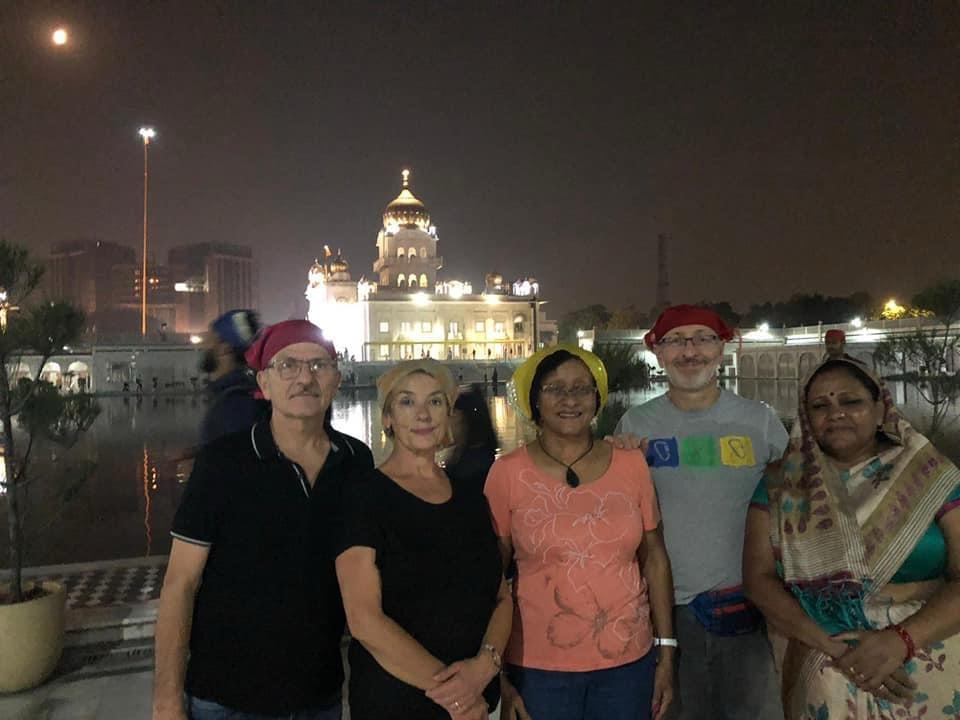
The morning belongs to Old Delhi. Begin with a cycle rickshaw ride through the lanes of Chandni Chowk — the great Mughal-era bazaar where the smell of spices, frying street food, incense, and four centuries of commerce arrives simultaneously from every direction. Stop at Humayun’s Tomb — a UNESCO World Heritage Site and the direct architectural predecessor of the Taj Mahal, built in 1572 for the Mughal Emperor Humayun by his grieving wife. Less famous than the Taj, far less crowded, and equally moving. Continue to the golden-domed Bangla Sahib Gurudwara — the finest Sikh temple in Delhi and one of the most serene spaces in the city.
After lunch, the afternoon belongs to New Delhi. Qutub Minar — the 73-metre medieval tower of victory, the world’s tallest brick minaret. Then a scenic drive through Lutyens’ Delhi — India Gate, the Secretariat, and Rashtrapati Bhavan — the grand colonial-era capital built by the British in the 1930s and now one of the world’s finest examples of planned civic architecture.
Optional additions for the evening: an Old Delhi food walk through the lanes behind Chandni Chowk — one of the finest food experiences in India — or a cook-and-dine experience with an Indian family in their home.
After breakfast, your private car departs for Agra — approximately 3 to 3.5 hours along the Yamuna Expressway.
Arrive in time for the afternoon at Agra Fort — the massive red sandstone fortress that served as the primary Mughal residence before Shahjahanabad (Old Delhi) was built. A UNESCO World Heritage Site, the fort’s interior reveals a complex of palaces, halls, and gardens that speak of an imperial court of extraordinary sophistication. From the fort’s upper ramparts, you can see the Taj Mahal shimmering in the distance — the same view that the imprisoned Emperor Shah Jahan had of his greatest creation in his final years.
As evening approaches, drive to Mehtab Bagh — the garden directly across the Yamuna from the Taj Mahal. This is the finest external viewpoint for the monument, and it is almost unknown to tourists. As the sun drops toward the horizon, the Taj changes colour from white to gold to pale pink, reflected in the Yamuna below. Seeing this before tomorrow’s sunrise visit gives you two completely different versions of the same monument — and the contrast is extraordinary.
For those who prefer an authentic travel experience over the car journey, an optional scenic train from Delhi to Agra is available — covering the distance in 1 hour 40 minutes on the Gatimaan Express through the Gangetic plain.
Wake at 4:30 AM.
Be at the gate by 5:15 AM. Walk through the main gateway arch. Stop.
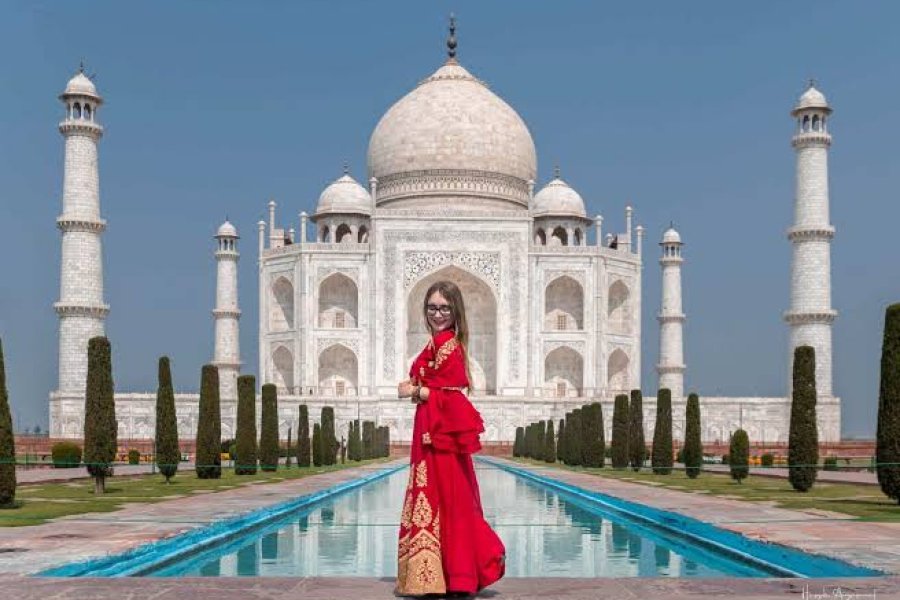
The Taj Mahal at sunrise in soft golden morning light — the marble shifting from white to gold, the reflecting pool perfectly still, the minarets framing the dome against a brightening sky — is one of those travel experiences that simply cannot be described adequately in advance. Every photograph you have seen becomes irrelevant when you stand in front of the actual monument. The scale. The symmetry. The silence at this hour.
Spend the first 90 minutes before tour groups arrive. Enter the main mausoleum — where the cenotaphs of Shah Jahan and Mumtaz Mahal are kept — before 8 AM. The mausoleum add-on ticket is non-negotiable — do not skip it.
Note: The Taj Mahal is closed every Friday. If this day falls on a Friday, the sunrise visit is rescheduled to the nearest alternate day. Your guide confirms this in advance.
After breakfast, begin the drive to Jaipur — with two stops that most Golden Triangle tours miss entirely.
The first is Fatehpur Sikri — Emperor Akbar’s abandoned Mughal capital, built in 1571 and deserted 14 years later, leaving a perfectly preserved red sandstone ghost city of courts, pavilions, and mosques. The Buland Darwaza is the largest gateway in Asia. The Diwan-i-Khas, where Akbar held private audience, is extraordinary in its carved detail. Allow a full two hours.
The second stop is the Abhaneri Stepwell — one of India’s deepest and most photogenic stepwells, built in the 9th century by the Nikumbha dynasty. The 3,500-step descent into this geometric marvel, photographed from the rim at ground level, is one of the most visually striking sights in Rajasthan. Almost no one on the standard Golden Triangle circuit stops here. You do.
Arrive Jaipur by evening. Optional Rajasthani dinner with folk dance.
Jaipur is one of those cities that justifies every superlative applied to it.
Begin at Amber Fort — 11 km from central Jaipur, perched on a hillside above Maota Lake. The jeep ride up to the entrance gate is exhilarating. Inside, the Sheesh Mahal — the Hall of Mirrors — is the architectural centrepiece: ceiling and walls encrusted with thousands of tiny mirror fragments that reflect a single candle flame into an apparent galaxy of stars. The fusion of Rajput and Mughal architectural traditions throughout the fort is both visible and explained by your expert local guide.
Continue to the City Palace — still partially the residence of the Jaipur royal family, housing an extraordinary museum of royal textiles, weapons, manuscripts, and paintings. Then Jantar Mantar — the outdoor astronomical observatory built by Maharaja Jai Singh II in 1734, a UNESCO World Heritage Site with giant stone sundials and celestial calculators of extraordinary accuracy.
Drive past Hawa Mahal — the five-storey Palace of Winds, with its 953 carved sandstone latticed windows — and photograph it from the chai stall directly across the street, as every Jaipur local knows to do.
Spend the afternoon in the bazaars. Johari Bazaar for gemstones. Bapu Bazaar for block-print textiles. Tripolia Bazaar for lac bangles and traditional Rajasthani jewellery. The shopping in Jaipur is among the finest in India and the bazaars in the late afternoon light — warm, busy, and colourful — are an experience in themselves.
Close the day with a visit to the illuminated Birla Temple or the ancient Galta Ji Temple at sunset.
Today’s drive takes you off the tourist map and into something altogether different.
After approximately five hours through open Rajasthani countryside — agricultural villages, rocky outcrops, and the occasional peacock crossing the road — arrive at Rawla Narlai.
The description “restored 17th-century royal hunting lodge set among dramatic granite boulders” does not prepare you for what this place actually feels like. The lodge is built around and between the boulders, so the rock itself becomes part of the architecture — dining terraces perch on top of outcrops, rooms overlook the boulder field, and the whole property has the feeling of a place that belongs exactly where it is. The village of Narlai surrounds it: a working agricultural community with a significant Jain temple at its centre, peacocks walking through the lanes, and a way of life that has not changed substantially in centuries.
This is where the trip slows down. It needs to.
In the evening, join a guided village walk through Narlai — meeting local families, watching craftspeople at work, and understanding what rural Rajasthani life actually looks like rather than the version presented for tourism. The walk is one of those experiences that changes how you see everything you have seen before.
Rise before dawn for the Narlai leopard safari.
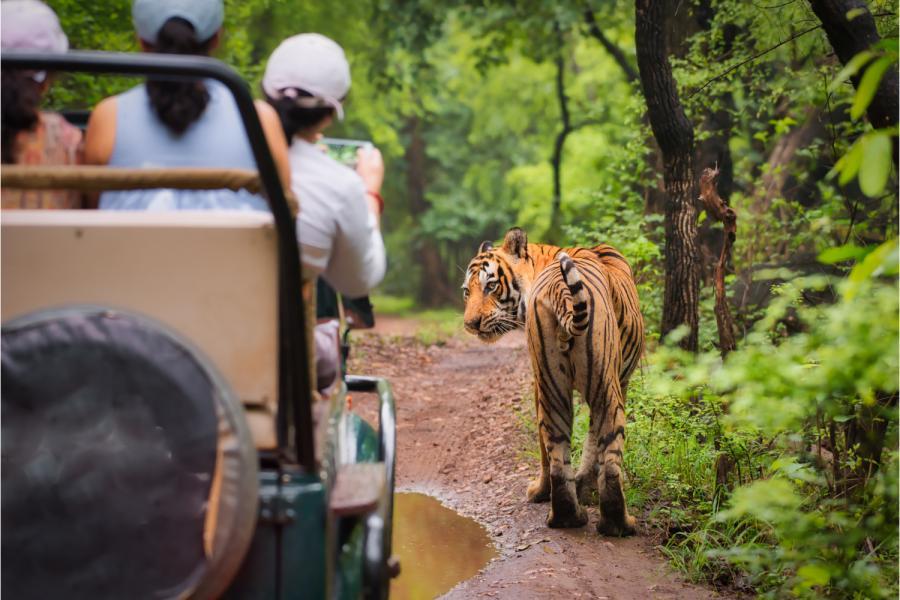
Narlai’s rocky granite hills are one of the few places in Rajasthan where wild leopards are genuinely and regularly sighted. The safari runs by jeep through the boulder fields and scrub forest as the light comes up. The animals here are wild and in an unfenced landscape — sightings are likely but cannot be guaranteed. The safari delivers an extraordinary early morning experience regardless: dramatic terrain, extraordinary light, and the possibility — always the possibility — of a leopard on a boulder against the sunrise sky.
After breakfast, check out and continue driving to Udaipur. En route, the stop at Ranakpur Jain Temple is one of the most significant monuments in the itinerary.
Built in 1446 by the merchant Seth Dharna Shah under the Rana Kumbha of Mewar, the Ranakpur Chaumukha temple (dedicated to Adinatha, the first Jain Tirthankara) contains 1,444 individually carved marble pillars — no two alike. The carving quality is extraordinary: every surface covered in figures, geometric patterns, and botanical motifs at a standard of detail that takes time to absorb. Stand in the centre of the main hall and look up. The interlocking carved marble of the ceiling above you is one of the finest things in Indian architecture.
Arrive Udaipur in the afternoon. Check in. The evening is yours — and Udaipur rewards unhurried exploration. The lakeside promenade, the lanes of the old city, the rooftop restaurants overlooking the water. Let the city’s atmosphere begin to work on you.
Udaipur is the lake city, the city of palaces, and by most accounts the most beautiful city in India. Today is for experiencing all three.
Begin at the City Palace — the largest royal complex in Rajasthan, built by successive Mewar rulers over several centuries and overlooking Lake Pichola from the hilltop above the old city. The museum within is one of the finest in Rajasthan: royal collections of miniature paintings, crystal, weapons, and textiles that speak of a dynasty with extraordinary aesthetic sensibility.
Walk down into the old city to Jagdish Temple — the finest temple in Udaipur, dedicated to Lord Vishnu, built in 1651 and still active with daily worship. The surrounding lanes are some of the most atmospheric in Rajasthan: narrow, shaded, fragrant with incense and marigolds, lined with shops selling miniature paintings, Rajasthani silverware, and block-printed textiles of exceptional quality.
As the afternoon light softens, take the Lake Pichola boat ride.
The Lake Palace Hotel floats in the middle of the lake — a white marble palace built in 1746 as a pleasure retreat for the Mewar kings, accessible only by boat, and now one of the most romantic hotels in the world. Your boat glides past it as the evening light falls across the facades. The City Palace and the surrounding hills are reflected in the water. The sky turns rose and gold. This moment — more than any other in the itinerary — is why Udaipur has the reputation it does.
The core itinerary concludes in Udaipur. From here, choose the extension that matches your schedule and interests.
Day 9 — Udaipur to Delhi
A relaxed final morning in Udaipur — a spa treatment at your hotel, a final walk through the old city bazaars, or simply a long breakfast overlooking the lake. Then fly to Delhi and spend the evening exploring a neighbourhood you missed on day one, or a farewell dinner at one of Delhi’s finest restaurants.
Day 10 — Depart Delhi
After breakfast, transfer to Indira Gandhi International Airport for your international departure.
Day 9 — Udaipur to Varanasi
Fly to Varanasi — India’s oldest living city, the spiritual heart of Hinduism, and the one destination on the subcontinent that simply cannot be described in advance. It has to be experienced. The city’s energy is unlike anywhere else on earth. Check in, and spend the evening walking toward the ghats for a first look at the riverfront before tomorrow’s full immersion.
Day 10 — Varanasi — Boat Ride, Sarnath, Ganga Aarti
Wake at 5:00 AM for the dawn boat ride on the Ganges.
As your boat moves slowly along the 84 ghats — the ancient stone stairways descending to the river — the city is waking up. Pilgrims stand waist-deep in the water performing morning rituals. Priests chant on the steps. The smoke from the cremation fires at Manikarnika Ghat drifts low over the water. Varanasi has been continuously inhabited for over 3,000 years, and at this hour, on this river, that age is entirely credible.
After breakfast, visit Sarnath — 10 km from Varanasi — where the Buddha delivered his first sermon after attaining enlightenment. The Dhamek Stupa, the Ashoka Pillar lion capital (now India’s national emblem), and the archaeological museum housing Gupta-period Buddhist sculpture are all extraordinary. Visit the Kashi Vishwanath Temple — one of the holiest Shiva temples in India — and the Sankat Mochan Hanuman Temple, beloved by Varanasi’s residents.
In the evening, attend the Ganga Aarti ceremony at Dashashwamedh Ghat from pre-assigned seating — the finest position to witness this extraordinary synchronized fire ritual as priests perform with brass lamps, conch shells, incense, and chanting before thousands of devotees gathered on the ghat steps and in boats on the river.
Day 11 — Varanasi to Delhi
Fly to Delhi. A relaxed evening — ideal for last-minute shopping at Connaught Place or a farewell dinner.
Day 12 — Depart Delhi
Transfer to the airport after breakfast for your international flight home.
Day 9 — Udaipur to Kochi
Fly to Kochi — the Queen of the Arabian Sea — and spend the evening exploring Fort Kochi’s remarkable heritage district: Portuguese churches, Dutch palaces, colonial warehouses converted into cafes and galleries, and the famous Chinese fishing nets silhouetted against the harbour sunset.
Day 10 — Kochi to Marari Beach
Morning sightseeing in Kochi: the Chinese Fishing Nets at dawn, the Mattancherry Palace (the Dutch Palace) with its extraordinary Keralan mural paintings, and the Paradesi Synagogue — the oldest active synagogue in the Commonwealth — in the Jewish Quarter of Mattancherry.
Then drive south to Marari Beach — one of Kerala’s most beautiful and least-developed coastlines, backed by coconut groves and paddy fields rather than tourist infrastructure. Your Ayurvedic wellness programme begins with a consultation on arrival.
Days 11 and 12 — Marari Beach
Two full days for complete rest and rejuvenation. Traditional Ayurvedic treatments — Abhyanga (full body oil massage), Shirodhara (warm oil poured continuously over the forehead), or a personalised treatment programme based on your consultation. Sunrise beach yoga. Cycling through coconut groves. Swimming in the Arabian Sea. Or simply lying in a hammock under the palms and doing absolutely nothing. After the intensity of North India, Kerala’s pace is a revelation.
Day 13 — Kochi and Fly Home
Drive back to Kochi (approximately 1.5 hours) and fly home directly from Cochin International Airport, or connect via Delhi for your international departure.
Every element of logistics is managed completely throughout the tour.
Five-star or heritage hotel accommodation on double or twin-sharing basis at every destination. Daily breakfast throughout, plus additional meals as specified in the itinerary. Private air-conditioned vehicle — Toyota Innova Crysta or Hycross — with an experienced driver for all transfers and sightseeing. Airport pickups and drops at every stage. English-speaking, Ministry of Tourism-licensed expert local guides in Delhi, Agra, Jaipur, Udaipur, and all extension destinations. Monument and temple entrance fees as per itinerary. Cycle rickshaw ride in Old Delhi or Jaipur. Morning leopard safari at Narlai. Evening boat ride on Lake Pichola in Udaipur. Pre-assigned seating for Ganga Aarti in Varanasi (Varanasi extension). Complimentary mineral water and snacks throughout. 24/7 on-tour assistance.
International and domestic flights. Indian visa fees. Travel insurance — strongly recommended for all India travel. Optional experiences listed throughout the itinerary. Personal expenses including laundry, room service, and minibar. Tips for drivers and guides — optional but standard practice and genuinely appreciated.
This itinerary is a foundation, not a fixed product.
Hotel upgrades at any destination: the Oberoi Amarvilas in Agra (Taj Mahal views from every room), the Rambagh Palace in Jaipur, Devi Garh in Udaipur, and the BrijRama Palace or Taj Nadesar Palace in Varanasi are available at the luxury tier.
Add Ranthambore National Park between Jaipur and Narlai for a two-night tiger safari extension. October to March, Ranthambore delivers excellent tiger sightings with 65 to 80% probability across two to three safaris.
Add Pushkar for the Camel Fair (November 17 to 24) or as a standalone overnight extension from Jaipur.
Adjust the pace at any destination — more nights in Udaipur, a slower drive from Jaipur to Narlai, or additional experiences at any stop can be built in.
Guide languages available: English, Hindi, Spanish, German, Italian, French, Japanese, and Mandarin.
Explore related itineraries:
October to March is the ideal window. Daytime temperatures across Delhi, Agra, Jaipur, and Rajasthan are comfortable for outdoor sightseeing, fort visits, and the Narlai leopard safari. The Taj Mahal’s white marble is at its most vivid. The Lake Pichola boat ride at sunset is finest in the clear winter air.
November is our first recommendation for this specific itinerary. The weather is outstanding across all destinations. Diwali falls on November 8, 2026 — meaning your Jaipur days can coincide with the most spectacular night in Indian festivals, when the Pink City is outlined in lights and fireworks burst over the Aravalli Hills.
February is equally excellent — perfect weather, no fog risk, and the Rajasthan landscape at its most golden and atmospheric before the pre-summer heat arrives.
October offers the same comfort with post-monsoon lushness — the Aravalli Hills around Jaipur and the countryside between Jaipur and Narlai are at their most vivid green, and the Mehtab Bagh sunset view of the Taj Mahal over a full Yamuna is particularly beautiful.
December and January work well but carry a fog risk at Agra — perhaps 20 to 30% of dawn safaris in these months encounter fog that reduces Taj Mahal visibility at sunrise. Plan a minimum of two Agra evenings to account for the variable.
What is the Best of India Tour? This is a private luxury tour combining the classic Golden Triangle — Delhi, Agra, and Jaipur — with an extended journey deeper into Rajasthan through Rawla Narlai and Udaipur. It covers eight UNESCO World Heritage Sites, a sunrise Taj Mahal visit, a leopard safari, a heritage haveli stay, and an evening Lake Pichola boat ride. Three extension options add Varanasi, Kerala, or a clean return to Delhi.
How many days does this tour take? The core itinerary runs 8 days (9 nights). Adding the Delhi extension makes it 10 nights / 11 days. The Varanasi extension is 13 nights / 14 days. The Kerala extension is 14 nights / 15 days.
Which cities does this tour cover? Delhi, Agra, Jaipur, Rawla Narlai, and Udaipur — plus an optional extension to Varanasi or Kochi and Kerala.
When is the best time to travel? September through March. October and November are ideal — comfortable temperatures, post-monsoon lushness, and the possibility of Diwali in Jaipur.
Is this a group tour or private? This is a fully private tour. You travel with your own vehicle, driver, and expert local guides throughout. No group timetables, no shared buses. The pace and programme can be adjusted on the day to your preferences.
Is the Taj Mahal visit at sunrise? Yes — the itinerary is built around a sunrise visit on Day 4. A sunset view from Mehtab Bagh is also included on Day 3 — giving you the Taj Mahal in two completely different lights.
Are leopard sightings guaranteed at Narlai? Narlai is one of the more reliable leopard sighting locations in Rajasthan, but wildlife encounters cannot be guaranteed. The morning safari delivers an extraordinary experience regardless — dramatic terrain, extraordinary dawn light, and the genuine possibility of a leopard on a boulder against the sunrise sky.
What hotels are used? Five-star or heritage hotels throughout, including Rawla Narlai heritage lodge (the standout property of the itinerary). Upgrade options to Oberoi Amarvilas, Rambagh Palace, Devi Garh, and BrijRama Palace are available.
Can this itinerary be customised? Absolutely. Every element — hotel category, pace, additional experiences, extension choice, and route sequence — can be tailored. Contact us and we will build the exact version that matches your travel style.
At Squid Travel India, this Golden Triangle with Rajasthan itinerary represents exactly what we do best — a perfectly sequenced private journey through India’s most extraordinary destinations, managed completely so that you can focus on the experience rather than the logistics.
Every departure is built from scratch around your dates, group size, and preferences. No two trips are identical. No element is left to chance.
Tell us your travel dates and how many people are travelling. We will send you a detailed personalised quote within 24 hours — with full transparency on hotel options, costs, and what is included at every stage.
📞 Call / WhatsApp: +91 9990812499 📧 Email: Squidtravelindia@gmail.com 🌐 Visit: squidtravelindia.com
1,800+ trips completed | 98% happy clients | TripAdvisor Travelers’ Choice 2024–2025