from 0 review
3
Daily Tour
1 person
English, Espanol, Francais, Japanese, Vietnamese
Most first-time visitors to India do the Golden Triangle and come back wishing they had seen more.
This 10-day itinerary is the answer.
The classic Golden Triangle — Delhi, Jaipur, and Agra — is already the finest introduction to India available. But when you extend it eastward through Orchha, Khajuraho, and Varanasi, something remarkable happens. The trip moves through four completely different versions of India in a single logical arc: the Rajput royal heritage of Jaipur, the Mughal grandeur of Agra and the Taj Mahal, the extraordinary medieval temple art of Khajuraho, and the ancient spiritual world of Varanasi and the Ganges.
No other 10-day North India route delivers this range. This is India at its most complete.
Most Golden Triangle tours follow the Delhi → Agra → Jaipur sequence. This itinerary deliberately reverses it — going Delhi → Jaipur → Agra — for a very practical reason.
Starting with Jaipur after Delhi allows a smooth westward-to-eastward geographic flow for the rest of the trip. From Agra, you continue east by train to Jhansi, stopping at Orchha, then driving to Khajuraho, then flying to Varanasi, and finally flying back to Delhi for departure. No backtracking. No wasted travel. The route moves in one continuous direction from start to finish.
This is the difference between a trip that feels well-designed and one that feels improvised.
The 10-day Golden Triangle tour with Khajuraho and Varanasi covers the following experiences:
Old and New Delhi — Red Fort, Humayun’s Tomb, Qutub Minar, Chandni Chowk by rickshaw, and India Gate. Two of Delhi’s three UNESCO World Heritage Sites in a single day.
Jaipur — Amber Fort with its legendary Sheesh Mahal (Hall of Mirrors), City Palace, Jantar Mantar astronomical observatory, and the iconic Hawa Mahal facade. The finest single day of monument sightseeing available anywhere in Rajasthan.
Fatehpur Sikri — the abandoned Mughal capital en route from Jaipur to Agra. Emperor Akbar built and deserted it in 14 years, leaving a ghost city of extraordinary red sandstone courts and mosques that most visitors simply drive past. This itinerary stops there properly.
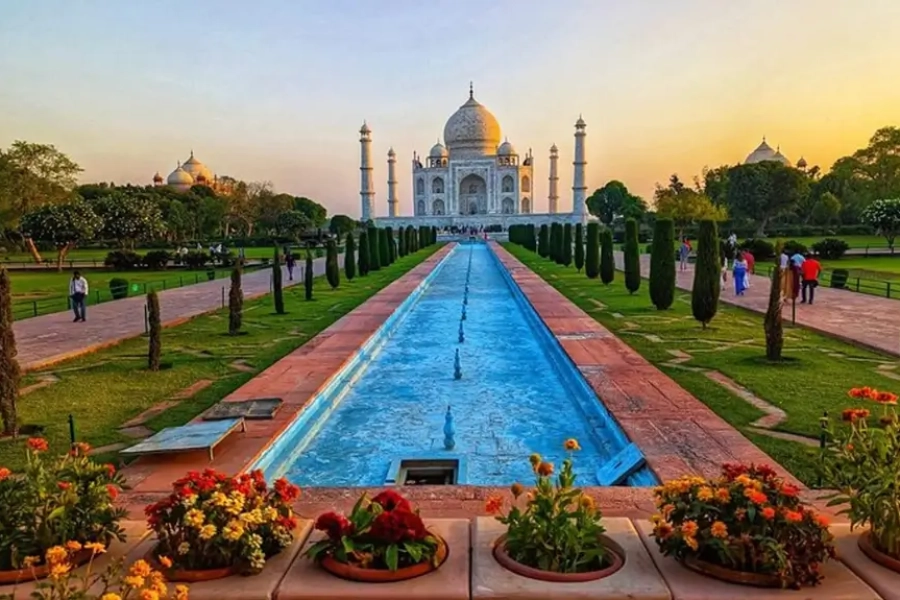
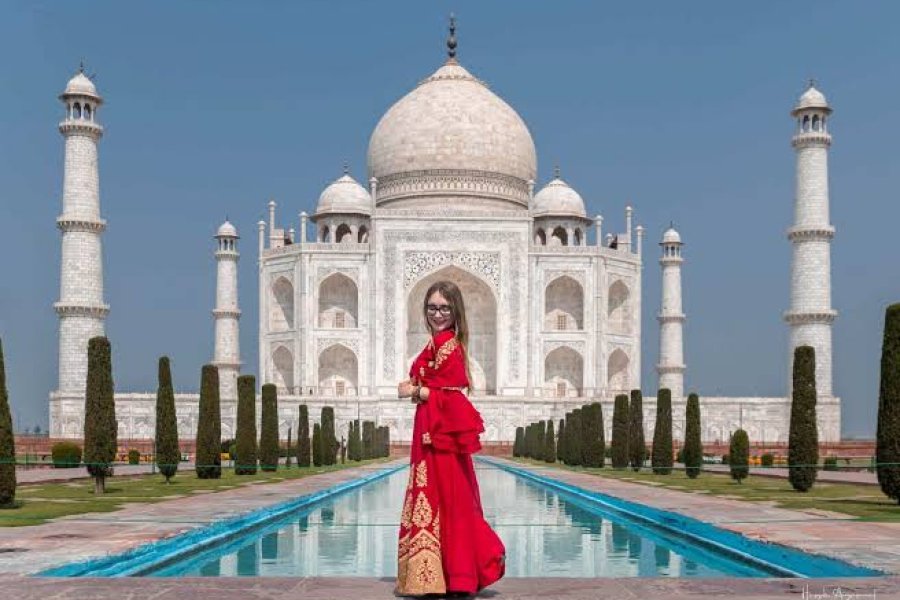
Agra — Taj Mahal at sunrise. Agra Fort. Optional Itmad-ud-Daulah (the Baby Taj). The Taj Mahal at sunrise is genuinely one of the most extraordinary experiences in travel. The sunrise visit is non-negotiable — this itinerary is designed around it.
Orchha — the hidden heritage gem. This medieval Bundela Rajput town on the Betwa River — cenotaphs, Raja Mahal, Jahangir Mahal, ancient temples in various states of romantic ruin — is one of Central India’s finest sights and completely unknown to most international visitors. The stop here, en route from Jhansi to Khajuraho, adds no cost and enormous reward.
Khajuraho — the UNESCO-listed temple complex of the Chandela dynasty, built between the 9th and 12th centuries. The Western Group of Temples — particularly the Kandariya Mahadev temple — represent the absolute peak of medieval Indian temple sculpture. The carvings cover every surface: deities, celestial beings, musicians, animals, and the famous apsara figures in poses of extraordinary fluid grace. Whatever you have read about Khajuraho does not prepare you for the actual scale and quality of what is here.
Varanasi — the Ganga Aarti ceremony at Dashashwamedh Ghat. The sunrise boat ride on the Ganges. Sarnath, where the Buddha delivered his first sermon after achieving enlightenment. These three experiences together constitute the most intense single day available in Indian travel. Varanasi is the world’s oldest continuously inhabited city and its energy is unlike anywhere else on earth.
Your tour begins the moment you land at Indira Gandhi International Airport. Your Squid Travel India representative meets you at arrivals and transfers you to your hotel.
Allow yourself this first day to rest and acclimatise. The jet lag from long-haul travel to India is real — particularly from the USA (10.5 hours ahead of Eastern Time) and the UK (4.5 hours ahead of BST). A relaxed evening in Delhi rather than a packed sightseeing programme on day one makes every subsequent day better.
If you arrive with energy to spare, Connaught Place — Delhi’s grand colonial-era commercial centre — is a short drive from most central hotels. The covered colonnade, well-lit restaurants, and general evening energy of CP is an excellent first taste of Delhi. The United Coffee House, established 1942, serves excellent Indian food with extraordinary period atmosphere.
Your tour manager will brief you on the full ten-day programme. Confirm all pickup timings. Sleep well.
After breakfast, your licensed Delhi guide and private vehicle collect you for a full day across both Old and New Delhi.
Old Delhi comes first. Begin at the Red Fort — the great red sandstone fortress that served as the Mughal seat of power for over two centuries. Built by Shah Jahan (the same emperor who built the Taj Mahal), the fort’s outer walls are imposing; inside, the complex opens into pavilions, halls, and gardens of extraordinary refinement. From the Red Fort, take a cycle rickshaw through the lanes of Chandni Chowk — Old Delhi’s legendary bazaar, where the smell of spices, street food, incense, and four centuries of commerce hits you before you turn the first corner. Stop at Jama Masjid — India’s largest mosque — and climb the minaret for a rooftop view over Old Delhi’s packed rooflines.
After lunch, switch to New Delhi. Visit Humayun’s Tomb — a UNESCO World Heritage Site and the direct architectural predecessor of the Taj Mahal, built in 1572 and far less crowded than the Taj while being almost equally magnificent. Then Qutub Minar — a 73-metre medieval tower of victory, the world’s tallest brick minaret, surrounded by the ruins of Delhi’s oldest mosque. Drive past India Gate, the Parliament buildings, and Rashtrapati Bhavan to understand the scale of Lutyens’ colonial-era city planning.
Return to your hotel by early evening. Optional rooftop dinner at one of Delhi’s excellent Khan Market or Hauz Khas restaurants.
After an early breakfast, drive to Jaipur — approximately 5 to 6 hours along the Delhi-Jaipur Expressway.
The drive itself is interesting — the landscape transitions from the dense suburb sprawl of greater Delhi to the flat, dry Rajasthani plains. Stop at a roadside dhaba for chai and something fried. This is how most of India actually eats and experiences the road.
Jaipur is the capital of Rajasthan and India’s first planned city — laid out in a grid pattern by Maharaja Jai Singh II in 1727, the year the city was founded. The buildings of the old city are painted in a distinctive terracotta-pink (applied in 1876 to welcome the Prince of Wales), giving the city its famous nickname. The old city’s streets are wide, the bazaars are extraordinary, and the atmosphere in the evenings is deeply lively.
Arrive by midday. Check in. Rest briefly. In the afternoon or evening, walk the Johari Bazaar and Bapu Bazaar — Jaipur’s finest shopping streets, selling gemstones, block-print textiles, blue pottery, silver jewellery, and leather footwear. This is the finest introduction to Rajasthani bazaar culture available anywhere.
Today is Jaipur’s finest day — one of the best single days of sightseeing in all of India.
Begin at Amber Fort, 11 km from central Jaipur on a hillside above Maota Lake. The jeep ride up to the entrance gate is exhilarating. Inside, the Sheesh Mahal — the Hall of Mirrors — is the centrepiece: a ceiling and walls entirely encrusted with thousands of tiny mirror fragments, set so that a single candle flame reflects into an apparent galaxy of stars. The fort’s architecture is a deliberate fusion of Rajput and Mughal styles — the result of the powerful Kachhwaha clan’s political relationships with both royal traditions.
Return to central Jaipur for the City Palace — still partially the residence of the Jaipur royal family. The museum within the palace complex houses remarkable collections of royal textiles, weapons, manuscripts, and portraits. Then Jantar Mantar — the outdoor astronomical observatory built by Maharaja Jai Singh II in 1734. The instruments here — massive stone sundials and celestial calculators — are both architecturally spectacular and historically extraordinary. They calculated the position of celestial bodies with an accuracy that contemporary European instruments could not match.
Photograph the Hawa Mahal — the Palace of Winds — from the chai stall directly across the street. The five-storey pink sandstone facade with its 953 latticed windows is one of the most recognisable buildings in Indian architecture.
Spend the evening shopping in the bazaars or dinner at a heritage haveli restaurant.
After breakfast, drive toward Agra — approximately 5 to 6 hours including the Fatehpur Sikri stop.
Fatehpur Sikri is the stop that most itineraries rush through or skip. This one does not.
Emperor Akbar — the greatest of the Mughal emperors — built Fatehpur Sikri as his new imperial capital in 1571. Fourteen years later, he abandoned it — most likely due to a water shortage — and the city has stood largely intact ever since. Walking through it today feels like stepping directly into the 16th century. The Buland Darwaza is the largest gateway in Asia. The Diwan-i-Am and Diwan-i-Khas (halls of public and private audience) speak of an imperial court of extraordinary sophistication. The Panch Mahal — a five-storey open pavilion — has views across the entire abandoned city. Allow two full hours.
Continue driving to Agra. Arrive by early evening.
If time permits — and if it is not raining — go directly to Mehtab Bagh, the garden across the Yamuna from the Taj Mahal. This is the finest external viewpoint for the monument at sunset. The Taj changes colour in the evening light from white to gold to pale pink. Seeing the Taj from Mehtab Bagh before your sunrise visit the following morning transforms the experience — you understand the setting, the river, and the geography before you walk inside.
Wake at 4:30 AM. This is not negotiable.
Be at the West Gate of the Taj Mahal by 5:15 AM — 30 minutes before gate opening at approximately 5:30 AM. Enter with pre-booked tickets. Walk through the main gateway arch. Stop.
What opens before you — the Taj Mahal in its full symmetrical perfection, the long reflecting pool stretching toward it, the marble glowing in the first light of dawn — is one of the most extraordinary sights any human being has ever constructed. No photograph prepares you for the scale. No description conveys the quality of silence that surrounds a monument at this hour.
Spend the first 90 minutes before tour groups arrive. Enter the main mausoleum — the inner chamber with the cenotaphs of Shah Jahan and Mumtaz Mahal — before 8 AM. The mausoleum add-on ticket (₹200 extra) is essential. Do not skip it.
Note: The Taj Mahal is closed every Friday. If Day 6 falls on a Friday, this day is adjusted — your guide will have confirmed this in advance.
After breakfast and a rest, visit Agra Fort in the afternoon — the other UNESCO World Heritage Site in Agra, just 2.5 km from the Taj. The massive red sandstone fortress was the primary Mughal residence before Delhi was established. From the fort’s upper ramparts, you can see the Taj Mahal shimmering in the distance across the Yamuna — the same view that the imprisoned Shah Jahan had of his greatest creation in the final years of his life.
Early morning transfer to Agra Cantonment Railway Station for the Shatabdi Express to Jhansi — approximately 2 to 2.5 hours through the flat central Indian countryside.
Your driver meets you at Jhansi station and drives to Orchha (18 km).
Orchha is the stop that will surprise you most on this entire trip.
This small medieval town on the banks of the Betwa River was the capital of the Bundela Rajput kingdom in the 16th and 17th centuries. What remains today — entirely intact, remarkably well-preserved, and almost completely unknown to international tourists — is a collection of palaces, temples, and cenotaphs that would be considered extraordinary anywhere in India. The Jahangir Mahal, built to welcome the Mughal Emperor Jahangir on his visit in 1606, is a masterpiece of Rajput architecture. The Ram Raja Temple — the only temple in India where Lord Ram is worshipped as a king rather than a deity — is extraordinary in its active ceremonial life. The cenotaphs of the Orchha kings on the banks of the Betwa, lit golden in the afternoon sun, are one of the finest photographic subjects in Central India.
Allow two to three hours in Orchha, then continue driving to Khajuraho (approximately 170 km — 4 to 4.5 hours).
Arrive Khajuraho by evening. Check in. Rest.
Morning dedicated to Khajuraho.
The Khajuraho Group of Monuments is a UNESCO World Heritage Site — one of the most remarkable concentrations of medieval Indian temple architecture anywhere in the world. Built by the Chandela dynasty between 950 and 1050 CE, the temples are covered from plinth to spire in carved figures of extraordinary quality: gods and goddesses, celestial beings, musicians, elephants, horses, and the famous mithuna figures — couples in poses of erotic union that represent the divine union of human and cosmic energy.
The Western Group is the most complete and most visited. The Kandariya Mahadev temple — dedicated to Shiva — is the largest and finest, its shikhara (tower) rising 31 metres above the platform, every surface carved with figures in extraordinary detail and movement. Stand close enough to examine individual figures — the quality of carving at arm’s length reveals a standard of craftsmanship that the medieval Indian stone workers achieved and that has never been surpassed.
Allow three hours for Khajuraho. The Eastern Group of Jain temples is worth 30 additional minutes if time permits.
After the temple visit, transfer to Khajuraho airport for the short domestic flight to Varanasi (approximately 1 hour). Check into your Varanasi hotel. Early evening at the ghats — a quiet first look at the riverfront before tomorrow’s full immersion.
Wake at 5:00 AM for the sunrise boat ride on the Ganges.
The Ganges boat ride at dawn in Varanasi is one of those travel experiences that stays with you for the rest of your life. Your boat moves slowly along the ghats — the ancient stone stairways descending to the river — as the city wakes up. Pilgrims are already in the water performing their morning rituals, offering prayers to the rising sun. Priests chant on the ghat steps. The smoke of the cremation fires at Manikarnika Ghat drifts over the river. Temple bells sound from a dozen directions simultaneously.
Varanasi has been continuously inhabited for over 3,000 years. It is the oldest living city on earth. On this morning boat ride, that age is entirely credible.
After breakfast, drive to Sarnath (10 km from Varanasi). The Dhamek Stupa marks the spot where the Buddha delivered his first sermon after attaining enlightenment — one of the four most sacred sites in Buddhism. The archaeological site includes monastery ruins, the Ashoka Pillar (the lion capital from which became India’s national emblem), and an excellent museum housing some of the finest Gupta-period Buddhist sculpture in India.
Return to Varanasi in the afternoon. Time for a walk through the lanes of the old city — the lanes of Varanasi behind the ghats are some of the densest, most atmospheric urban spaces in Asia.
Evening: Dashashwamedh Ghat for the Ganga Aarti ceremony. At dusk, a team of young priests performs a synchronized fire ritual — brass lamps, conch shells, incense, and chanting — while hundreds of devotees and visitors watch from the ghat steps and from boats on the river. The ceremony lasts approximately 45 minutes and builds to a crescendo of fire, sound, and extraordinary collective energy.
After breakfast, transfer to Varanasi Lal Bahadur Shastri Airport for the flight to Delhi. Depending on your international departure time, you may have a few hours in Delhi for a final Indian lunch, last-minute shopping at Connaught Place, or simply transferring directly to Indira Gandhi International Airport for your onward flight.
Your Squid Travel India representative assists with your departure.
Ten days. Five UNESCO World Heritage Sites. A sunrise at the Taj Mahal. An afternoon in an abandoned medieval city no one knows about. The carved temples of Khajuraho. A dawn boat ride on the Ganges in Varanasi.
This is the trip.
Every aspect of logistics is handled completely by Squid Travel India.
Airport, railway station, and hotel pickup and drop throughout the full ten days. Nine nights accommodation at 4-star or 5-star properties depending on your chosen package tier. Daily breakfast at every hotel. All transfers and sightseeing in a private air-conditioned vehicle. Train tickets from Agra to Jhansi on the Shatabdi Express in AC Chair Car. Domestic flight tickets from Khajuraho to Varanasi and Varanasi to Delhi. English-speaking, Ministry of Tourism-licensed local guides in Delhi, Jaipur, Agra, Khajuraho, and Varanasi. All monument entrance fees as per the itinerary. Sunrise boat ride on the Ganges in Varanasi. Evening Ganga Aarti experience at Dashashwamedh Ghat. All applicable taxes, tolls, parking charges, and driver allowances. 24/7 support throughout the journey.
International airfare. Lunch and dinner at hotels or restaurants unless specified. Personal expenses including tips, laundry, telephone, and shopping. Camera or video fees at monuments where applicable. Travel insurance (strongly recommended — see below). India visa fees. Any services not listed above. Early check-in or late check-out charges. Tips for drivers and guides — optional but appreciated and recommended.
This itinerary is a starting point, not a fixed product. Every element can be adjusted.
Add Ranthambore National Park between Jaipur and Agra for a two-night tiger safari extension. October to March, Ranthambore delivers some of the finest Bengal tiger sightings of any reserve in India.
Add Pushkar for the Camel Fair (November 17 to 24) or as a standalone one-night addition from Jaipur.
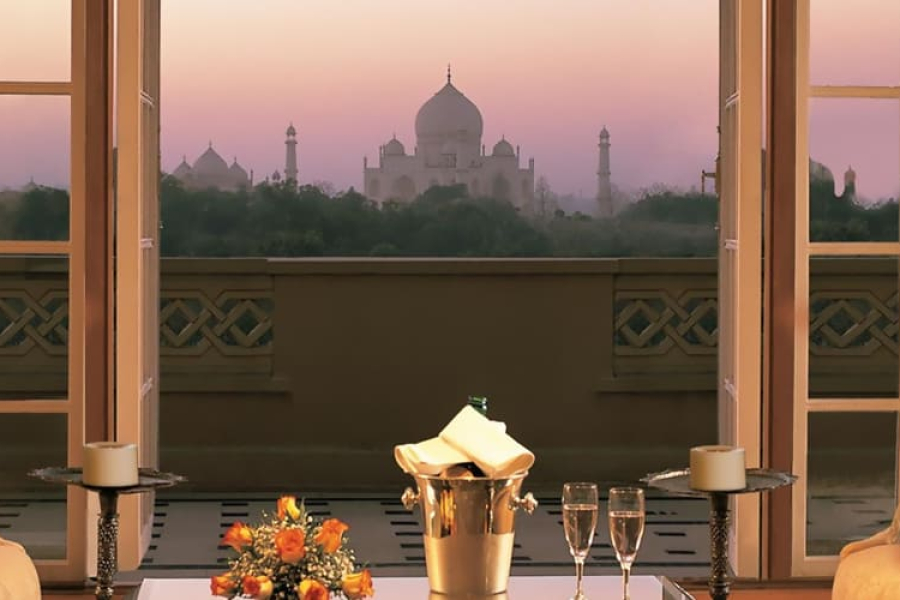
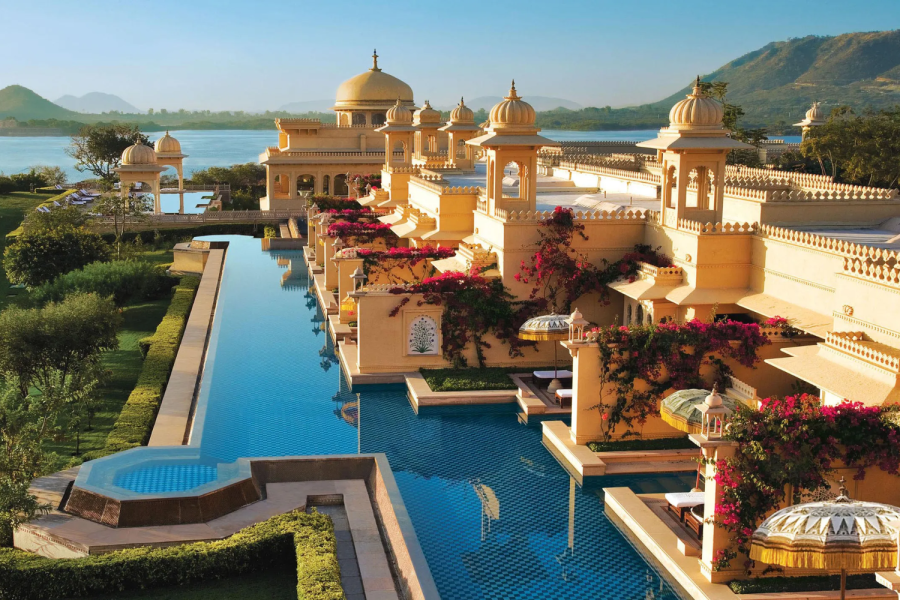
Upgrade hotels to full luxury at any or all properties — the Oberoi Amarvilas in Agra, the Rambagh Palace in Jaipur, and BrijRama Palace in Varanasi are our luxury recommendations.
Adjust the route sequence if you prefer Delhi → Agra → Jaipur instead — we can accommodate either direction.
Extend the trip with Udaipur, Jodhpur, or a Kerala backwaters conclusion after Varanasi.
Also worth considering:
October to March is the ideal window. The weather across Delhi, Jaipur, Agra, Orchha, Khajuraho, and Varanasi is pleasant throughout — warm days, cool evenings, and clear skies. The Taj Mahal’s white marble is at its most vivid. The Khajuraho temples in October and November light are extraordinary for photography.
November is our top recommendation for this specific itinerary. Diwali falls on November 8, 2026 — meaning you can be in Jaipur on Diwali night, one of the most spectacular evenings available in India, without adding any extra days to the programme.
February is equally excellent — perfect weather, no fog risk (which can affect December and January morning visibility at the Taj Mahal and on the Ganges), and consistently clear skies.
April to June: manageable with proper preparation for the heat, and sightseeing is best done before 10 AM each day. Prices are significantly lower and sights are emptier.
July to September: Ranthambore closes, the Rajasthan section is humid, and the Varanasi ghats during monsoon have their own haunting beauty. Possible but not recommended for first-time visitors.
Visa: Most nationalities require a visa for India. The India e-Tourist Visa — applied for online at indianvisaonline.gov.in — is the simplest option. Apply at least two weeks before departure. Carry a printed copy.
Travel insurance: Non-negotiable. Medical care for foreigners in India can be expensive. Trip cancellation coverage matters given the logistical complexity of a ten-day multi-city itinerary. A good policy for this trip costs $60 to $120 for most nationalities.
Currency: Indian Rupee (INR). Carry enough cash from the major cities — ATMs in Orchha and Khajuraho can be unreliable. Withdraw in Jaipur or Agra before heading into Central India.
Health: Consult your doctor before travel about required vaccinations (Hepatitis A, typhoid, and regional malaria advice). Drink only bottled water throughout. Carry oral rehydration salts.
Photography: A camera with a telephoto lens is ideal for Khajuraho’s detailed temple carvings. A tripod is useful for Varanasi dawn photography. Respect the no-photography rule inside the Taj Mahal mausoleum.
What route does this tour follow?
Delhi → Jaipur → Agra → Jhansi by train → Orchha (stop) → Khajuraho → fly to Varanasi → fly to Delhi. A logical westward-to-eastward arc with no backtracking.
Why visit Jaipur before Agra?
The Jaipur-before-Agra sequence allows a clean geographic flow eastward through the rest of the trip — Agra to Jhansi to Khajuraho to Varanasi — without doubling back toward Rajasthan. It also allows for easier train connections at each stage.
Is the Taj Mahal open every day?
No. The Taj Mahal is closed every Friday for prayers at the mosque within the complex. If your Day 6 falls on a Friday, your guide adjusts the Agra day schedule accordingly so the Taj Mahal visit always happens on an alternate day.
How do we travel from Agra to Jhansi?
By superfast train — the Shatabdi Express or Bhopal Shatabdi Express — taking approximately 2 to 2.5 hours. AC Chair Car. The train connects Agra Cantonment station to Jhansi Junction efficiently.
What is Orchha and why is it included?
Orchha is a remarkably preserved medieval Bundela Rajput town on the Betwa River — 18 km from Jhansi and directly en route to Khajuraho. Its palaces, temples, and riverside cenotaphs are extraordinary and almost entirely unknown to international tourists. The stop adds no extra travel cost and enormous cultural reward.
How do we get from Khajuraho to Varanasi?
Short domestic flight — approximately 1 hour. Road travel is also possible (approximately 9 hours) but the flight is strongly recommended given the distances and the value of a rested arrival in Varanasi for the dawn boat ride.
Is this tour suitable for families?
Absolutely. Private vehicles throughout, flexible pacing, child-friendly accommodation options, and genuinely extraordinary child-appropriate experiences (Amber Fort, Taj Mahal, Khajuraho, Varanasi boat ride) make this itinerary excellent for families with children of most ages.
Can this itinerary be extended?
Yes — Ranthambore, Pushkar, Udaipur, and Kerala are all natural extensions. Contact us and we will build the additions seamlessly around your available days.
At Squid Travel India, this extended Golden Triangle circuit is one of our most loved itineraries — and one that consistently produces the most enthusiastic reviews from our guests.
We handle every element: pre-booked Taj Mahal tickets so you never queue at the gate, train tickets booked well in advance, domestic flights, hand-picked accommodation at every stop, licensed expert guides who bring each destination to life, and 24/7 support throughout the ten days.
Tell us your travel dates, group size, and hotel preference. We will send you a full personalised quote within 24 hours — with complete transparency on exactly what is included and what is not.
📞 Call / WhatsApp: +91 9990812499 📧 Email: Squidtravelindia@gmail.com 🌐 Visit: squidtravelindia.com
1,800+ trips completed | 98% happy clients | TripAdvisor Travelers’ Choice 2024–2025