

Every year, thousands of Americans visit India for the first time. Almost all of them start with the Golden Triangle.
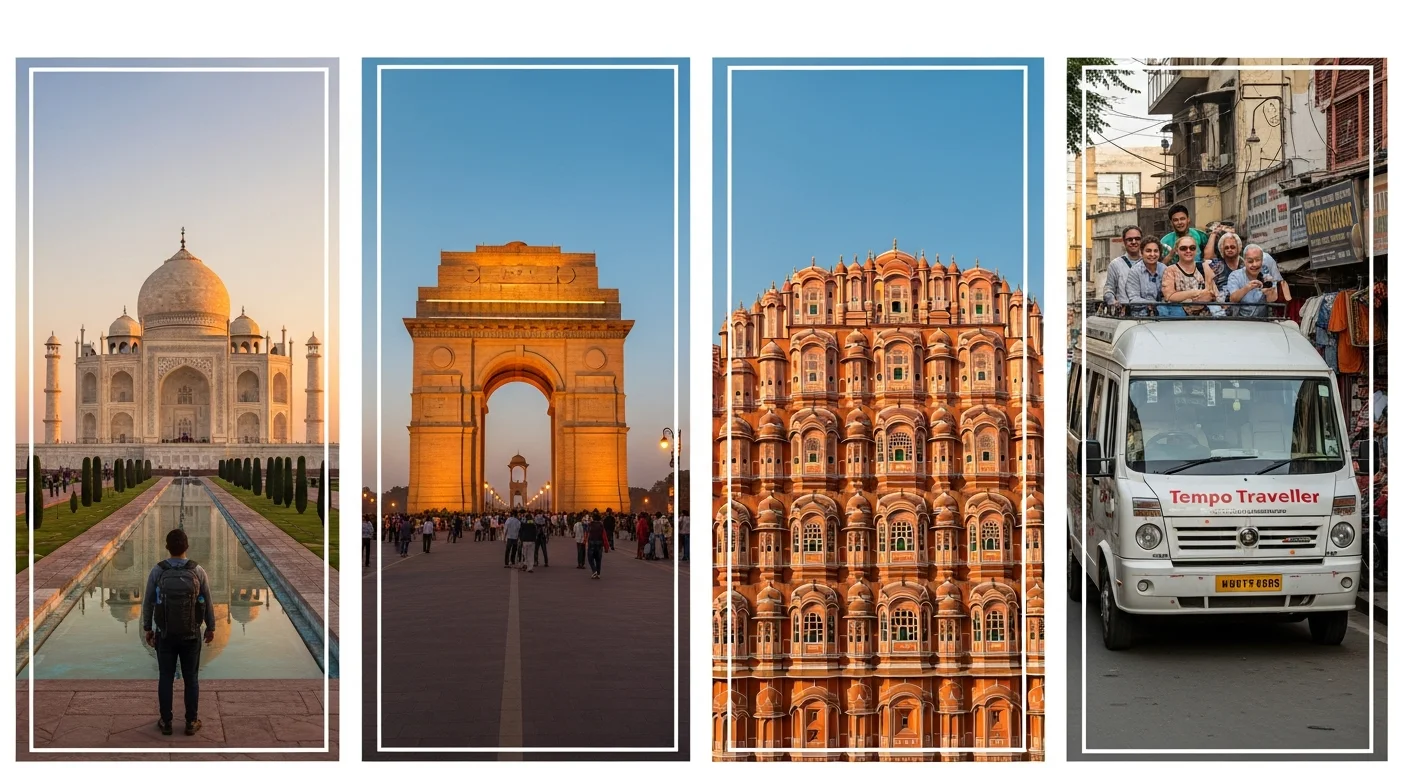
Delhi. Agra. Jaipur. Three cities connected by a roughly triangular route across North India, covering 750 kilometres and more than a thousand years of history. The Taj Mahal in Agra. The Red Fort in Delhi. Amber Fort in Jaipur. Three UNESCO World Heritage Sites in a single trip — and that is before you add Qutub Minar, Humayun’s Tomb, Fatehpur Sikri, and Jantar Mantar to the list.
The Golden Triangle works for Americans for a specific reason: it is comprehensible. Unlike a multi-week pan-India journey that tries to cover everything, the Golden Triangle fits inside a standard American vacation window of 7 to 14 days. It is logistically straightforward, comfortable to navigate with a private tour operator, and delivers an intensity of experience — monument after extraordinary monument — that no other comparable trip in the world can match.
This guide covers everything an American needs to plan the trip from scratch — flights, visas, timing, costs in USD, what to expect on the ground, and how to choose the right operator. Written specifically for the American traveller, not recycled from a generic India travel page.
Step 1: The India eVisa — What Americans Need to Know in 2026
Every US citizen needs a visa to enter India. The good news is that the process is entirely online, takes about 15 minutes to complete, and costs $25 to $80 depending on the visa type you choose.
Apply at indianvisaonline.gov.in — the official Government of India portal. Do not use third-party sites that charge extra for the same result.
Which visa to choose:
For most Americans doing a 7 to 14-day Golden Triangle trip, the 30-day single-entry eVisa at $25 is sufficient. If you are planning to visit India more than once in the next year, the 1-year multiple-entry eVisa at $80 is better value. The 5-year eVisa is also available for frequent visitors.
Processing time is typically 72 hours. Apply at least one week before your departure as a safety buffer — never leave it to the day before. Print a copy of your eVisa approval and carry it with you. Immigration at Delhi’s Indira Gandhi International Airport will ask to see it alongside your passport.
Your US passport must be valid for at least 6 months beyond your intended departure date from India.
New 2026 Requirement — Su-Swagatam Digital Arrival Card:
As of 2026, all international visitors to India including US citizens must complete a mandatory digital arrival card called Su-Swagatam within 72 hours before landing. This replaces the old paper arrival form that used to be filled out on the plane. Complete it online at indianvisaonline.gov.in/earrival — it takes about 5 minutes and requires your passport details, flight number, and hotel address in India. Save the confirmation to your phone and carry a printed copy. Not completing this before arrival can cause delays at immigration.
Your pre-India checklist: eVisa approved → Su-Swagatam completed → passport valid for 6+ months → both saved on phone and printed. That is everything immigration requires.
Step 2: Flights from the USA to Delhi
All Golden Triangle trips begin and end at Indira Gandhi International Airport in Delhi (airport code: DEL). This is India’s largest international hub with the best onward connection options.
Flight times from major US cities:
New York JFK to Delhi: approximately 14 to 15 hours nonstop on Air India, or 16 to 18 hours with one connection through Dubai, Doha, or Abu Dhabi. Air India’s nonstop service is the most convenient option — no layover, no connection risk, and it arrives in Delhi in the morning, leaving you a full day.
Los Angeles LAX to Delhi: 18 to 22 hours with one connection, typically through Dubai (Emirates), Doha (Qatar Airways), or London (British Airways codeshare). No nonstop service exists from LA — choose your connection based on airline alliance and preferred layover city.
Chicago ORD to Delhi: 15 to 18 hours with one connection. United Airlines codeshare via London or Frankfurt are both popular options from Chicago.
Houston IAH to Delhi: typically 17 to 20 hours via Dubai or Doha. Good connections from both Emirates and Qatar Airways.
Booking and pricing:
Economy round-trip from the East Coast to Delhi: $700 to $1,400 depending on season and how far in advance you book. From the West Coast: $900 to $1,800. These figures assume booking 3 to 4 months in advance — last-minute fares for the October to March peak season can be significantly higher.
Book 3 to 5 months in advance for October through March travel. The December peak (Christmas and New Year) is particularly competitive — book by September for December travel.
The open-jaw option: If your Golden Triangle trip includes a southern India extension — Goa, Kerala, or the Andamans — consider booking a flight that arrives Delhi and departs from Mumbai or Kochi. This is called an open-jaw ticket and is often the same price as or cheaper than a round-trip to Delhi alone, while saving you an internal flight back to Delhi at the end.
Airline recommendations for Americans: Air India is the most direct option from the East Coast with the nonstop JFK-DEL service. Emirates via Dubai is consistently well-reviewed and Dubai is one of the better layover airports for connections. Qatar Airways via Doha delivers a premium economy product worth considering for longer trips. United Airlines codeshare options work well for frequent flyers with existing United or Star Alliance miles.
Step 3: The Right Time to Go — Aligned to the American Calendar
The Golden Triangle has a clear best season and a clear season to avoid. Here is how it maps to the American holiday calendar.
October to March — Go. Perfect conditions.
This is the peak season for a reason. Daytime temperatures across Delhi, Agra, and Jaipur run 18°C to 28°C (65°F to 82°F) — warm enough for comfortable sightseeing, cool enough that you are not dripping sweat at the Taj Mahal by 9 AM. The sky is clear and blue. The Taj Mahal’s white marble is at its most vivid. Ranthambore National Park is open (October 1 through June 30). November and February are the single finest months by most measures.
Thanksgiving week (late November): One of the finest India windows of the entire year. Post-Diwali Jaipur is still decorated. Ranthambore tiger sightings are excellent. Weather is perfect. And because Thanksgiving is a uniquely American holiday, you will find the Taj Mahal somewhat less crowded with international visitors than Christmas week.
Spring Break (March): Excellent. Perfect weather. Holi falls in March 2027 — the Festival of Colors — making Spring Break 2027 one of the most exciting India windows available. The Taj Mahal in March light is extraordinary.
Christmas and New Year (late December): Great weather, but the most crowded and expensive period of the year. The week between Christmas and New Year at the Taj Mahal can involve queues from 6 AM. Heritage hotels in Jaipur charge peak rates. Book everything by September for a Christmas trip.
April to June — Avoid for first-timers.
Temperatures in Delhi and Agra can exceed 45°C (113°F) in May and June. Sightseeing must be done before 10 AM. The Taj Mahal marble platform at midday in May is genuinely hot underfoot. Not recommended for first-time visitors or families with young children. Experienced India travellers who specifically want the highest tiger sighting rates at Ranthambore visit in April and May — but they know what they are signing up for.
July to September — Monsoon season.
Rain, humidity, and reduced visibility. Ranthambore is closed (July 1 to September 30). Domestic flight delays are common. Not the Golden Triangle at its best. However, Ladakh — in the Himalayan rain shadow — is actually at peak season in July and August. A Ladakh extension in place of Ranthambore works for monsoon-window travellers.
Step 4: How Many Days You Need
This is the question every American asks first — because the flight is so long.
7 days minimum. A 7-day trip gives you 2 nights in Delhi, 1 night in Agra, and 2 nights in Jaipur. With a flight that arrives Thursday morning and departs the following Wednesday evening, this works cleanly within a standard American vacation week. You see all three cities properly and visit the Taj Mahal at sunrise.
10 days is better. With 10 days you can add Ranthambore National Park (2 nights, 3 safaris) between Jaipur and Delhi. The combination of the Taj Mahal and a Bengal tiger in the same trip is genuinely extraordinary — and 10 days fits within a standard American two-week vacation with travel days.
14 days is the complete experience. Add Varanasi, Pushkar, or a Kerala beach extension. The 14-day window is what allows you to see the Golden Triangle properly, add wildlife, and still have time to experience something completely different — the Ganges at Varanasi, or the backwaters of Kerala.
The jet lag reality: India Standard Time is 10.5 hours ahead of Eastern Time and 13.5 hours ahead of Pacific Time. The first day after a long-haul flight from the US is a write-off. Do not plan sightseeing on your arrival day. The best strategy is to arrive on Day 1, rest, eat at local meal times, and start properly on Day 2. Experienced India travellers from the US build this into the itinerary rather than trying to fight it.
Step 5: What It Costs — Honest USD Numbers
This is the question that deserves the most direct answer and gets the most evasive ones online.
International flights: $700 to $1,400 per person round-trip from the East Coast. $900 to $1,800 from the West Coast. Book early for the bottom end of this range.
The ground package — what you pay in India: This covers hotels, private transport, licensed guides, monument entry fees, and breakfast. It does not cover international flights, personal meals beyond breakfast, shopping, or tips.
For a standard 7-day Golden Triangle private tour with 4-star hotels, private air-conditioned vehicle, and expert guides at every monument, budget $700 to $1,200 per person on the ground package. For 4 to 5-star heritage properties — havelis and palace hotels — the ground package runs $1,200 to $2,500 per person. For full luxury (Oberoi Amarvilas in Agra, Rambagh Palace in Jaipur, ITC Maurya in Delhi), the ground package is $3,000 to $5,000+ per person.
The all-in number most Americans want:
A standard 10-day Golden Triangle + Ranthambore trip from the US, including international economy flights, 4-star hotels, private guided tour, and all entries, runs approximately $3,000 to $5,500 per person for two people traveling together.
A budget-conscious 7-day Golden Triangle trip from the US — economy flights, 3-star hotels, private tour — can be done for $2,000 to $3,000 per person.
A luxury 10-day trip with business-class flights and Oberoi and Rambagh Palace properties runs $10,000 to $18,000 per person.
Monument entry fees for Americans: The Taj Mahal costs ₹1,100 (approximately $13) for foreign nationals plus ₹200 ($2.40) for the mausoleum inner chamber — do not skip this. Children under 15 enter all Indian ASI monuments free regardless of nationality — a meaningful saving for family groups. Agra Fort is ₹650 ($8) for foreign nationals. Amber Fort in Jaipur is ₹500 ($6).
Full cost breakdown: Golden Triangle Tour Cost 2026 — Honest USD Guide — every cost component across budget, standard, and luxury tiers.
Step 6: Private Tour vs Group Tour — The Decision Americans Get Wrong
The most common mistake American first-timers make when booking the Golden Triangle is choosing a group tour to save money.
Here is the reality. Group tours — where you share a coach with 15 to 40 other people on a fixed timetable — exist in India primarily for domestic Indian tourists. The pace, the hotel choices, the guide quality, and the flexibility are calibrated for that market. International visitors almost always find the group tour experience rushed, inflexible, and unsatisfying.
A private tour — your own vehicle, your own driver, your own licensed guide at each monument — costs roughly the same as or modestly more than a group tour when you factor in the full comparison. The difference in experience is not incremental. It is categorical.
On a private tour, you leave for the Taj Mahal at exactly the time you want (4:30 AM for sunrise — non-negotiable for the best experience). You spend as long as you want at each monument. You stop for chai when you feel like it. You visit Fatehpur Sikri on the drive from Agra to Jaipur without asking anyone’s permission. You do not wait for 30 other people to finish taking photographs of the same wall.
At Squid Travel India, every tour we operate for American clients is entirely private. Your own vehicle throughout. Your own guide at every monument. No group timetables. No shared buses.
Step 7: The Itinerary — What a Classic Golden Triangle Trip Looks Like
Here is the sequence that works best for American visitors — built around the American travel pattern of arriving Thursday or Friday and departing the following week.
Day 1 — Arrive Delhi Land at Indira Gandhi International Airport. Private driver meets you at arrivals — no navigation required, no shared shuttles. Transfer to hotel. Rest. Do not try to sightsee today. Eat at local dinner time. Sleep early and wake with Delhi’s dawn.
Day 2 — Delhi: Old and New The morning belongs to Old Delhi. Cycle rickshaw through the lanes of Chandni Chowk — the great Mughal-era bazaar where the smell of spices, frying street food, and four centuries of commerce hits you before you turn the first corner. Jama Masjid — India’s largest mosque. Red Fort — the sandstone fortress from which the Mughal emperors governed India for two centuries. After lunch, switch to New Delhi. Humayun’s Tomb — the architectural predecessor to the Taj Mahal and dramatically underrated. Qutub Minar — the 73-metre medieval tower of victory. A drive past India Gate, Parliament, and the colonial-era grandeur of Lutyens’ city.
Day 3 — Delhi to Agra Drive to Agra — approximately 3.5 hours on the Yamuna Expressway, or 1 hour 40 minutes on the Gatimaan Express train if you prefer rail. Arrive in time for Agra Fort in the afternoon. Then Mehtab Bagh at sunset — the garden directly across the Yamuna from the Taj Mahal, the finest external viewpoint for the monument, and almost unknown to tourists. As the sun drops, the Taj changes from white to gold to pale pink. This is your preview before tomorrow’s main event.
Day 4 — Taj Mahal at Sunrise, then Jaipur Wake at 4:30 AM. This is the most important morning alarm of the entire trip. Be at the gate by 5:15 AM. Walk through the main gateway arch. Stop. What opens in front of you — the Taj Mahal in its full symmetrical perfection in the first light of dawn — is genuinely one of the most extraordinary things any human being has ever built. Spend 90 minutes before the tour groups arrive. Enter the mausoleum. Drive to Jaipur in the afternoon, stopping at Fatehpur Sikri — the abandoned Mughal capital — en route.
Day 5 — Jaipur: Amber Fort and the Pink City Amber Fort at dawn — the jeep ride up, the Sheesh Mahal (Hall of Mirrors), the views over Maota Lake. City Palace. Jantar Mantar. Hawa Mahal photographed from the chai stall across the street. Afternoon in the bazaars — Johari Bazaar for gemstones, Bapu Bazaar for block-print textiles. Evening on a heritage hotel rooftop with a view over the illuminated old city.
Day 6 — Jaipur at Leisure or Ranthambore A second Jaipur day for shopping, cooking classes, or the textile museum. Or drive to Ranthambore National Park (3 hours from Jaipur) for the first evening nature briefing and night at a safari lodge.
Day 7 — Ranthambore Safaris (if included) Dawn jeep safari at 6 AM. Return for breakfast. Afternoon safari at 2:30 PM. Two safari sessions deliver 65 to 80% tiger sighting probability. The combination of the Taj Mahal and a Bengal tiger in a single week is the India experience that brings Americans back for a second trip.
Day 8 — Return to Delhi, Depart Drive back to Delhi (5 to 6 hours from Ranthambore, or fly Jaipur to Delhi in 1 hour). International departure from Indira Gandhi International Airport.
Step 8: Practical Information Americans Specifically Need
Time zone adjustment: India Standard Time is 10.5 hours ahead of Eastern, 13.5 hours ahead of Pacific. The half-hour offset means India does not align neatly with any US time zone. Build one full rest day into your itinerary on arrival. Do not plan monuments on Day 1.
Currency: Indian Rupees (INR). As of 2026, approximately ₹83 to ₹85 per US dollar. Your Visa or Mastercard works at ATMs across all three cities — withdraw rupees in Delhi on Day 1. Carry ₹5,000 to ₹10,000 in cash at any time. Street vendors, auto-rickshaws, and market stalls are cash-only. Major hotels and restaurants accept cards.
Tipping: Not mandatory but standard practice and genuinely appreciated. For a 7 to 10-day private tour, budget $150 to $200 total for driver and guide tips. The general Indian guideline is ₹500 to ₹1,000 per day for a driver and the same for a guide.
Food and water: Drink only bottled water throughout — never tap water or ice of unknown origin. The food in quality hotels and recommended restaurants is safe. Street food in tourist areas is generally fine for travellers with some India experience — more caution is appropriate for first-timers. The safest rule: hot food, freshly cooked, from a busy stall.
Health: Consult your doctor 4 to 6 weeks before departure about Hepatitis A, Typhoid, and routine vaccinations. Carry oral rehydration salts, a basic medical kit, and any prescription medications in their original packaging. Travel insurance with emergency medical evacuation coverage is non-negotiable.
Connectivity: Indian SIM cards are available at Delhi airport — an Airtel or Jio prepaid SIM with data costs $10 to $15 for 30 days of unlimited data. US phones on unlocked GSM networks accept Indian SIMs. Your US carrier’s international roaming rates are typically expensive by comparison — local SIM is significantly better value for a 7 to 14-day trip.
Electrical: India uses Type C and Type D plugs at 230V / 50Hz. US devices run at 110V / 60Hz — carry a universal travel adapter with voltage conversion for any non-dual-voltage devices. Most modern phones and laptops are dual-voltage and only need an adapter.
What to pack: Comfortable walking shoes (you will average 8 to 12 kilometres per day of walking at monuments). Modest clothing — shoulders and knees must be covered at all temples and mosques. A light scarf serves for spontaneous temple visits. Sunscreen SPF 50+. For October to February visits, a warm layer for cool evenings and cold early mornings is essential.
Step 9: Choosing the Right Tour Operator
This is where the quality of your entire India experience is determined.
The Indian tour operator market ranges from deeply experienced, accountable companies to poorly organised brokers who oversell and underdeliver. For American visitors making a long-haul trip that costs $3,000 to $6,000 per person, choosing the right operator is the most important single decision of the planning process.
What to look for:
TripAdvisor reviews specifically from American travellers — do previous US clients describe an experience that matches what you want? A legitimate operator will have dozens of verified reviews with specific details, not generic praise.
Response quality — email or WhatsApp the operator before booking. How quickly do they reply? How specifically do they answer your questions? An operator who responds within 24 hours with detailed, personalised answers is one who will support you during the trip.
Transparency on inclusions — a reputable operator tells you exactly what is and is not included before you pay. No hidden charges at monuments, no surprise “optional” add-ons that were implied to be included.
USD pricing — operators who work with American clients regularly will quote in US dollars and explain costs clearly. An operator who quotes only in rupees and is vague about the total is not well-set-up for American clients.
24/7 support — if your domestic flight is delayed, if you need to change a monument time, if something goes wrong on Day 3 in Agra, your operator should be reachable by WhatsApp immediately. This is non-negotiable for American travellers 10.5 hours from home.
Step 10: Extending Beyond the Golden Triangle
Once you have the Golden Triangle, the natural question is what to add.
Ranthambore Tiger Safari (2 extra nights): The most popular extension for Americans. Three hours from Jaipur. October to March — 65 to 80% tiger sighting probability across two to three safaris. The combination of the Taj Mahal and a Bengal tiger in the same week is the India trip most Americans describe as the best travel experience of their lives.
Varanasi (2 extra nights, fly from Delhi or Jaipur): India’s oldest living city. The Ganges at dawn. The Ganga Aarti ceremony. Sarnath — where the Buddha gave his first sermon. For Americans who want spiritual depth alongside the monuments, Varanasi is transformative.
Kerala (3 extra nights, fly from Delhi or Jaipur to Kochi): Complete contrast from the North. Backwater houseboat. Tea gardens at Munnar. Ayurvedic wellness. Kerala beaches. A Kerala extension turns a Golden Triangle trip into a complete India experience across two completely different cultures.
Rajasthan Extension (3 extra nights): After Jaipur, continue to Udaipur — the lake city, the most romantic destination in India. Lake Pichola and the City Palace. Or continue further to Jodhpur’s Blue City and Mehrangarh Fort. Or the desert dunes of Jaisalmer.
Full extension options:
Frequently Asked Questions from American Travelers
Do Americans need a visa for India?
Yes. Apply for the India eVisa online at indianvisaonline.gov.in. The 30-day single-entry eVisa costs $25. Processing takes 72 hours. Also complete the Su-Swagatam digital arrival card within 72 hours before landing — this is a new 2026 requirement. Your passport must be valid for at least 6 months beyond your departure date from India.
How long is the flight from the USA to India?
New York to Delhi: 14 to 15 hours nonstop (Air India) or 16 to 18 hours with one connection. Los Angeles to Delhi: 18 to 22 hours with one connection. All Golden Triangle trips arrive and depart from Delhi’s Indira Gandhi International Airport.
How much does a Golden Triangle tour cost from the USA?
A standard 10-day private Golden Triangle tour from the USA including international economy flights, 4-star hotels, private guided tour, and all entries runs approximately $3,000 to $5,500 per person for two people traveling together. Budget trips from $2,000. Luxury from $10,000.
How many days do I need for the Golden Triangle?
Seven days minimum — 2 nights Delhi, 1 night Agra, 2 nights Jaipur, 2 travel days. Ten days allows you to add Ranthambore tiger safari. Fourteen days allows a complete experience including Varanasi or Kerala.
What is the best time to visit the Golden Triangle from the USA? October to March. Thanksgiving week (late November) is one of the finest windows — perfect weather, post-Diwali atmosphere, and excellent Ranthambore safari season. Spring Break (March) is excellent. Christmas week is beautiful but the most expensive and crowded period.
Is India safe for American tourists?
Yes. The US State Department maintains a Level 2 (Exercise Increased Caution) advisory for India — the same level applied to France, Germany, and Japan. The major Golden Triangle cities of Delhi, Agra, and Jaipur are well-established for international travel. Booking with a reputable private tour operator significantly improves both safety and logistics.
Is a private tour worth it over a group tour?
For American first-timers on a long-haul trip, yes — consistently and significantly. Private tours depart when you want, move at your pace, and give you a guide dedicated entirely to your group. The price difference versus a quality group tour is modest. The experience difference is substantial.
What US airports fly to Delhi?
Air India flies nonstop from New York JFK. Emirates flies from New York JFK, Los Angeles LAX, Houston IAH, and others via Dubai. Qatar Airways connects from multiple US cities via Doha. United Airlines has codeshare options. From most US cities, expect one connection through a Middle Eastern or European hub.
Plan Your Golden Triangle Tour from the USA with Squid Travel India
At Squid Travel India, we have been planning Golden Triangle tours for American clients for over 15 years. We quote in US dollars, respond within 24 hours, provide 24/7 WhatsApp support throughout your trip, and handle every element — eVisa guidance, Taj Mahal ticket pre-booking, Ranthambore safari permits, and heritage hotel bookings secured months in advance.
Every tour is entirely private. Your own vehicle, your own guide, your own pace.
Tell us your travel dates, group size, and what matters most to you. We will build your India itinerary and send a full USD cost breakdown within 24 hours — no obligation.
Also worth reading:
- Golden Triangle Tour from Delhi
- Golden Triangle Tour Cost 2026
- 2 Weeks in India — American Itinerary
- Ranthambore Tiger Safari October 2026
- India in November 2026
- Taj Mahal Tickets, Timings & Entry Fee 2026
- Make Your Own Tour
📞 Call / WhatsApp: +91 9990812499 📧 Email: Squidtravelindia@gmail.com 🌐 Visit: squidtravelindia.com
1,800+ trips completed | 98% happy clients | TripAdvisor Travelers’ Choice 2024–2025
Comment (0)