Why UK Travellers Love This Trip
The Golden Triangle — India's Classic Circuit
The Golden Triangle connects three of India's most iconic cities — Delhi, Agra and Jaipur — in a roughly triangular route through the north of the country. It is the most popular itinerary in India for a reason: in seven to ten days you see the Taj Mahal, Mughal forts, Rajasthani palaces, Sufi shrines, ancient bazaars and some of the finest Indo-Islamic and Hindu architecture on earth. And you do it with a private car and driver, never a tour bus or a train schedule.
For UK travellers in particular, the Golden Triangle hits a sweet spot. The flight from London is just over eight hours — shorter than New York or Singapore, manageable in economy, and genuinely pleasant in business class. India is 5 hours 30 minutes ahead of GMT, so jet lag is gentler than heading west. And the exchange rate makes India extraordinary value: a pound stretches further in Rajasthan than almost anywhere else in the world. A private AC car and driver for a full day costs roughly £50–65. A luxury heritage hotel that makes the pages of Condé Nast costs £200–300 per night.
The connection between Britain and India is old and layered — in architecture, language, food and history. Many British travellers feel the resonance of that in ways that go beyond sightseeing. The Golden Triangle is a good place to feel it.
Getting There
Flights from the UK to Delhi
Indira Gandhi International Airport in Delhi (DEL) is your gateway to the Golden Triangle. Direct non-stop flights from London Heathrow take around 8 hours 30 minutes — one of the shorter long-haul routes from the UK. Passengers from Manchester, Birmingham, Edinburgh and other UK cities connect once, usually through Dubai, Doha or Abu Dhabi.
India's national carrier, strong service
Excellent business class, Avios redemptions
Good economy, strong Upper Class
Often the best value from regional UK cities
Consistently rated among the world's best
Competitive pricing from UK regional airports
For UK travellers on Avios, British Airways direct flights to Delhi are one of the most rewarding long-haul Avios redemptions — particularly in Club World (business class). The cabin has had a significant refresh and the nonstop routing is genuinely comfortable. For pure value in economy, Emirates from Manchester or Birmingham via Dubai is frequently the best-priced option outside London.
Planning Your Trip
Best Time to Visit India from the UK
India's north — Delhi, Agra and Jaipur — has a classic continental climate: hot summers, a June-to-September monsoon, and a cool, dry, brilliant winter. For UK travellers, the best months align perfectly with the British autumn and winter, making India a natural escape from grey skies.
Peak Season — Best Weather
The classic India winter — clear blue skies, comfortable warmth during the day and cool evenings. Perfect photography light. The busiest and most expensive period, but the right choice for a first visit. Book well ahead.
Shoulder Season — Best Value
Warm but manageable heat, fewer crowds, lower prices. October is especially good — the monsoon has cleared and the air is fresh. March has warmer afternoons but still comfortable mornings. Excellent for experienced travellers.
Avoid — Heat and Monsoon
Summer heat in Delhi, Agra and Jaipur is punishing — mid-40s in May and June. Monsoon brings humidity and intermittent heavy rain. Flights are cheaper but the experience suffers considerably. Not recommended for a first visit.
Entry Requirements
India e-Visa for UK Citizens
All British passport holders require a visa to enter India. The India e-Visa is entirely online — no embassy visit, no biometrics appointment, no queue. Apply at indianvisaonline.gov.in, and processing takes 72 hours.
For a standard 7–14 day Golden Triangle holiday, the 30-day single-entry e-Tourist Visa at around $25 USD (approximately £20) is all you need. A one-year multiple-entry visa is $40 and makes sense if you think you might return within twelve months. All visa fees are charged in USD — your card will convert at the prevailing rate.
Apply at least one week before travel to allow for the processing window and any delay. The approved visa is emailed as a PDF — print a copy and keep the digital version on your phone. India border officials will ask to see it on arrival at Delhi.
Day by Day
7-Day Golden Triangle Itinerary from the UK
This is the most popular structure for UK travellers on a first India trip — 7 nights on the ground. Arrive on day one, depart on the morning of day eight. It is a comfortable pace that covers the essential highlights without feeling rushed.
Arrival in Delhi — settle in, Old Delhi at dusk
Your flight from London lands mid-morning or early afternoon Delhi time (India is 5h 30m ahead of GMT). Your driver meets you at arrivals — no negotiating with taxi touts, no navigating alone. After hotel check-in and a rest, the late afternoon is ideal for Old Delhi: Jama Masjid (India's largest mosque), a cycle-rickshaw through the spice market of Chandni Chowk, and dinner in the lanes around Karim's, a Mughal-era restaurant that has fed visitors since 1913.
New Delhi — monuments, Lutyens and the colonial city
New Delhi was designed by Edwin Lutyens and Herbert Baker and built as the capital of the British Raj — it has a strange, grand familiarity to British eyes. Humayun's Tomb (the Mughal masterpiece that directly inspired the Taj Mahal), Qutub Minar (the world's tallest brick minaret, built in 1193), India Gate, and Lodhi Garden. The evening is free for Connaught Place, Hauz Khas Village, or the Khan Market neighbourhood.
Drive to Agra — Agra Fort and the Taj by sunset
The 200km drive from Delhi to Agra takes around 3.5 hours on the Yamuna Expressway — your driver collects you after breakfast. The afternoon is for Agra Fort, the massive red sandstone fortress where Shah Jahan spent his final years imprisoned by his son, with a perfect view of the Taj Mahal across the river from its towers. At sunset, walk down to Mehtab Bagh — the garden on the opposite bank of the Yamuna — for the classic Taj Mahal silhouette with no entry fee and no crowds.
The Taj Mahal at sunrise — the reason you came
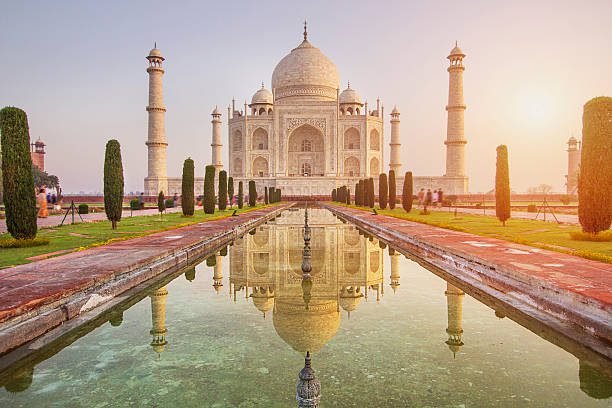
Set an alarm. The gates open around 6am and the light in the first hour — pink and golden, with mist lifting off the Yamuna — is what every photograph tries to capture. Your guide handles the tickets, the shoe covers, the entry flow. Take your time. Walk the full platform. Go inside the mausoleum for the inlay work (a small additional ticket, worth every penny). After the Taj, Fatehpur Sikri — the abandoned Mughal capital 40km west of Agra — is on the route toward Jaipur.
Arrival in Jaipur — the Pink City
Jaipur is the capital of Rajasthan and the most characterful city on the route — painted terracotta pink by royal decree, full of bazaars selling gems, textiles and block-printed fabrics, and ringed by hilltop forts. The drive from Agra through Fatehpur Sikri takes around 4–5 hours. Afternoon arrival gives time for Hawa Mahal (the five-storey honeycomb façade built so royal women could watch street processions unseen), and an evening in the bazaars around Johari Bazaar.
Amber Fort, City Palace and Jantar Mantar
Amber Fort sits on a ridge 11km from Jaipur city — approach it at opening time before the crowds arrive. The complex of courtyards, mirror rooms (Sheesh Mahal) and ornamental gardens is the finest Rajput fort in India. In the afternoon, the City Palace in the old city — still partly inhabited by the royal family — and Jantar Mantar, the 18th-century astronomical observatory with its giant stone instruments. The composite Jaipur ticket covers both and the fort, saving significantly on individual entry prices.
Shopping, Nahargarh Fort and the drive back to Delhi
A morning in Jaipur's gem and textile markets — the city is one of the world's main gem-cutting centres and a great place to buy semi-precious stones, silver jewellery, hand-block-printed fabric, blue pottery and miniature paintings. After lunch, the 5–6 hour drive back to Delhi — or stay a third night in Jaipur and fly back to Delhi for a morning departure. Your driver drops you at Indira Gandhi International for the overnight flight home, arriving London the following morning.
The Taj Mahal is closed every Friday
Plan your Agra day for any day that is not a Friday. This is non-negotiable — the entire site is closed, all day, every Friday for prayers. When booking your trip, confirm with your operator that your Agra day falls on a non-Friday. See our guide: Taj Mahal closed on Fridays — what to do instead.
Extend Your Trip
Golden Triangle Add-Ons from the UK
UK travellers who can take ten days or more have excellent options for extending beyond the core three cities. All of these are within comfortable reach by road or a short domestic flight from the Golden Triangle route.
On the Ground
Practical Tips for UK Travellers in India
Money and spending
The Indian Rupee is the currency. Withdraw rupees from an ATM on arrival at Delhi airport — there are ATMs in the arrivals hall before you exit. Most 4-star and 5-star hotels accept credit cards; smaller restaurants, markets and tips require cash. The 2026 exchange rate is approximately ₹85–90 per pound, making India one of the best-value destinations in the world for British travellers.
Health and vaccinations
The NHS recommends Hepatitis A, Typhoid, and a Tetanus/Diphtheria/Polio booster for most India trips. Book a travel health appointment with your GP or a private travel clinic 4–8 weeks before departure. The NHS Fit for Travel website (fitfortravel.nhs.uk) is the authoritative reference. Take a supply of your regular prescription medication plus a basic travel health kit including rehydration salts and an antidiarrhoeal.
Mobile and connectivity
UK mobile networks charge roaming fees in India. The simplest and cheapest option is to buy a local SIM card at Delhi airport on arrival — Airtel and Jio both have counters in the arrivals hall. A prepaid tourist SIM with 2–3GB of data for a 10-day trip costs around ₹500 (roughly £5). You need your passport and a printed copy of your hotel address to register. Data is excellent across all three cities on the Golden Triangle.
Tipping
Tipping is customary in India but far more modest than UK norms. For your driver, £3–5 per day is appropriate. For your guide, £5–10 for a full day. Hotel porters £1–1.50 per bag. Keep a supply of ₹100 and ₹500 notes — your driver and guide cannot exchange foreign currency. Always tip in rupees, not pounds.
Travel insurance
Your NHS card does not cover you in India. Take out comprehensive travel insurance that includes emergency medical treatment and medical evacuation to the UK — medical repatriation from India without insurance can cost tens of thousands of pounds. Standard annual travel insurance policies from UK providers such as Aviva, Saga, Direct Line or specialist travel insurers like Battleface or World Nomads cover India. Check that medical coverage is adequate, especially evacuation coverage.
Also Useful
More Golden Triangle Planning Guides
Common Questions
Golden Triangle from the UK — FAQ
How long is the flight from the UK to India?
Do UK citizens need a visa for India?
Is the Taj Mahal closed on any days?
What is the best time for UK travellers to visit the Golden Triangle?
How many days do I need for the Golden Triangle from the UK?
What vaccinations do I need for India from the UK?
What is the time difference between the UK and India?
Is India good value for UK travellers?
Ready to Book Your Golden Triangle?
Tell us your travel dates, group size and how you like to travel — and we'll put together a detailed, fully-priced itinerary in GBP within 24 hours. No obligation, no call required.
+91 99908 12499 · Squidtravelindia@gmail.com