

Every year, on the full moon night of Kartik in Varanasi, something happens that people who have witnessed it spend the rest of their lives struggling to describe.
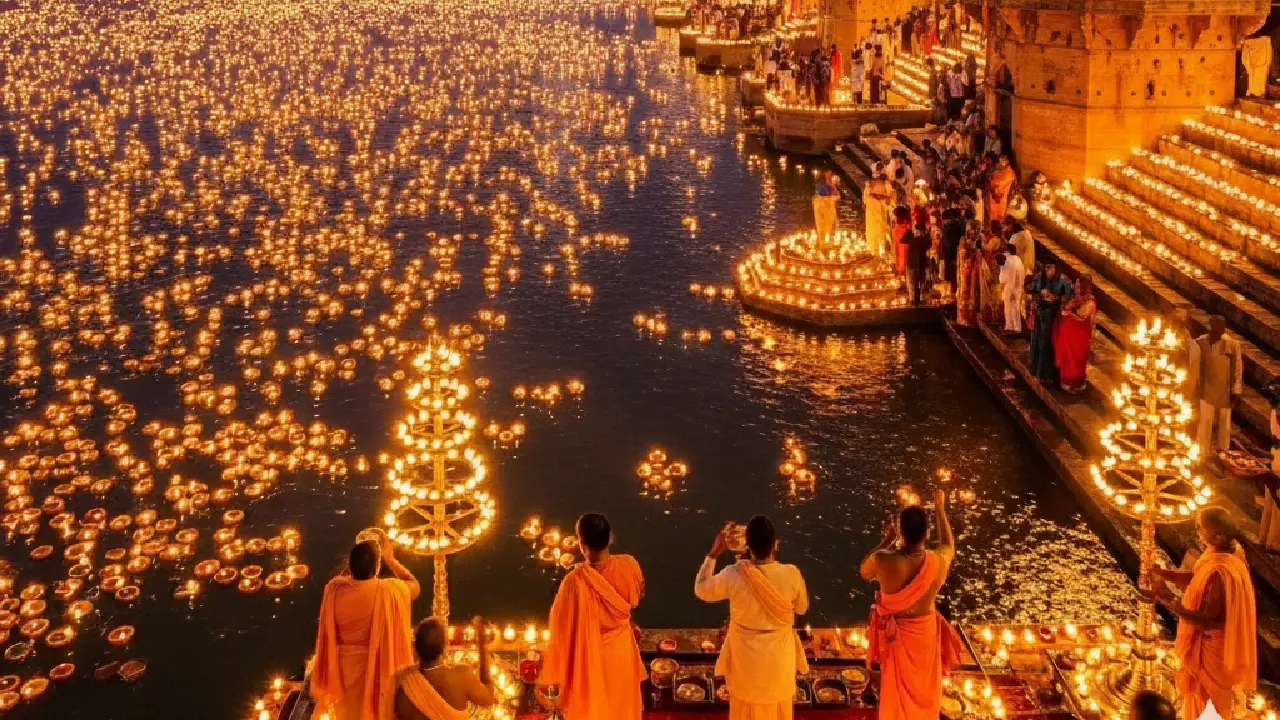
The sun sets. The ghats go dark. Then, simultaneously, hundreds of thousands of earthen oil lamps are lit along the entire 6-kilometre staircase of the Ganges riverfront — from Assi Ghat in the south to Rajghat in the north. Every step of Varanasi’s 84 ghats fills with flame. The Ganges below reflects the light. The full moon above adds its own silver to the scene. And the world’s oldest continuously inhabited city — which has been doing this on this night for thousands of years — becomes the most beautiful place on earth.
This is Dev Deepawali.
It happens on Tuesday, November 24, 2026.
This guide tells you everything you need to be there — the exact date, the festival’s meaning, a timeline of the day, where to watch, how to get a boat, where to stay, and how to experience it properly rather than just surviving the crowd.
The Date: Dev Deepawali 2026 Falls on November 24
Dev Deepawali 2026 falls on Tuesday, November 24, 2026.
The festival is timed to Kartik Purnima — the full moon of the Hindu month of Kartik — which falls exactly 15 days after Diwali. In 2026, with Diwali on November 8, the full moon lands on November 24.
The main celebrations begin at sunset — approximately 5:15 to 5:30 PM in Varanasi in late November — and continue well into the night. The lighting of diyas (clay oil lamps) begins as dusk falls, the Ganga Aarti ceremony follows, and the full illumination of the ghats peaks between 6:00 PM and 8:00 PM.
Arrive in Varanasi by November 22 at the latest. Hotel availability collapses in the final 48 hours before Dev Deepawali, and being settled and oriented before the event allows you to enjoy November 24 rather than scrambling through it.
What Is Dev Deepawali? The Story Behind the Festival
Dev Deepawali literally means “Diwali of the Gods” — and understanding why requires knowing the story it celebrates.
According to Hindu mythology, a powerful three-headed demon named Tripurasura had conquered the three worlds — heaven, earth, and the underworld — and brought terror and chaos to all of creation. The gods, unable to defeat him individually, appealed to Lord Shiva — the supreme deity of Varanasi and the destroyer of evil. On the full moon night of Kartik, Shiva destroyed Tripurasura with a single cosmic arrow.
In celebration of this divine victory, the gods themselves are believed to have descended to earth — specifically to the holy city of Varanasi, known to Hindus as Kashi — to bathe in the sacred waters of the Ganges. The people of Kashi, witnessing this divine celebration, lit thousands of lamps along the riverbanks in honour of the gods.
That lighting of lamps has been repeated on this same lunar night every year since.
The festival is also called Tripurotsav and Tripurari Purnima, reflecting its connection to the defeat of Tripurasura. In Varanasi, it is observed with far greater ceremony than anywhere else in India — because Varanasi is itself the home of Lord Shiva, and this night is considered among the most sacred the city experiences all year.
Why Dev Deepawali Is Different from Diwali
Many visitors to India have experienced Diwali and wonder how Dev Deepawali compares. The answer is: they are almost completely different experiences.
Diwali is a pan-India domestic celebration — primarily experienced inside homes and families, with fireworks, sweets, and the illumination of individual households. In cities like Jaipur and Delhi, the cumulative effect of millions of simultaneously lit homes creates a spectacular citywide spectacle. Diwali is joyful, noisy, explosive, and domestic.
Dev Deepawali is something quieter and far more concentrated. It is observed primarily in Varanasi, specifically at the Ganges ghats. It is not a domestic festival — it is a riverfront spiritual ceremony. The mood is reverent rather than celebratory in the Diwali sense. The scale, in terms of a single concentrated visual experience, is arguably greater than anything Diwali offers — because instead of lights distributed across an entire city, you have hundreds of thousands of flames concentrated along a 6-kilometre river staircase, all lit simultaneously, all reflected in the Ganges below, on the night of the full moon.
Most experienced India travellers who have seen both say the same thing: Diwali is spectacular. Dev Deepawali is transcendent.
The Spiritual Significance of Varanasi on This Night
To understand Dev Deepawali properly, you need to understand what Varanasi is.
Varanasi — also called Kashi and Banaras — is not simply India’s oldest city. It is the spiritual centre of the Hindu world. It is the city where Lord Shiva is believed to be perpetually present. It is the city where Hindus most desire to die, because dying in Varanasi is believed to guarantee moksha — liberation from the cycle of death and rebirth.
The ghats of Varanasi — the great stone stairways descending to the Ganges — are where life and death intersect openly and publicly in a way that exists nowhere else on earth. Cremation fires burn at Manikarnika Ghat day and night, every day of the year. Pilgrims bathe at dawn beside them. Priests conduct aarti ceremonies as the sun rises and sets. The Ganges is simultaneously a site of purification, of prayer, of grief, of joy, and of the most ancient ritual continuity available anywhere in the modern world.
On Dev Deepawali night, all of this becomes visible simultaneously. The devotional intensity that Varanasi carries 365 days a year is concentrated, amplified, and made visually magnificent in a way that even the most secular visitor cannot remain unmoved by.
This is not a tourist event that happens to involve a religious ceremony. It is a religious ceremony of profound antiquity that happens to be open to visitors.
The Full Day on November 24 — What Happens Hour by Hour
Dawn: The Sacred Bathing Hour (4:00 AM to 7:00 AM)
Dev Deepawali begins not at dusk but at dawn.
Kartik Purnima is one of the holiest bathing days in the Hindu calendar. From before sunrise, hundreds of thousands of pilgrims descend to the ghats to bathe in the Ganges — an act believed to cleanse the sins of an entire lifetime when performed on this specific lunar morning.
Watching the dawn bathing from a boat on the river — as the full moon sets in the west and the sun rises in the east simultaneously, the ghats filling with white-clad pilgrims waist-deep in the river, the first light turning the water gold — is one of the finest experiences Varanasi offers at any time of year. On Dev Deepawali morning, it is extraordinary.
Book a dawn boat ride for 5:00 to 6:30 AM. Many boat operators and hotels arrange this specifically for Dev Deepawali. Dress warmly — November dawns in Varanasi are cold, typically 8 to 12°C before sunrise.
Morning: Temples and Exploration (7:00 AM to 4:00 PM)
After the dawn bathing, the day has a long and rewarding middle.
Kashi Vishwanath Temple is the most sacred Shiva temple in India, rebuilt in the 18th century and gold-plated by Maharaja Ranjit Singh. On Dev Deepawali, the temple is extraordinarily busy from dawn. Visit in the mid-morning for the most intense devotional atmosphere.
Walking the ghats between morning and early afternoon is Varanasi at its most accessible. The walk from Assi Ghat in the south to Manikarnika Ghat takes approximately 45 minutes at a gentle pace and reveals more of the city’s living culture than any guided tour can show.
Sarnath — where the Buddha delivered his first sermon — is 10 km from Varanasi and an excellent morning excursion if you arrive November 22 or 23 with time to spare.
Rest between 2:00 PM and 4:00 PM. Dev Deepawali evening is long and physically demanding. A proper rest before the main event is not indulgence — it is essential for fully experiencing what follows.
Late Afternoon: Positioning (4:00 PM to 5:15 PM)
This is the most important practical window of the entire day.
Be on your boat or at your viewing position by 4:30 PM at the absolute latest.
The crowd at Dashashwamedh Ghat — the heart of the celebration — becomes impenetrable after 4:30 PM. Roads leading to the main ghats are closed to vehicles from early afternoon. If you are trying to navigate the narrow lanes of Varanasi’s old city to reach the river after 4:00 PM on Dev Deepawali evening, you will spend the most beautiful part of the night stuck in a crowd rather than watching the ghats illuminate.
Get to the river. Get on your boat. Be settled and waiting before the sun begins to set.
Sunset and the Lighting: The Main Event (5:15 PM to 7:00 PM)
Sunset in Varanasi on November 24, 2026 is at approximately 5:15 PM.
As the sun drops below the horizon, the transition happens quickly. Volunteers begin lighting the diyas that have been placed on the ghat steps throughout the day — millions of small clay lamps pre-filled with oil and pre-wicked, lined up in rows on every step of every ghat from the waterline to the top.
The lighting spreads from ghat to ghat. Within 30 to 45 minutes of sunset, the entire visible riverfront is aflame. The reflection of hundreds of thousands of lamp flames in the Ganges creates a river of light below the steps of fire. The full moon rises in the east. The temples behind the ghats are illuminated. Fireworks burst from various points along the riverbank.
This is the moment that cannot be adequately photographed or described. It simply has to be witnessed.
The Ganga Aarti at Dashashwamedh Ghat — the great riverfront ceremony in which priests in saffron robes conduct a formal fire worship of the Ganges, holding brass lamps with multiple tiers of flame and moving them in synchronised circular patterns — begins at approximately 6:00 to 6:30 PM. On Dev Deepawali, the aarti is performed with greater ceremony than on any other night of the year. Seen from a boat on the river, with the illuminated ghats stretching in both directions and the aarti fire at the centre, it is the defining image of the entire evening.
Night: Deepdan and Celebrations (7:00 PM onwards)
After the main aarti, the celebrations continue well into the night.
Deepdan — the ritual of floating diyas on the river — is performed by thousands of devotees throughout the evening. Individual clay lamps are lit, placed on small leaf boats, and released onto the Ganges current. The river fills with floating flames moving south with the current, creating a river of moving light that continues for hours.
Classical music concerts, folk performances, and devotional singing continue at various ghats throughout the evening. The Kashi Vishwanath Temple and other major temples remain open for extended hours and are brilliantly illuminated throughout the night.
The crowds begin to thin after 9:00 PM, and the later evening — when the diyas are still burning but the main crush has eased — is one of the finest times to walk the ghats by lamplight.
The 84 Ghats — Where to Watch From
From a Boat on the Ganges — The Best View
The unanimous recommendation of everyone who has experienced Dev Deepawali multiple times is this: watch from the river, not from the ghats.
Standing on the ghats puts you among the crowd, seeing the lamps immediately around you but unable to perceive the full scale of the illumination. A boat on the river gives you the complete panoramic view — the entire 6-kilometre staircase of glowing steps, the reflected flames in the water below, the temples silhouetted against the lit sky above, and the aarti ceremony visible at Dashashwamedh Ghat from the perfect angle.
Book your Dev Deepawali boat well in advance — weeks, not days. Hotels typically arrange boats for their guests and these are the most reliable option. A 2 to 3 hour Dev Deepawali boat ride costs approximately ₹1,500 to ₹5,000 per person depending on the boat type and operator. Private boats offer a significantly better experience than shared boats for this event.
Position your boat south of Dashashwamedh Ghat to get both the full ghat illumination view and a sight line to the aarti ceremony. Ask your boatman specifically for this positioning before hiring.
Dashashwamedh Ghat — The Heart of the Ceremony
The most famous ghat in Varanasi and the site of the grandest Ganga Aarti. On Dev Deepawali, the aarti at Dashashwamedh is performed with maximum ceremony — more priests, more lamps, more spectacle than on any other night of the year.
If you want to experience the aarti from the ghat itself rather than a boat, arrive by 4:00 PM and establish your position on the stone steps. By 5:00 PM, standing room at Dashashwamedh is essentially zero.
Assi Ghat — The Southern Starting Point
Assi Ghat is slightly removed from the main tourist crush around Dashashwamedh and has an atmosphere that is more devotional and less managed. The walk north from Assi Ghat along the river edge as the diyas light in sequence along the steps is one of the most powerful ways to experience the festival’s gradual illumination.
Manikarnika Ghat — The Burning Ghat
Manikarnika — where cremation fires burn 24 hours a day — takes on a different quality on Dev Deepawali. The cremation fires continue, as they always do. But on this night they are surrounded by diya light and devotional ceremony in a way that brings the Hindu understanding of death, liberation, and the divine into extraordinary proximity.
This is not comfortable in the Western sense. It is not supposed to be. It is real, honest, and profoundly moving. Many visitors describe Manikarnika on Dev Deepawali as the single most spiritually intense moment of their India experience.
Private Rooftop Access — The Alternative View
Several hotels and guesthouses facing the Ganges offer rooftop access for Dev Deepawali — a panoramic view above the crowd that captures the full scale of the illumination. Hotels in this category include Brijrama Palace and Suryauday Haveli, both with direct river-facing rooftops. Ask specifically when booking whether Dev Deepawali rooftop access is included or charged separately.
Where to Stay in Varanasi for Dev Deepawali 2026
Book immediately. Hotels with Ganges views for November 24, 2026 are sold out by September every year. This is not an exaggeration.
Ghats-Facing Hotels
For Dev Deepawali, a Ganges-facing room transforms the experience entirely. Watching the ghats illuminate from your window — before and after you venture out — is something a hotel 10 minutes’ walk from the river simply cannot offer.
BrijRama Palace is a 250-year-old riverside palace converted into a boutique hotel, directly on the Ganges. The finest address in Varanasi. Rooftop views over the illuminated ghats on Dev Deepawali are extraordinary. Typically sold out for this date by August. Rates during Dev Deepawali: ₹18,000 to ₹40,000 per night.
Suryauday Haveli is a heritage haveli directly facing the Ganges at Shivala Ghat. Intimate, beautifully restored, excellent rooftop. Rates: ₹12,000 to ₹25,000 per night during Dev Deepawali.
Ganges View Hotel is one of Varanasi’s most beloved heritage properties, directly facing the ghats. River-facing rooms book out for Dev Deepawali months ahead. Rates: ₹8,000 to ₹18,000 per night.
Rashmi Guest House and similar budget ghat-facing guesthouses offer simple rooms but prime riverside locations for ₹3,000 to ₹7,000 per night during Dev Deepawali.
Important Booking Notes
Cancellation policies during Dev Deepawali are strict — most properties require full payment 30 to 60 days in advance with no refund for late cancellation. Read terms carefully before booking. Verify directly with your hotel that November 24 is confirmed in your reservation.
How to Get to Varanasi
By Air
Varanasi has its own airport — Lal Bahadur Shastri International Airport (VNS) — with direct flights from Delhi (1 hour 10 minutes), Mumbai (2 hours), and other major cities.
For Dev Deepawali 2026, book flights to arrive by November 22 at the latest. Flights on November 23 and 24 are expensive and heavily booked. Delhi to Varanasi economy flights around Dev Deepawali period: ₹4,000 to ₹12,000 one way. Book 2 to 3 months ahead for reasonable fares.
By Train
Varanasi Junction (BSB) has excellent connections to Delhi, Mumbai, Kolkata, and all major Indian cities. The overnight Delhi to Varanasi journey takes 12 to 14 hours. Book AC 2-tier or AC 3-tier class at least 60 to 90 days in advance — trains fill completely around Dev Deepawali.
By Road
Not recommended for Dev Deepawali travel unless you are already in Uttar Pradesh. Varanasi is 820 km from Delhi — a 14+ hour drive.
Getting Around Varanasi During Dev Deepawali
On November 24, large sections of the old city close to vehicles from the afternoon onwards. Do not plan to take a taxi or auto-rickshaw to the ghats after 2:00 PM.
Walk from wherever you are staying. If your hotel is more than 20 minutes from the ghats, arrange a hotel drop-off by 1:30 PM and a pickup from an agreed point by 10:00 PM.
Within the old city, cycle rickshaws navigate the narrow lanes better than any motorised vehicle. On the river itself, boats are the primary transport between ghats throughout the festival evening.
What to Wear
Varanasi on November 24 will be approximately 10 to 15°C after dark. A warm layer is not optional.
Pack a lightweight thermal base layer, a warm fleece or light down jacket, a scarf (doubles as religious site modesty cover), and comfortable flat shoes with grip for wet, uneven stone surfaces. If you plan to visit the Kashi Vishwanath Temple, wear shoes you can remove and replace quickly in a crowd.
For the boat ride: bring an extra layer in a bag. The river at night in late November is significantly colder than the ghat level, and the wind off the Ganges makes it colder still.
Modesty matters near the temples and ghats — covered shoulders and knees throughout the evening.
Photography Guide for Dev Deepawali
Dev Deepawali is one of the world’s great photography events. Here is how to make the most of it.
Equipment
A camera with good low-light performance is essential. Modern smartphones with night mode perform better than most people expect. A dedicated camera with a fast wide-angle lens (f/1.8 or wider) gives the finest results. Bring a small gorilla pod or travel tripod — long exposures of 2 to 4 seconds turn the diyas and their Ganges reflections into continuous rivers of gold. Bring twice as many batteries as you think you need. Cold air and intensive low-light shooting drain power quickly.
Key Shots to Plan For
The full ghat panorama — position your boat south of Dashashwamedh and use a wide-angle lens to capture the entire sweep of illuminated steps. Long exposure (1 to 4 seconds) at low ISO gives the cleanest image.
The aarti fire — the rotating brass lamps during Ganga Aarti, photographed at 1/200 second, produce circular light trails that are among the most recognised images from Varanasi.
The diyas on the steps — shallow depth of field (f/1.8 to f/2.8) with one row of lamps sharp and the rest dissolving into bokeh creates intimate images the wide panoramas cannot capture.
Floating deepdan lamps — small leaf boats carrying flames, photographed from your boat with a slow shutter, turn into gold light trails across dark water.
The golden twilight window — the 20 to 30 minutes immediately after sunset when the ghats are lit but the sky still holds colour. This is the finest photography window of the night. Be on your boat and positioned by 5:00 PM. The window opens around 5:20 PM and closes by approximately 5:50 PM. Do not miss it.
Combining Dev Deepawali with the Golden Triangle
Dev Deepawali on November 24 falls exactly 16 days after Diwali on November 8. This creates one of the finest India festival itineraries available in any year: Diwali in Rajasthan followed by Dev Deepawali in Varanasi.
| Day | Location | Highlight |
|---|---|---|
| Nov 3 | Arrive Delhi | Transfer, rest |
| Nov 4 | Delhi | Old Delhi, Red Fort, Humayun’s Tomb |
| Nov 5 | Delhi to Agra | Taj Mahal at sunrise, Agra Fort |
| Nov 6 | Agra to Jaipur | Fatehpur Sikri, Dhanteras evening |
| Nov 7 | Jaipur | Amber Fort, bazaars, Choti Diwali |
| Nov 8 | Jaipur | Diwali night — city illuminated |
| Nov 9–10 | Ranthambore | Tiger safari — park freshly open |
| Nov 11 | Fly to Varanasi | Arrive, settle |
| Nov 12–13 | Varanasi | Ghats, Kashi Vishwanath, Sarnath |
| Nov 14–23 | Delhi / Rajasthan / Pushkar | Flexibility or extension itinerary |
| Nov 24 | Varanasi | Dev Deepawali — the most spectacular night |
The gap between November 11 and November 24 can be filled with a return to Delhi, a visit to Udaipur or Pushkar (where the Pushkar Camel Fair peaks in the same window), or simply spending more time in Varanasi itself — a city that rewards slow, deep exploration in ways that brief visits cannot access.
Practical Tips for Dev Deepawali 2026
Book everything months in advance. Anyone who has not booked accommodation and boats by October 2026 will find options severely limited. The best experiences are reserved by travellers who plan 3 to 6 months ahead.
Arrive in Varanasi two days before. A November 22 arrival gives you a full orientation day on November 23 — walk the ghats without the crowd, confirm your boat operator, identify your viewing position, visit Kashi Vishwanath at a manageable time, and sleep properly before the big night.
Hire a local guide specifically for this event. A knowledgeable local guide who has attended Dev Deepawali many times — not just a standard city guide — transforms the experience. Ask your tour operator to arrange a senior guide specifically for November 24.
Do not underestimate the crowd. Dev Deepawali draws hundreds of thousands of people to a city whose old city lanes are 2 to 3 metres wide. If you are uncomfortable in very large crowds, the boat option is strongly preferable to navigating the ghats on foot on the evening of November 24. Plan your exit route before you need one.
Protect your phone and camera. In the dense crowd, keep all electronics in a zippered bag or inner pocket.
Embrace the unpredictability. Dev Deepawali is not a managed event in the Western sense. It is a living ancient festival in one of the world’s most complex cities. Things will not go exactly to plan. Travellers who surrender to the experience rather than trying to manage it perfectly come home with the most extraordinary memories.
Frequently Asked Questions
When is Dev Deepawali 2026?
Dev Deepawali 2026 falls on Tuesday, November 24, 2026 — the full moon night of Kartik Purnima, exactly 15 days after Diwali on November 8.
What time does Dev Deepawali start?
The sacred dawn bathing begins around 4:30 to 5:00 AM. The main evening celebrations — diya lighting, Ganga Aarti, and Deepdan — begin at sunset around 5:15 to 5:30 PM and continue until late at night.
Is Dev Deepawali better than Diwali?
They are different experiences. Diwali is a pan-India citywide celebration — joyful and explosive. Dev Deepawali is more concentrated, more spiritual, and in terms of a single visual spectacle in one location, arguably more extraordinary. Most experienced India travellers who have witnessed both describe Dev Deepawali as the more powerful experience.
Is it better to watch from a boat or from the ghats?
From a boat, almost unanimously. A boat gives you the full panoramic view of all illuminated ghats simultaneously, the best sight line to the Ganga Aarti, and the reflection of the diyas in the river — none of which are visible from the ghat crowd.
How far in advance should I book for Dev Deepawali 2026?
Book accommodation immediately — by September 2026 at the absolute latest. Boats should be booked 4 to 6 weeks before the festival, ideally through your hotel or tour operator.
What is Deepdan?
Deepdan is the ritual of floating a lit diya on a small leaf or flower boat on the Ganges as an offering. Throughout the evening, thousands of devotees release these floating lamps into the river current, creating a river of moving flame that continues for hours.
Is Varanasi safe for international tourists during Dev Deepawali?
Yes. Varanasi is a well-established international tourism destination and Dev Deepawali is attended by thousands of international visitors every year. The main practical considerations are crowd management (use a boat), protecting your belongings in dense crowds, and dressing warmly for the cold November evening.
Can I combine Dev Deepawali with Diwali in the same trip?
Yes — this is the finest India festival itinerary available. Diwali on November 8 in Jaipur or Udaipur, followed by Dev Deepawali on November 24 in Varanasi, with the Golden Triangle and Ranthambore tiger safari in between.
Plan Your Dev Deepawali 2026 Trip with Squid Travel India
Dev Deepawali in Varanasi is one of the most frequently requested experiences among visitors who come to us after seeing photographs or reading accounts from previous travellers. We organise complete itineraries incorporating Dev Deepawali — from the Golden Triangle to Varanasi, with boat bookings, ghats-facing accommodation secured months in advance, and expert local guides who know exactly where to be and when.
Ghats-facing hotel rooms for November 24 are already filling. Book now to secure the best available positions.
WhatsApp / Call: +91 9990812499 Email: squidtravelindia@gmail.com Explore Festival Tour Packages: squidtravelindia.com
Dev Deepawali happens once a year. It fills the world’s oldest city with light. Come and see it.

Comments (3)