

If there is a single month that shows Jaipur at its absolute best, November is it. The city has emerged from the monsoon refreshed — the sandstone of Amber Fort is washed clean, the Aravalli hills behind the city have turned an unexpected green, and the heat that makes June and July genuinely punishing has retreated to a distant memory. What you get instead is bright, cool, dry weather that makes walking through the pink city lanes, climbing the ramparts of Nahargarh Fort, and spending a full day at Amber Fort not just comfortable but genuinely pleasurable.
November also brings the tail end of Diwali’s festive energy and the approach of the Pushkar Camel Fair — two reasons that make this particular month more than just a weather story. For international visitors planning their first trip to Rajasthan, November 2026 is the window to build around.
Jaipur Weather in November 2026
November in Jaipur divides neatly into two phases, and understanding the difference helps with packing and planning.
The first two weeks of November run warmer — daytime highs around 27–30°C (80–86°F), pleasantly warm rather than hot, with almost no humidity and clear blue skies from morning to evening. Evenings cool quickly to around 16–18°C (61–64°F). This is excellent sightseeing weather: warm enough that you are comfortable outdoors all day, cool enough in the evenings for a shawl and a rooftop dinner without sweating through it.
The second half of November sees the temperature drop noticeably. By late November, daytime highs have settled around 23–25°C (73–77°F) and nights drop to 11–14°C (52–57°F). Mornings become genuinely cool — the kind of temperature that makes a cup of chai at a street stall before your Amber Fort visit feel like a necessity rather than a tourist activity. This is also the period when the Rajasthani winter light becomes most spectacular: the low-angle sun coming across the sandstone old city in the late afternoon turns everything a warm amber that photographs unlike anything else in India.
Rain in November is essentially zero. The monsoon finishes by late September, and Jaipur’s dry season runs until the following July without interruption. Whatever day you arrive, the sky will be clear.
Diwali in Jaipur — Early November 2026
In 2026, Diwali falls on October 20, which means the first days of November carry the festival’s afterglow — and in Jaipur, that afterglow is worth arriving early to catch.
The old city havelis still have their diyas burning on doorsteps into the first week of November. The sweet shops in the lanes around Johari Bazaar and Bapu Bazaar are still heaped with mithai in the days after Diwali, and the string lights that wrap the old city buildings from Chandpole Gate to Sanganeri Gate stay up well into the month. Walking through Jaipur’s walled city in the first week of November, with the Diwali light decorations still in place and the festive mood still present, is one of those experiences that is specific to this particular timing and impossible to replicate later.
Govardhan Puja and Bhai Dooj follow Diwali by a day or two, which extends the festive period into the last days of October and the very first of November. If you can arrive on November 1 or 2, you catch the celebrations still at their warmest.
Pushkar from Jaipur: The November Highlight
Pushkar is 150 kilometres from Jaipur — about two and a half to three hours by road — and in early November 2026 it hosts one of India’s most extraordinary events: the Pushkar Camel Fair. In 2026, the fair runs across approximately November 1–9, culminating on the full moon of Kartik Purnima (November 5).
Most Jaipur itineraries include a day trip or overnight to Pushkar, and November is the obvious window to make that side trip mean something exceptional. The fair itself — a livestock market that has become a major international cultural event — fills the desert ground outside Pushkar with tens of thousands of camels, horses, and cattle, their herders camped alongside in a scene that has barely changed in centuries. Around this core, folk musicians perform, camel races are run, and the lake ghats fill for the full moon bathing ritual.
Pushkar accommodation during fair week books out months in advance, so if an overnight stay is part of the plan, that needs to be arranged well ahead. A day trip from Jaipur gives you four to five hours at the fair before returning — long enough to take in the main trading grounds, the Brahma temple (one of very few in the world dedicated to Brahma), and a walk along the lake ghats, but not long enough for the full moon evening ceremony. For that, you need to stay overnight.
The road from Jaipur to Pushkar via Ajmer passes through pleasant Rajasthani countryside and takes about two and a half hours each way. The private vehicle that handles your Jaipur sightseeing can take you to Pushkar and back in a day without difficulty.
What to See in Jaipur in November
Amber Fort
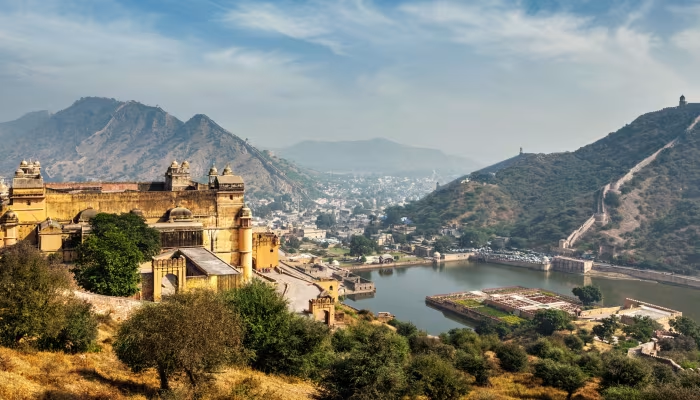
Amber Fort is the centrepiece of a Jaipur visit, and November is the month it earns its reputation most fully. The fort rises above Maota Lake on a ridge of the Aravalli Hills about 11 kilometres outside the city, its golden-pink sandstone walls and domes appearing from the road below as something between a fortress and a dream. In November, with the hills still carrying some post-monsoon green and the early morning light striking the lake surface before it hits the walls, the approach to Amber Fort is one of the most visually compelling moments in Indian travel.
Inside the fort, the Sheesh Mahal — the Hall of Mirrors — is the most famous room: every surface covered in tiny convex mirrors so that a single candle flame becomes a thousand points of light. The Diwan-i-Khas (Hall of Private Audience) and the Sukh Niwas with its system of water channels that cooled the air before air conditioning existed are both worth the time. The fort complex is large — allow three to four hours to explore it properly — and a licensed guide makes the layered history accessible in a way that walking through independently does not.
November mornings at Amber Fort are the optimal time to visit. Arrive at opening time (8am) and you have the fort largely to yourself for the first hour. By 10am the tour groups are in full flow. By midday it is busy but never overwhelmingly crowded in November the way it becomes in Christmas week.
City Palace
The City Palace occupies the heart of the walled city and remains partially home to the royal family of Jaipur — the Maharaja still lives in part of the complex, which gives it a living quality that a conventional museum does not have. The public sections include the Mubarak Mahal, which houses an extraordinary textile collection including garments from previous maharajas; the Armory, with one of the finest collections of weapons in Rajasthan; and the Diwan-i-Khas, which contains two enormous silver urns — the largest silver objects in the world — that were carried to England filled with Ganges water for the Maharaja’s visit in 1902.
The outer courtyard with the Peacock Gates — four ornately carved arches representing the four seasons — is free to enter and photograph, and worth doing even if you do not go into the main museum sections.
Hawa Mahal
The Palace of Winds is Jaipur’s most-photographed monument, a five-storey pink sandstone screen of 953 small windows that faces the main bazaar road of the old city. It was built in 1799 so that the women of the royal household could watch street life and festivals below without being seen — a remarkable piece of architecture that makes more sense when you understand its purpose. From outside, it is one of the most distinctive facades in India. From inside — going up to the upper floors where the windows open over the bazaar — you get the city panorama from an angle that most visitors miss.
November morning light on the Hawa Mahal facade is exceptional, particularly in the first hour after sunrise when the low sun hits the sandstone at full angle. The standard approach is to photograph it from the small rooftop cafe across the street, which gives you the full facade in one frame.
Jantar Mantar
Jaipur’s Jantar Mantar is a UNESCO World Heritage Site and one of five astronomical observatories built by Maharaja Jai Singh II in the early eighteenth century. It is easy to walk past it as a collection of unusual stone structures without understanding what you are looking at — with a guide or some background reading, it becomes one of the most surprising places in Jaipur. The Samrat Yantra, a sundial 27 metres tall that can measure time to an accuracy of two seconds, was the largest sundial in the world at its construction. The observatory was not a showpiece but a working scientific instrument that Jai Singh used to revise the existing astronomical tables. In November, the sky above the structures is clear blue and the instruments are lit beautifully for photography.
Nahargarh Fort
Nahargarh — the Tiger Fort — sits on the ridge above the city and is usually done as an evening visit for the sunset view over Jaipur. In November, that view is extraordinary: the city’s pink buildings spread out below, the Aravalli hills fading to purple in the distance, and the light going from gold to orange to red over the course of twenty minutes. The fort itself is less well-preserved than Amber, but the walls, the stepwells, and the quirky Victorian-era palace inside (built by Maharaja Ram Singh II with identical rooms for his nine queens) make for an interesting couple of hours. The restaurant at the top, run by a local hospitality group, does decent Rajasthani thali.
Jaigarh Fort
Connected to Amber by an underground passage (now closed to visitors) and sitting on the ridge above it, Jaigarh houses the world’s largest cannon on wheels — Jaivana — which was fired exactly once, in a test, sending a cannonball into the ground seven kilometres away and creating a small lake where it landed. The fort also has an excellent view down over Amber Fort from above, which gives the full context of the Amber complex that is impossible to appreciate from ground level.
The Bazaars of the Old City
Jaipur’s walled city bazaars are among the best markets in India for textiles, jewellery, leather goods, and Rajasthani handicrafts. Johari Bazaar is the city’s famous gemstone and jewellery market — Jaipur is one of the world’s major centres for coloured gemstone cutting and trading, and the range here, from semi-precious stone cabochons to finished gold and silver jewellery, is extraordinary. Bapu Bazaar and Nehru Bazaar sell block-printed textiles, cotton quilts, leather jootis (the pointed-toe Rajasthani shoes), and camel leather goods. Tripolia Bazaar is the place for lac bangles and brassware.
November brings the start of the winter textile season, when the richer fabrics — wool shawls, velvet quilts, mirror-work jackets — appear alongside the cotton prints that dominate in summer. Shopping in Jaipur’s bazaars in November is the best version of the experience.
Jal Mahal
The Water Palace sits in the middle of Man Sagar Lake on the road between Jaipur and Amber Fort, appearing from the lakeside road as a single storey Mughal-Rajput pavilion surrounded by water. Most visitors see it from the road. What is less well known is that the building is actually five storeys tall — four are submerged, and the lake level in November, still high from the monsoon, covers them completely. It is not open to visitors (conservation work has been ongoing) but the view from the lakeside at dawn or dusk, with the palace reflected in the still water, is one of Jaipur’s most beautiful scenes.
A Three-Day Jaipur November Itinerary
Day 1: Arrive, check in, afternoon walk through the old city — Hawa Mahal exterior and the lanes around Johari Bazaar. Dinner on a rooftop with city views. The restaurants along the old city walls near Nahargarh Road are excellent for Rajasthani dal baati churma and laal maas.
Day 2: Early start to Amber Fort at 8am (before the crowds). Spend three to four hours inside. After Amber, drive up to Jaigarh for the view over the Amber complex. Afternoon: City Palace and Jantar Mantar. Evening: Nahargarh Fort for sunset. Back into the city for dinner.
Day 3: Morning at the bazaars — Bapu Bazaar for textiles, Johari Bazaar for gems, Tripolia for lacware. If your dates align, this is the day for the Pushkar day trip (150 km, leave by 7am to arrive by 10am and return by 6pm). Afternoon if staying in Jaipur: Jal Mahal from the lakeside and a craft workshop for block printing or blue pottery.
Where to Stay in Jaipur in November
Heritage havelis (mid-range, ₹6,000–₹15,000 per night / $70–$180): Jaipur has more converted heritage properties than almost any city in India, and staying in a former merchant mansion or noble’s haveli is a significant part of the experience. Samode Haveli, in the old city itself, is one of the finest — a 475-year-old nobleman’s residence with a painted courtyard restaurant and rooms decorated in traditional Rajasthani style. Alsisar Haveli, Bissau Palace, and Narain Niwas Palace are all in this tier and deliver the Jaipur atmosphere that a business hotel cannot.
Boutique mid-range ($80–$150): Newer boutique properties in the Civil Lines and C-Scheme neighbourhoods offer well-designed rooms with reliable wifi, good restaurants, and proximity to the newer parts of the city. Umaid Mahal and Brijrama Palace are worth checking at this level.
Luxury ($250–$800+): Rambagh Palace is the headline — the former maharaja’s hunting lodge converted into a Taj hotel, with 47 acres of gardens, an enormous pool, and a restaurant in what was once the royal banquet hall. The level of service and the sense of place at Rambagh is unlike any other Jaipur stay. The Oberoi Rajvilas, a resort property with individual villa accommodation and an enormous central courtyard garden, is the other major luxury option — slightly further from the old city but consistently rated among the best hotels in India.
Getting to Jaipur in November
From Delhi: The most common approach for international visitors. The Jaipur Highway (NH48) takes four to four and a half hours by private car — the standard arrangement on a Golden Triangle tour. The Shatabdi Express train from Delhi to Jaipur takes four and a half to five hours from Delhi Cantt or Hazrat Nizamuddin station, with comfortable air-conditioned chair car seats at around $10–$15 USD each way. Jaipur also has a domestic airport (JAI) with regular flights from Delhi (about an hour), Mumbai, and Bengaluru.
From Agra: The Agra–Jaipur drive of 240 kilometres takes four to five hours and is usually done with a stop at Fatehpur Sikri en route — the abandoned Mughal capital is 40 kilometres from Agra and a two-hour detour well worth making.
From Pushkar: If you are returning from the Pushkar Camel Fair, Jaipur is two and a half to three hours by road.
Practical Information for International Visitors
Entry fees: Amber Fort charges approximately ₹700 (about $8 USD) for foreign nationals. The City Palace charges around ₹700 for the main museum. Hawa Mahal charges ₹200. Nahargarh charges ₹200. Jantar Mantar charges ₹200. A composite ticket (Amber + Nahargarh + Jaigarh + Jantar Mantar + Hawa Mahal + Albert Hall Museum) is available at a slight discount and is called the Jaipur City Pass — worth asking about at your first monument visit.
Getting around: Auto-rickshaws are plentiful in the old city and useful for short trips between monuments. Agreeing on the fare before you get in, or using a metered auto, avoids negotiation issues. For longer trips and inter-monument travel, your private tour vehicle is the most comfortable and efficient option.
Language: English is widely spoken in tourist areas, hotels, and better restaurants. Hindi is the local language. Basic Hindi words — namaste (hello), shukriya (thank you), kitna (how much) — are appreciated.
Currency: ATMs are plentiful in Jaipur’s main commercial areas. Cards are accepted at most hotels, larger restaurants, and shops that cater to tourists. Cash is still expected at smaller market stalls and street food vendors.
SIM card: A local Indian SIM with a data plan is the most cost-effective way to handle navigation, maps, and communication. Jio and Airtel SIMs are available at the airport and at shops throughout the city with a passport photocopy and a local address (your hotel address works). A 30-day plan with data costs approximately $5–$8 USD.
Jaipur in November vs Other Months
November is one of the two peak months for Jaipur tourism (the other being December-January), and for good reason. The weather is the closest to perfect that the city gets — warm days, cool evenings, no rain, extraordinary light. October is slightly warmer but comparable in quality, and the bazaars are at their post-Dussehra festive best. February is excellent weather but slightly cooler and the winter tourist crowds are fully present. March sees the Holi festival — extraordinary for those who want to experience the colour festival but logistically messy for monument visits in the days immediately after.
April through September covers the heat and monsoon — April and May see temperatures above 38°C, and June through September brings the rains. December is excellent weather but increasingly expensive and crowded toward Christmas. November, particularly the first three weeks, hits the sweet spot between ideal conditions and manageable visitor numbers.
Frequently Asked Questions
Is Jaipur worth visiting in November?
November is one of the best months to visit Jaipur. The weather is excellent — warm days and cool evenings — the light is spectacular for photography, and the Diwali festive atmosphere carries into the first week of the month. If your dates include early November, the proximity to the Pushkar Camel Fair (150 km from Jaipur) makes the visit even more compelling.
What is the temperature in Jaipur in November 2026?
Early November sees daytime highs around 27–30°C (80–86°F) with evenings dropping to 16–18°C (61–64°F). By late November, days cool to 23–25°C (73–77°F) and nights drop to 11–14°C (52–57°F). There is no rain. A light jacket or shawl for evenings and early mornings is advisable, particularly in the second half of the month.
How many days do I need in Jaipur?
Two full days covers the main monuments — Amber Fort, City Palace, Hawa Mahal, Jantar Mantar, and a sunset at Nahargarh. Three days allows time for the bazaars, a Pushkar day trip, and a more relaxed pace through the old city lanes. Most Golden Triangle itineraries allocate two to three nights in Jaipur, which translates to two full days of sightseeing.
Can I do a day trip to Pushkar from Jaipur in November?
Yes. Pushkar is 150 kilometres from Jaipur — about two and a half to three hours by car. A day trip gives you four to five hours at the Pushkar Camel Fair (if your dates align with early November) or the Brahma temple and lake ghats at any time during the month. If you want to experience the full moon ceremony on Kartik Purnima (November 5 in 2026), you need to stay overnight in Pushkar.
Is Amber Fort open every day in November?
Amber Fort is open every day of the week, including public holidays, from 8am to 5:30pm. There is no weekly closing day (unlike the Taj Mahal, which closes on Fridays). November is a busy month, so arriving at opening time is the best strategy to have the fort relatively to yourself in the first hour.
What should I buy in Jaipur?
Jaipur is one of India’s great shopping cities. The most popular purchases are gemstone jewellery from Johari Bazaar, block-printed cotton textiles from Bapu Bazaar, blue pottery (a Jaipur specialty, made from quartz powder and fired at low temperature — the cobalt blue glaze is distinctive), lac bangles from Tripolia Bazaar, and leather jootis — the pointed-toe Rajasthani shoes that come in every colour and style. Cashmere shawls and embroidered quilts are particularly good in November when the winter textile season begins. Prices are negotiable in most market contexts.
What is the best way to get from Jaipur to Delhi after a Golden Triangle tour?
The most common routes are private car (four to four and a half hours on the Delhi-Jaipur Highway), the Shatabdi Express train from Jaipur Junction (four and a half to five hours to Hazrat Nizamuddin, departing around 5:50pm and arriving around 10:30pm), or a domestic flight from Jaipur Airport (JAI) to Delhi Airport — one hour flying time. Most Golden Triangle tours include the return road transfer to Delhi as part of the package.
Is Jaipur safe for solo female travelers?
Jaipur is one of the more straightforward Indian cities for solo female travelers, with a well-developed tourist infrastructure and English widely spoken in tourist areas. Normal urban awareness applies — using pre-arranged transport rather than unmarked vehicles, staying in well-reviewed accommodation, and keeping your hotel’s contact number accessible covers most situations. The old city bazaars can be overwhelming for first-time visitors to India; having a guide for the first day is useful for orientation.
Jaipur in November 2026 is the Pink City at its finest — the weather, the post-Diwali atmosphere, and the proximity to the Pushkar Camel Fair combine to make this one of the strongest windows in the year.
Squid Travel India arranges private Jaipur and Golden Triangle tours for international visitors. Contact us to plan your November 2026 Rajasthan itinerary.

Comment (0)