

There is a reason India sits on almost every serious traveller’s bucket list. It is not just a destination. It is an experience that rewires something in you — the scale of it, the colour, the noise, the spirituality, the food, the history, the sheer impossible variety of it all.
But let’s be honest: India can also feel overwhelming before you arrive. The visa process, the heat, the crowds, the different customs, the unfamiliar currencies — if you are visiting India for the first time in 2026, there is a lot to navigate.
This guide exists to make that navigation simple.
We have put together the most complete, honest, and practical India travel guide for first-time visitors — covering everything from visas and vaccinations to the best destinations, ideal itineraries, what to eat, how to get around, what things cost, and the cultural tips that will make the difference between a trip that frustrates you and one that transforms you.
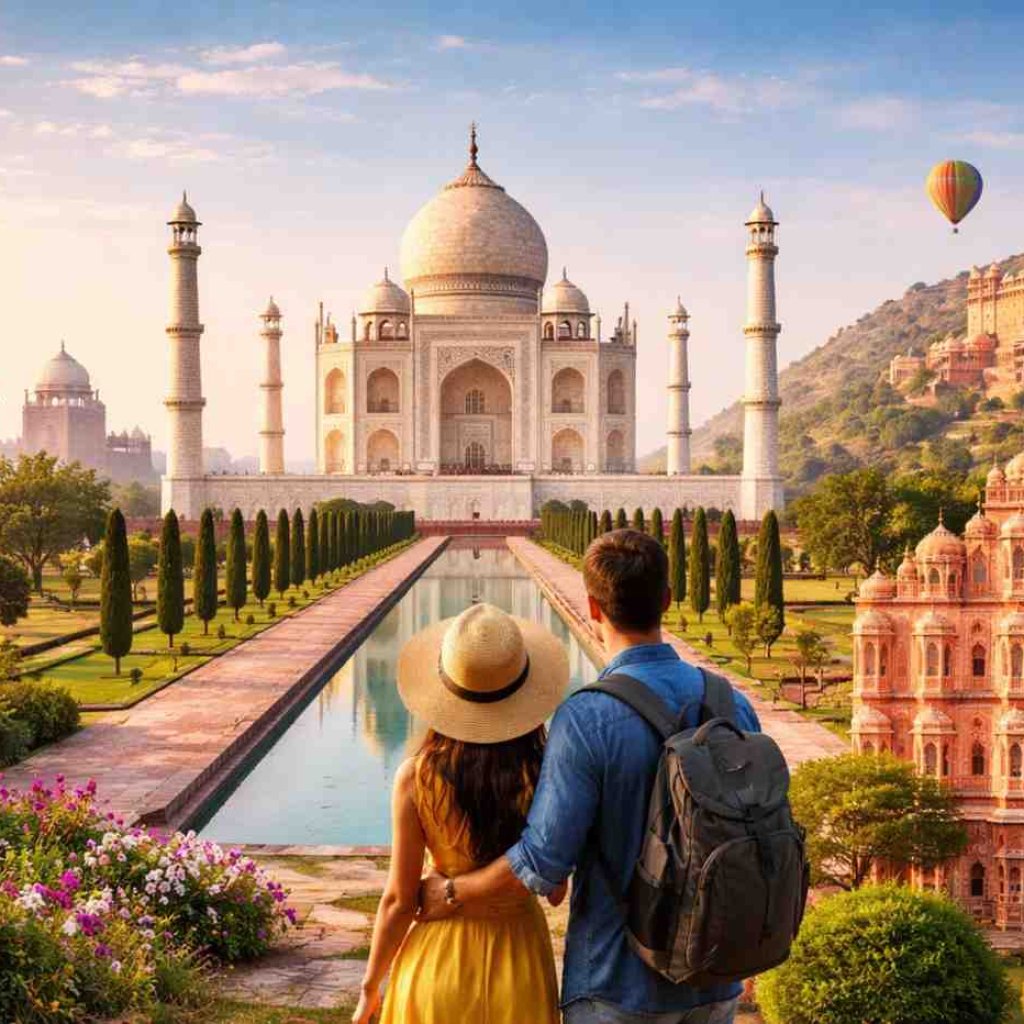
India is ready for you. Let’s get you ready for India.
Is India the Right Destination for You?
Before anything else — a straight answer to the question many first-timers quietly ask.
India is generally safe as long as you stay aware. Pickpocketing is the most common trouble, so keep your valuables close, especially in crowded areas. Be wary of anyone offering deals that sound too good to be true, whether tours, gems, or hotels. Stick to official counters, apps, or recommendations from your place of stay.
India is right for you if:
- You want history, culture, and architecture at a world-class level
- You are excited by extraordinary food that you cannot get anywhere else
- You are open to things not always going exactly to plan — and seeing that as part of the adventure
- You want to travel somewhere that genuinely feels different from anywhere you have been before
India may not be right for you if you need complete predictability, perfectly smooth logistics, or pristine infrastructure at every step. Parts of India are chaotic. But the rewards of leaning into that chaos, rather than resisting it, are extraordinary.
Step 1: Getting Your India Visa in 2026
For most international visitors, the India e-Tourist Visa (eVisa) is the easiest and most convenient option — applied for entirely online before your trip.
The Tourist e-Visa remains the most popular choice in 2026 for short leisure or cultural visits. Validity options include 30 days (double entry), 1 year (multiple entry), or 5 years (multiple entry). The maximum stay is 90 days per visit for most countries, and 180 days for US, UK, Japan, and Canada passport holders. The application is fully online via the official Indian e-Visa portal, and processing usually takes 3 to 5 business days — though applying 10 days in advance is wise.
The 1-year multiple-entry eVisa at $40 allows travellers to enter India up to three times within the validity period — ideal for those planning multiple shorter trips. The 5-year multiple-entry eVisa at $80 suits frequent visitors.
Important 2026 update: As of 2026, every foreign national, including OCI cardholders, must submit the e-Arrival Card online within 72 hours of their inbound flight. The QR code generated at the end of the form is required at the immigration counter. Filing it during the flight is too late if you have a connection with limited Wi-Fi.
Key visa tips:
- Apply only through the official government portal: indianvisaonline.gov.in
- Do not pay unofficial agents — the Government of India has not authorised any agent or intermediary to charge a fee for emergency or express visa facilitation.
- Tourist e-Visas cannot be extended. You must exit and re-enter if planning a longer stay.
- If you are arriving from a yellow fever-endemic country, carry a valid yellow fever vaccination certificate in original.
Step 2: When to Visit India
This is one of the most important decisions you will make — and it varies significantly depending on where in India you plan to visit.
October to March — The Golden Window
The best time to visit India is from October to March, when the weather is pleasant for sightseeing in Delhi, Agra, and Jaipur. Summers can be hot, while winter months are perfect for enjoying outdoor tours. This applies to most of North India, Rajasthan, and the Golden Triangle. This peak travel season offers ideal temperatures ranging between 15°C and 25°C, though prices are higher and bookings should be made 2 to 3 months in advance.
October & November — Diwali, India’s Festival of Lights, transforms the entire country. Cities are illuminated, the mood is festive, and witnessing Diwali in Jaipur, Varanasi, or Delhi is a once-in-a-lifetime experience.
March — Holi, the Festival of Colours, is one of the most joyful and visually spectacular celebrations in the world. If you can time your visit around Holi, do it.
April to June — Hot but Cheap
Temperatures cross 40°C across much of North India. Not ideal for heavy sightseeing, but tour prices drop by 40 to 60 percent despite warmer temperatures — a significant saving for budget travellers who don’t mind the heat. South India and the Himalayas remain comfortable in these months.
July to September — Monsoon Season
The monsoon brings heavy rainfall and high humidity, though it is the best time for budget travel and visiting the Himalayan highlands. Spiti Valley, Ladakh, and Himachal Pradesh are in peak season during July and August. Kerala turns impossibly lush and green. Rajasthan becomes quieter and cheaper. Just be prepared for disruptions to road travel.
Quick Regional Guide:
- North India / Rajasthan / Golden Triangle: October to March
- Kerala / South India: September to March
- Goa: November to February
- Himalayas / Ladakh / Spiti: June to September
- Varanasi: October to March (though beautiful year-round)
Step 3: How Long Should You Spend in India?
India is enormous — roughly the size of Western Europe. You cannot see all of it. Do not try.
A two-week visit realistically allows deep exploration of one region. Three weeks permits a meaningful combination.
Here are the most practical trip lengths for first-timers:
9 to 10 Days — The Classic Introduction
For classic 9-day tours, you could choose to discover India’s icons in the north: spend a week seeing the Golden Triangle cities (Delhi, Agra, and Jaipur), then allocate the remaining 2 days to Varanasi or a tiger safari in Ranthambore National Park. Alternatively, focus entirely on Kerala’s backwaters, hill stations, and beaches in the south.
2 Weeks — The Sweet Spot
Two weeks is genuinely the ideal first trip to India. It gives you time to settle in, absorb the pace, handle the inevitable adjustment period, and still see a meaningful amount. Following one week in the Golden Triangle, you could spend another week in Rajasthan (Bikaner, Jaisalmer, Jodhpur, and Udaipur) in North India, or delve into the top two regions of South India: Kerala (7 days) and Tamil Nadu (7 days).
3 to 4 Weeks — The Full Experience
Three weeks lets you combine North and South India meaningfully. A classic route: Golden Triangle → Rajasthan → fly to Kerala → backwaters → Munnar. This is the trip people come back from utterly changed.
Step 4: The Best Regions for First-Time Visitors
Most first-time visitors to India focus on one of three broad approaches: the heritage circuit — the iconic path through Delhi, Agra, Jaipur, and surrounding Rajasthan; the nature and culture combination — Kerala’s backwaters and hill stations, Karnataka’s heritage temples, or the wildlife parks of Assam and Madhya Pradesh; or the spiritual journey — following the Buddhist pilgrimage circuit through Bodh Gaya, Varanasi, Sarnath, and Sanchi, or the Hindu pilgrimage towns of Rajasthan and Tamil Nadu.
Here is a rundown of the best destinations for first-timers:
Delhi — Where Ancient and Modern Collide
India’s capital is chaotic, magnificent, and completely unmissable. Spend 2 to 3 days here. The must-sees include the Red Fort, Qutub Minar, Humayun’s Tomb (a UNESCO World Heritage Site and the architectural predecessor of the Taj Mahal), India Gate, and the sensory overload of Old Delhi’s Chandni Chowk bazaar. Delhi’s food scene — from street chaat to world-class restaurants — is among the best in Asia.
Agra — Home of the Taj Mahal
You go to Agra for one reason: the Taj Mahal. And it is worth every mile. Described as the epitome of love, this white marble mausoleum is a UNESCO World Heritage Site and one of the New Seven Wonders of the World. Visit at sunrise for the best light and thinnest crowds. Beyond the Taj, Agra Fort and the abandoned Mughal capital of Fatehpur Sikri are both extraordinary.
Jaipur — The Pink City of Rajasthan
Jaipur is the jewel of Rajasthan and the perfect introduction to India’s royal heritage. Painted pink to welcome the Prince of Wales in 1876, the city remains a testament to Rajput courage and luxury. Amber Fort, Hawa Mahal, City Palace, and Jantar Mantar are the headline attractions. The markets are world-class for shopping — gemstones, textiles, blue pottery, and silver.
Rajasthan — India’s Royal Heartland
Beyond Jaipur, Rajasthan is a world of its own. Udaipur is all white marble palaces reflected in serene lakes. Jodhpur is the Blue City — a dense tangle of cobalt-washed houses beneath a fortress that dominates the skyline. Jaisalmer is a golden sandstone city rising from the Thar Desert. Rajasthan alone can easily fill two weeks of extraordinary travel.
Kerala — God’s Own Country
Known as “God’s Own Country,” Kerala is a world away from the desert forts of the north. Think palm trees, spice plantations, and endless green water. Spend a night on a traditional Kettuvallam houseboat in the Alleppey backwaters. Visit the tea estates of Munnar. Watch a Kathakali dance performance. Try the traditional “Sadhya” feast served on a banana leaf. Kerala is India for those who want the pace to slow down.
Varanasi — The Spiritual Heart of India
No description adequately prepares you for Varanasi — India’s oldest living city, where the ghats of the Ganges river are the stage for an ancient, daily ritual of life, death, prayer, and renewal. The Ganga Aarti ceremony at sunset is one of the most powerful things you will witness anywhere in the world. Varanasi is essential.
Ranthambore — Where You See Tigers in the Wild
Ranthambore National Park in Rajasthan is one of the best places in the world to see Bengal tigers in their natural habitat. A two-night stay gives you two or three jeep safaris — and the experience of seeing a tiger emerge from tall grass at dawn is, quite simply, unforgettable.
Goa — Beaches, Forts, and Colonial History
North Goa is for parties and markets; South Goa is for peace and seclusion. Goa’s Portuguese colonial history gives it a completely distinct flavour from the rest of India — the churches, the food (vindaloo, bebinca, feni), and the relaxed beachside pace make it the perfect end to an India trip.
Step 5: Getting Around India
India has improved dramatically in transport infrastructure over the past decade, and getting around is easier than ever in 2026.
By Train — The Best Way to Experience India
Indian Railways is one of the great travel experiences on earth. The network is vast, the trains are comfortable (especially 2AC and 1AC classes on overnight routes), and the views through the windows are constantly extraordinary. Book at least 6 to 8 weeks in advance on IRCTC for popular routes. Foreign tourists can access a dedicated tourist quota through the IRCTC portal.
Key routes for first-timers: Delhi to Agra (Gatimaan Express — 1 hour 40 minutes), Delhi to Jaipur (Vande Bharat — under 4 hours), Mumbai to Goa (overnight — 10 hours), and Delhi to Varanasi (overnight — 12 hours).
By Domestic Flight — Fast but Unpredictable
Domestic aviation has expanded quickly, with a range of low-cost and full-service airlines linking major hubs and secondary cities. Flight times are short compared with rail, but schedules can be affected by weather, congestion, and operational issues — a reminder that you should allow buffer time around important connections and avoid overly tight same-day transfers.
By Private Car with Driver — The Most Comfortable Option
A hire car covering Delhi-Agra-Jaipur-Delhi (approximately 800 kilometres total, 3 to 4 days) costs ₹8,000 to ₹12,000 all-in — a reasonable cost split between two or more travellers that eliminates all transport logistics. For families, couples, and those who value flexibility and comfort, a private car with an experienced driver is the recommended option — especially in Rajasthan and Kerala, where road travel between destinations is part of the experience.
In Cities — Metro, Auto-Rickshaw & Rapido/Ola/Uber
Delhi and Mumbai have excellent metro systems — clean, air-conditioned, and cheap. For shorter distances, auto-rickshaws are part of the authentic India experience — always agree on a fare before getting in, or insist on the meter. Ola and Uber are widely available in all major cities and are the safest, most transparent option for getting around independently.
Step 6: Money, Currency & Costs
The Currency
India uses the Indian Rupee (INR / ₹). The exchange rate in early 2026 is approximately 84 to 86 INR per US dollar and 97 to 100 INR per euro.
Cash vs Card
Cash remains important in India, particularly at local restaurants, markets, rickshaws, and small heritage towns. Carry ₹3,000 to ₹5,000 in small denominations (₹100, ₹200, ₹500 notes) as daily operating cash. ATMs at airports, major cities, and tourist towns reliably dispense rupees using international cards (Visa and Mastercard have the widest acceptance).
Carry the equivalent of $300 to $500 (₹25,000 to ₹42,000) in mixed currency for emergencies, taxis, tips, and street food. India has also become a UPI-dominant country — many restaurants and shops now accept QR code payments, and some apps allow international tourists to set up UPI wallets with a foreign number.
What Does India Cost?
India offers extraordinary value across all budget levels. Traveller-reported averages are about $12 / ₹1,134 per day for budget travellers, $33 / ₹3,120 per day for mid-range, and $90 / ₹8,508 per day for luxury travellers — excluding international flights.
Food: India is extraordinarily cheap to eat well in — if you are comfortable eating where locals eat. A full thali at a no-frills dhaba can cost ₹80 to ₹200. Budget travellers spend ₹400 to ₹700 per day on food, mid-range travellers spend ₹1,000 to ₹2,500 per day, and comfort travellers spend ₹3,000 to ₹6,000 per day.
Accommodation: From ₹800 per night in a clean hostel dormitory to ₹30,000+ per night in a heritage palace hotel. The range is extraordinary, and quality at every level has improved significantly.
Step 7: Health & Vaccinations
Preparation here is essential — not because India is dangerous, but because the food, water, and climate are genuinely different, and a little advance care makes for a much smoother trip.
Recommended vaccinations: Ask about Hepatitis A and typhoid for food and water exposure. Discuss Japanese encephalitis if you will spend time in rural or long-stay settings. Check yellow fever entry rules if you are arriving from a risk country. Ask whether malaria prevention is relevant to your route and season.
Book a travel health appointment 4 to 6 weeks before your departure date.
Water: Do not drink tap water anywhere in India. Stick to sealed bottled water, or carry a filter bottle. This applies to ice in drinks as well — in budget restaurants and street stalls, ask for no ice.
Stomach: The famous “Delhi belly” is a real risk, especially in the first few days as your stomach adjusts to new bacteria. Start with cooked food, avoid raw salads and unpeeled fruit in your first few days, eat where locals eat (high turnover = fresher food), and carry oral rehydration salts just in case.
Sun & Heat: The heat and pollution might be more challenging than any crime concerns. Carry a scarf or mask for dusty cities like Delhi and stay hydrated. Sunscreen SPF 50+ and UV sunglasses are essential between March and October.
Travel Insurance: Non-negotiable. Medical costs for foreigners in India can be significant if you end up in a private hospital. International travel insurance typically costs $50 to $180 USD for a 2 to 4 week trip — always get it.
Step 8: Indian Culture — What to Know Before You Go
Understanding a few cultural basics will transform how you experience India — and how warmly you are received.
Remove your shoes before entering temples, mosques, gurudwaras, and many homes. This is not optional. Look for a shoe rack or other visitors removing footwear at the entrance.
Dress modestly at religious sites. Cover your shoulders and knees — both men and women. Carry a light scarf or shawl for spontaneous temple visits. Temples, mosques, churches, and gurudwaras exist side-by-side, welcoming visitors with open arms. Always be respectful: cover your head in sacred places if asked, remove your shoes before entering, and don’t take photos during rituals unless it’s clearly acceptable.
The head wobble. The famous Indian head wobble — a side-to-side rocking of the head — can mean yes, I understand, I acknowledge you, or I am listening. It is an expression of positive engagement. Once you start spotting it, you will see it everywhere.
Bargaining is normal in markets, with rickshaw drivers (always agree on price before getting in), and at tourist stalls. In restaurants, fixed shops, and malls, prices are set. In bazaars and street stalls, negotiating is expected and part of the social ritual of buying.
Use your right hand. In Indian culture, the left hand is considered unclean. Use your right hand to eat, to give and receive things, and to greet people.
Personal questions are friendly. Indians may ask your name, country, profession, marital status, and salary within the first five minutes of conversation. This is not rude — it is warm and curious. Answer or deflect gently as you choose.
Photography etiquette. Always ask before photographing people, especially in rural areas and at religious sites. Most Indians are happy to be photographed — many will invite you to take a photo. But asking first is always respectful.
Step 9: India’s Food — A First Timer’s Guide
Indian food is one of the great culinary traditions of the world. One of the best decisions you will make on this trip is to eat adventurously and eat often.
North Indian staples: Butter chicken (murgh makhani), Dal makhani, Rogan josh, Biryani, Chole bhature, Parathas, Kebabs, Samosas. Rich, aromatic, often dairy-heavy sauces with flatbreads (naan, roti) or rice.
South Indian staples: Dosa (crispy fermented crepe served with sambar and coconut chutney), Idli, Uttapam, Fish curry, Kerala prawn moilee, Sadhya (the full banana-leaf vegetarian feast). Lighter, rice-based, coconut-forward flavours.
Street food essentials: Pani puri / gol gappa, Chaat (tangy, spiced potato dishes), Vada pav (Mumbai’s iconic potato fritter sandwich), Pav bhaji, Lassi (yoghurt drink — sweet or salty), Kulfi (Indian ice cream), Chai from a roadside tea stall.
Tips for first-timers:
- Start milder in your first few days, then ramp up the spice
- Eat where locals eat — high footfall means fresher food
- Street food is generally safe at busy, popular stalls — use your eyes: hot, freshly cooked, high turnover
- Vegetarian food in India is extraordinary — do not feel you are missing out
- Always carry a packet of electrolytes for the inevitable day your stomach protests
Step 10: Safety Tips for First-Time Visitors to India
India is experiencing high tourist occupancy and positive traveller reviews. Tour operators and hotels have adapted well to international expectations, with improved hygiene, better guest services, multilingual staff, and seamless payment options.
Here are the practical safety essentials:
Book with reputable operators. If you book a tour with experienced operators offering Golden Triangle tours, luxury Rajasthan itineraries, or South India wellness journeys, you can travel confidently and securely.
Use official transport. At airports and railway stations, use pre-paid taxi counters or app-based rides (Ola/Uber) rather than drivers who approach you unsolicited.
Scams to know about: The classic ones are gem investment schemes in Jaipur, overpriced “government handicraft emporiums” that are actually private shops, fake tour guides at monuments, and drivers who claim your hotel is “closed” or “moved” and take you to an expensive alternative. A licensed tour operator handles all of this.
Keep digital copies of documents. Email yourself a scan of your passport, visa, travel insurance, and emergency contacts. Keep a printed copy in your luggage as backup.
Emergency numbers: Police 100, Ambulance 108, Tourist Helpline 1800-111-363.
Step 11: The Best 2-Week India Itinerary for First Timers
Here is our recommended 14-day itinerary for a first trip to India — combining the Golden Triangle, Rajasthan, and a taste of South India.
Days 1–2: Delhi Arrive, acclimatise, explore Old Delhi (Red Fort, Chandni Chowk, Jama Masjid) and New Delhi (Humayun’s Tomb, Qutub Minar, India Gate).
Days 3–4: Agra Drive or train to Agra. Taj Mahal at sunrise. Agra Fort. Sunset at Mehtab Bagh. Day trip to Fatehpur Sikri.
Days 5–7: Jaipur Drive to Jaipur via Fatehpur Sikri. Amber Fort, Hawa Mahal, City Palace, Jantar Mantar. Explore the pink city’s bazaars.
Days 8–9: Ranthambore Drive to Ranthambore National Park. Two tiger safaris. One of the most thrilling experiences in India.
Day 10: Fly to Kochi, Kerala Fly from Jaipur to Kochi (via Delhi). Arrive in Kerala — the contrast with Rajasthan is immediate and extraordinary.
Days 11–12: Alleppey Backwaters Board a traditional houseboat on the Kerala backwaters. Drift through canals, villages, rice paddies, and coconut groves. Sleep on the water under a star-filled sky.
Day 13: Munnar Drive up to Munnar’s tea estates. Walk through rolling hills of manicured green tea bushes. Fresh mountain air. Complete peace.
Day 14: Fly Home from Kochi or Trivandrum A final morning in Kerala before your flight home — changed, rested, and already planning your return.
What to Pack for India
- Clothing: Light, breathable fabrics (linen, cotton). Modest coverage for temples. One warm layer for hill stations and cool evenings in winter months. A light rain jacket for monsoon months or tropical Kerala.
- Footwear: Comfortable walking shoes for monuments. Slip-on sandals for temples (easy to remove). Flip-flops for beach destinations.
- Health essentials: Sunscreen SPF 50+, UV sunglasses, insect repellent, oral rehydration salts, anti-diarrhoeal tablets, personal prescription medications in original packaging.
- Tech: Universal power adapter (India uses Type C, D, and M plugs, with Type C and D most common). Power bank. Offline maps downloaded before you leave.
- Documents: Passport with at least 6 months validity. Printed eVisa and e-Arrival Card. Travel insurance documents. Emergency contact list.
- SIM card: Buy a local prepaid tourist SIM at the airport on arrival. A prepaid tourist SIM with data costs ₹300 to ₹600 and gives you connectivity from day one. Airtel and Jio are the most reliable networks.
Common Mistakes First-Time Visitors Make (And How to Avoid Them)
Trying to see too much. India rewards depth over breadth. Two cities explored properly are better than five cities rushed through. Resist the temptation to cram.
Not accounting for journey times. India is large. A 200 km drive can take 5 hours on a busy road. A train that is scheduled to arrive on time often does not. Always build buffer time into your schedule.
Trusting strangers at transport hubs. Airports, railway stations, and monument gates attract touts. Use pre-paid taxis, app rides, and book your guides through your tour operator in advance.
Skipping travel insurance. A serious illness or injury without travel insurance in India can be financially devastating. Never skip it.
Not booking in advance during peak season. Book at least 3 to 6 months in advance, especially for peak seasons like October to March. Heritage palace hotels, tiger safari slots, and houseboat stays in Kerala book up well ahead.
Drinking tap water. Stick to sealed bottles. Always.
Why Book Your First India Trip with Squid Travel India
Your first trip to India deserves to go well. Not just adequately — extraordinarily well.
At Squid Travel India, we specialise in crafting first-time India experiences for international travellers from the UK, USA, Europe, Australia, and beyond. We are TripAdvisor Travelers’ Choice 2024–2025 with over 1,800 trips completed and a 98% client satisfaction rate. Every tour we design is fully private, fully personalised, and fully managed — from your airport pickup on day one to your departure on the final day.
We handle:
- Visa guidance and documentation support
- Airport pickups and all private transfers
- Licensed, expert guides at every monument
- Hotel bookings across all budget levels — from boutique heritage havelis to 5-star palace hotels
- Tiger safari bookings and permits
- Kerala houseboat reservations
- Everything in between
You focus on experiencing India. We handle everything else.
Ready to Plan Your First India Trip?
Tell us your travel dates, your group size, the number of days you have, and your interests — and we will design your perfect personalised India itinerary within 24 hours.
📞 Call / WhatsApp: +91 9990812499 📧 Email: Squidtravelindia@gmail.com 🌐 Visit: squidtravelindia.com
No obligation. No pressure. Just honest, expert India travel planning from a team that lives and breathes this country.

Comments (5)