

By Squid Travel India | Updated: July 2026 | 16 min read
Written by the travel experts at Squid Travel India — a New Delhi-based tour operator with years of first-hand experience guiding international visitors through India’s most iconic destinations. TripAdvisor Travellers’ Choice Award, 2024–2025.
The classic Golden Triangle — Delhi, Agra, Jaipur — is the world’s most famous India itinerary. It is extraordinary. But there is a version of this journey that goes deeper into India’s soul than any three-city circuit can reach.
Add Varanasi.
Varanasi is the oldest continuously inhabited city on earth. It has been a centre of learning, spirituality, art, and commerce for over 3,000 years. Every evening without exception, seven Brahmin priests stand at the edge of the sacred Ganges at Dashashwamedh Ghat and perform the Ganga Aarti — a 45-minute fire ceremony of such staggering beauty and spiritual intensity that it leaves most visitors speechless.
If the Golden Triangle shows you the grandeur of the Mughal empire and the colour of Rajput royalty, Varanasi shows you something older and harder to name. The primal, beating heart of Hindu civilisation. The city where life and death happen openly, without apology, in the same narrow lanes.
Adding two days in Varanasi to the Golden Triangle creates one of the most complete, most moving, and most unforgettable journeys available anywhere in India.
This guide covers everything: a complete 8-day day-by-day itinerary, how to get between all four cities, what the Ganga Aarti is and exactly how to experience it, costs, best time to visit, and every practical detail a first-time visitor needs.
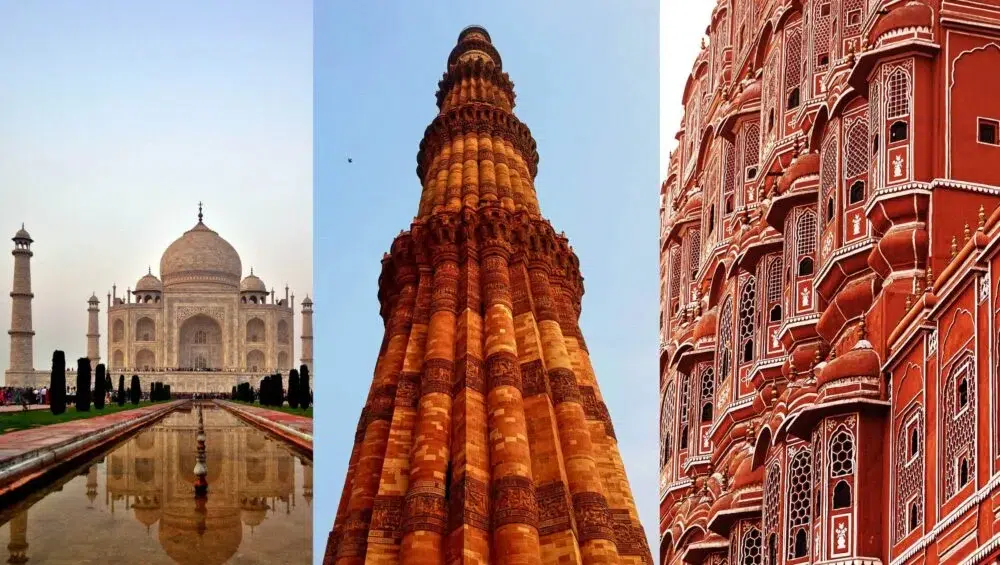
Why Add Varanasi to the Golden Triangle Tour?
The standard Golden Triangle covers three chapters of North India’s story — Mughal Delhi, Mughal Agra, and Rajput Jaipur. All three are primarily stories of kings, emperors, and the monuments they built.
Varanasi is a different kind of story entirely.
Varanasi — also called Kashi, the City of Light, and Banaras — is the spiritual capital of Hinduism, one of the world’s oldest and most complex religious traditions. It sits on the western bank of the Ganges, India’s holiest river. For Hindus, to die in Varanasi is to attain moksha — liberation from the cycle of birth and rebirth. The city’s burning ghats — where bodies are cremated openly on the riverbank, 24 hours a day, 365 days a year — are among the most confronting and most profound sights available to any traveller anywhere in the world.
But Varanasi is not just about death. It is a city overflowing with life — with silk weavers producing the finest Banarasi silk in India, with classical musicians who trace their musical lineage back generations, with street food that rivals anything in the subcontinent, and with a chaos and energy that is simultaneously overwhelming and intoxicating.
The Golden Triangle Tour with Varanasi gives you:
- Mughal grandeur and history (Delhi, Agra)
- Rajput royalty and colour (Jaipur)
- Ancient Hindu civilisation and the sacred Ganges (Varanasi)
- The Taj Mahal at sunrise and the Ganga Aarti at dusk
- 3,000 years of Indian history in a single 8-day journey
It is India in full.
Golden Triangle Tour with Varanasi: At a Glance
Cities covered: Delhi — Agra — Jaipur — Varanasi
Recommended duration: 8 days (minimum 7 days)
Ideal for: First-time India visitors, history and spirituality travellers, photographers
Best time: October to March
Starting point: Delhi (Indira Gandhi International Airport)
Ending point: Varanasi (Lal Bahadur Shastri International Airport) or return to Delhi
8-Day Golden Triangle Tour with Varanasi: Day-by-Day Itinerary
Day 1: Arrive Delhi — Old Delhi & New Delhi
Your 8-day journey begins in Delhi. After airport pickup and hotel check-in, the day divides naturally into two halves — the ancient chaos of Old Delhi and the imperial sweep of New Delhi.
Morning — Old Delhi:
Begin with a cycle rickshaw ride through the narrow lanes of Chandni Chowk — Delhi’s 17th-century spice, textile, and street food market, still operating in full magnificent chaos after nearly 400 years. Visit the Jama Masjid, India’s largest mosque built by Emperor Shah Jahan in 1656, and climb the southern minaret for a panoramic view over the rooftops. Walk through Khari Baoli, Asia’s largest spice market, where open sacks of turmeric, cumin, and dried chillies line the lane in extraordinary colour.
Afternoon — New Delhi:
Cross into the wide imperial boulevards of Lutyens’ Delhi. Visit Humayun’s Tomb — the 16th-century Mughal mausoleum that directly inspired the Taj Mahal and a UNESCO World Heritage Site in its own right. Then Qutub Minar, the 73-metre 12th-century minaret surrounded by India’s earliest mosques. Drive past India Gate and Rajpath as the evening lights come on across the ceremonial boulevard.
Evening:
Dinner in Connaught Place or Khan Market. Try butter chicken, dal makhani, and naan at one of Delhi’s legendary North Indian restaurants. This is one of India’s great food cities — start as you mean to go on.
Where to stay in Delhi:
- Budget: Hotel Alka, Connaught Place (₹3,500–₹5,500/night)
- Standard: The Lalit New Delhi (₹8,000–₹14,000/night)
- Luxury: The Imperial, ITC Maurya, or The Leela Palace (₹25,000–₹60,000+/night)
Day 2: Delhi to Agra — Taj Mahal Sunrise & Agra Fort
Depart Delhi 5:00 AM | Drive 3–3.5 hours
The most important scheduling decision on the entire Golden Triangle Tour with Varanasi is this: arrive at the Taj Mahal in the first hour after it opens.
Pre-dawn departure:
Leave your Delhi hotel at 5:00 AM on the smooth Yamuna Expressway. Arrive at the Taj Mahal’s East Gate by 7:00–7:30 AM.
Morning — Taj Mahal:
In the first hour after opening, the Taj’s white Makrana marble catches the morning sun and shifts from luminous gold to rose to pure dazzling white as the hour progresses. The crowds are thin, the reflecting pool is still, and the space carries something close to the monument’s original spirit.
With a knowledgeable guide, the story of Shah Jahan and Mumtaz Mahal, the 22 years of construction, and the extraordinary detail of the 28 varieties of semi-precious stone inlaid into the marble come alive in ways no guidebook can replicate. Allow 2.5–3 hours. Enter the main mausoleum (additional ₹200 ticket). Walk to the far end of the reflecting pool and to the rear terrace overlooking the Yamuna.
Late Morning — Agra Fort:
10 minutes by car from the Taj, Agra Fort is the massive red sandstone fort-palace that served as the primary Mughal residence for over a century. The Musamman Burj tower — where Shah Jahan spent his final years under house arrest with a direct view of the Taj Mahal where his wife was buried — is one of the most emotionally powerful sights in India. Allow 2–2.5 hours.
Afternoon — Mehtab Bagh:
Cross the Yamuna to Mehtab Bagh for the best unobstructed rear view of the Taj Mahal at sunset — beloved by photographers and far less crowded than the main complex.
Overnight in Agra.
Where to stay in Agra:
- Budget: Hotel Kamal, Taj Ganj — rooftop Taj views (₹2,000–₹4,000/night)
- Standard: Courtyard by Marriott Agra (₹7,000–₹12,000/night)
- Luxury: Oberoi Amarvilas — direct Taj Mahal view from every room (₹45,000–₹90,000+/night)
Day 3: Agra to Jaipur via Fatehpur Sikri
Drive Agra to Jaipur: 4.5–5.5 hours with Fatehpur Sikri stop
Morning — Fatehpur Sikri:
37 kilometres west of Agra, Fatehpur Sikri is Akbar’s ghost capital — a perfectly preserved Mughal city built in 1571 and abandoned after just 14 years. The Buland Darwaza at 54 metres is the world’s highest gateway. The Tomb of Salim Chishti, the Panch Mahal with its 176 columns, and the Diwan-i-Khas with its singular central pillar are all extraordinary. Allow 2.5–3 hours.
Continue to Jaipur:
After Fatehpur Sikri, drive west through the Rajasthani landscape. Arrive in Jaipur by late afternoon.
Evening in Jaipur:
Check in and head to Hawa Mahal at golden hour — the 953-window Palace of Winds is most magnificent in the late afternoon light. Walk through Johari Bazaar. Rooftop dinner overlooking the Pink City.
Where to stay in Jaipur:
- Budget: Pearl Palace Heritage (₹3,500–₹6,000/night)
- Standard: Samode Haveli or ITC Rajputana (₹9,000–₹18,000/night)
- Luxury: Rambagh Palace or Oberoi Rajvilas (₹40,000–₹1,20,000+/night)
Day 4: Jaipur Full Day — Amber Fort, City Palace & Bazaars
Full day in Jaipur
Morning — Amber Fort:
Drive 11 km north to Amber Fort — the spectacular hilltop palace of the Rajput Maharajas. The Sheesh Mahal (Hall of Mirrors), the ornate Ganesh Pol gateway, and rooftop ramparts with views over the Aravalli Hills are unmissable. Allow 2–2.5 hours. Walk up to Jaigarh Fort above for panoramic views.
Afternoon — City Palace & Jantar Mantar:
The City Palace — still partly the official residence of the Jaipur Royal Family — houses a museum with royal costumes, Mughal miniatures, and ancient weapons. Adjacent Jantar Mantar, built in 1724, features the world’s largest stone sundial. Both are UNESCO World Heritage Sites.
Late Afternoon — Bazaars:
Johari Bazaar for gems and jewellery, Bapu Bazaar for Rajasthani textiles, Nehru Bazaar for leather juttis. The Pink City’s markets are among India’s finest.
Evening:
Dal baati churma — Rajasthan’s iconic dish — at a rooftop restaurant overlooking the illuminated Pink City.
Day 5: Jaipur to Varanasi — Travel Day & Evening Ganga Aarti
Fly Jaipur to Varanasi: ~2 hours | Or train via Delhi: 14+ hours
This is the travel day that takes you from Rajasthan’s royal desert into the ancient spiritual heartland of India.
Getting from Jaipur to Varanasi:
A direct or one-stop flight from Jaipur (JAI) to Varanasi (VNS) is by far the most practical option — approximately 2 hours with one stop, or direct on select days. Fares range from ₹4,000–₹12,000 per person depending on airline and booking window. Book well in advance during October to March peak season.
The train alternative via Delhi is a full day of travel — only practical for those with flexible schedules or a strong preference for surface travel.
Arrive Varanasi by 2:00–3:00 PM. Check in to your hotel.
Evening — Ganga Aarti at Dashashwamedh Ghat:
This is the moment that defines Varanasi for most visitors — and it requires careful timing.
Every evening without exception, seven trained Brahmin priests stand at the edge of the sacred Ganga at Dashashwamedh Ghat, each holding a multi-tiered brass lamp ablaze with fire, and offer it to the river in a choreographed ceremony of devotion, gratitude, and surrender. The chanting of mantras, the deep reverberation of conch shells, the fragrance of camphor and incense, and the sight of hundreds of flickering flames reflected in the dark water — this is not a performance. It is a living Vedic fire offering to the river that Hindus regard as a goddess. Ayodhyavaranasitourism
The Ganga Aarti usually starts at 6:45 PM in summer and monsoon, and 5:45 PM in winter. Arrive 45 minutes before the aarti start time. If you arrive by the 45-minute mark, you can secure a position on steps 2–4. After that, you are relegated to steps 5–10+. Varanasi GuruPinaak
Three ways to watch the Ganga Aarti:
Watching from the steps: You stand among thousands of pilgrims and tourists on the tiered stone steps of Dashashwamedh Ghat. The energy is extraordinary. The downside: you need to arrive 45 minutes early to get a good position, the crowd is dense, and photography is difficult from ground level. Banaras Tour
Watching from a private boat on the Ganges gives you an unobstructed panoramic view of all seven priests simultaneously. The river reflects the fire. The sound carries across the water. And you are never in a crowd. A private boat for the aarti typically costs ₹1,800–₹4,500. Banaras Tour
Rooftop restaurant viewing: Several restaurants and guesthouses overlooking the ghat offer elevated views of the ceremony with dinner service. Book in advance during peak season. Banaras Tour
At Squid Travel India, we always recommend the private boat for first-time visitors. The view of all seven priests simultaneously, the fire reflecting in the water, and the freedom from the ghat’s dense crowd transforms the experience entirely.
After the Aarti:
Dinner at a Banarasi restaurant. Try the legendary tamatar chaat at Kashi Chat Bhandar, thandai (a spiced milk drink), and malaiyyo — a seasonal sweet made from dew-touched cream, available only in the winter months.
Where to stay in Varanasi:
- Budget: Stops Hostel or Hotel Ganges View, near Assi Ghat (₹1,500–₹4,000/night)
- Standard: Brijrama Palace — a 200-year-old haveli directly on the Ganges (₹8,000–₹18,000/night)
- Luxury: Taj Ganges or Radisson Hotel Varanasi (₹15,000–₹35,000+/night)
Day 6: Varanasi Full Day — Ghats, Temples & Old City
Full day in Varanasi
Give Varanasi a full unhurried day. It is the kind of city that only reveals itself to those who slow down.
Pre-Dawn — Sunrise Boat Ride on the Ganges:
The best time to visit Varanasi is from October to March. During these months, the weather is cool and dry, making it perfect for walking along the ghats, photography, and comfortably enjoying the city’s spiritual atmosphere.
Whatever the season, the most important thing you can do in Varanasi is be on the river before sunrise.
Depart your ghat by boat at around 5:00–5:30 AM. As dawn breaks over the eastern bank, the entire western ghat front comes alive — bathers entering the river in the first light, priests performing the morning puja, sadhus meditating on the stone steps, children flying kites from rooftops, and the ghats shifting from grey to gold to amber as the sun climbs. This is one of the most visually extraordinary and emotionally moving sights in all of India. It has not changed in its essentials for centuries.
Morning — The Ghats on Foot:
Varanasi’s soul lives on its ghats — the long chain of steps leading down to the holy River Ganges. There are over 80 ghats, each with its own story and significance. Varanasi Taxi
After your boat returns, walk the ghats on foot heading north from Assi Ghat — the most rewarding direction for a morning walk:
Assi Ghat: The southernmost major ghat, popular with long-term visitors and scholars. The morning aarti here, called Subah-e-Banaras, is a broader programme that begins with Vedic chanting and a havan (fire offering), followed by the aarti, then live classical music by local Banarasi musicians, and sometimes a communal yoga session. Ayodhyavaranasitourism
Tulsi Ghat: Named after the saint-poet Tulsidas, who wrote the Ramcharitmanas — the most beloved Hindi version of the Ramayana — here in the 16th century.
Harishchandra Ghat: One of Varanasi’s two burning ghats, smaller and less visited than Manikarnika. Cremations happen here around the clock. Approach with respect and silence; no photography.
Manikarnika Ghat: The most spectacular and busiest ghat — the main cremation ground. It is a must-see for any visitor who wants to understand what Varanasi truly is. The fires at Manikarnika have reportedly burned continuously for over 3,000 years. The scale and openness of what happens here — bodies being carried through the lanes on bamboo stretchers, the pyres burning day and night, the Dom (caste of cremation workers) managing the fires — is confronting for first-time visitors but profoundly important. Stand quietly at a respectful distance. Do not photograph. Your guide will provide the full context. Varanasi Taxi
Dashashwamedh Ghat: The main ghat, most magnificent in the morning quiet after the aarti crowd has dispersed. Sit on the steps and watch the world pass — dhobis (washermen) beating laundry on the stone steps, priests performing private pujas, pilgrims bathing, boatmen calling for custom.
Mid-Morning — Kashi Vishwanath Temple:
The Kashi Vishwanath Temple — dedicated to Lord Shiva, the presiding deity of Varanasi — is the most sacred temple in one of Hinduism’s most sacred cities. The current temple structure was built by Maratha queen Ahilya Bai Holkar in 1780 after the earlier temple was demolished by Mughal Emperor Aurangzeb. The Kashi Vishwanath Corridor — a massive new renovation completed in 2023 — has transformed access to the temple, with a grand courtyard complex now connecting it to the Ganges ghats.
Non-Hindus are not permitted inside the main sanctum but can observe from the outer courtyard. The architecture, the atmosphere, and the extraordinary density of faith concentrated in this small area are worth the visit regardless.
Afternoon — Sarnath:
15 kilometres north of Varanasi lies Sarnath — one of the four most sacred sites in Buddhism. This is the deer park where Siddhartha Gautama gave his first teaching — the Dhammacakkappavattana Sutta — after attaining enlightenment, thereby “setting the wheel of dharma in motion.” It is one of the most important religious sites in Asia.
The Dhamek Stupa — built by Emperor Ashoka in 249 BC and later expanded — marks the exact spot of the first teaching. The Sarnath Archaeological Museum contains the Lion Capital of Ashoka, which became India’s national emblem. The surrounding deer park is peaceful and contemplative.
Allow 2.5–3 hours for Sarnath. It provides a profound counterpoint to the overwhelmingly Hindu experience of Varanasi’s ghats — a reminder that this river valley was the birthplace of multiple great religious traditions.
Evening — Lanes of the Old City:
Varanasi’s old city — the dense medieval tangle of lanes (called galis) between the ghats and the main road — is one of the great walking experiences in India. The lanes are too narrow for vehicles. Temple bells, the smell of incense and marigolds, the sound of classical music drifting from a first-floor window, silk weavers at work in basement workshops, chai stalls in doorways — this is life in a city that has barely paused for 3,000 years.
Your guide will take you through the silk weaving quarter — Varanasi’s Banarasi silk is among the finest fabric produced anywhere in the world, and watching a weaver at a hand loom working with gold and silver zari thread is extraordinary.
Second Evening — Assi Ghat Aarti or Leisure:
If you attended Dashashwamedh Ghat on Day 5, consider the smaller evening aarti at Assi Ghat tonight. Where Dashashwamedh feels collective and intense, Assi Ghat feels personal and grounded. Locals attend regularly. There is more space to breathe. The contrast between the two is illuminating. Prayag Pandits
Day 7: Varanasi to Delhi — Return or Onward Journey
Fly Varanasi to Delhi: 1.5 hours | Or extend to Day 8
Depending on your flight schedule and onward plans, Day 7 works in several ways:
Option A: Morning boat ride at dawn (if not done on Day 6), final walk through the old city, fly Varanasi to Delhi in the afternoon. One final night in Delhi before your international departure.
Option B: Early morning Subah-e-Banaras at Assi Ghat, visit the Bharat Mata Mandir (a unique temple with a marble map of India instead of a deity), then afternoon flight.
Option C (recommended for international travellers): Check whether your airline operates direct flights home from Varanasi (VNS). Several airlines serve London, Dubai, and Singapore from Lal Bahadur Shastri Airport — avoiding an unnecessary return trip to Delhi.
Day 8 (Optional Extension): Delhi — Final Sightseeing or Departure
If your international flight is from Delhi and departs late on Day 8 or Day 9, use the extra time in Delhi for:
- The National Museum — one of India’s finest, covering 5,000 years of Indian art, sculpture, and history
- Lodhi Garden — the most beautiful public park in Delhi, dotted with 15th-century Mughal tombs
- Dilli Haat — the open-air craft bazaar where artisans from every state sell directly, perfect for last-minute quality gifts and souvenirs
- Akshardham Temple — a breathtaking 21st-century Hindu temple complex on the banks of the Yamuna
Getting Between Cities: Golden Triangle Tour with Varanasi Transport Guide
Delhi to Agra:
Private car on the Yamuna Expressway (3–3.5 hours) or Gatimaan Express train (1 hour 40 minutes, ₹755–₹1,505 per person). The Gatimaan Express is India’s fastest train and a genuinely comfortable option.
Agra to Jaipur:
Private car via Fatehpur Sikri (4.5–5.5 hours) — strongly recommended as this allows the Fatehpur Sikri stop en route.
Jaipur to Varanasi:
Direct or one-stop flight (approximately 2 hours, ₹4,000–₹12,000). This is the only practical option for most international travellers. The train alternative via Delhi takes 14+ hours.
Varanasi to Delhi:
Direct flight (1.5 hours, ₹3,000–₹8,000). Or train — the Kashi Vishwanath Express takes approximately 12–13 hours overnight, a viable budget option.
Within Varanasi:
The old city and ghat areas are accessible only on foot or by cycle rickshaw — vehicles cannot enter the narrow galis. Your private car handles all transfers to Sarnath, the airport, and the railway station. The ghats themselves are a walking experience.
Golden Triangle Tour with Varanasi: Cost Overview
| Tour Type | Cost Per Person (8 Days) | What’s Included |
|---|---|---|
| Budget | ₹45,000–₹65,000 | Private car, 2–3 star hotels, breakfast, internal flights |
| Standard | ₹85,000–₹1,40,000 | Private car, 3–4 star hotels, breakfast, guides, flights |
| Luxury | ₹2,50,000–₹6,00,000+ | Luxury vehicle, 5-star hotels, all meals, premium guides |
Monument entry fees for foreign nationals across all four cities (Taj Mahal, Agra Fort, Fatehpur Sikri, Amber Fort, City Palace, Red Fort etc.): approximately ₹7,000–₹9,000 per person — typically separate from package pricing.
Ganga Aarti boat ride: ₹1,800–₹4,500 for a private boat for up to 5 people — book through your tour operator or in advance.
Internal flights (Jaipur–Varanasi and Varanasi–Delhi): ₹7,000–₹20,000 per person total depending on advance booking.
Best Time for the Golden Triangle Tour with Varanasi
October to March — Ideal
The best combination of comfortable weather, vibrant culture, and ideal photography conditions. Typical temperatures are 15–25°C by day, with soft light and mist over the Ganga at sunrise and magical evening Ganga Aarti viewing.
The winter months in Varanasi — November through February — are when the city is at its most atmospheric. The morning mist on the Ganges, the cool air on the ghats at dawn, the Ganga Aarti in the early evening darkness — all are at their most beautiful in this period. The Ganga Aarti in winter begins at 5:45 PM, meaning you are watching it in true darkness rather than at dusk — more dramatic and more photogenic.
November and December are also when Dev Deepawali falls — the Festival of Lights on the Ganges, held on the full moon of Kartik month (typically 15 days after Diwali). Every ghat in Varanasi is covered in thousands of earthen lamps (diyas) and the entire riverfront is illuminated in fire. It is considered by many the most beautiful single night in India. If your travel dates can be arranged to include Dev Deepawali, do it.
April to June — Avoid
Temperatures in Varanasi reach 45°C. Outdoor sightseeing is genuinely challenging. The ghats are hot stone in direct sun.
July to September — Manageable
The Ganges rises dramatically in monsoon, sometimes flooding the lower ghats. The city has a raw, intense, uncrowded energy. For experienced India travellers who are not fazed by heat and unpredictable rain, monsoon Varanasi is extraordinary. For first-timers, wait for winter.
Practical Tips for Varanasi
On the ghats:
Walk slowly and without an agenda. The ghats reward observation, not rushing. Let your guide set the context and then take your own time to absorb what you are seeing.
At Manikarnika Ghat:
Approach with silence and respect. Do not photograph the cremation fires or the bodies — this is a deeply serious request, not a suggestion. The families of those being cremated are present. Your guide will handle this with care.
On the Ganga Aarti:
Arrive 40 minutes early, pre-select your exit route via the Godowlia left flank barricade, and ignore touts selling ₹600+ “VIP” seats — the paid seating is not worth the premium on most nights. If using a private boat, your operator will handle all logistics. Varanasi Guru
Food in Varanasi:
Varanasi is a vegetarian city by culture and tradition — most restaurants near the ghats serve no meat. This is actually a highlight, not a limitation. The vegetarian food of Varanasi — from the tamatar chaat at Kashi Chat Bhandar to the lassi at Blue Lassi near the ghats — is extraordinary.
What to buy:
Banarasi silk sarees and fabric are Varanasi’s most famous product. Buy from government-registered weavers or cooperatives to ensure authenticity and fair prices. Your Squid Travel India guide will take you to reliable weaving workshops rather than commission-driven shops.
Photography:
The Ganges at sunrise, the Ganga Aarti from a boat, the narrow lanes of the old city at dawn — Varanasi is one of the most photographic cities on earth. However: never photograph the cremation ghats, never photograph people in private moments of prayer without permission, and be discreet near temples.
Golden Triangle Tour with Varanasi vs Standard Golden Triangle
| Feature | Golden Triangle (5 days) | With Varanasi (8 days) |
|---|---|---|
| Cities | Delhi, Agra, Jaipur | + Varanasi |
| Religious diversity | Mughal mosques, Rajput temples | + Hinduism’s holiest city, Buddhism’s birthplace |
| Unique experiences | Taj Mahal sunrise | + Ganga Aarti, sunrise boat on Ganges |
| Historical depth | Mughal + Rajput (500 years) | + 3,000 years of civilisation |
| Emotional intensity | High | Significantly higher |
| Ideal for | First-timers on tighter schedule | First-timers with 8 days |
| Extra cost | — | +₹25,000–₹50,000 per person |
The verdict: if you have 8 days, the Varanasi extension is not optional — it is the difference between seeing India’s monuments and feeling India’s soul.
Frequently Asked Questions: Golden Triangle Tour with Varanasi
Q: How many days do you need for the Golden Triangle Tour with Varanasi?
A: 8 days is the recommended duration — 2 days Delhi, 1 day Agra, 1 day travel to Jaipur via Fatehpur Sikri, 1 day Jaipur, 1 travel day to Varanasi, 1 full day Varanasi, 1 day departure. A 7-day version is possible by reducing either Delhi or Jaipur to a single day.
Q: How do I get from Jaipur to Varanasi?
A: A direct or one-stop flight is strongly recommended — approximately 2 hours total, with services on IndiGo and Air India starting from around ₹4,000–₹12,000 per person. The train alternative via Delhi takes 14+ hours and is only practical for budget-conscious travellers with flexible schedules.
Q: What is the Ganga Aarti and why should I see it?
A: Every evening, seven trained priests stand at the edge of the sacred Ganga at Dashashwamedh Ghat, each holding a multi-tiered brass lamp ablaze with fire, and offer it to the river in a choreographed ceremony of devotion, gratitude, and surrender. It is one of the most powerfully atmospheric experiences available to any traveller in India and it happens every single evening without exception. Ayodhyavaranasitourism
Q: What time does the Ganga Aarti start in Varanasi?
A: The Ganga Aarti at Dashashwamedh Ghat begins at sunset. In winter (October to March), it begins at 5:45 PM. In summer (April to September), it begins at 6:45 PM. The ceremony lasts approximately 45 minutes. Arrive at least 45 minutes before the ceremony begins to secure a good position. Banaras Tour
Q: Is Varanasi safe for international tourists?
A: Yes. Varanasi is one of India’s most visited cities and is safe for international travellers. The main practical challenges are the narrow lanes near the ghats (which require walking and negotiating crowds) and the overwhelming sensory intensity of the cremation ghats. A knowledgeable guide handles all of this.
Q: Can I end my tour in Varanasi rather than returning to Delhi?
A: Yes and this is often the better option. Varanasi’s Lal Bahadur Shastri Airport (VNS) has direct connections to several international destinations including London, Dubai, and Singapore. Check whether your airline flies direct from Varanasi — it can save you an unnecessary return journey to Delhi.
Q: What is the Golden Triangle Tour with Varanasi cost?
A: A standard 8-day package including private transport, 3–4 star hotels, daily breakfast, licensed guides, and internal flights runs approximately ₹85,000–₹1,40,000 per person. Budget options start from around ₹45,000 per person. For a complete breakdown, see our Golden Triangle Tour Cost 2026 guide.
Q: Is the Golden Triangle Tour with Varanasi suitable for first-time India visitors?
A: It is the single best extended itinerary for a first-time visitor with 8 days. Varanasi can be overwhelming for some travellers — the cremation ghats in particular require emotional preparation. Your Squid Travel India guide will manage the experience carefully and sensitively. The vast majority of first-time visitors say Varanasi was the most profound experience of their entire trip.
Book Your Golden Triangle Tour with Varanasi with Squid Travel India
The Golden Triangle Tour with Varanasi is, in our experience, the most complete introduction to India available to any first-time traveller. In 8 days you move from the world’s most famous monument to one of the world’s oldest cities. From Mughal marble to ancient stone ghats. From the silence of the Taj Mahal at dawn to the fire and sound of the Ganga Aarti at dusk.
At Squid Travel India, every tour is private, personalised, and designed around you. We handle every detail — airport pickups, hotel bookings, monument tickets, licensed guides in all four cities, internal flight bookings, boat arrangements for the Ganga Aarti, and the Varanasi old-city logistics that make or break the experience.
Contact us today to plan your Golden Triangle Tour with Varanasi.
Comments (3)