 2026 · 2027 Guide
India has been on British travellers' bucket lists for generations — and the Golden Triangle makes it remarkably easy to tick off. Three extraordinary cities, one seamless circuit: eight-hour flights from Heathrow, a straightforward e-Visa, and some of the most iconic sights on earth. This guide covers everything you need to plan a Golden Triangle holiday from the UK — flights from London, Manchester, Birmingham and Edinburgh; costs in pounds; the best time to travel; a day-by-day itinerary; and the one question every British visitor asks: what does it really cost?
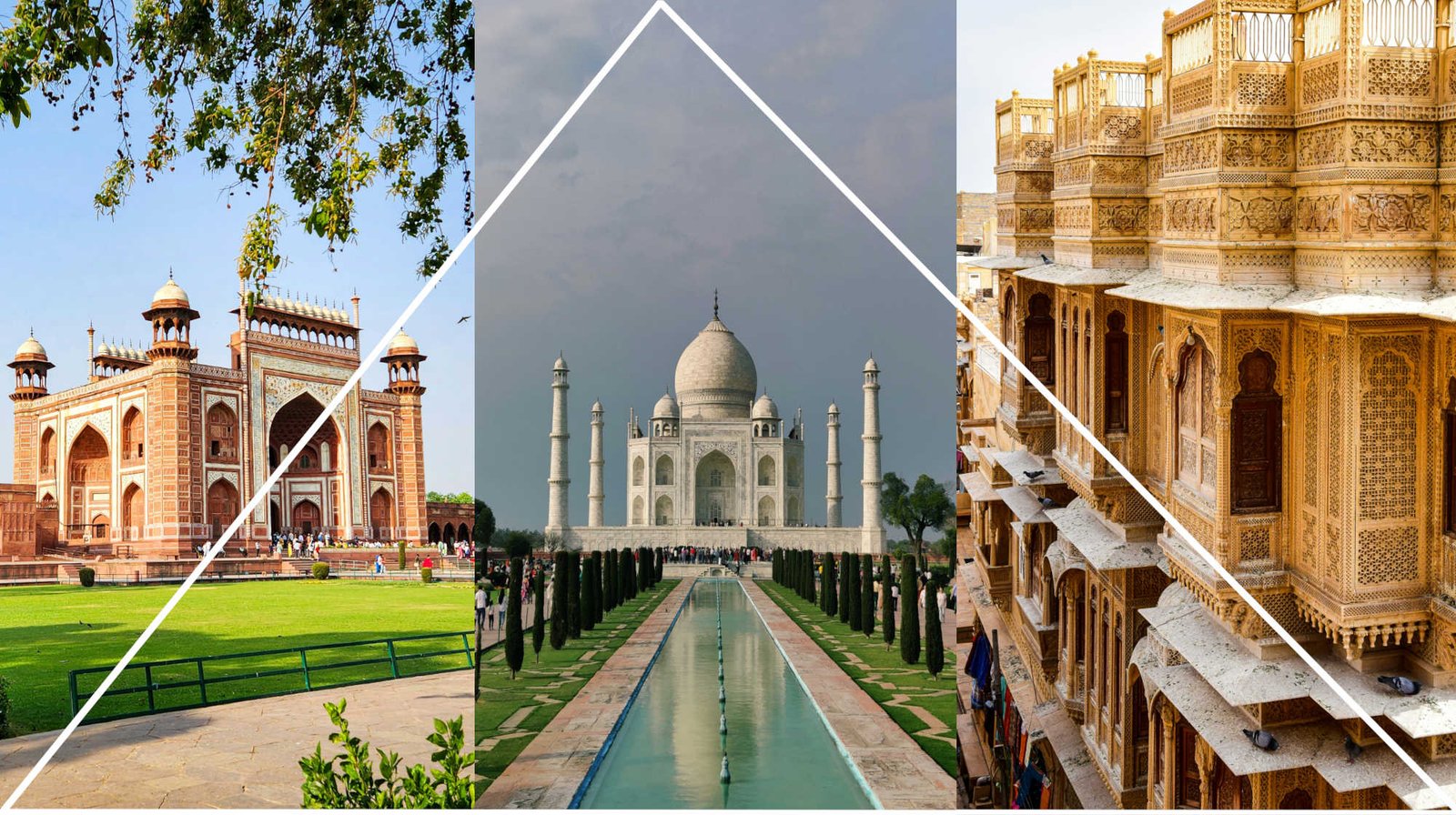
The Golden Triangle is India's most popular tourist circuit, linking three cities in northern India: Delhi (the capital), Agra (home of the Taj Mahal), and Jaipur (the Pink City of Rajasthan). The three cities form a near-perfect triangle on the map, each roughly 230 km apart — close enough to travel comfortably by road or express train, far enough apart that each feels like a completely different world.
For British visitors, the Golden Triangle is the ideal introduction to India. The distances are manageable, English is widely spoken, the sights are genuinely world-class, and the infrastructure for tourists is well established. You arrive in Delhi on a Monday and by Friday you've ticked off the Taj Mahal, ridden an elephant up to a Rajput fort, and explored a Mughal emperor's abandoned capital. No other route in India packs so much into a single week.
Your Golden Triangle holiday starts with a flight into Indira Gandhi International Airport, Delhi (DEL). This is the most convenient entry point — you can be in Connaught Place within 30 minutes of landing, and the express Metro makes the airport genuinely easy.
Two airlines fly direct from Heathrow to Delhi: Air India and British Airways. The journey takes approximately 8 hours 30 minutes westbound and around 9 hours on the return. It is worth noting that Air India's direct service is consistently the cheaper of the two and operates daily.
If you are flying from Manchester, Birmingham, Edinburgh, or Gatwick, you will connect through a hub — usually London, Dubai, Abu Dhabi, Doha, or Frankfurt. The connection adds 2–4 hours to your total travel time but is often significantly cheaper than positioning to Heathrow for a direct service.
| Departure Airport | Route | Economy Return (per person) | Notes |
|---|---|---|---|
| London Heathrow | Direct (Air India / BA) | £650 – £950 | 8h 30min; daily |
| London Heathrow | Via hub (Emirates, etc.) | £550 – £850 | 10–12h total |
| London Gatwick | Via hub | £550 – £800 | IndiGo, easyJet feeds |
| Manchester | Via hub | £580 – £880 | Emirates, Qatar popular |
| Birmingham | Via hub | £560 – £850 | Good value options |
| Edinburgh | Via hub | £600 – £900 | Via London or Gulf |
| London Heathrow | Premium Economy | £1,400 – £2,200 | Air India / BA |
| London Heathrow | Business Class | £2,500 – £5,500 | Flat-bed on overnight returns |
British passport holders require a visa to enter India. The good news is that the India e-Visa is applied for entirely online and takes around 72 hours to process — no queuing at an embassy, no posting your passport. You apply at the official Indian government portal, pay online, receive your e-Visa by email, and print it to show at the airport.
The Golden Triangle sits in northern India's plains, which means it experiences extreme seasonal variation — something that matters enormously when planning a package holiday from the UK where your dates are often fixed by school terms or annual leave.
This is the window British travellers should aim for without exception. Temperatures are pleasant — Delhi and Jaipur in November, December, and January sit in the mid-20s°C during the day, dropping to a comfortable 10–15°C at night. The sky is clear, the light is beautiful, and the monuments are at their most photogenic. October half-term, Christmas, New Year, and February half-term all fall perfectly within this window.
Temperatures climb sharply from April. By May, Delhi can hit 43–45°C. The Taj Mahal does not get less impressive in the heat, but long outdoor sightseeing days become genuinely tiring. If April or May are the only windows you have, go early in the morning and rest at the hotel in the afternoon — the monuments are quieter and the light at 7am is exceptional.
The monsoon brings high humidity, heavy rain, and difficult road conditions across northern India. While some travellers enjoy the green landscapes and empty monuments, the Taj Mahal and Amber Fort in the rain is not the experience most British holidaymakers have saved for. July and August departures from the UK almost always result in a soggy, uncomfortable trip — this is the one season to avoid.
The absolute minimum for a Golden Triangle holiday from the UK is 7 nights on the ground — but we recommend 9 or 10 nights for most British travellers. Here's why: UK flights typically arrive in Delhi in the evening, so your first night is a travel night. If you try to pack Delhi, Agra, and Jaipur into 7 nights, you spend most of your time in cars and trains. At 9–10 nights you get proper time in each city — two full days in Delhi, two in Agra, three in Jaipur — and you return home having genuinely seen India rather than rushed through it.
This is our recommended structure for a 10-night Golden Triangle holiday departing from the UK. All sightseeing is private with a dedicated guide and vehicle.
Evening departure on the direct service from Heathrow arrives in Delhi around 7–8am the following morning. Gulf-connecting flights often depart mid-afternoon and arrive mid-evening Delhi time. Either way, check in, rest, and let the jet lag settle. Delhi's tap water is not safe to drink — use bottled water from the moment you land.
Start in Old Delhi with a cycle rickshaw through the bazaars of Chandni Chowk — the spice market, the silver street, the paratha lane. India's most atmospheric neighbourhood. Visit the Red Fort and Jama Masjid before the afternoon crowds. End the day with cocktails in Connaught Place.
New Delhi has a completely different character from Old Delhi — wide boulevards, Mughal-era monuments, and Lutyens' colonial architecture. Qutub Minar's 73-metre minaret is the tallest brick minaret in the world. Humayun's Tomb is the direct architectural predecessor of the Taj Mahal and far less crowded. Walk through Lodhi Garden in the late afternoon.
The Yamuna Expressway makes Delhi to Agra a comfortable 3-hour drive — leave at 8am to avoid traffic. Stop at Sikandra to visit Akbar's tomb en route. Arrive in Agra for lunch, then visit the magnificent Agra Fort in the afternoon. In the evening, watch the Taj Mahal turn gold from the Mehtab Bagh gardens across the river — no entrance fee, no crowds.
Set the alarm. The Taj Mahal at 6:30am — before the tour groups, in the low morning light — is one of the great travel experiences of a lifetime. Every single visitor who doubted it before going says afterwards that it exceeded their expectations. The afternoon belongs to Fatehpur Sikri, the ghost city Akbar built and abandoned, 40 km from Agra.
The Agra–Jaipur road passes through beautiful Rajasthani countryside — flat scrubland, peacocks on the roadside, remote temples. Break the 4-hour journey at the Chand Baori stepwell at Abhaneri — 13 storeys deep, 3,500 steps, and one of the most extraordinary geometric structures in India. Arrive in Jaipur for dinner in the old city.
Rise early for Amber Fort before the heat and crowds. The elephant ride to the fort gates (or the jeep, if you prefer) deposits you at one of the finest examples of Rajput architecture in India. The Hall of Mirrors inside is extraordinary. The afternoon is Hawa Mahal and the bazaars of the old city — Johari Bazaar for gems, Bapu Bazaar for textiles and the famous blue pottery.
The City Palace complex in the heart of the walled city includes the Maharaja's residence (still occupied), a superb royal textile collection, and the famous silver urns that carried the Maharaja's Ganges water to England for Queen Victoria's Diamond Jubilee. Jantar Mantar next door is one of the world's largest astronomy instruments. Book a Rajasthani cooking class for the evening.
Drive back to Delhi (5 hours) or take the Shatabdi Express train (4.5 hours — highly recommended, book in advance). Evening free for final shopping, a good meal in Delhi's restaurant district, and packing. Don't forget the cardamom tea — you'll be craving it within a week of getting home.
Evening flights from Delhi on the direct service arrive at Heathrow the following morning. Connecting flights via the Gulf can arrive earlier in the afternoon. Check-in opens 3 hours before departure at Indira Gandhi International.
Below are realistic, current costs for a Golden Triangle holiday from the UK, broken down by travel style. All ground package prices are per person based on two adults sharing, and exclude international flights.
Adding return economy flights from Heathrow (£650–£950), the e-Visa (~£16), monument entry fees (~£50 pp), and a reasonable spending budget (~£250 pp for food and sundries), here is what a 10-night Golden Triangle holiday realistically costs per person:
The Golden Triangle pairs beautifully with several extensions that add just 2–3 nights and transform the trip from a sightseeing holiday into something much more complete.
India uses Type C and Type D sockets. British plugs (Type G) do not fit without an adaptor. Buy a universal travel adaptor before you leave — they cost £3–£5 in the UK and £1–£2 in Delhi. Voltage is 230V / 50Hz, same as the UK, so no converter is needed for UK appliances.
A local Indian SIM card costs approximately £4–£6 and gives you 1.5GB of 4G data per day for 28 days — far better value than UK roaming. Buy one at the Airtel or Jio counter at Delhi airport on arrival; you will need your passport and e-Visa. Your UK number will still receive calls via WhatsApp. Alternatively, an eSIM (Airalo or Holafly) can be set up before departure.
Withdraw Indian Rupees from ATMs on arrival — Delhi airport has multiple ATMs post-immigration. Visa and Mastercard are accepted at most hotels and larger restaurants, but carry cash for monuments, rickshaws, markets, and small eateries. Starling and Monzo cards are popular with British travellers because they charge no foreign transaction fees.
A UK EHIC/GHIC card has no validity outside Europe. Travel insurance is not optional for India — medical costs can be extremely high and evacuation flights back to the UK are expensive. Check that your policy covers: emergency medical (minimum £5m), repatriation, trip cancellation, and personal liability. Specialist travel insurers such as Battleface, True Traveller, or AllClear (for pre-existing conditions) offer competitive India policies.
The NHS recommends visiting a travel health clinic 4–6 weeks before departure. Typically recommended for India: Hepatitis A, Typhoid, and a course of Tetanus/Diphtheria if not up to date. Some travellers also opt for Rabies and Japanese Encephalitis depending on extensions. Malaria prophylaxis is not usually required for the Golden Triangle cities themselves (Delhi, Agra, Jaipur) but may be recommended for Ranthambore or rural extensions.
Never drink tap water. Use sealed bottled water — your hotel will provide it. At restaurants, reputable establishments are generally safe for international visitors. Avoid salads washed in tap water and ice in drinks at street stalls. The food in good Delhi, Agra, and Jaipur restaurants is excellent and completely safe — don't let food anxiety prevent you from eating well.
India is a safe destination for British tourists. The vast majority of Golden Triangle holidays go entirely without incident, and the FCDO does not advise against travel to Delhi, Agra, or Jaipur. That said, there are a few scams worth knowing before you go.
We specialise in private, tailor-made holidays to India for British travellers. No group coaches, no fixed departures — just you, a dedicated driver, and expert local guides.
Squid Travel India is a small, specialist operator focused entirely on private, tailor-made tours of northern India. We are not a high-street travel agent and we are not a large coach-tour operator — we build every itinerary from scratch around you.
Golden Triangle holidays from the UK start from £500 per person for the ground package (excluding international flights). We are happy to advise on flights and can recommend ATOL-protected flight booking options.
Holidays from £500 pp (ground package). Private tours, expert guides, transparent pricing.