

India has been on British travellers’ bucket lists for generations. The shared history, the English language, the cricket, the cuisine — there is a familiarity to India that makes it feel both exotic and approachable in equal measure. And no India holiday captures that feeling more perfectly than the Golden Triangle.
Delhi, Agra, and Jaipur. Three cities. One iconic circuit. The most rewarding first-time India holiday available to anyone flying out of Heathrow, Gatwick, Manchester, or Birmingham.
This is your complete 2026 planning guide — written specifically for British travellers. Flights from the UK, holiday costs in pounds, visa requirements, the best time to go around the school terms and bank holidays, a day-by-day itinerary, holiday extensions, and everything you need to know before you board.
What Is the Golden Triangle?
The Golden Triangle is the name given to the three-city circuit connecting Delhi, Agra, and Jaipur in northern India — forming a rough triangle on the map with each city approximately 200 miles from the others.
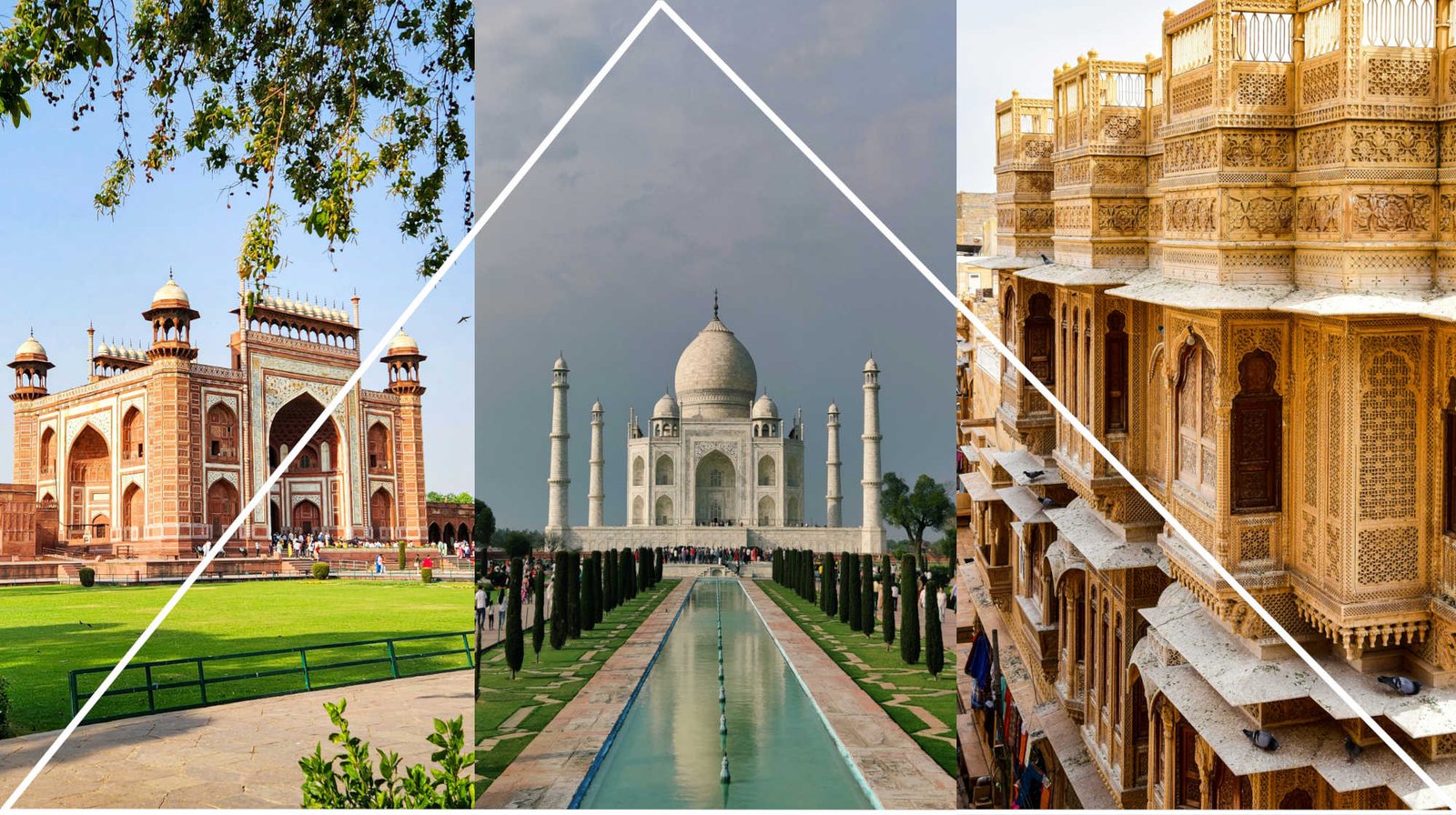
- Delhi — India’s extraordinary capital. Ancient Mughal monuments, Raj-era boulevards, street food markets, and one of the world’s great modern cities all layered on top of each other.
- Agra — Home of the Taj Mahal, which is every bit as breathtaking in person as it appears in photographs. Also home to Agra Fort and the haunting ruins of Fatehpur Sikri.
- Jaipur — The Pink City of Rajasthan. Amber Fort, the City Palace, Hawa Mahal, ancient observatories, and some of the finest bazaars in Asia.
The Golden Triangle is consistently ranked among the world’s great travel circuits — and for British travellers, it has the added advantage of being genuinely manageable. English is widely spoken throughout, the tourist infrastructure is well-developed, and the sites themselves are among the finest in the world. A fortnight’s holiday gives you everything you need for a complete, unhurried experience.
Quick Facts: Golden Triangle from the UK
| Flight time from London | 8–9 hours direct / 10–13 hours via connection |
| Time difference | India is 4.5 hours ahead of BST (5.5 hours ahead of GMT) |
| Currency | Indian Rupee (INR). £1 = approximately ₹107–112 (July 2026) |
| Best time to visit | October to March |
| UK school holiday alignment | October half-term, Christmas, February half-term all fall within peak season |
| Visa required | Yes — India e-Visa online, costs approx. £16–£62 |
| Holiday starting price | From £500 per person (ground package, excluding flights) |
| Language | English widely spoken in all tourist areas |
| ATOL protection | Not applicable for ground-only packages — ensure your tour operator is IATA-registered |
Step 1: Flights from the UK to Delhi
Direct flights
The most convenient option from the UK is a direct flight to Delhi’s Indira Gandhi International Airport (DEL). Direct services are available from:
London Heathrow (LHR) — Air India operates direct flights to Delhi in approximately 8 hours 30 minutes. British Airways also operates direct services on this route. These are the most convenient and time-efficient options for British travellers.
London Gatwick (LGW) — No regular direct services currently. Connections are required.
Manchester (MAN) — No direct services to Delhi. Connections via Dubai, Doha, or London are the most popular options.
Birmingham (BHX) — No direct services. Connections via the Gulf or European hubs.
Connecting flights
For travellers outside London, or those looking for more competitive fares, connecting flights via Dubai (Emirates), Doha (Qatar Airways), or Abu Dhabi (Etihad) are excellent options. Connection times are typically 2–3 hours and the Gulf hub airports are comfortable for layovers.
Alternatively, Lufthansa via Frankfurt and Air France via Paris offer competitive fares for travellers in the north of England, Scotland, and Wales — and European connections are generally shorter than Gulf hubs.
Return fares from the UK (economy class, per person, 2026)
| Departure Airport | Direct Route | Via Connection | Premium Economy |
|---|---|---|---|
| London Heathrow | £650–£950 | £550–£850 | £1,400–£2,200 |
| London Gatwick | N/A | £550–£800 | £1,300–£2,000 |
| Manchester | N/A | £580–£880 | £1,400–£2,100 |
| Birmingham | N/A | £560–£850 | £1,300–£2,000 |
| Edinburgh | N/A | £600–£900 | £1,400–£2,200 |
Business class from the UK to Delhi typically costs £2,500–£5,500 return per person. Emirates business class via Dubai is considered among the finest on the route.
Money-saving tips on flights
Book 3–4 months ahead for October to March travel — fares increase significantly as peak season dates approach. The period between late January and mid-February is often slightly cheaper than Christmas and October half-term. Flying mid-week (Tuesday or Wednesday departures) typically yields better fares than weekend departures.
Step 2: India e-Visa for British Travellers
British passport holders require a visa to enter India. The India e-Visa is obtained entirely online — no visit to the High Commission required.
Apply at: indianvisaonline.gov.in Processing time: 72 hours (apply at least one week before travel to allow a buffer)
| Visa Type | Cost (approx.) | Duration | Best For |
|---|---|---|---|
| e-Tourist Visa (30 days, single entry) | ~£16 | 30 days | First-time visitors, single trips |
| e-Tourist Visa (1 year, multiple entry) | ~£30 | 12 months | Flexible plans or repeat visits |
| e-Tourist Visa (5 years, multiple entry) | ~£62 | 5 years | Frequent India travellers |
For a standard Golden Triangle fortnight, the 30-day single-entry e-Visa at approximately £16 is all you need.
New 2026 requirement: Digital Arrival Card (Su-Swagatam)
All international visitors to India — including British travellers — must complete a mandatory digital arrival card within 72 hours before landing. This replaced the paper arrival card that was previously distributed on the aircraft. As of April 2026, this is fully mandatory with no paper alternative.
Complete it at: indianvisaonline.gov.in/earrival/
It takes approximately 5 minutes. You will need your passport details, flight number, and hotel address in India. Save the confirmation on your phone and print a copy as backup. Not completing this before arrival can cause delays at immigration.
Passport validity
Your British passport must be valid for at least 6 months beyond your intended departure date from India. Check your expiry date now — HMPO passport processing times are currently running 3–6 weeks for standard applications and 1–2 weeks for the fast-track service.
Step 3: When to Go — UK School Holidays vs India’s Best Season
The good news for British families and couples planning around school terms and bank holidays: India’s best travel season aligns almost perfectly with the UK’s main holiday windows.
India’s seasons in plain English
October to March — GO. This is India’s best season. Temperatures across Delhi, Agra, and Jaipur range from 10°C to 28°C. Clear skies, low humidity, and perfect conditions for sightseeing. The Taj Mahal is at its most beautiful in the clear winter light.
April to June — Avoid. Temperatures regularly exceed 40°C in Agra and Jaipur, occasionally reaching 45°C in May. Not recommended.
July to September — Monsoon season. Heavy rainfall, high humidity, and reduced outdoor sightseeing comfort. Prices are significantly lower. Late September becomes manageable.
Matching India to the UK holiday calendar
| UK Holiday Window | India Conditions | Our Verdict |
|---|---|---|
| October Half-Term (late Oct) | Perfect — start of peak season | Excellent. Book 3–4 months ahead |
| Christmas & New Year | Perfect — clear skies, cool and pleasant | Excellent. Book 4–5 months ahead. Delhi can have fog in January |
| February Half-Term | Very good — late peak season | Good. Slightly less busy than December |
| Easter (late Mar / early Apr) | Warming up — can still be pleasant | Reasonable but avoid late April |
| Summer Holidays (July–Aug) | Monsoon season | Not recommended for Golden Triangle |
| May Half-Term | Extreme heat | Not recommended |
For British families, October half-term and the Christmas fortnight are the ideal windows. Both fall squarely within India’s finest travel season.
One important January note: Dense fog frequently affects Delhi and Agra in December and January — a weather phenomenon specific to the Indo-Gangetic Plain. Early morning Taj Mahal visits can occasionally be obscured. This doesn’t ruin the experience — the fog has its own atmospheric beauty — but it’s worth knowing in advance. Book a flexible itinerary that allows for adjustment.
Step 4: How Long Do You Need?
Most British travellers take a fortnight for India, including travel time. Here’s how different durations work:
10 nights (12 days total including flights)
The most popular option for British travellers. With the direct flight taking approximately 8.5 hours and minimal jet lag adjustment needed (India is only 4.5 hours ahead in summer), you have a genuine 9–10 nights in India.
This gives you a comfortable Golden Triangle — 3 nights Delhi, 2 nights Agra, 3 nights Jaipur — with one night extension if you wish. For most British first-time visitors, this is the ideal length.
7 nights (9 days total)
Perfectly doable for the Golden Triangle highlights. Tighter but very manageable. A solid option for a half-term break.
14 nights (16 days total)
The dreamer’s option. Two weeks in India gives you the full Golden Triangle plus a meaningful extension — a tiger safari at Ranthambore, the spiritual intensity of Varanasi, the romantic lakes of Udaipur, or the entirely different world of Kerala’s backwaters in the south.
Our recommendation for first-time British visitors: 10 nights on the ground. It’s the sweet spot between depth and feasibility, and it gives you room to breathe rather than sprint.
Step 5: Your Day-by-Day Golden Triangle Itinerary
This is our most popular Golden Triangle itinerary for British travellers — 9 nights on the ground, paced for genuine enjoyment rather than monument-ticking.
Day 0 (Travel Day) — UK to Delhi
Board your flight from Heathrow, Manchester, or your nearest regional airport. The direct Air India or British Airways service from Heathrow arrives in Delhi the following morning — ideal timing, as you arrive with a full day ahead of you.
On the flight: set your watch to India time immediately. India is 4.5 hours ahead of BST. Try to sleep on the plane during what would be India’s night hours. Avoid alcohol during the flight — it amplifies jet lag.
Your Squid Travel India driver will meet you in the arrivals hall at Delhi airport with a name board and transfer you directly to your hotel.
Day 1 — Arrive Delhi / Gentle Orientation
You’ve landed in one of the world’s most extraordinary cities after an 8–9 hour flight. Today is a day for settling in, not sprinting around.
Check into your hotel and freshen up. In the afternoon, take a gentle walk around your neighbourhood — enough to feel India beneath your feet without any agenda. If your hotel has a pool or spa, now is the time.
Evening: Head to a rooftop restaurant for dinner with a view. Order dal makhani, butter chicken, or paneer tikka. Have a cold Kingfisher. Watch the city go about its evening business. You are in India.
Day 2 — Old Delhi & New Delhi
Delhi is consistently underestimated by first-time visitors who allocate just one day. It deserves two full days — and reveals itself slowly.
Morning — Old Delhi: Start at the Jama Masjid — India’s largest mosque, built by Shah Jahan in 1656. Its great courtyard can hold 25,000 worshippers and the views from the minarets on a clear morning are extraordinary. Climb into a cycle rickshaw and plunge into the lanes of Chandni Chowk — the 17th-century market street that still sells everything from wedding garlands to street spices in magnificent, chaotic abundance. Stop at Paranthe Wali Gali for the finest stuffed flatbreads in northern India — a breakfast that costs pennies and tastes remarkable.
Walk to the Red Fort — the great Mughal palace-fortress from which the Emperor Aurangzeb surveyed his empire. Its red sandstone walls are a kilometre in circumference.
Afternoon — New Delhi: Drive south into New Delhi — the formal imperial capital designed by Edwin Lutyens and Herbert Baker in the 1920s. Walk along Rajpath past the grand secretariat buildings to India Gate, the war memorial that feels unmistakably British in scale and ambition. Visit Humayun’s Tomb — the magnificent 16th-century garden mausoleum that is the direct architectural forerunner of the Taj Mahal, and only slightly less beautiful. Stroll through Lodhi Garden, 90 acres of parkland scattered with Mughal-era tombs used as a morning walking park by Delhi’s residents.
Evening: Dinner in Hauz Khas Village — one of Delhi’s most atmospheric neighbourhoods, built around a medieval reservoir and now lined with restaurants, art galleries, and wine bars. A surprising and thoroughly enjoyable evening.
Day 3 — Delhi Sightseeing Continued
Morning: Visit Qutub Minar — the extraordinary 73-metre minaret built in 1193, the tallest brick minaret in the world and India’s oldest surviving example of Afghan architecture. The surrounding complex of mosques and tombs is one of Delhi’s most beautiful environments.
Continue to the Akshardham Temple — the enormous contemporary Hindu temple completed in 2005 whose scale and intricacy have to be seen to be believed. No cameras allowed inside, which forces you to actually look rather than photograph.
Afternoon: Visit the vibrant bazaars of Connaught Place — Delhi’s elegant colonial-era commercial centre, with its circular colonnaded architecture and the excellent underground Palika Bazaar beneath it. Spend the afternoon exploring Khan Market, Delhi’s most upmarket shopping street, with excellent bookshops, delis, and cafés.
Evening: Early night — tomorrow is an early start for Agra.
Day 4 — Delhi to Agra (The Taj Mahal City)
Morning: Drive to Agra — approximately 3.5 hours by road through the flat Indo-Gangetic Plain. The Yamuna Expressway is one of India’s finest roads and the drive is comfortable in a private air-conditioned car.
Afternoon: Check into your Agra hotel. If your budget allows, book a hotel with a Taj Mahal view. Watching the white marble dome turn amber and rose in the late afternoon sun from your hotel rooftop is a moment that stays with you.
Spend the afternoon at Agra Fort — the monumental red sandstone fortress that served as the Mughal imperial capital before the court moved to Delhi. Shah Jahan, who built the Taj Mahal, spent the last eight years of his life imprisoned here by his own son — close enough to see his wife’s tomb from his window.
Sunset: Drive to Mehtab Bagh — the moonlight garden directly across the Yamuna River from the Taj Mahal. At sunset the dome and minarets turn gold against the cooling sky and reflect in the river below. No entry queues. No crowds. Just the most beautiful building in the world from the perfect distance.
Day 5 — Taj Mahal at Sunrise + Fatehpur Sikri
5:00 AM: Your alarm goes off. This is non-negotiable.
Arrive at the Taj Mahal gates at 6:00 AM opening. In the first hour of the morning — before the tour coaches arrive, as the mist lifts from the gardens and the light shifts from rose-pink to gold to brilliant white — the Taj Mahal is yours. Walk through the great gateway. See the reflection pool frame the dome. Stand in front of the most perfect building ever created by human hands and feel the genuine, unexpected emotion that almost every visitor reports.
The Taj Mahal was built by the Mughal Emperor Shah Jahan as a tomb for his wife Mumtaz Mahal, who died in 1631 during the birth of their fourteenth child. Construction took 22 years. Twenty thousand workers. Marble from Makrana in Rajasthan — the same quarry that supplied stone for the Victoria Memorial in Calcutta. Every surface is inlaid with carnelian, lapis lazuli, turquoise, malachite, and jade, in patterns of extraordinary intricacy. It is, without question, one of the greatest achievements in human history.
Spend at least two hours. Examine the inlay work close up. Walk around to the rear, where the Yamuna flows silent and dark behind the tomb. Find a quiet corner and simply sit with it.
Mid-morning: Drive to Fatehpur Sikri — 40 miles from Agra along the Jaipur road. This was Emperor Akbar’s purpose-built capital city, constructed in 1571 and mysteriously abandoned just 14 years later. The entire city — its palaces, mosques, audience chambers, and elephant stables — remains perfectly preserved in deep red sandstone, frozen in the 16th century. It is one of the most haunting places in India and entirely missed by visitors who drive straight from Agra to Jaipur without stopping.
Afternoon: Drive to Jaipur (approximately 3.5–4 hours). Arrive and check into your hotel.
Day 6 — Jaipur: Amber Fort & Old City
Morning — Amber Fort: Drive 11 miles north of Jaipur to Amber Fort, perched on the Aravalli Hills above a shimmering lake. Built in 1592 and expanded over successive generations of Rajput kings, Amber Fort is one of the finest examples of Rajput military architecture in the world. The Sheesh Mahal — the Hall of Mirrors, whose ceiling of mirror mosaic reflects a single candle flame thousands of times — is one of the most extraordinary interiors you will ever stand in.
Arrive at 8:00 AM opening. The morning light on the sandstone is spectacular and you will have at least an hour before the coaches arrive.
On the drive back to Jaipur, stop at Jal Mahal — the palace that appears to float on Man Sagar Lake. In the morning mist, the reflection in the still water is genuinely beautiful.
Afternoon — The Old City: Enter the UNESCO World Heritage-listed walled old city through the grand Ram Pol gate. Visit the City Palace — the royal residence still home to the Maharaja of Jaipur — and its extraordinary museum, which contains the two Gangajali silver vessels (each holding 4,000 litres of water) made for Maharaja Sawai Madho Singh II to carry Ganges water to England for the coronation of Edward VII. These are the world’s largest silver objects and are listed in the Guinness World Records.
Visit Jantar Mantar — the 18th-century astronomical observatory whose 27-metre Samrat Yantra sundial is accurate to within 20 seconds. Built in 1724. No electronics. No computers. Extraordinary.
Photograph the Hawa Mahal (Palace of Winds) from the café rooftop directly opposite — the best angle on its extraordinary 953-windowed facade, built in 1799 to allow the royal women to observe street life unseen from behind the latticed screens.
Day 7 — Jaipur: Bazaars, Nahargarh & Evening
Morning: A slower morning in Jaipur. Spend it in the bazaars at your own pace.
Johari Bazaar — India’s most important gemstone market. Jaipur is the world’s largest centre for gemstone cutting and polishing. Certified rubies, emeralds, sapphires, and semi-precious stones are available at a significant discount to UK retail prices. Stick to shops with GIA or government certification.
Bapu Bazaar — block-printed cottons, tie-dye scarves, embroidered leather mojari shoes (the most comfortable souvenir you’ll bring home), and Rajasthani quilts.
Tripolia Bazaar — lac bangles, traditional Rajasthani brass and copperware, and handmade puppets.
The rule for all of these: agree a price before you commit. Counter at 40–50% of the opening offer and work toward a middle ground. Do it with a smile — it’s a social exchange, not a conflict.
Afternoon: Drive up to Nahargarh Fort — perched 700 metres above the city on the Aravalli ridge — for the finest panoramic view over all of Jaipur. Arrive by 4:30 PM to catch the golden hour as the city turns honey-coloured below you.
Evening: Dinner at Chokhi Dhani (15 miles south of Jaipur) — the recreation of a traditional Rajasthani village with folk dance, puppet shows, camel rides, and a proper Rajasthani thali dinner served on the floor in traditional style. It sounds touristy. It is, a little. It is also genuinely entertaining and the food is excellent.
Day 8 — Jaipur to Delhi
Morning: One final Jaipur experience. Options:
- A textile block-printing workshop — 2 hours with a master craftsman, you leave with something you printed yourself
- Sunrise at Nahargarh Fort — the best dawn view in Jaipur if you didn’t catch it yesterday
- Last-minute shopping in the old city
Afternoon: Drive back to Delhi (approximately 5 hours). Depending on your flight time, either head directly to the airport or have a final evening in Delhi for one last meal before flying home.
Most UK-bound flights from Delhi depart late evening or overnight, which works perfectly — a full day in Jaipur followed by an evening drive to Delhi and a late-night departure home.
Step 6: Holiday Extensions from the Golden Triangle
With 12–14 nights from the UK, you have room to add one meaningful extension to the classic Golden Triangle circuit. These are the options most popular with British travellers:
Ranthambore Tiger Safari (+2 nights, 3 hours from Jaipur)
India’s most celebrated tiger reserve and one of the world’s finest places to see wild Bengal tigers. Morning and afternoon jeep safaris led by expert naturalist guides through the jungle and grasslands of Ranthambore National Park. With over 70 tigers in the reserve, sighting rates are excellent in the dry season (November to April).
Slot it between Jaipur and Delhi for a seamless addition to the circuit. Book at least 2–3 months ahead — safari permits are limited and popular dates sell out fast.
Best for: Wildlife lovers, photographers, anyone who has dreamed of seeing a wild tiger
Varanasi — India’s Holiest City (+2 nights, short flight or overnight train)
The oldest continuously inhabited city in the world and the spiritual heart of India. The Ganga Aarti ceremony at Dashashwamedh Ghat at dusk — priests in saffron robes conducting a fire ceremony to the river as bells ring, incense rises, and hundreds of boats float on the Ganges — is one of the most profoundly moving experiences available to any traveller anywhere in the world.
A dawn boat ride on the Ganges, watching the ghats come alive as pilgrims bathe, priests pray, and the city begins its day — this is not like anywhere else on earth. Many British travellers who add Varanasi describe it as the single most memorable two days of their entire trip.
Best for: Travellers seeking cultural and spiritual depth, photographers, anyone who wants to understand India beyond its monuments
Udaipur — The Lake City (+2 nights, flight or train from Jaipur)
The most romantic city in India and arguably Rajasthan’s finest. The white City Palace rising from the shores of Lake Pichola, the Lake Palace Hotel floating on the water (the filming location for the James Bond film Octopussy), rooftop restaurants with candlelit lake views, and the gentle pace of a city that has not forgotten how to be beautiful.
A perfect final stop before flying home — the contrast with the intensity of Delhi and the historical weight of Agra and Jaipur makes Udaipur feel like a long exhale.
Best for: Couples, honeymooners, anyone who appreciates beauty and wants to end their India holiday on a note of quiet luxury
Kerala (+4 nights, flight from Delhi or Jaipur)
An entirely different India. The backwaters of Alleppey, the tea gardens of Munnar, the colonial harbour of Kochi, the beaches of Varkala. Kerala feels like the tropical south of a country you thought you understood — and completely changes the picture.
For British travellers with a genuine fortnight to spend, combining the Golden Triangle in the north with 4 nights in Kerala in the south gives you the most complete India holiday available in one trip. Fly between them — Delhi to Kochi is a 3-hour domestic flight.
Best for: Those with 14+ nights, anyone who wants north India AND south India, couples combining cultural and beach/relaxation elements
Step 7: Holiday Costs in Pounds
All prices per person based on two adults travelling together. International flights from London excluded unless stated.
Ground package costs (hotels, private car, guides, breakfast)
| Budget Level | Hotels | Per Person (7 nights) | Per Person (10 nights) |
|---|---|---|---|
| Budget | 3-star | £350–£600 | £500–£850 |
| Standard | 4-star | £600–£1,000 | £850–£1,400 |
| Premium | Boutique / Heritage | £1,000–£1,800 | £1,400–£2,500 |
| Luxury | Oberoi / Taj Group | £2,000–£4,500 | £2,800–£6,000 |
Return flights from London (economy, per person)
| Airline / Route | Return Fare |
|---|---|
| Air India direct from Heathrow | £650–£950 |
| British Airways direct from Heathrow | £700–£1,000 |
| Emirates via Dubai | £550–£850 |
| Qatar Airways via Doha | £550–£850 |
Monument entry fees (per person, in pounds, 2026)
| Monument | Entry Fee |
|---|---|
| Taj Mahal, Agra | ~£12 (₹1,300) |
| Agra Fort | ~£6.50 (₹700) |
| Amber Fort, Jaipur | ~£9.50 (₹1,000) |
| City Palace, Jaipur | ~£6.50 (₹700) |
| Qutub Minar, Delhi | ~£5 (₹550) |
| Humayun’s Tomb, Delhi | ~£5 (₹550) |
| Fatehpur Sikri | ~£5 (₹550) |
Budget approximately £70–£100 per person for monument entry fees across a standard 7-night Golden Triangle holiday.
All-in holiday cost summary (per person, 10 nights from London)
| Travel Style | Flights | Ground Package | Extras | Total |
|---|---|---|---|---|
| Budget | £700 | £650 | £200 | ~£1,550 |
| Standard | £800 | £1,100 | £300 | ~£2,200 |
| Premium | £900 | £1,800 | £400 | ~£3,100 |
| Luxury | £1,500 | £3,500 | £600 | ~£5,600 |
For comparison: a 10-night package holiday to Tuscany or the Algarve for two people typically costs £2,500–£4,000 per person. A Golden Triangle India holiday at standard tier costs less and delivers experiences that no European destination can match.
The pound in India — excellent value in 2026
£1 = approximately ₹107–112 as of July 2026. This is a strong exchange rate for British travellers and means India is exceptional value. A quality restaurant meal in Jaipur costs £3–£10 per person. A private car and driver for a full day costs approximately £50–£65. Even luxury heritage hotels in Rajasthan — palace properties with swimming pools and butler service — cost £120–£250 per night, compared to £400–£800 for comparable quality in the UK or Europe.
Tipping guide for British travellers (in pounds)
| Service | Recommended Tip |
|---|---|
| Private driver (per day) | £3–£5 |
| Local guide (per half-day) | £4–£6 |
| Local guide (full day) | £6–£12 |
| Hotel porter (per bag) | £0.75–£1.50 |
| Restaurant (if no service charge) | 10% of bill |
Always tip in Indian Rupees rather than pounds sterling — your driver and guide cannot easily exchange foreign notes.
Step 8: Travel Insurance for British Travellers
Travel insurance is mandatory — not optional — for any India holiday. Standard EHIC/GHIC coverage does not apply outside Europe. Your standard UK travel insurance policy may or may not cover India adequately — check the small print carefully, particularly for:
- Medical treatment costs (India does not have reciprocal NHS-style arrangements with the UK)
- Emergency medical evacuation (repatriation to the UK can cost £30,000–£80,000 without coverage)
- Trip cancellation and curtailment
- Lost or stolen luggage and documents
Recommended UK travel insurers for India holidays: Aviva, AXA, Direct Line, Post Office Travel Insurance, Battleface (for adventure extensions). Compare policies at MoneySuperMarket or GoCompare.
Ensure your policy specifically covers India and lists the activities you plan to do (jeep safaris if visiting Ranthambore, hot air balloon rides in Jaipur if you plan them).
Step 9: Practical Tips for British Travellers
Electricity and adapters
India uses Type C and Type D plugs with 230V supply — the same voltage as the UK. However, the plug shape is different. Pack a universal travel adapter. Most 4-star and above hotels provide adapters on request, but carry your own.
Mobile phones
UK mobile phones work in India. Check your provider’s international roaming rates — EE, Vodafone, and O2 vary significantly. For holidays of 7 days or more, buying a local Indian SIM card at Delhi airport on arrival is more economical (approximately £4–£6 for unlimited data and local calls for your entire stay). Bring your unlocked phone or check your handset is SIM-free before travelling.
Payment
Major credit and debit cards (Visa, Mastercard) are accepted at hotels, quality restaurants, and large shops. Carry Indian Rupees for bazaars, auto-rickshaws, tips, and smaller vendors. Avoid UK debit card withdrawals if possible — ATM fees and foreign exchange charges add up. A Wise or Revolut card gives you competitive exchange rates with minimal fees.
Water and food
Never drink tap water in India. Drink only sealed bottled water. This applies to ice at street stalls and smaller restaurants. At major hotels, filtered water is generally safe. Most British travellers experience a day or two of mild stomach adjustment — carry Imodium and oral rehydration sachets as a precaution, though many visitors have no issues at all.
Health vaccinations
Consult your GP or a travel clinic 4–6 weeks before departure. Vaccinations commonly recommended for India: Hepatitis A (strongly recommended), Typhoid (strongly recommended), Tetanus-Diphtheria booster, Hepatitis B (discuss with your GP). Malaria prophylaxis is not generally required for the Delhi-Agra-Jaipur circuit — confirm with your travel clinic. Your NHS GP can administer Hepatitis A and Typhoid on the NHS. Some private travel clinics offer combined appointments.
The Taj Mahal is closed on Fridays
This is one of the most commonly overlooked planning details. The Taj Mahal closes every Friday for prayers. Ensure your Agra day does not fall on a Friday — your tour operator should automatically plan around this, but it’s worth double-checking.
Step 10: Is India Safe for British Travellers?
India is safe for British tourists. Hundreds of thousands of British visitors travel to India every year — it is consistently one of the UK’s most popular long-haul destinations.
The risks that exist are primarily petty theft and tourist scams rather than violent crime. The main scams to be aware of:
The “closed monument” scam: A friendly stranger tells you the Taj Mahal or Red Fort is closed today for a special ceremony and offers to take you somewhere else. The monument is never closed (except the Taj on Fridays). Walk away.
The gem investment scam: Someone — often introduced by your driver — offers to sell you precious gems at wholesale prices to resell at home for profit. The gems are worthless. Never buy gemstones based on a referral from your driver or guide.
The rickshaw diversions: An auto-rickshaw driver agrees to a destination and then “remembers” a better version of the same place — usually a shop where he earns commission. Agree destination firmly before getting in.
The best protection against all of these: Travel with a reputable tour operator who pre-arranges all your transport and guides. When your driver, accommodation, and guides are all vetted and booked, the entire scam ecosystem is effectively bypassed.
The Foreign, Commonwealth & Development Office (FCDO) currently advises against travel to specific regions of India (Jammu and Kashmir, Manipur, and certain northeastern states) and advises against travel within 10km of the India-Pakistan border. None of these regions affect the standard Golden Triangle itinerary. The FCDO advises normal travel precautions for Delhi, Agra, Jaipur, and Rajasthan — the same level as most mainstream holiday destinations.
Why Book Your Golden Triangle Holiday with Squid Travel India
At Squid Travel India, we have been organising Golden Triangle holidays for British travellers for over 15 years. We understand what British visitors need — the right pace, reliable English-speaking guides, well-located accommodation, and the confidence that someone knowledgeable is available if anything needs adjusting.
Every Golden Triangle holiday we organise includes:
- Private air-conditioned car throughout — never shared coaches or minibuses
- Expert English-speaking local guides at Delhi, Agra, and Jaipur — vetted, knowledgeable, and genuinely excellent
- Hand-picked hotels at your chosen standard — 3-star comfortable to Oberoi and Taj Group luxury
- All airport and hotel transfers, timed around your actual flight times
- 24/7 WhatsApp support from our New Delhi team throughout your holiday
- Female guides arranged at any destination on request
- Free cancellation up to 24 hours before departure
- No hidden charges — full cost transparency from the moment you enquire
We are not a UK package holiday company adding a margin on top of our prices. We are a New Delhi-based tour operator working directly with you — which means better service, more flexibility, and significantly better value than booking through a British travel agent.
Golden Triangle holidays start from £500 per person (ground package, excluding flights).
📞 WhatsApp: +91 9818489607 📧 Email: squidtravelindia@gmail.com 🌐 Browse packages: squidtravelindia.com/tours/golden-triangle-tours/ 🏆 TripAdvisor Travellers’ Choice Award Winner 2024–25
We respond to all enquiries within 24 hours — usually faster. No obligation to book.
Frequently Asked Questions
How long is the flight from the UK to India? Direct flights from London Heathrow to Delhi take approximately 8 hours 30 minutes. Connecting flights via Dubai, Doha, or European hubs add 2–4 hours to total journey time. There are no direct services from UK regional airports — connections via London or the Gulf are required.
Do British travellers need a visa for India? Yes. British passport holders require an India e-Visa, applied for online at indianvisaonline.gov.in. The 30-day single-entry e-Tourist Visa costs approximately £16 and is processed within 72 hours. You must also complete the Su-Swagatam digital arrival card within 72 hours before landing — this is mandatory as of 2026.
What is the best time for British travellers to visit the Golden Triangle? October to March is ideal — cool, dry, and perfect for sightseeing. October half-term, Christmas, and February half-term all fall within this window and are excellent times to travel. The Golden Triangle is not recommended in the British summer holidays (July–August) due to monsoon season in India.
Is the Golden Triangle suitable for families with children? Yes — and India is a wonderful country for children to visit. The monuments are extraordinary and genuinely engaging for children old enough to appreciate history. The main considerations are food and water hygiene, heat management (stick to October–March), and booking hotels with swimming pools. We adapt all our itineraries for families with younger children on request.
How much spending money should I budget for a Golden Triangle holiday? For a 7-night Golden Triangle holiday, budget approximately £200–£350 per person for food (assuming breakfast included in package), tips, shopping, and sundries. Add £70–£100 for monument entry fees. Enthusiastic shoppers in Jaipur’s gem and textile markets should budget separately for shopping — the temptation is considerable.
What is the difference between a private tour and a group tour? On a private tour, the vehicle, driver, and guides are exclusively for your party. Your schedule is flexible — you can linger at the Taj Mahal longer if you wish, or change the programme if you fancy something different. On a group tour, you travel with other holidaymakers, share a coach, and follow a fixed itinerary. Private tours are generally better value for couples and families of three or more, and deliver a significantly more personal experience.
Is the Taj Mahal worth the visit? It is one of the most frequently asked questions we receive and our answer is unchanged after 15 years: yes, without qualification. The Taj Mahal at sunrise is one of the genuinely great experiences available to any traveller on earth. Every visitor who has said they’re not sure it will live up to the hype has come away saying it exceeded it.
Comment (0)