

By Vivek Sharma — Founder, Squid Travel India Updated June 2026 · 15+ years planning India tours for American travelers · TripAdvisor Travelers’ Choice Award Winner 2024–25
You’ve been thinking about India for years. Maybe it started with a documentary about the Taj Mahal. Maybe a colleague came back from Jaipur and couldn’t stop talking about the forts. Maybe you just reached the point in life where bucket list stops being a metaphor.
Whatever brought you here — this is your complete guide.
The Golden Triangle Tour is the single best introduction to India for first-time American visitors. It covers three of the country’s most extraordinary cities — Delhi, Agra, and Jaipur — in a logical, comfortable circuit that takes between 5 and 10 days depending on your vacation time. It’s India at its most iconic, most manageable, and most rewarding.
This guide covers everything an American traveler needs to know before booking: flights from the US, visa requirements, total costs in USD, the best time to go around your calendar, a day-by-day itinerary, how to extend your trip, what to pack, and how to choose the right tour operator.
No fluff. No vague “India is amazing” inspiration content. Just the practical planning information you actually need.
What Is the Golden Triangle Tour?
The Golden Triangle refers to the roughly triangular route connecting three cities in Northern India:
- Delhi — India’s capital and one of the world’s great historic cities. Ancient Mughal monuments sit alongside colonial-era boulevards and a buzzing modern metropolis.
- Agra — Home of the Taj Mahal, one of the Seven Wonders of the World and the most beautiful building most visitors will ever stand in front of.
- Jaipur — The Pink City of Rajasthan. A living royal city of extraordinary forts, opulent palaces, ancient science, and vibrant bazaars.
The three cities form a triangle of roughly 230–260 miles per side, making the circuit efficient — you spend your time experiencing India, not staring out of a bus window.
For American travelers with 10–14 days of vacation, the Golden Triangle is the perfect anchor itinerary. It gives you the Taj Mahal, Mughal history, Rajput royalty, world-class food, and cultural immersion — all within a well-connected, tourist-friendly route that has been welcoming international visitors for decades.
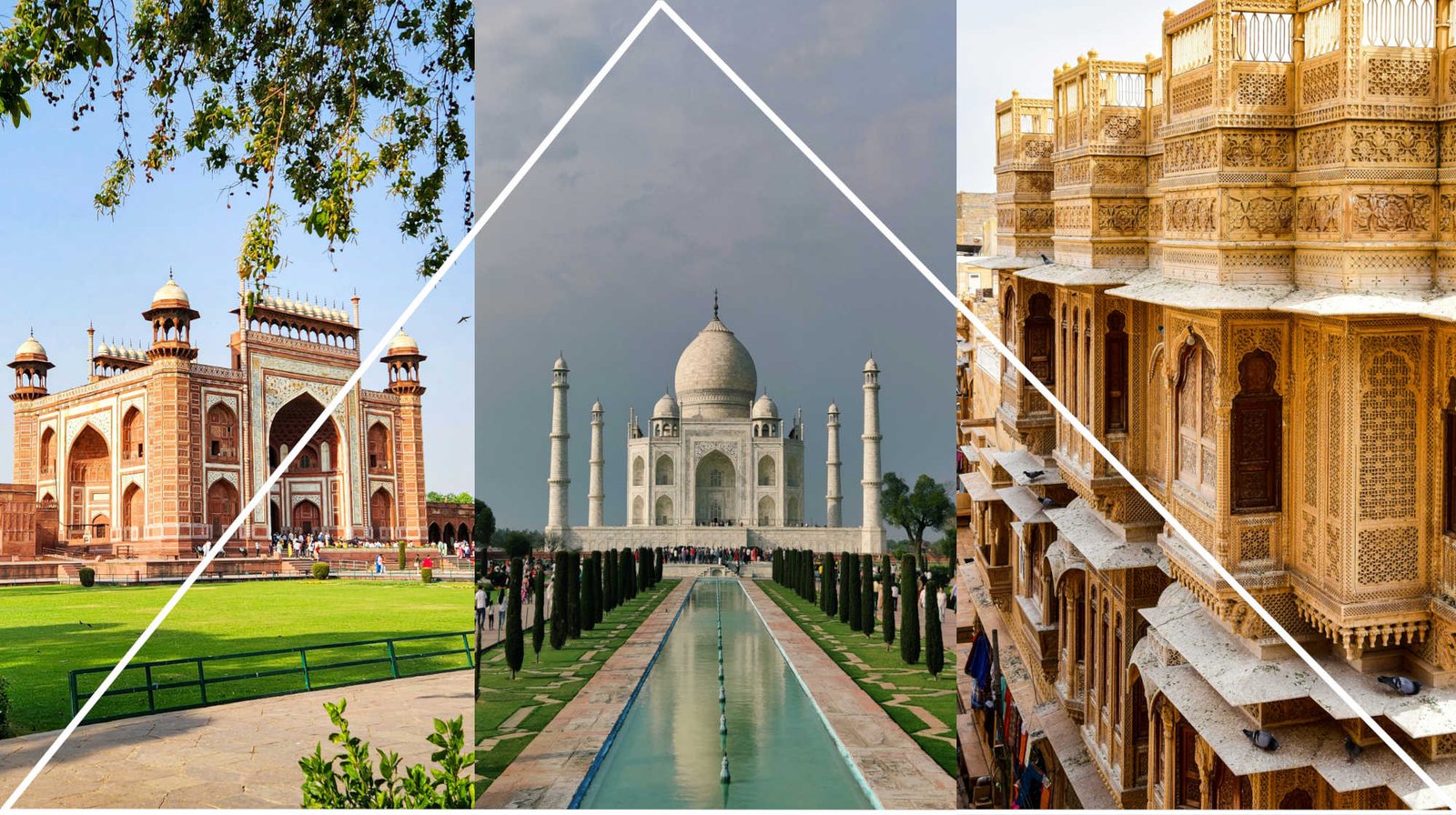
Quick Facts: Golden Triangle from USA
| Cities covered | Delhi · Agra · Jaipur |
| Total distance | ~480 miles (Delhi → Agra → Jaipur → Delhi) |
| Recommended duration | 5–10 days on the ground |
| Flights from USA | 14–20 hours depending on your city |
| Time zone difference | India is 9.5 hours ahead of EST / 12.5 hours ahead of PST |
| Currency | Indian Rupee (INR). $1 USD ≈ ₹85–87 (June 2026) |
| Best time to go | October to March |
| Visa required | Yes — e-Visa online, takes 72 hours, costs $25–$80 |
| Tour starting price | From $250 per person (excluding international flights) |
| Language | English widely spoken in all tourist areas |
Step 1: Getting There — Flights from the USA to Delhi
Which airports fly to Delhi (DEL)?
Delhi’s Indira Gandhi International Airport (IATA: DEL) is your entry point for the Golden Triangle. Here’s what flights look like from major US cities:
| Departing From | Flight Time | Best Airlines | Typical Layover |
|---|---|---|---|
| New York (JFK / EWR) | 14–15 hours non-stop | Air India (non-stop), Emirates via Dubai, Qatar via Doha | None or Dubai/Doha |
| Los Angeles (LAX) | 17–19 hours | Air India via DEL, Emirates via Dubai, Qatar via Doha | Dubai or Doha |
| Chicago (ORD) | 16–18 hours | Air India, United via Frankfurt, Emirates via Dubai | Various |
| San Francisco (SFO) | 18–20 hours | Air India, Qatar Airways via Doha, Lufthansa via Frankfurt | Doha or Frankfurt |
| Washington DC (IAD) | 14–16 hours | Air India direct, United via Frankfurt | None or Frankfurt |
| Houston (IAH) | 17–19 hours | Qatar Airways via Doha, Air India via JFK | Doha |
| Dallas (DFW) | 17–19 hours | American via London, Qatar via Doha | London or Doha |
How much do flights cost?
Round-trip airfare from the US to Delhi varies significantly by season and how far in advance you book:
- Economy class: $700–$1,400 round trip from East Coast / $900–$1,800 from West Coast
- Business class: $3,500–$7,000 round trip depending on airline and timing
- Best booking window: 3–6 months before travel for peak season (October–March)
Money-saving tip: Flying into Delhi and out of a different city (like Mumbai or Kochi if you’re extending to Kerala) is often cheaper than a round trip to the same airport. Ask your tour operator about open-jaw routing options.
Jet lag — what Americans should know
India is 9.5 hours ahead of Eastern Time and 12.5 hours ahead of Pacific Time. That half-hour offset trips up a lot of travelers. Most flights from the US arrive in Delhi in the early morning hours (typically 11pm–2am local time), which means your first day in India starts at a strange hour.
Our recommendation: Build in a half-day buffer on arrival in Delhi. Don’t try to do a full sightseeing day on your first day. Check into your hotel, eat, sleep, and start fresh the following morning. Most of our packages at Squid Travel India account for this automatically.
Step 2: India e-Visa for US Citizens (2026 Update)
American travelers need a visa to enter India. The good news: it’s one of the easiest e-Visas in the world to obtain.
The India e-Visa — how it works
Apply online at the official Indian government portal: indianvisaonline.gov.in
The process takes less than 15 minutes to complete and the visa is approved within 72 hours (usually faster). You do not need to visit a consulate or submit physical documents.
e-Visa options for US citizens:
| Visa Type | Duration | Cost | Best For |
|---|---|---|---|
| e-Tourist Visa (30 days) | 30 days, single entry | ~$25 | Short trips |
| e-Tourist Visa (1 year) | 1 year, multiple entry | ~$40 | Flexible travel |
| e-Tourist Visa (5 years) | 5 years, multiple entry | ~$80 | Repeat visitors |
For a Golden Triangle tour, the 30-day single-entry e-Visa is perfectly sufficient and the most affordable option.
New 2026 requirement: Digital Arrival Card (Su-Swagatam)
This is important and many Americans don’t know about it yet. As of April 1, 2026, all international visitors to India — including US citizens — must complete a mandatory digital arrival card (Su-Swagatam) within 72 hours before landing. This replaces the old physical arrival form you used to fill out on the plane.
Complete it online at: indianvisaonline.gov.in/earrival/
It takes about 5 minutes and you’ll need your passport details, flight number, and hotel address in India. Print or save the confirmation — you may be asked to show it at immigration.
Not completing this before arrival can cause delays at immigration. Add this to your pre-travel checklist alongside your e-Visa.
Passport validity
Your US passport must be valid for at least 6 months beyond your intended departure date from India. Check your expiry date now — US passport processing times in 2026 are running 6–10 weeks for routine applications.
Step 3: When to Go — US Vacation Calendar vs India’s Seasons
This is where American travelers need specific advice, because India’s seasons don’t align neatly with US school holidays and long weekends.
The honest season breakdown
October to March — GO. This is the window. Cool, dry, and perfect across all three cities. Daytime temperatures range from 60°F to 82°F (15°C to 28°C). November to February is the sweet spot — blue skies, crisp mornings, excellent Taj Mahal visibility, and Rajasthan at its most beautiful.
April to June — DO NOT GO. Temperatures in Agra and Jaipur regularly exceed 110°F (43°C) in May and June. Sightseeing in this heat is genuinely dangerous for visitors not acclimatized to Indian summers. This is not an exaggeration.
July to September — Possible, but challenging. Monsoon season. Heavy rainfall, high humidity, and occasional flooding. Prices drop significantly and crowds thin out, but outdoor sightseeing becomes difficult. Late September is manageable and can be beautiful.
Matching India’s best season to your US calendar
| US Vacation Window | India Conditions | Verdict |
|---|---|---|
| Thanksgiving (late Nov) | Peak season. Perfect weather. | ✅ Excellent — book 4+ months ahead |
| Christmas & New Year | Peak season. Festive atmosphere. | ✅ Excellent — book 5–6 months ahead |
| Spring Break (March) | Late peak season. Still good. | ✅ Good — book 3 months ahead |
| Memorial Day (late May) | Extreme heat | ❌ Not recommended |
| July 4th / Summer | Monsoon season | ⚠️ Not ideal |
| Labor Day (Sept) | Late monsoon | ⚠️ Manageable but humid |
| Columbus Day (Oct) | Start of peak season | ✅ Great timing |
The ideal American vacation window for the Golden Triangle is Thanksgiving week, Christmas–New Year, or late October. All three put you squarely in India’s best travel season with comfortable temperatures and excellent visibility at the monuments.
Step 4: How Long Do You Need? US Vacation vs India Trip Lengths
Most American workers get 2 weeks of vacation annually. Here’s how different durations work:
10 days total (including travel)
The most common American Golden Triangle trip. With 2 days each way for international flights and jet lag recovery, you have approximately 6–7 days in India. This gives you a solid Golden Triangle experience — Delhi, Agra, and Jaipur done properly, without rushing.
Recommended itinerary: 2 nights Delhi + 1 night Agra + 2 nights Jaipur
12–14 days total
The sweet spot. Two weeks gives you 8–10 days in India — enough to do the Golden Triangle comfortably AND add one meaningful extension: a tiger safari at Ranthambore, the spiritual city of Varanasi, the romantic lakes of Udaipur, or the Himalayan foothills of Rishikesh.
Recommended itinerary: 2 nights Delhi + 2 nights Agra + 2 nights Jaipur + 2 nights extension
3 weeks or more
For travelers who can swing three weeks, a complete North + South India journey becomes possible. Golden Triangle in the north followed by Kerala’s backwaters and beaches in the south — two completely different faces of India in one trip.
The rule we tell every American: Don’t try to see all of India in one trip. You’ll spend your entire vacation in airports. The Golden Triangle plus one extension is the ideal first India trip. India is a country you come back to — and almost everyone does.
Step 5: Your Day-by-Day Golden Triangle Itinerary from USA
Here is our most popular 8-day Golden Triangle itinerary for American travelers, optimized around US flight patterns and realistic jet lag recovery.
Day 0 (Travel Day) — USA to Delhi
Board your flight from the US. Most flights arrive in Delhi between 10pm and 2am local time. Your Squid Travel India driver will meet you at the arrivals terminal with a name board and transfer you to your hotel.
What to do on the plane: Set your watch to India time immediately. Avoid alcohol on the flight (it worsens jet lag at altitude). Try to sleep during the India nighttime hours. Eat light.
Hotel tonight: Delhi — your choice of budget guesthouse to 5-star palace hotel.
Day 1 — Arrive Delhi / Rest & Acclimatize
You’ve landed in one of the world’s most intense cities after a 15+ hour journey. Today is a recovery day, not a sightseeing sprint.
Sleep as late as your body allows. Eat a proper breakfast at your hotel. Take a short, gentle orientation walk around your neighborhood in the afternoon — just to feel India beneath your feet without any agenda. If your hotel has a pool, use it.
Evening: Head to the rooftop of a restaurant in Connaught Place or Khan Market for dinner. Order dal makhani, butter chicken, or paneer tikka. Have a Kingfisher beer. Watch the city do its thing. You’re in India.
Hotel tonight: Delhi
Day 2 — Full Day Delhi Sightseeing
Now the real India begins. Delhi is a city of extraordinary depth — it has been continuously inhabited for over 5,000 years and wears every layer of its history visibly on its streets.
Morning — Old Delhi: Start at the Jama Masjid — India’s largest mosque, built by Shah Jahan (the same emperor who built the Taj Mahal). Its red sandstone courtyard holds 25,000 worshippers. Then climb into a cycle rickshaw and plunge into the lanes of Chandni Chowk — the 17th-century market street that still sells everything from spices to bridal wear in chaotic, magnificent abundance. Stop at Paranthe Wali Gali for the best stuffed flatbreads you’ll eat anywhere on earth.
Walk to the Red Fort — the great Mughal palace-fortress from which emperors once ruled the subcontinent. Outside its walls, pause at Raj Ghat, the simple black marble platform marking the spot where Mahatma Gandhi was cremated in 1948.
Afternoon — New Delhi: Drive south into New Delhi, the formal imperial capital laid out by the British. See India Gate — the war memorial at the end of the grand Rajpath boulevard — and the Rashtrapati Bhavan (President’s House), which is larger than Versailles. Visit Humayun’s Tomb, the stunning 16th-century garden mausoleum that directly inspired the design of the Taj Mahal. Walk through the peaceful Lodhi Garden, 90 acres of parkland scattered with ancient tombs.
Evening: Dinner in Hauz Khas Village — one of Delhi’s most atmospheric neighborhoods, built around a medieval reservoir and deer park, now lined with excellent restaurants, art galleries, and bars.
Hotel tonight: Delhi
Day 3 — Delhi to Agra (Taj Mahal City)
Morning: Drive or take the Gatimaan Express train to Agra (approximately 3.5 hours by road / 1 hour 40 minutes by train). Most travelers prefer the drive as it offers more flexibility and door-to-door comfort with your private vehicle.
Afternoon: Check into your hotel in Agra. If possible, choose a hotel with a Taj Mahal view from the rooftop — watching the marble dome glow orange and pink in the late afternoon sun from your hotel restaurant is one of those moments that stays with you for years.
Visit Agra Fort in the afternoon — the massive red sandstone fortress that served as the Mughal imperial capital before the court moved to Delhi. Shah Jahan, who built the Taj Mahal for his wife Mumtaz, was later imprisoned in Agra Fort by his own son. From certain chambers, he could see the Taj Mahal in the distance — his view of her tomb for the last eight years of his life.
Sunset: Drive to Mehtab Bagh — the moonlight garden directly across the Yamuna River from the Taj Mahal. At sunset, the Taj turns amber and gold against a cooling sky, reflected in the river. No crowds. No ticket barriers. Just the most beautiful building in the world across the water. This is the photograph you came to India to take.
Hotel tonight: Agra
Day 4 — Taj Mahal at Sunrise + Fatehpur Sikri + Drive to Jaipur
5:00 AM: Your alarm goes off. This is not the day to ignore it.
Get to the Taj Mahal gates by 6:00 AM when they open. In the first hour of the morning, before the tour groups arrive and as the mist lifts from the gardens, the Taj Mahal is yours. The white marble turns rose-pink, then gold, then the pure bright white of full morning light. You’ll walk through the great gateway, see the reflection pool align perfectly with the dome, and stand in front of the world’s greatest monument to love feeling genuinely, unexpectedly moved.
The Taj Mahal was built by Emperor Shah Jahan as a tomb for his wife Mumtaz Mahal, who died in 1631. Construction took 22 years and 20,000 workers. The white marble was brought from Makrana in Rajasthan, the same quarry that supplied marble for the US Supreme Court building. The inlaid gemstones — carnelian, lapis lazuli, turquoise, malachite — were sourced from across the Persian Empire. Every surface tells a story.
Spend at least two hours here. Walk around the back where the Yamuna River flows silently behind the tomb. Examine the inlay work up close. Read the Quranic inscriptions. Most visitors say they expected it to be beautiful and were still surprised by how beautiful it actually is.
Mid-morning: Drive to Fatehpur Sikri (40 miles from Agra) — the abandoned Mughal capital built by Emperor Akbar in 1571 and mysteriously deserted just 14 years later, likely due to water scarcity. The entire city — mosques, palaces, courtyards, elephant stables — remains perfectly preserved in red sandstone, frozen in the 16th century. It is one of the most haunting places in India.
Afternoon/Evening: Drive to Jaipur (approximately 4 hours). Arrive and check in to your hotel. If time allows, an evening stroll through the old city bazaars for a preview of what tomorrow brings.
Hotel tonight: Jaipur
Day 5 — Full Day Jaipur Sightseeing
Jaipur is the most layered city on the Golden Triangle and the one most American travelers underestimate. Give it a full day.
Morning — Amber Fort: Drive 11 miles north to Amber Fort, perched dramatically on the Aravalli Hills above a shimmering lake. Built in 1592, this is Rajput military architecture at its absolute finest — a maze of ornate courtyards, mirror-inlaid chambers, secret passages, and painted gateways. The Sheesh Mahal (Hall of Mirrors), where a single candle reflects thousands of times across a mirror-inlaid ceiling, is one of the most extraordinary interiors you’ll see anywhere on earth.
Arrive at 8:00 AM opening. The morning light on the sandstone is spectacular for photography and you’ll have at least an hour before the crowds.
Mid-morning: Stop at Jal Mahal (the Water Palace) on the drive back — the five-storey palace that appears to float on Man Sagar Lake. The effect is genuinely magical in the morning mist.
Afternoon — Old City: Enter the UNESCO-listed walled old city through the grand Ram Pol gate. Visit the City Palace — the royal residence that is still home to the Maharaja of Jaipur, whose silver vessels (the world’s largest) are on display in the museum. Walk to Jantar Mantar, the 18th-century astronomical observatory where a 27-meter sundial tells time to within 20 seconds — a remarkable scientific achievement from 300 years before GPS. Photograph the Hawa Mahal (Palace of Winds) from the café across the street for the iconic Pink City shot.
Late afternoon — The Bazaars: Spend at least two hours in Jaipur’s legendary bazaars. Johari Bazaar for gemstones (India is the world’s largest gemstone cutting center — you can buy certified rubies and emeralds here at a fraction of US retail prices). Bapu Bazaar for block-printed textiles, tie-dye scarves, and embroidered leather shoes. Tripolia Bazaar for lac bangles and traditional Rajasthani crafts. Bargaining is expected and enjoyable — counter at 40% of the opening price and work from there.
Evening: Dinner at a rooftop restaurant in the old city with views over the illuminated pink skyline. Order dal baati churma — Rajasthan’s signature dish of baked wheat balls dipped in spiced lentils with sweet crumbled dough. It’s unlike anything you’ve eaten before.
Hotel tonight: Jaipur
Day 6 — Jaipur Morning + Drive Back to Delhi
Morning: One final Jaipur experience. Options depending on your interests:
- Nahargarh Fort — The fort above the city for the best panoramic view over all of Jaipur. Perfect for sunrise or early morning.
- Textile block-printing workshop — A 2-hour hands-on session with a master craftsman. You’ll leave with a piece you printed yourself.
- Last-minute bazaar shopping — Whatever you didn’t buy yesterday.
Afternoon: Drive back to Delhi (approximately 5 hours). Depending on your flight time, you may go directly to the airport or have a few hours in Delhi for a final meal.
Note for Americans: Most US-bound flights from Delhi depart late at night (10pm–2am). This works in your favor — you have an entire afternoon and evening in Delhi before heading to the airport.
Flight home or onward to extension destination.
Step 6: Popular Extensions from the Golden Triangle
The Golden Triangle is the foundation. These are the destinations most American travelers add on when they have extra days:
Ranthambore Tiger Safari (+2 nights, 3 hours from Jaipur)
India’s most famous tiger reserve and one of the world’s best places to see Bengal tigers in the wild. Morning and afternoon jeep safaris through the jungle, led by expert naturalist guides. If you’ve ever watched a nature documentary and wanted to be inside it — this is that experience. Slot it between Jaipur and Delhi for a seamless circuit.
Best for: Wildlife lovers, photographers, anyone who has dreamed of seeing a wild tiger
Varanasi — India’s Holiest City (+2 nights, flight or overnight train from Agra/Delhi)
The oldest continuously inhabited city in the world. The Ganga Aarti ceremony at Dashashwamedh Ghat — priests in saffron robes, fire lamps, bells, and smoke rising over the ancient river at dusk — is described by nearly every traveler who witnesses it as one of the most profound experiences of their lives. Varanasi is not comfortable or convenient, but it is unforgettable.
Best for: Spiritual seekers, photographers, travelers who want to understand India’s soul
Udaipur — The Lake City (+2 nights, flight or drive from Jaipur)
The most romantic city in India. Shimmering Lake Pichola, the white marble City Palace rising from the lake shore, island palace hotels, rooftop restaurants with candle-lit lake views. Often called the Venice of the East. Perfect for honeymooners or anyone who wants to end their India trip on a note of gentle, luxurious beauty.
Best for: Couples, honeymooners, luxury travelers, photographers
Rishikesh — Yoga Capital of the World (+2 nights, 4 hours from Delhi)
Set in the Himalayan foothills where the Ganga emerges from the mountains, Rishikesh is the world center of yoga and meditation. White-water rafting, trekking, temple visits, yoga classes on platforms above the river. A completely different India — peaceful, green, and cool.
Best for: Wellness travelers, yoga practitioners, adventure seekers, anyone needing to decompress after the intensity of the cities
Step 7: Costs — What Americans Should Budget
All prices in USD. Based on two adults traveling together, October to March 2026.
Package cost (excluding international flights)
| Budget Level | Per Person / 7 Days | What’s Included |
|---|---|---|
| Budget | $350–$600 | 3-star hotels, shared transport options, guided sightseeing |
| Standard | $700–$1,200 | 4-star hotels, private AC car, expert local guides, daily breakfast |
| Luxury | $1,500–$4,000 | 5-star / palace hotels (Oberoi, Taj, RAAS), private car, premium guides |
International flights (from USA to Delhi, round trip, per person)
| Class | Economy | Business |
|---|---|---|
| East Coast (JFK/IAD/BOS) | $700–$1,300 | $3,500–$6,500 |
| West Coast (LAX/SFO/SEA) | $900–$1,600 | $4,000–$7,500 |
| Midwest (ORD/DFW) | $800–$1,400 | $3,800–$7,000 |
Total all-in budget per person (2 people, 7 days, standard tier)
| Item | Estimated Cost |
|---|---|
| Round trip flights (Economy) | $900–$1,400 |
| Tour package (hotels, car, guides) | $700–$1,200 |
| Monument entry fees | $80–$120 |
| Meals not included in package | $150–$250 |
| Shopping, personal expenses | $100–$500 |
| Travel insurance | $80–$150 |
| Total per person | $2,000–$3,600 |
By American travel standards — where a week in Europe for two people easily costs $8,000–$15,000 all-in — a Golden Triangle tour to India is exceptional value for the experience you get.
Money in India — practical tips for Americans
- Currency: Indian Rupee (INR). $1 USD ≈ ₹85–87 as of June 2026
- ATMs: Available everywhere in Delhi, Agra, and Jaipur. Notify your bank before traveling
- Cards: Visa and Mastercard accepted at hotels and larger restaurants. Carry cash for bazaars, rickshaws, and smaller restaurants
- Tipping: Not mandatory but genuinely appreciated. Guideline: ₹200–500 ($2.50–$6) per day for your driver, ₹300–500 ($3.50–$6) per guide per half-day, 10% at restaurants
- Avoid: Carrying large amounts of cash visibly. Gem investment scams from driver/guide referrals (extremely common and well-documented)
Step 8: What to Pack — The American’s India Packing List
India packing is different from Europe packing. Here’s what actually matters:
Clothing:
- Lightweight, breathable fabrics — cotton and linen, not synthetics. India is hot.
- Modest clothing is culturally respectful and practically required at temples and mosques — shoulders covered, knees covered for women and men
- A light layer for October–February evenings (Jaipur nights can drop to 45°F in January)
- Comfortable walking shoes — you will walk a LOT on uneven stone
- Sandals or slip-on shoes — you’ll remove footwear frequently at temples
Health & hygiene:
- Prescription medications — bring more than you think you need
- Hand sanitizer (carry constantly)
- Imodium and oral rehydration salts — stomach issues are common for first-timers, usually mild and brief
- Sunscreen (SPF 50+ — Indian sun is intense even in winter)
- Insect repellent (DEET-based)
- Small first aid kit
Documents:
- Passport (6+ months validity)
- Printed copy of India e-Visa
- Printed/saved Digital Arrival Card (Su-Swagatam)
- Travel insurance documents
- Emergency contacts (hotel addresses, tour operator’s WhatsApp number)
Technology:
- US phones work in India with international roaming or a local SIM card (local SIM is far cheaper)
- Power adapter — India uses Type C and D plugs (230V). US electronics need a voltage converter or use dual-voltage devices
- Portable power bank — long days away from outlets
What NOT to bring:
- More than 2 checked bags — you’ll be moving between cities daily
- Expensive jewelry — leave it at home
- Tight or revealing clothing — it draws unwanted attention and isn’t practical
Step 9: Safety — What Americans Need to Know
India is safe for American tourists. Millions of Western visitors travel across India every year, including thousands of Americans, and complete their trips without incident beyond an upset stomach or a pushy souvenir vendor.
That said, there are specific precautions that make your trip significantly smoother:
Transport: Use only pre-arranged transport from your tour operator or hotel, or reputable ride-hailing apps (Uber and Ola both operate in all three cities). Avoid unmarked taxis at airports.
Scams to know about: The gem investment scam (your driver takes you to a cousin’s shop selling “investment quality” gems you can sell for profit back home — this is always a lie), the “closed for cleaning” scam (a stranger tells you your destination is closed today and offers to take you somewhere better — it’s never actually closed), and overpriced auto-rickshaws if you haven’t agreed a price in advance.
Food and water: Drink only bottled or sealed filtered water — no exceptions, no ice unless at a major hotel. Eat at reputable restaurants and busy street food stalls where food is cooked fresh and hot in front of you. Most stomach issues Americans experience in India are mild and pass within 24–48 hours.
Solo female travelers: Many American women travel the Golden Triangle solo and safely every year. Dressing modestly significantly reduces unwanted attention. Travel with a reputable tour operator who uses vetted, professional drivers and guides. Our team at Squid Travel India arranges female guides at each destination on request.
The single most effective safety decision: Traveling with a reputable, experienced tour operator. Every significant risk is dramatically reduced when your transport, accommodation, and guides are pre-vetted by people who know the country well.
Step 10: Choosing the Right Tour Operator
This is the most important decision you will make for your India trip — more important than which hotel you choose or how many days you allocate to each city.
The Golden Triangle is full of tour operators. Some are excellent. Some are not. Here is how to tell the difference:
Signs of a trustworthy operator:
- Verified reviews on TripAdvisor, Google, or Viator from international travelers (specifically Americans or Europeans, not just domestic Indian reviews)
- Clear, transparent pricing in USD with no hidden charges
- Named, contactable founder or owner (not a faceless agency)
- 24/7 WhatsApp support — you should be able to reach a real person at any hour during your trip
- References available on request
Red flags:
- Prices that seem impossibly cheap (they are)
- No verifiable reviews from Western travelers
- Pressure to pay a large deposit immediately
- Vague about accommodation names and standards
- No written itinerary provided before payment
What Squid Travel India provides for American travelers:
- Private, air-conditioned vehicle for your entire trip — no shared coaches
- English-speaking expert local guides at each city (not your driver doubling as a guide)
- Hand-picked hotels at your chosen tier — from boutique 3-stars to Oberoi and Taj Group properties
- All airport and hotel transfers, timed around your actual flight schedule
- Named contact (Vivek Sharma, Founder) reachable directly on WhatsApp throughout your trip
- Female guides arranged at any destination on request
- Free cancellation up to 24 hours before departure
We have been organizing Golden Triangle tours for American travelers for over 15 years. Our TripAdvisor reviews — written by real travelers from the USA, UK, Japan, Spain, and beyond — are the most honest reflection of what to expect.
Sample Golden Triangle Tour Packages from Squid Travel India
Option A: Classic Golden Triangle — 5 Days / 4 Nights (from $250/person)
Delhi (1 night) → Agra (1 night) → Jaipur (2 nights) → Delhi
Perfect for Americans with tight vacation time who want to experience all three cities efficiently. Private car, English-speaking guides, 3-star accommodation, all transfers.
Option B: Golden Triangle Comfort — 7 Days / 6 Nights (from $599/person)
Delhi (2 nights) → Agra (1 night) → Jaipur (2 nights) → Delhi (1 night)
Our most popular option for first-time American visitors. An extra day in Delhi, full Jaipur coverage including bazaars, 4-star accommodation, sunrise Taj Mahal visit built into the schedule.
Option C: Golden Triangle + Ranthambore — 8 Days / 7 Nights (from $850/person)
Delhi (2 nights) → Agra (1 night) → Ranthambore (2 nights) → Jaipur (2 nights)
Adds a tiger safari. Two morning and afternoon jeep safaris at one of India’s finest national parks, with expert naturalist guides. Highly recommended for wildlife lovers.
Option D: Golden Triangle + Varanasi — 9 Days / 8 Nights (from $999/person)
Delhi (2 nights) → Agra (1 night) → Jaipur (2 nights) → Varanasi (2 nights) → Delhi
Adds India’s holiest and most unforgettable city. The Ganga Aarti at Varanasi’s ghats is one of the most powerful experiences available to any traveler, anywhere in the world. Strongly recommended for travelers seeking cultural and spiritual depth.
All packages include: Private AC transport, English-speaking guides at each city, hand-picked accommodation, airport transfers, 24/7 on-trip support.
Frequently Asked Questions (Americans Ask Us These Every Week)
Do I need travel insurance for a Golden Triangle tour? Yes — and not negotiable. Your US health insurance almost certainly does not cover you abroad. Purchase a comprehensive international travel insurance policy that includes medical coverage, medical evacuation, trip cancellation, and lost luggage. Medical evacuation from India to the US can cost $50,000–$100,000 without insurance. World Nomads and SafetyWing are reputable options popular with American travelers.
Is the food safe for American stomachs? Mostly yes. Eat at reputable restaurants, drink only bottled water, avoid ice at street stalls, and wash hands frequently. Most Americans experience a day or two of mild stomach adjustment — rarely anything serious. Carry Imodium as a precaution.
Will my cell phone work in India? US phones with international plans (AT&T International Day Pass, T-Mobile International) work in India but are expensive ($10–$15/day). For anything longer than a few days, buy a local SIM at Delhi airport for approximately $5–$10 — this gives you unlimited data and local calls for your entire trip.
Can I use USD or credit cards? Major hotels, restaurants, and shops accept Visa and Mastercard. Carry Indian rupees for bazaars, rickshaws, tips, and smaller vendors. Exchange currency at authorized banks or airport exchange counters — not street money changers.
How do I handle tipping? Tipping in India is customary but not mandatory. A rough guide for Americans: $3–$6 per day for your driver, $4–$7 per guide per half-day tour, 10% at restaurants if service charge isn’t included, $1–$2 for hotel porters. Always tip in Indian rupees rather than USD.
What vaccinations do I need? Consult a travel health clinic 4–6 weeks before your trip. Commonly recommended for India: Hepatitis A, Typhoid, Tetanus-Diphtheria-Pertussis update. Your doctor may recommend Hepatitis B and Rabies depending on your itinerary. Malaria prophylaxis is generally not required for the Delhi-Agra-Jaipur circuit but ask your doctor. Visit a travel health clinic — not just your regular GP — for India-specific advice.
Is the Taj Mahal worth it? (People ask this.) Yes. We’ve been taking travelers there for 15 years and no one — not one person — has ever said it wasn’t worth it. Most say it was better than they expected. A few say it was the most beautiful thing they’ve ever seen. Go early. Stay two hours. It’s worth it.
The Bottom Line for American Travelers
The Golden Triangle is not a compromise version of India. It is India at its most historic, most beautiful, and most accessible — and it has been welcoming American travelers for decades because it delivers exactly what it promises.
The Taj Mahal at sunrise is one of the genuinely great experiences available to any person on this planet. Amber Fort is one of the finest pieces of architecture in the world. Old Delhi’s lanes are one of the most sensory, alive, unforgettable places you will ever walk through. And Jaipur — the Pink City at golden hour, its forts glowing against the Aravalli Hills — will stay with you longer than you expect.
India asks more of its visitors than Europe does. The sensory intensity is real. The chaos is real. The bureaucracy around visas and arrival cards is real. But what you get in return — the depth of history, the warmth of the people, the food, the color, the sheer scale of it — is unlike anything available on the continent you live on.
Start planning. October to March is the window. Book 3–4 months in advance for the best accommodation and pricing.
We’ll take care of everything else.
Book Your Golden Triangle Tour from the USA
At Squid Travel India, we’ve helped hundreds of American travelers experience the Golden Triangle safely, comfortably, and memorably. Every tour includes a private vehicle, hand-picked accommodation, expert English-speaking guides, and direct access to our team before, during, and after your trip.
📞 WhatsApp us: +91 9818489607 📧 Email: squidtravelindia@gmail.com 🌐 Browse packages: Golden Triangle Tour Packages 🏆 TripAdvisor Travelers’ Choice Award Winner 2024–25
We reply within 24 hours — usually much faster. No commitment required for an initial quote.
Comment (0)