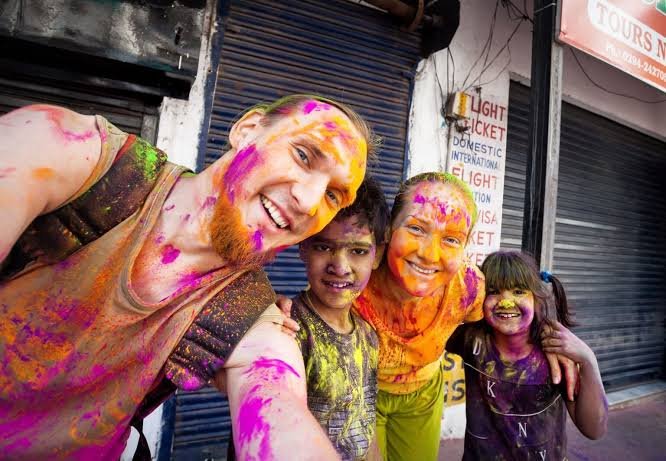
When is Holi 2027 in Mathura?
Rangwali Holi — the main day of colour — falls on Monday 22 March 2027. Holika Dahan (the bonfire ceremony) is the evening before: Sunday 21 March. But in Mathura and Vrindavan, the festival runs for a full week. Lathmar Holi in nearby Barsana and Nandgaon begins around 14–17 March. If you can only come for one day, 22 March at Vrindavan’s Banke Bihari temple is the highlight.
Why Mathura & Vrindavan
The Festival at Its Source
Most Indian festivals become more intense the closer you get to their spiritual origin. Holi is no exception. Mathura — Krishna’s birthplace — and Vrindavan — the forest where he spent his childhood — are where the festival of colour was born. While the rest of India celebrates for a day, the Braj region around Mathura celebrates for over a week, in a sequence of events that each carry their own distinct ritual, mood and spectacle.
For international visitors, this is the full Holi experience: not a commercial event staged for tourists, but a living tradition that has unfolded in the same temples and lanes for centuries. The scale is extraordinary. During the week of Holi, tens of thousands of pilgrims and travellers pour into this small city on the Yamuna, and the celebration spills from temple courtyards onto every street.
2027 Holi Calendar
The Full Week of Celebrations
Sunday
Mon–Tue
Tue–Wed
Saturday
Sunday evening
Monday
Where to Be
The Events That Matter Most
Sample Plan
3-Day Holi Itinerary from Delhi or Agra
Depart Delhi early morning (3 hours by road; 2 hours by train to Mathura Junction). Check in and rest through midday — the lanes are quieter and you need energy for the evening. At dusk, walk to Vishram Ghat on the Yamuna to witness Holika Dahan. The atmosphere — oil lamps on the river, firelight on the ghats, thousands of worshippers — is unlike anything else. Return to your hotel by 9 pm.
Be at Banke Bihari temple by 7:30 am. Colour play starts immediately at sunrise and peaks by 9–10 am. After the temple, explore the lanes around it — the entire neighbourhood becomes a colour battlefield. By noon, action starts winding down. Return to your hotel to shower and change. Spend the afternoon at Dwarkadhish temple in Mathura, which holds a more composed second celebration. That evening, the city is calm and beautiful — a good time to walk the ghats as they quiet down.
Mathura to Agra is only 58 km (1 hour). The Taj Mahal opens at sunrise — go first thing for the golden morning light and smaller post-Holi crowds. After the Taj, visit Agra Fort, then continue to Delhi (3 hours), Jaipur (4 hours) or your next destination. This three-city loop — Delhi, Mathura/Vrindavan, Agra — is a natural extension of the Golden Triangle and one of the best ways to combine India’s greatest monument with its greatest festival.
⚠️ Note: The Taj Mahal is closed every Friday. 22 March 2027 (Holi) falls on a Monday — it is open. Plan your Agra day for Monday or Tuesday; never Friday.
On the Ground
What to Expect
Holi in Mathura is not a ticketed event or a staged performance. It is a living religious celebration and you are stepping into it as a guest. The scale is immense — hundreds of thousands of people gather in a town built for far fewer — and the energy swings between joyful and overwhelming. That said, international visitors have been coming here for decades, and with a few practical preparations the experience is transformative rather than stressful.
Colour is everywhere: gulal (dry powder), pichkari (water guns) and buckets of coloured water. By 10 am on the main day you will be thoroughly covered regardless of where you stand. Wet colour takes several washes to remove from skin, and even longer from hair — this is expected and normal. The colour sold in and around Mathura’s temples is generally mineral-based rather than chemical.
Crowds thin significantly after noon. If you have a low tolerance for density, arriving at Banke Bihari by 7:30 am, playing for two hours, and leaving by 10 am puts you well ahead of peak crowd levels and still gives you the full experience.
Practical Preparation
What to Wear & What to Bring
Getting There
How to Reach Mathura
🚂 By Train (Best Option)
Mathura Junction is well-connected from Delhi (2 hours), Agra Cantonment (45 minutes) and Jaipur (3.5 hours). Dozens of trains run daily. Book 60–90 days ahead — trains fill completely for Holi week. Vrindavan is 15 km from Mathura station; auto-rickshaws make the run for ₹100–150.
🚗 By Road
Mathura is 145 km south of Delhi on the Yamuna Expressway — roughly 2.5–3 hours by car. Agra is 58 km south of Mathura, about 1 hour. A private car is the most flexible option for Holi week, as it lets you reach Barsana and Nandgaon (40–45 km from Mathura) for Lathmar Holi without depending on shared transport.
✈️ Nearest Airports
Delhi’s Indira Gandhi International Airport is the main gateway (145 km). Agra’s Kheria Airport receives a small number of domestic flights. Most international visitors fly into Delhi and travel to Mathura by train or private car.
Combined With
Holi + Golden Triangle: A Natural Pairing
Mathura sits almost exactly halfway between Delhi and Agra on the Yamuna Expressway — it is not a detour but a natural midpoint. Adding Mathura for Holi to a Golden Triangle itinerary requires almost no extra travel; it simply replaces a driving day with the most memorable 48 hours in India.
The sequence works perfectly: fly into Delhi, spend two days seeing Old Delhi and New Delhi, drive down to Mathura on the afternoon of 21 March to catch Holika Dahan, spend the main Holi day (22 March) in Vrindavan and Mathura, then continue 58 km south to Agra on 23 March to see the Taj Mahal. From Agra, the standard Golden Triangle loop continues to Jaipur (4 hours) for two or three days before returning to Delhi. Total extension over a standard GT tour: zero — just a reordering of arrival days.
Jaipur also hosts its own celebrated Holi, with organised events at heritage hotels and the old city. If you can spare two extra days, some travellers do Delhi — Mathura — Agra — Jaipur in Holi week and experience the festival in both cities: Vrindavan for the religious intensity, Jaipur for the photogenic colour at Amber Fort and heritage venues.
Common Questions
Frequently Asked Questions
Also On This Site