

The Three Parks Every Tiger Safari Traveller Needs to Know
India has 54 tiger reserves. Most wildlife travellers to India visit one.
The three that matter most for international visitors — particularly those visiting from the UK, USA, Australia, and Europe — are Ranthambore in Rajasthan, Jim Corbett in Uttarakhand, and Bandhavgarh in Madhya Pradesh. Each has its own character, its own landscape, and its own reason to choose it over the others.
This guide covers all three in full — what makes each one special, which zones deliver the best tiger sightings, how to book permits, when to go, and how to combine them with the Golden Triangle and other North India destinations.
If you have never been on a tiger safari in India before, start here.
The Quick Summary: Which Park Is Right for You?
Before the detail — a direct answer to the question most travellers ask first.
Choose Ranthambore if you are doing the Golden Triangle (Delhi, Agra, Jaipur) and want to add a wildlife extension. Ranthambore is three hours from Jaipur by road. The Golden Triangle + Ranthambore combination is the most popular and most efficient India first-timer itinerary available. The park has historically comfortable sighting rates and an extraordinary setting — tigers against the backdrop of a 10th-century fort.
Choose Bandhavgarh if seeing a tiger is your primary goal and you are willing to build your itinerary specifically around the park. Bandhavgarh has the highest tiger density of any core zone in India. Experienced wildlife operators describe sighting probability here as as close to a guarantee as the wild allows.
Choose Jim Corbett if you want breadth over intensity — tigers, but also elephants, leopards, and the extraordinary Himalayan foothills setting. Corbett is India’s oldest national park, its landscapes are the most diverse, and an overnight stay in the Dhikala forest rest house is one of the most distinctive wildlife experiences in Asia.
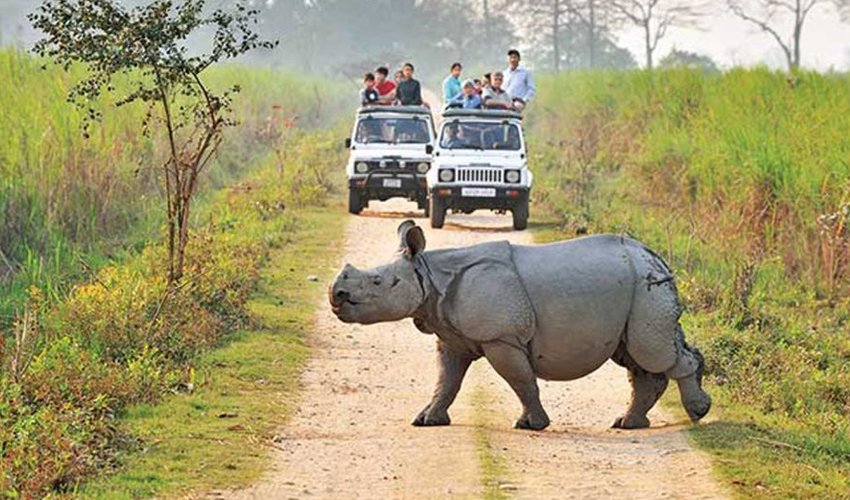
Ranthambore National Park: The Golden Triangle Wildlife Extension
The Setting
Ranthambore is in Sawai Madhopur district of Rajasthan — three hours south of Jaipur by road and five to six hours from Delhi. For international visitors doing the Golden Triangle, it is the most natural and accessible wildlife extension available. The circuit Delhi → Agra → Jaipur → Ranthambore → Delhi fits cleanly within eight to ten days.
The park spans 1,334 square kilometres of dry deciduous forest, rocky outcrops, and three beautiful lakes — Padam Talao, Raj Bagh Talao, and Malik Talao. At its centre, the 10th-century Ranthambore Fort rises above the jungle on a rocky hill. The combination of ancient fort, placid lakes, and open scrub forest creates a visual backdrop for tiger sightings that is completely unlike any other wildlife destination in India.
The park currently has approximately 75 Bengal tigers, making it one of the most tiger-rich reserves in India by population. The tigers here are unusually comfortable around safari vehicles — decades of observation and study have made them largely indifferent to jeeps. When you encounter a Ranthambore tiger, it typically continues whatever it is doing without regard for your presence. That quality of encounter — relaxed, prolonged, unhurried — is what makes Ranthambore so memorable.
The Zones
Ranthambore divides its safari area into ten zones. The core zones — Zones 1 to 5 — cover the historical heart of the park around the three lakes and the area below the fort. These zones deliver the highest historical sighting rates and the most dramatic scenery. Zone 1 centres on Padam Talao, where some of the most iconic Ranthambore photographs have been taken — tigers drinking or swimming in the lake with the fort visible in the background. Zone 2 focuses on Raj Bagh Talao ruins. Zone 3 is the densest forest section. Zone 4 is known for sloth bear sightings alongside tigers. Zone 5 has open grasslands where tigers are frequently seen walking in the open — excellent for photography.
Zones 6 to 10 are the buffer zones. Lower historical sighting rates but growing tiger populations and significantly easier to book — particularly important for October visits when the core zones sell out first.
Zone allocation through the official government booking portal is random — you cannot guarantee your preferred zone. The strategy is to book multiple safaris: across three or four safari sessions, you statistically receive at least one core zone assignment.
Tiger Sighting Probability
October: 65 to 75% across two safaris. November: 70 to 80%. February and March: 75 to 85%. April and May: 85 to 95%.
The probability rises as the dry season progresses and the waterholes become the primary water source for all the park’s animals. In October — the first month of the season after monsoon closure — the vegetation is still relatively dense, which can make spotting a tiger through the undergrowth slightly harder than in November onwards. The waterholes are full and the tigers visit them regularly, but the sighting may be briefer.
By February and March, the waterholes are shrinking, the grass has thinned significantly, and tigers are visiting water sources with increasing predictability. Sighting rates at this point approach those of the true dry season peak.
When to Visit Ranthambore
The park opens October 1 and closes June 30. October to February is peak season for international visitors — excellent weather, good sighting rates, and the safari season in combination with the Golden Triangle and Diwali makes this the most popular window.
March to June delivers the highest sighting rates but increasingly intense heat. April and May in Ranthambore are extraordinarily productive for wildlife photography — tigers at the waterholes in golden morning light — but temperatures exceed 40°C by midday and midday activity must happen in air-conditioned accommodation.
How to Book
Book safari permits through the official Rajasthan Forest Department portal. Permits for any given date open approximately 90 days in advance. October permits became available in early July. By the time this guide was updated, October core zone permits were already limited.
Always book the jeep (Gypsy) over the canter. The jeep carries a maximum of six passengers plus a naturalist and driver. It can stop for extended periods during a sighting, access narrower trails, and positions everyone within photography distance. The canter carries 20 passengers and delivers a meaningfully inferior experience.
Book accommodation near the park gates rather than in Sawai Madhopur town. Gate-adjacent properties allow 5:30 AM departures without an additional 30-minute pre-dawn drive.
Full Ranthambore guides:
Jim Corbett National Park: India’s Oldest and Most Diverse Reserve
The Setting
Jim Corbett National Park is India’s oldest national park, established in 1936 and named after the legendary hunter and conservationist Jim Corbett. It sits in the Himalayan foothills of Uttarakhand, in the Nainital district — approximately 280 km from Delhi (five to six hours by road) and accessible by overnight train from Delhi to Ramnagar Junction.
The park covers 1,288 square kilometres of extraordinarily diverse terrain — dense sal forest, river grasslands called chaurs, rocky ridgelines, and the Ramganga River that runs through the heart of the reserve. The Ramganga is the park’s spine. Almost all significant wildlife activity in Corbett — tigers, elephants, gharial crocodiles, otters — relates to this river in some way.
What makes Corbett different from Ranthambore and Bandhavgarh is breadth. This is not purely a tiger park. Corbett has one of the finest elephant populations in India — large herds that move through the chaur grasslands in the morning and evening. Leopards. Sloth bears. Over 600 bird species. Gharial crocodiles on the Ramganga banks. King cobras in the undergrowth. The biodiversity here is extraordinary, and even a safari without a tiger sighting delivers a rich and rewarding wildlife experience.
Tiger sighting rates at Corbett are lower than at Ranthambore or Bandhavgarh — but Corbett’s tigers, when encountered, tend to be seen in the open grasslands rather than at waterholes, which produces a different and often more dramatic kind of sighting. A tiger striding across the open chaur with the Himalayan foothills visible in the distance behind it is an image that stays with you.
The Zones
Corbett divides into five main zones plus buffer areas.
Dhikala is the crown jewel. Located deep in the core area, Dhikala is the largest zone, featuring the park’s most extensive chaur grasslands alongside the Ramganga River. The visibility here — across open grassland with the river visible in the background — is unmatched in any other part of the park. Tiger sighting probability in Dhikala is the highest of any Corbett zone. The unique feature of Dhikala is that you can stay overnight inside the park at the Dhikala Forest Lodge — the only zone in Corbett where this is possible. An overnight stay dramatically improves your wildlife encounters, as the early morning and late afternoon drives from within the zone capture the most active wildlife periods without the 90-minute drive from the outside gates. Book Dhikala Forest Lodge months in advance through the Uttarakhand Forest Department — it is the most competed-for wildlife accommodation in North India.
Bijrani is the most accessible core zone — located near the Amdanda Gate close to Ramnagar town. Open grasslands, sal forest, and small seasonal streams combine to make it a consistent tiger sighting zone. For day visitors who cannot book a Dhikala overnight stay, Bijrani is the first choice. Both jeep and canter safaris are available.
Jhirna Zone is notable for one specific quality: it remains open throughout the monsoon season (July to September) when all other Corbett zones close. For visitors who must travel in the monsoon window, Jhirna provides an opportunity for a Corbett wildlife experience year-round.
Durgadevi Zone on the north-eastern border is primarily known for elephant and otter sightings near the Ramganga and Mandal Rivers. Less popular with tiger-focused visitors but exceptional for birdwatching and elephant encounters.
Sonanadi Zone and the Garjia area round out the accessible zones. Both have lower tiger sighting rates than Dhikala and Bijrani but offer solitude and excellent bird and elephant encounters.
Tiger Sighting Probability at Corbett
October to February: 50 to 65% across two safaris in core zones. Dhikala delivers higher rates than any other zone. March to June: 70 to 85% — rising as waterholes concentrate wildlife activity. The absolute peak for Corbett tiger sightings is April to June.
The honest context: Corbett is a large park with low tiger density relative to Bandhavgarh. If your primary goal is a tiger sighting, Bandhavgarh or Ranthambore deliver higher probability. If you want the complete Indian wildlife experience — tigers as one element of a diverse ecosystem encounter in a dramatically beautiful landscape — Corbett is the finest wildlife destination in North India.
When to Visit Corbett
October to June for the core zones. Jhirna Zone is open year-round. November to February is the most comfortable period — weather is excellent, wildlife is active, and the Himalayan foothills visible above the forest canopy make for extraordinary landscape photography. March to June delivers peak sighting rates as the season progresses toward summer.
How to Reach Corbett
The Ramnagar Railway Station is the closest rail connection — overnight trains from Delhi Anand Vihar Terminal reach Ramnagar in the morning, perfect timing for an afternoon safari. By road from Delhi: 280 km via the NH34 through Moradabad and Kashipur — approximately five to six hours. Nearest airport: Pantnagar (85 km from the park), served by flights from Delhi.
Bandhavgarh National Park: The Highest Tiger Density in India
The Setting
Bandhavgarh is in the Umaria district of Madhya Pradesh, in the Vindhya Hill ranges of Central India. It is approximately 165 km from Jabalpur by road (2.5 hours) and accessible by flight from Delhi or Mumbai to Jabalpur airport.
The park covers 1,536 square kilometres total, with a core zone of 453 square kilometres — the most intensely tiger-populated section of any Indian national park. More tigers in less space means more encounters. It is as simple as that.
The landscape is a classic Central Indian mixed forest — dense sal and bamboo forest on the hillsides, open meadows in the valleys, and the rocky Bandhavgarh Fort (also an ancient ruin, like Ranthambore) rising from the centre of the core zone. The White Tiger lineage — the genetic line that produced the famous white tigers now seen in zoos worldwide — originated in Bandhavgarh in the 1950s.
The current estimated tiger population across the full reserve is 150 or more — one of the largest concentrations in India. In the core zone, the density is extraordinary. Experienced wildlife operators who work across multiple Indian reserves consistently describe Bandhavgarh as the park where first-time tiger safari visitors have the highest confidence of a sighting. One established wildlife specialist notes that in their experience, only one guest has ever returned from Bandhavgarh’s Tala Zone without a tiger encounter.
The Zones
Bandhavgarh divides into three main safari zones.
Tala Zone is the core — the most famous, the most tiger-dense, and the most competed-for permit allocation in the park. The Tala Zone is where the majority of Bandhavgarh’s most documented tigers reside and where sighting rates are at their highest. Permits for Tala Zone must be booked months in advance for the peak October to March season. Booking opens 120 days in advance through the Madhya Pradesh Forest Department online portal.
Magdi Zone offers a quieter alternative to Tala with a landscape of mixed forest and open meadows. Tiger sightings are frequent — lower density than Tala but still significantly higher than most Indian parks. An excellent second choice when Tala is fully booked.
Bamera Zone is the newest addition to Bandhavgarh’s safari area, covering the buffer forest to the north of the core zones. Lower sighting rates than Tala and Magdi but growing tiger populations and increasingly positive reports from regular visitors.
Tiger Sighting Probability at Bandhavgarh
This is where Bandhavgarh sets itself apart from every other park in India.
Tala Zone in peak season (November to May): 85 to 95% across two safaris. Across three to four safaris, the probability approaches certainty for most visitors. Seasoned operators track individual tigers by territory and behaviour — your naturalist knows which tigers are likely to be active in which section of the Tala Zone on any given morning.
October (first month after opening): 75 to 85% across two safaris — slightly lower as the vegetation is still dense from the monsoon, but the sighting rates recover quickly as October progresses.
When to Visit Bandhavgarh
The park opens October 1 and closes June 30. November to February delivers the finest combination of comfortable weather and excellent sighting rates. October is a strong month with high sightings and the benefit of lush post-monsoon scenery. March to May is peak sighting season — waterholes concentrate wildlife and sighting rates reach their seasonal maximum — but temperatures in May in Central India are genuinely demanding.
How to Reach Bandhavgarh
Jabalpur Airport is the most convenient entry point — approximately 2.5 hours from the park by road (165 km). Jabalpur is connected by direct flights from Delhi (1.5 hours), Mumbai (1.5 hours), and Bengaluru (2 hours). Rewa Airport is closer (approximately 1 hour) with fewer flight connections. The Umaria Railway Station (35 km from the main gate) is served by trains from Delhi, Jabalpur, and Bhopal.
Note that Bandhavgarh is in Madhya Pradesh — not on the Golden Triangle circuit. Including Bandhavgarh in a Golden Triangle itinerary requires a dedicated internal flight from Delhi or Jaipur and is best suited to travellers with ten days or more. The most common Bandhavgarh circuit for international visitors from the Golden Triangle: fly from Delhi or Jaipur to Jabalpur, two to three nights at Bandhavgarh, fly back to Delhi for onward departure.
All Three Parks: What They Share
Every park on this list shares the following requirements regardless of which one you choose.
Book well in advance. All three parks use government online permit systems that open 90 to 120 days in advance. Core zone permits — particularly Tala at Bandhavgarh and Dhikala at Corbett — sell out within hours of opening for peak season dates. Set reminders and book the moment permits become available.
Choose the jeep. At all three parks, the jeep (Gypsy, maximum 6 passengers) delivers a fundamentally better experience than the canter (20 passengers). The jeep can stop for extended periods, access narrower trails, and provides every occupant with a direct, unobstructed view. The price difference is worth it entirely.
Book a qualified naturalist. An experienced naturalist — tracking pugmarks, reading animal behaviour, interpreting the alarm calls of prey animals — dramatically increases both your sighting probability and your understanding of what you are seeing. At all three parks, a licensed guide is compulsory; the quality difference between guides is significant. Book through a reputable operator who can confirm guide quality.
Wear the right colours. Khaki, olive green, and grey. Avoid white, bright red, orange, or any fluorescent colours. The forest is your environment and you want to be part of it rather than a disturbance within it. Most experienced safari visitors at all three parks wear the same subdued palette.
Go in the morning. Morning safaris at all three parks deliver the best sighting rates. Tigers are most active between dawn and approximately 10 AM. Evening safaris (departing around 2:30 to 3 PM) are productive — particularly in summer when tigers move toward water in the late afternoon — but the morning session is consistently superior across all months at all three parks.
Combining Wildlife with the Golden Triangle
The most popular North India wildlife itinerary combines the Golden Triangle with Ranthambore — and for good reason. The circuit fits neatly within eight to ten days, the drive from Jaipur to Ranthambore is just three hours, and October to March aligns perfectly with both the prime safari season and the ideal Golden Triangle travel window.
For Bandhavgarh or Jim Corbett, a separate dedicated wildlife trip (fly from Delhi, two to three park nights, fly back) is the most efficient approach — particularly if you are combining with a Golden Triangle visit.
A fourteen-day trip might look like: four days Golden Triangle → two nights Ranthambore → fly to Jabalpur → two nights Bandhavgarh → fly back to Delhi. This covers the finest India monument experience, the most accessible safari (Ranthambore), and the highest sighting probability safari (Bandhavgarh) in a single two-week trip.
Plan your wildlife trip:
What to Pack for an India Tiger Safari
The packing list is similar across all three parks with minor seasonal adjustments.
Clothing: All safari clothing in neutral colours — khaki, olive, grey, beige, tan. Light cotton or moisture-wicking synthetic fabrics. Long trousers and long-sleeved shirts even in warm weather — protection against mosquitoes and sun on the open vehicle. Avoid denim (heavy when wet, uncomfortable when sweaty). A fleece or light down jacket for early morning safaris from October through February — open jeep at 6 AM in November can be genuinely cold.
Footwear: Comfortable walking shoes or boots with ankle support. Easy to slip off if required at religious sites elsewhere on your trip. Avoid bright white trainers — they are the wrong colour and get dusty quickly.
Camera equipment: A telephoto lens of 300mm minimum — 400mm or 500mm is significantly better for wildlife photography at the distances typical of Indian national parks. Image stabilisation is essential in the low light of dawn safaris. Carry a cleaning kit — dust and vibration from jeep movement affect lenses over a full safari session. A camera strap that allows quick movement is practical. If you do not have telephoto equipment, a modern smartphone camera will record the experience but delivers significantly inferior wildlife images.
Health and practical: Insect repellent with DEET — particularly in October and November when mosquitoes are still active after the monsoon. Sunscreen SPF 50+. Sunglasses. A hat or cap for the open jeep. At least one litre of water for each safari session. A small binocular (8×42 is the most practical for safari use) helps with scanning the middle distance for animals before they are clearly visible.
Frequently Asked Questions
Which Indian national park has the most tiger sightings?
Bandhavgarh National Park’s Tala Zone delivers the highest consistent tiger sighting rates of any park in India — with experienced operators describing 85 to 95% probability across two safaris in peak season. Ranthambore is the most accessible for Golden Triangle travellers. Jim Corbett offers the most diverse ecosystem.
When is the best time for a tiger safari in India?
November to February delivers the best combination of comfortable weather and good sighting rates across all three parks. March to May delivers peak sighting rates as the dry season concentrates wildlife at waterholes — but temperatures are significantly higher. October is excellent at all three parks as the season opens after the monsoon.
Do you need to book safari permits in advance?
Yes — for all three parks. Core zone permits at Ranthambore, Tala Zone at Bandhavgarh, and Dhikala Zone at Corbett sell out weeks to months in advance for peak season dates. Use the official state forest department portals. Ranthambore: rajasthan.gov.in. Bandhavgarh and Kanha: mpforest.gov.in. Corbett: uttarakhandforest.gov.in.
Is a tiger sighting guaranteed?
No. The animals are wild, in unfenced landscapes, and their movements cannot be predicted. However, experienced operators with knowledge of individual tiger territories, recent pugmark data, and animal behaviour significantly increase your probability. At Bandhavgarh Tala Zone, probability across two safaris approaches 85 to 95%. At Ranthambore across three or four safaris, 85 to 90%.
How many safaris should I book?
Minimum two per park (one morning, one afternoon). Three to four safaris across two days delivers the best statistical coverage of zones, timing, and tiger territory. Experienced wildlife travellers typically book at least two morning safaris on consecutive days at any park they visit.
Can I combine Ranthambore with the Golden Triangle?
Yes — this is the most popular combination in North India. Ranthambore is three hours from Jaipur by road. A Golden Triangle itinerary ending in Jaipur followed by two nights at Ranthambore fits within eight to ten days total.
Plan Your India Wildlife Safari with Squid Travel India
At Squid Travel India, we arrange wildlife safaris across all three parks — standalone or as extensions of Golden Triangle itineraries. We handle safari permit bookings the moment they open, accommodation near the park gates, private transfers, and connections with experienced naturalists who know the parks deeply.
Every wildlife package is built around maximising your sighting opportunity — the right zone, the right timing, and the right guide for your specific dates.
Also worth reading:
- Ranthambore Tiger Safari October 2026
- Best Time to Visit Ranthambore — Month by Month
- 4-Day Golden Triangle with Ranthambore
- India in October 2026
- India in November 2026
- Make Your Own Tour
📞 Call / WhatsApp: +91 9990812499 📧 Email: Squidtravelindia@gmail.com 🌐 Visit: squidtravelindia.com
1,800+ trips completed | 98% happy clients | TripAdvisor Travelers’ Choice 2024–2025
Last updated: September 2026. Park open dates, permit booking portals, and zone availability are subject to change each season. Always verify current information directly with the relevant state forest department before booking.
Comment (0)