

By Vivek Sharma — Founder, Squid Travel India Updated July 2026 · 15+ years organising North India tours · TripAdvisor Travelers’ Choice Award Winner 2024–25
North India is where India’s story is written most dramatically. The Himalayan peaks. The Mughal monuments. The Rajput palaces. The sacred rivers. The desert dunes. The colonial hill stations. And at the centre of it all — the Taj Mahal, the most beautiful building on earth.
No other region of any country packs this much variety, this much history, and this much sheer visual power into a single geography. A traveller who explores North India properly will stand before the Taj Mahal at sunrise, spot a wild Bengal tiger in Ranthambore, watch the Ganga Aarti ceremony in Varanasi, ride a camel into the dunes outside Jaisalmer, and breathe mountain air in Rishikesh — often within a single two-week trip.
This is your complete 2026 guide to the top 10 places to visit in North India — every iconic destination ranked and described honestly, with the practical details you need to plan your trip.
What Counts as North India?
North India broadly covers the states of Delhi, Uttar Pradesh, Rajasthan, Himachal Pradesh, Uttarakhand, Punjab, Haryana, Jammu & Kashmir, and Ladakh. Together they form a travel region of extraordinary diversity — from the Thar Desert in the west to the Himalayan ranges in the north and east, connected by the Indo-Gangetic Plain with its ancient cities and sacred rivers.
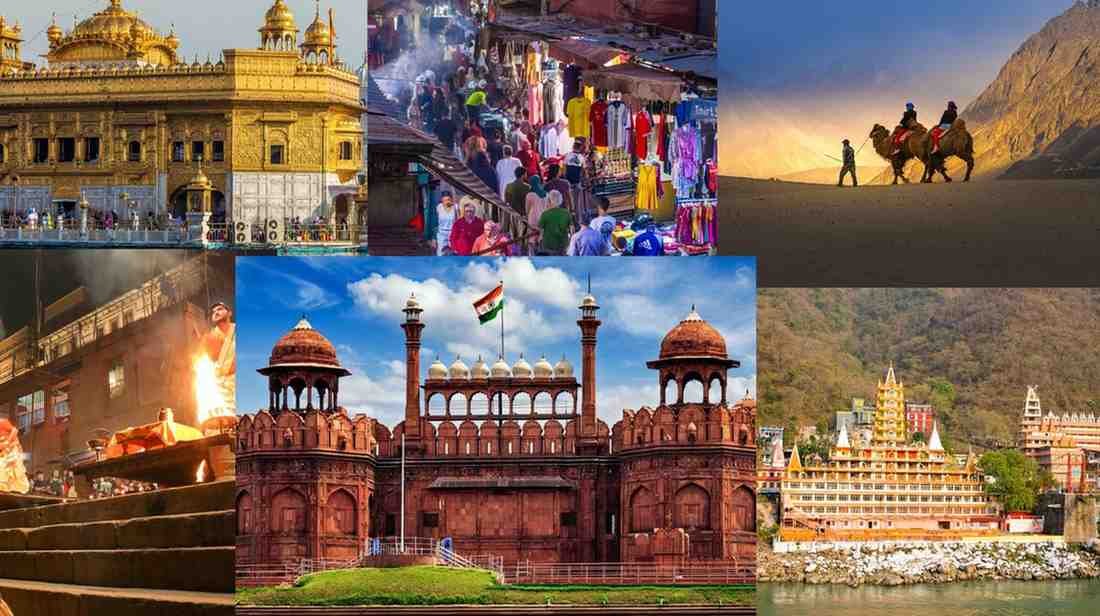
For international travellers visiting for the first time, North India is almost always the starting point — and for good reason. The Golden Triangle (Delhi, Agra, Jaipur) alone delivers some of the world’s greatest monuments. Add Varanasi, Ranthambore, Rishikesh, or Ladakh and you have one of the most rewarding travel itineraries available anywhere on the planet.
1. Agra — The Taj Mahal and Its Companion Monuments
There is no need to build suspense about the number one entry. Agra is on this list because of the Taj Mahal — and the Taj Mahal deserves to be the first thing any first-time India visitor sees.
Built between 1631 and 1653 by Emperor Shah Jahan as a tomb for his wife Mumtaz Mahal, the Taj Mahal is not merely a beautiful building. It is the physical embodiment of grief, devotion, and artistic perfection on a scale that no photograph — however good — fully captures. Standing before it for the first time, most visitors go quiet. Many cry. All of them say it exceeded their expectations.
The Taj Mahal is best visited at sunrise — arriving at the gates when they open at 6:00 AM. In the first hour, before the tour groups arrive, the marble shifts from rose-pink to gold to brilliant white in the changing light. The reflection pool creates a perfect symmetry. The silence of the gardens amplifies the scale of the monument. This is one of those rare travel experiences that remains in the memory permanently.
Beyond the Taj: Agra rewards visitors who stay more than a day.
Agra Fort — the enormous red sandstone Mughal fortress across the river from the Taj, where Shah Jahan spent his final imprisoned years close enough to see his wife’s tomb from the window. The fort contains palaces, mosques, and audience chambers of considerable beauty — and one of the most poignant views in India: the Taj Mahal seen through a pierced marble screen from Shah Jahan’s imprisonment chamber.
Fatehpur Sikri — 40 km from Agra, the abandoned Mughal capital built in 1571 by Emperor Akbar and deserted just 14 years later. The entire city — mosques, palaces, courtyards — is preserved in red sandstone, frozen in the 16th century. One of the most haunting places in India and consistently underrated by visitors who drive straight from Agra to Jaipur.
Mehtab Bagh — the moonlight garden across the Yamuna River from the Taj. At sunset, the Taj turns amber and reflects in the river. No crowds. No entry queues. Just the most beautiful building in the world from the perfect distance, at the perfect hour.
Best time to visit Agra: October to March. The Taj Mahal is open every day except Friday. Sunrise visits (6:00 AM entry) are essential.
Entry fee (Taj Mahal): ₹1,300 for foreign nationals (approximately $15/£12)
2. Jaipur — The Pink City of Rajasthan
Jaipur is the city that most surprises first-time visitors to North India. They expect a monument or two. They find a living, breathing royal city of 4 million people whose historic walled centre — declared a UNESCO World Heritage Site in 2019 — contains some of the finest architecture in Asia.
Founded in 1727 by Maharaja Sawai Jai Singh II and painted its distinctive terracotta pink in 1876 to welcome Britain’s Prince Albert, Jaipur is Rajasthan at its most accessible, most vibrant, and most complete.
Amber Fort is the centrepiece — perched dramatically on the Aravalli Hills above a shimmering lake, 11 km north of the city. Built in 1592, expanded over generations of Rajput kings, it is a maze of courtyards, ornate chambers, secret passages, and painted gateways. The Sheesh Mahal — the Hall of Mirrors — where a single candle flame reflects thousands of times across a ceiling of mirror mosaic — is one of the finest interiors in all of India.
The City Palace remains home to the Maharaja of Jaipur and contains a museum of extraordinary objects — including the two Gangajali silver vessels, the world’s largest silver objects, made to carry Ganges water for the coronation of King Edward VII.
Jantar Mantar — the 18th-century astronomical observatory whose 27-metre sundial is accurate to within 20 seconds. Built in 1724 without a single electronic component. A UNESCO World Heritage Site and genuinely mind-bending in person.
Hawa Mahal — the five-storey Palace of Winds with its 953 latticed windows, built in 1799 for royal women to observe street life unseen. The most photographed facade in Rajasthan and justifiably so.
The bazaars — Johari Bazaar for gemstones (Jaipur is the world’s largest gemstone cutting centre), Bapu Bazaar for block-printed textiles and embroidered leather shoes, Tripolia Bazaar for lac bangles and traditional crafts.
Best time to visit Jaipur: October to March. October is exceptional — post-monsoon green hills, Diwali possible, manageable crowds.
3. Delhi — Where Ancient Monuments Meet Modern India
Delhi has been continuously inhabited for over 5,000 years and ruled by eight successive empires. It shows. Standing anywhere in Delhi, you are surrounded by layers of history — Mughal, Rajput, Sultanate, British colonial, and modern Indian all stacked on top of each other with no clear boundary between them.
For international visitors, Delhi is typically both the entry point and one of the most rewarding destinations in North India — often underestimated because travellers budget only a day and then wish they had given it two.
Old Delhi is where the city reveals its most extraordinary self. The Jama Masjid — India’s largest mosque, built by Shah Jahan in 1656 — opens onto a courtyard capable of holding 25,000 worshippers. A cycle rickshaw ride through the lanes of Chandni Chowk — the 17th-century market street still selling everything from wedding garlands to silver in chaotic, magnificent abundance — is one of the most intense sensory experiences in travel anywhere.
The Red Fort — the great Mughal palace-fortress from whose ramparts the Emperor once addressed his subjects — dominates the skyline of Old Delhi with its massive red sandstone walls stretching a kilometre around.
New Delhi, designed by Edwin Lutyens in the 1920s, delivers a completely different city. Humayun’s Tomb — the magnificent garden mausoleum that is the direct architectural ancestor of the Taj Mahal — sits in immaculate Mughal gardens in the south of the city. Qutub Minar (73 metres of 12th-century Afghan stonework) is India’s oldest surviving monument complex. India Gate anchors the grand Rajpath boulevard of the imperial capital.
Delhi is also one of Asia’s great food cities — from the legendary haleem and biryani of Old Delhi’s Karim’s restaurant (established 1913) to the contemporary restaurants of Hauz Khas Village and Khan Market.
Best time to visit Delhi: October to March. Air quality deteriorates in November–January due to crop burning — October offers the best balance of good weather and clean air.
4. Varanasi — The World’s Oldest Living City
If Agra and Jaipur represent India’s imperial grandeur, Varanasi represents something far older and far stranger — the spiritual heart of a civilisation that has been continuously inhabited for over 4,000 years.
Varanasi sits on the banks of the Ganges in Uttar Pradesh, approximately 800 km southeast of Delhi. It is simultaneously India’s holiest city, one of its most confronting, and one of its most unforgettable.
The city revolves around the Ganges and the 84 ghats — great stepped riverbanks — that line the river for approximately 6 km. Every morning before dawn, Hindu pilgrims descend to bathe in the sacred waters. Priests perform rituals. Boats push off into the river. The city wakes up the same way it has for 4,000 years.
The Ganga Aarti ceremony at Dashashwamedh Ghat at dusk is the event that most visitors describe as the most powerful experience of their entire India trip — and arguably one of the most extraordinary things a traveller can witness anywhere in the world. Priests in saffron robes hold brass lamps with multiple tiers of flames, moving them in synchronised circles above the river as drums beat, conch shells sound, incense rises, and hundreds of boats float on the darkening Ganges. It is simultaneously theatrical and deeply, profoundly spiritual in a way that transcends religion.
A dawn boat ride on the Ganges — watching the city’s ghats emerge from mist as the rising sun turns the river gold, pilgrims bathing and praying at every step — is an experience that stays with travellers for life.
Sarnath — 10 km from Varanasi — is where the Buddha delivered his first sermon after attaining enlightenment. The Dhamek Stupa marks the exact spot. The Sarnath Museum contains the original Lion Capital of Ashoka — the emblem that became independent India’s national seal.
Best time to visit Varanasi: October to March. Dev Deepawali (15 days after Diwali) is the most spectacular night of the year — the entire ghats are illuminated with hundreds of thousands of clay lamps.
5. Ranthambore — Tiger Country
For wildlife lovers, Ranthambore National Park in Rajasthan is not just the best tiger reserve in India — it is one of the finest wildlife experiences available anywhere in the world.
Located 130 km from Jaipur and easily combined with a Golden Triangle itinerary, Ranthambore covers 1,334 square kilometres of dry deciduous forest and ancient rocky terrain at the edge of the Aravalli and Vindhya hills. It is home to over 70 Bengal tigers, making it India’s most reliable location for tiger sightings.
The landscape itself is extraordinary — rocky gorges, ancient ruins (including the 10th-century Ranthambore Fort rising dramatically above the jungle), lakes, and grasslands that create an endlessly varied environment. Unlike some tiger reserves where the forest is so dense that sightings require luck, Ranthambore’s open terrain means that a tiger, once spotted, can often be watched for extended periods as it moves through clearings and along lakesides.
Beyond tigers, Ranthambore supports leopards, sloth bears, striped hyenas, Indian wild boars, four species of deer, marsh crocodiles, and over 500 species of birds. A full safari here — even without a tiger sighting — is a richly rewarding wildlife experience.
Safari types: Jeep safaris (6 passengers) and Canter safaris (20 passengers). Jeep safaris are significantly better — quieter, more flexible, and allowing better photography. Book jeep safaris 45–60 days in advance through the official Rajasthan Forest Department portal.
Park season: October 1 to June 30. Closed July to September (monsoon).
Best time for tiger sightings: November to April, when the vegetation dries and tigers are more visible near waterholes.
6. Rishikesh and Haridwar — Where the Ganges Meets the Himalayas
Where the Ganges emerges from the Himalayan foothills and enters the plains of North India, two cities stand on its banks at almost the same point — and together they offer one of India’s most distinctive and compelling travel experiences.
Haridwar is one of India’s seven sacred cities, a place of profound religious significance where Hindu pilgrims come to bathe at the Har Ki Pauri ghat — believed to be the exact spot where the Ganges leaves the mountains. The evening Ganga Aarti at Har Ki Pauri is smaller and more intimate than Varanasi’s — but in some ways more immediately moving, the brass lamps reflected in the swift-flowing Ganges as the Himalayan darkness falls.
Rishikesh, 24 km upstream, is simultaneously the yoga capital of the world and an adventure sports destination of considerable reputation. It was here that the Beatles came in 1968 to study with Maharishi Mahesh Yogi — and the ashram they stayed in (now officially called the Beatles Ashram and open to visitors) remains a pilgrimage site for music fans as much as spiritual seekers.
Rishikesh today is a layered and fascinating place. Ashrams and meditation centres sit alongside white-water rafting operators, bungee jumping platforms, and cafés serving filter coffee. The two famous suspension bridges — Laxman Jhula and Ram Jhula — span the Ganges in the middle of the town, offering some of the finest river views in North India.
The white-water rafting on the Ganges through the gorges above Rishikesh is among the best in Asia — Class III to V rapids depending on the section, with a multi-day camping expedition option for serious adventurers.
Best time to visit Rishikesh/Haridwar: September to April for rafting and outdoor activities. The Kumbh Mela cycle brings tens of millions of pilgrims to Haridwar at specific intervals — the next Ardh Kumbh is scheduled for 2028.
Getting there: 5–6 hours by road from Delhi. Nearest airport: Jolly Grant, Dehradun.
7. Jaisalmer — The Golden City of the Desert
Rising from the Thar Desert of western Rajasthan like a mirage of golden stone, Jaisalmer is one of the most immediately dramatic cities in India. The Jaisalmer Fort — the only fully inhabited living fort in the world — sits on a rocky outcrop 76 metres above the desert plain, its golden sandstone walls turning amber and deep ochre as the sun moves through the sky.
Founded in 1156 by the Rajput chieftain Rawal Jaisal, Jaisalmer grew wealthy from its position on the great Silk Road trade routes between Central Asia and Delhi. When those routes declined with the arrival of maritime trade, the city turned inward and preserved itself in the amber of its own history. Today, walking through the narrow lanes of the Jaisalmer Fort — past havelis with intricately carved facades, past temples and palaces and the houses of families who have lived here for 30 generations — feels genuinely like entering the 14th century.
The desert experience is what draws most international visitors to Jaisalmer. The Sam Sand Dunes, 42 km from town, are Rajasthan’s most dramatic dune landscape — a vast expanse of golden sand where camel rides, desert camping, and sunset views over the dunes deliver the quintessential Rajasthan experience. Spending a night in a luxury tented camp beneath a sky full of Thar Desert stars is one of those experiences that sounds clichéd in description and is extraordinary in reality.
Patwon Ki Haveli — the largest and most ornate of Jaisalmer’s famous merchant mansions — is a five-storey edifice of carved sandstone that took 50 years to build. An extraordinary example of Rajput domestic architecture.
Gadisar Lake — a 14th-century reservoir on the edge of the city, surrounded by temples and cenotaphs, at its most atmospheric in the early morning when the light is soft and the only sounds are birds.
Best time to visit Jaisalmer: October to March. Summer in Jaisalmer (April–June) sees temperatures exceeding 45°C.
8. Ladakh — The Roof of the World
Ladakh is in a different category from every other destination on this list — not because it is more beautiful (though it might be) but because it operates in a completely different physical and cultural world.
Situated at an average altitude of 3,000–4,500 metres above sea level in the Trans-Himalayan rain shadow zone, Ladakh is a high-altitude desert surrounded by some of the world’s highest mountain ranges — the Himalayas to the south, the Karakoram to the north. The landscape is stark, vast, and humbling — vast open plains and gorges of coloured stone, ancient Buddhist monasteries clinging to clifftops, rivers of turquoise and cobalt blue, and skies of an intensity of blue not found at lower altitudes.
Leh — Ladakh’s capital — is the base for most visitors. A compact Tibetan Buddhist city with a market street, the ruined Leh Palace above the town, and the famous Shanti Stupa on a hilltop offering panoramic views across the valley.
Pangong Tso — the famous lake at 4,350 metres altitude, known for its extraordinary colour that shifts from turquoise to blue to navy to green in the space of minutes as the light changes. Approximately 134 km long and spanning the India-China border. The most photographed lake in the Himalayas.
Nubra Valley — reached via Khardung La (one of the world’s highest motorable passes at 5,359 metres), Nubra is a sand dune-studded valley between the Karakoram and Himalayan ranges where Bactrian camels still roam. An extraordinarily unlikely landscape for so high an altitude.
Monasteries — Hemis, Thiksey, Diskit, Alchi, and dozens of others dot the Ladakhi landscape. Thiksey Monastery, rising on a hillside above the Indus Valley, is often compared to the Potala Palace in Lhasa. Hemis Festival in July brings traditional mask dancing and ceremony to the largest monastery in Ladakh.
Best time to visit Ladakh: June to September. Roads close in winter due to snow. Altitude acclimatisation is essential — spend the first day in Leh resting and ascending slowly.
Important note: US State Department and FCDO advise normal travel precautions for Leh/Ladakh (excepting the restricted military zones near the line of actual control). Check current advisories before travelling.
9. Manali and the Himachal Hills — Mountains, Adventure and Cool Air
Where Ladakh is remote and extreme, Manali and the Himachal Pradesh hill stations offer a more accessible version of the Himalayan experience — and one of India’s finest adventure sports destinations.
Manali sits at 2,050 metres in the Beas River valley of Himachal Pradesh, surrounded by peaks rising to 6,000 metres. It is simultaneously a popular domestic hill station and a serious mountaineering base — the two sides of the town reflecting these different identities.
Old Manali is the original village, now a neighbourhood of cafés, guesthouses, apple orchards, and a relaxed traveller atmosphere centred on the 450-year-old Hadimba Temple — a striking wood and stone pagoda-style shrine in ancient deodar cedar forest.
Solang Valley — 14 km from Manali — is Himachal’s premier adventure sports zone. Skiing and snowboarding in winter (January to March), paragliding and zorbing in summer.
Rohtang Pass (3,978 metres) — the high-altitude pass above Manali that opens in May and closes in November — is where many visitors from the plains see snow for the first time. The Atal Tunnel below the pass (completed in 2020) now makes the Lahaul Valley accessible year-round.
Spiti Valley — reached via the Kunzum Pass from Manali or via Shimla from the south — is one of India’s last great offbeat destinations. A high-altitude cold desert valley with ancient monasteries, tiny villages clinging to cliffsides, and landscapes so stark and beautiful that visitors invariably describe them as otherworldly.
Shimla — Himachal’s capital and India’s most famous hill station, the former Summer Capital of British India. Mall Road, colonial architecture, the famous toy train (UNESCO World Heritage Site), and views over forested Himalayan ridges make Shimla the most classically “hill station” experience available in North India.
Best time to visit Manali/Himachal: May to October for most activities. January to March for snow and skiing. Avoid Manali peak season (June–July) if you dislike crowds — traffic can be severe.
10. Amritsar — The Golden Temple and the Weight of History
Amritsar in Punjab is North India’s most spiritually powerful destination — and the most emotionally complex.
The Harmandir Sahib — the Golden Temple — is one of the most beautiful and most meaningful religious buildings in the world. The central gold-covered shrine sits in the middle of a large sacred lake called the Sarovar, connected to the marble walkway surrounding the lake by a causeway. At any hour of the day or night, the reflection of the gilded temple in the still water of the Sarovar creates an image of extraordinary beauty and serenity.
The Golden Temple is simultaneously the holiest site in Sikhism and one of India’s most accessible religious experiences for visitors of all faiths and none. Entry is completely free, open 24 hours, and requires only the covering of heads (scarves provided at the entrance) and removal of shoes. The langar — the free community kitchen that feeds 100,000 people daily, every day, without exception — is one of the most remarkable expressions of human generosity and religious principle in the world. Visitors are welcome to eat.
Wagah Border Ceremony — 28 km from Amritsar at the India-Pakistan border, the daily flag-lowering ceremony conducted jointly by the Indian Border Security Force and Pakistan Rangers is one of North India’s most theatrical experiences — high-stepping military drill, nationalistic fervour, and crowds of thousands on both sides of the border fence. It is simultaneously absurd and genuinely moving.
Jallianwala Bagh — the public garden adjacent to the Golden Temple where British troops massacred hundreds of unarmed civilians in 1919 — is one of India’s most sombre and important historical sites. The bullet holes in the garden walls are still visible. The memorial garden is maintained with dignity and provides essential context for understanding modern India’s relationship with its colonial past.
Best time to visit Amritsar: October to March. Baisakhi (April 13) is the most important Sikh festival and Amritsar during Baisakhi is extraordinary — but requires advance booking many months ahead.
Getting there: Amritsar International Airport (ATQ) has flights from Delhi (1 hour) and major Indian cities. Well connected by rail to Delhi (6 hours on express trains).
Honourable Mentions — Beyond the Top 10
North India’s list of extraordinary destinations extends well beyond ten. These destinations deserve a mention for specific types of travellers:
Udaipur — Rajasthan’s most romantic city, set on the shores of Lake Pichola with white marble palaces reflected in the water. Often called the Venice of the East. Exceptional for couples and honeymooners.
Jodhpur — the Blue City of Rajasthan. The Mehrangarh Fort above the blue-painted old city is one of the finest forts in India. Extraordinary photography.
Jim Corbett National Park — India’s oldest national park and an excellent alternative to Ranthambore for tiger and elephant safaris, with a different and lusher forest environment.
Haridwar — standalone entry for spiritual travellers seeking the Ganga Aarti without the overwhelming intensity of Varanasi.
Dharamshala/McLeod Ganj — the home-in-exile of the Dalai Lama and the Tibetan government-in-exile. A fascinating collision of Himalayan mountain environment, Tibetan Buddhist culture, and backpacker internationalism.
How to Plan Your North India Trip
For first-time visitors (7–10 days)
The Golden Triangle (Delhi, Agra, Jaipur) plus one extension. Options:
- GT + Ranthambore — culture + wildlife
- GT + Varanasi — culture + spirituality
- GT + Rishikesh — culture + adventure + wellness
For return visitors (10–14 days)
The Golden Triangle as a base with deeper extensions into Rajasthan (Udaipur, Jaisalmer) or north into the Himalayas (Shimla, Manali, or Ladakh depending on season).
For dedicated travellers (3+ weeks)
A complete North India circuit — Golden Triangle + Rajasthan circuit + Varanasi + either Ladakh or the Himachal hills, depending on the season.
Best Time to Visit North India
| Season | Dates | Best For |
|---|---|---|
| Peak season | October to March | Everything — perfect for all destinations except Ladakh/Himalayas |
| Shoulder | September, early April | Good weather, lower prices, fewer crowds |
| Summer | April to June | Hill stations (Manali, Shimla) and Ladakh excellent — Golden Triangle hot |
| Monsoon | July to September | Hill stations lush, Golden Triangle manageable from late September |
Frequently Asked Questions
What is the best place to visit in North India?
The Taj Mahal in Agra is the single unmissable destination — no other monument in North India (or arguably the world) matches its beauty and impact. For a complete first North India experience, the Golden Triangle covering Delhi, Agra, and Jaipur covers the three most important destinations efficiently and comfortably.
How many days do you need for North India?
A minimum of 7 days for the classic Golden Triangle. 10 days allows one meaningful extension (Ranthambore, Varanasi, or Rishikesh). Two weeks opens up Rajasthan beyond Jaipur or the Himalayan destinations. Three weeks is the ideal length for a comprehensive North India experience.
Is North India safe for international tourists?
Yes. The major tourist destinations in North India — Delhi, Agra, Jaipur, Rajasthan, Varanasi, Rishikesh — are all well-developed for international tourism with good infrastructure, English widely spoken, and an experienced hospitality industry. Standard travel precautions apply. Travel with a reputable operator for the smoothest and safest experience.
What is the best time to visit North India?
October to March is the best overall window — cool, dry, and clear across all major destinations. October is exceptional for festivals (Diwali, Dussehra). November to February is peak season with the finest weather. Early October and late February to March offer good conditions with slightly lower prices and fewer crowds than December–January peak.
What should I not miss in North India?
The Taj Mahal at sunrise. The Ganga Aarti in Varanasi. A tiger safari in Ranthambore. Amber Fort at golden hour. The Golden Temple in Amritsar. Diwali night in Jaipur or Udaipur. These six experiences define North India travel and are genuinely irreplaceable.
Which is better — Jaipur or Varanasi?
They are so different that comparison is difficult. Jaipur is the finest example of North India’s royal Rajput history — forts, palaces, bazaars, and organised magnificence. Varanasi is the oldest and most spiritually intense city in India — raw, overwhelming, and profoundly moving. For a first North India trip, Jaipur is more accessible. For travellers seeking a deeper India encounter, Varanasi is unmissable. The best itineraries include both.
Plan Your North India Tour with Squid Travel India
At Squid Travel India, we have been organising North India tours for international travellers for over 15 years. From a 5-day Golden Triangle introduction to a 21-day complete North India circuit, every itinerary we design is personalised, fully private, and backed by our team’s genuine on-the-ground knowledge.
Every package includes private AC transport, hand-picked accommodation, expert English-speaking guides at each destination, all transfers, and 24/7 on-trip support throughout your journey.
📞 WhatsApp: +91 9818489607 📧 Email: squidtravelindia@gmail.com 🌐 Browse packages: squidtravelindia.com/tours/ 🏆 TripAdvisor Travelers’ Choice Award Winner 2024–25
We reply within 24 hours. Free quote, no obligation.
Comment (0)