

The classic Golden Triangle — Delhi, Agra, Jaipur — is one of the world’s great travel circuits. But there is a version of this journey that goes deeper, covers more of India’s soul, and leaves travellers with experiences they talk about for years after they return home.
Add Amritsar.
The Golden Triangle Tour with Amritsar takes India’s most iconic circuit and extends it north-west into the heart of Punjab — to a city unlike any other on the subcontinent. A city built around faith, shaped by tragedy, and defined by a warmth and generosity that will stop you in your tracks.
In Amritsar you will stand at the edge of the Amrit Sarovar — the sacred pool surrounding the Golden Temple — and watch the gilded shrine shimmer in the first light of morning. You will sit in the world’s largest free community kitchen and share a meal with strangers from every corner of the earth. And in the evening, 28 kilometres away at the Wagah Border, you will witness the most electrically charged public ceremony in India — the daily flag-lowering ritual at the India-Pakistan border, accompanied by tens of thousands of spectators in full-throated patriotic voice.
This is the Golden Triangle Tour with Amritsar. It is the Golden Triangle done properly.
This guide covers everything: the complete 7-day itinerary, day-by-day sightseeing, transport between cities, costs, best time to visit, and every practical detail a first-time visitor needs to know.
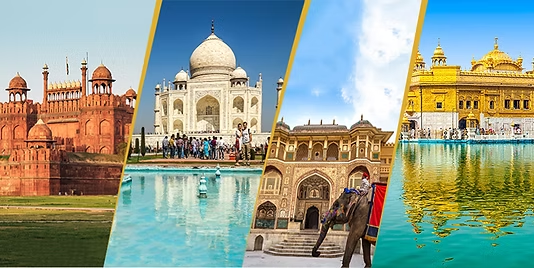
Why Add Amritsar to the Golden Triangle Tour?
The classic Golden Triangle — Delhi, Agra, Jaipur — covers Mughal India and Rajput India. It is extraordinary. But it tells one part of the story.
Amritsar tells another. The city is the spiritual capital of Sikhism — one of the world’s most fascinating religions, built around the principles of equality, service, and devotion. The Golden Temple, completed in 1604, is the holiest shrine in the Sikh faith and one of the most visited religious sites on earth. Over 100,000 visitors come to the Golden Temple every single day.
But Amritsar is not just a pilgrimage destination. It is a city that carries the full weight of modern Indian history — the 1919 Jallianwala Bagh massacre, the trauma of Partition in 1947, the turbulence of the 1980s, and the extraordinary resilience of a people who have rebuilt, again and again, with grace and hospitality.
Add to this the Wagah Border ceremony — one of the most uniquely charged public ceremonies in the world — and you have a travel experience that is simply irreplaceable.
The Golden Triangle with Amritsar gives you:
- Mughal grandeur (Agra, Delhi)
- Rajput royalty (Jaipur)
- Sikh spirituality and Punjabi culture (Amritsar)
- The India-Pakistan border (Wagah)
- Ancient history, colonial tragedy, living faith, and modern patriotism
All in one unforgettable journey.
Golden Triangle Tour with Amritsar: At a Glance
Cities covered: Delhi — Agra — Jaipur — Amritsar Recommended duration: 7 days (minimum 6 days) Ideal for: First-time India visitors, history and culture travellers, spiritual seekers, photographers Best time: October to March Starting point: Delhi (Indira Gandhi International Airport) Ending point: Delhi or Amritsar (Sri Guru Ram Dass Jee International Airport)
7-Day Golden Triangle Tour with Amritsar: Day-by-Day Itinerary
Day 1: Arrive Delhi — Old Delhi & New Delhi
Your journey begins in Delhi. After airport pickup and hotel check-in, the day splits naturally into the ancient chaos of Old Delhi and the imperial sweep of New Delhi.
Morning — Old Delhi: Start with a cycle rickshaw ride through Chandni Chowk, the 17th-century market that has been the commercial and culinary heart of Delhi for over 350 years. Visit the Jama Masjid — India’s largest mosque, built by Shah Jahan in 1656 — and climb the southern minaret for a panoramic view over Old Delhi’s rooftops. Walk through Khari Baoli, Asia’s largest spice market, where sacks of turmeric, cardamom, and dried chillies line narrow lanes in extraordinary colour.
Afternoon — New Delhi: Cross into the wide imperial boulevards of Lutyens’ Delhi. Visit Humayun’s Tomb — the UNESCO World Heritage Site Mughal mausoleum that directly inspired the Taj Mahal. Then Qutub Minar, the 12th-century red sandstone minaret and the tallest brick tower in India. Drive past India Gate and Rajpath at dusk as the monuments light up.
Evening: Dinner in Connaught Place or Khan Market. Try butter chicken, dal makhani, and tandoori roti at a classic North Indian restaurant. This is one of the great food cities on earth — start as you mean to go on.
Where to stay in Delhi:
- Budget: Hotel Alka, Connaught Place (₹3,500–₹5,500/night)
- Standard: The Lalit New Delhi (₹8,000–₹14,000/night)
- Luxury: The Imperial or ITC Maurya (₹25,000–₹60,000+/night)
Day 2: Delhi to Agra — Taj Mahal Sunrise & Agra Fort
Depart Delhi at 5:00 AM | Drive 3–3.5 hours
The single most important scheduling decision on the entire Golden Triangle Tour with Amritsar is this: arrive at the Taj Mahal in the first hour after it opens.
Pre-dawn departure: Leave Delhi at 5:00 AM on the smooth, fast Yamuna Expressway. Arrive at the Taj Mahal’s East Gate by 7:00–7:30 AM.
Morning — Taj Mahal: In the first hour of the day the Taj’s white Makrana marble catches the morning light and shifts from gold to rose to pure brilliant white as the sun climbs. The crowds are thin, the reflecting pool is still, and the silence — relative to what comes later — is close to the monument’s original spirit.
With a knowledgeable guide, the story of Shah Jahan and Mumtaz Mahal, the engineering of the 22-year construction, the 28 varieties of semi-precious stones inlaid into the marble by craftsmen from across the empire — all of it comes alive in ways no guidebook can replicate. Allow 2.5–3 hours. Enter the main mausoleum (additional ₹200 ticket). Walk to the far end of the reflecting pool and to the rear terrace overlooking the Yamuna River.
Late Morning — Agra Fort: 10 minutes by car from the Taj Mahal, Agra Fort is the massive red sandstone fort-palace that served as the primary Mughal residence for nearly a century. Do not miss the Musamman Burj tower — the octagonal chamber where Shah Jahan spent the last eight years of his life under house arrest by his son Aurangzeb, with a direct view of the Taj Mahal where his wife lay buried. It is one of the most emotionally powerful sights in India.
Afternoon: Choose between Mehtab Bagh — the Mughal garden directly across the Yamuna with the best unobstructed view of the Taj at sunset — or Itmad-ud-Daulah, the Baby Taj, the first all-marble Mughal structure, built before the Taj and every bit as exquisite in its detail.
Check in to your Agra hotel. Overnight in Agra.
Where to stay in Agra:
- Budget: Hotel Kamal, Taj Ganj — rooftop Taj views (₹2,000–₹4,000/night)
- Standard: Courtyard by Marriott Agra (₹7,000–₹12,000/night)
- Luxury: Oberoi Amarvilas — direct Taj Mahal view from every room (₹45,000–₹90,000+/night)
Day 3: Agra to Jaipur via Fatehpur Sikri
Drive Agra to Jaipur: 4.5–5.5 hours with Fatehpur Sikri stop
Morning — Fatehpur Sikri: 37 kilometres west of Agra, on the road to Jaipur, lies Fatehpur Sikri — Emperor Akbar’s ghost capital. Built between 1571 and 1585 and abandoned after just 14 years, this UNESCO World Heritage Site is one of the most perfectly preserved Mughal cities in existence.
The Buland Darwaza — the Gate of Magnificence at 54 metres tall, the highest gateway in the world — stops you mid-breath when you first see it. Inside the complex: the Jama Masjid, the Tomb of Salim Chishti (where devotees still tie threads seeking blessings), the Panch Mahal with its 176 columns, and the enigmatic Diwan-i-Khas with its single central pillar. Allow 2.5–3 hours.
Continue to Jaipur: After Fatehpur Sikri, drive west through the flat Rajasthani landscape, entering the Pink City by late afternoon.
Evening in Jaipur: Check in and head to Hawa Mahal at golden hour — the 953-window pink sandstone Palace of Winds is most magnificent in the late afternoon light. Walk through Johari Bazaar, Jaipur’s famous jewellery market. Rooftop dinner overlooking the illuminated Pink City.
Where to stay in Jaipur:
- Budget: Pearl Palace Heritage (₹3,500–₹6,000/night — one of India’s most consistently top-rated budget hotels)
- Standard: Samode Haveli or ITC Rajputana (₹9,000–₹18,000/night)
- Luxury: Rambagh Palace or Oberoi Rajvilas (₹40,000–₹1,20,000+/night)
Day 4: Jaipur Full Day — Forts, Palaces & Bazaars
Full day in Jaipur
Jaipur rewards a complete day of exploration — a living royal capital that feels as alive and overwhelming as Delhi, but with the added magnificence of Rajput architecture.
Morning — Amber Fort: Drive 11 km north to Amber Fort — the spectacular hilltop palace-fort of the Rajput Maharajas. The approach through the valley with the fort rising above in tiered pink and ochre sandstone is one of India’s great arrival sequences. Inside: the Sheesh Mahal (Hall of Mirrors) where a single candle reflects into infinity, the ornate Ganesh Pol gateway, and rooftop ramparts with views over the Aravalli Hills. Allow 2–2.5 hours. Option to walk up to nearby Jaigarh Fort for the world’s largest wheeled cannon and extraordinary panoramic views.
Afternoon — City Palace & Jantar Mantar: Back in the city, the City Palace — still partly occupied by the Jaipur Royal Family — houses a museum with royal costumes, Mughal miniatures, and ancient weapons. Adjacent Jantar Mantar, Maharaja Jai Singh II’s open-air astronomical observatory built in 1724, features 19 architectural instruments including the world’s largest stone sundial. Both are UNESCO World Heritage Sites.
Late Afternoon — Bazaars: Johari Bazaar for gems and jewellery, Bapu Bazaar for Rajasthani textiles, Nehru Bazaar for leather juttis. The Pink City’s markets are among India’s finest.
Evening: Dal baati churma — Rajasthan’s iconic dish — at a rooftop restaurant near Hawa Mahal. The view of Jaipur after dark, with the forts lit above the city, is worth lingering over.
Day 5: Jaipur to Amritsar — Travel Day & Wagah Border Ceremony
Fly Jaipur to Amritsar: ~1.5 hours | Or train via Delhi: 9–10 hours
This is the travel day that takes you from Rajasthan’s desert royalty to Punjab’s spiritual heartland.
Getting from Jaipur to Amritsar:
The fastest and most practical option is a direct flight from Jaipur (JAI) to Amritsar (ATQ) — approximately 1.5 hours, with several daily services on IndiGo and Air India. Book in advance; fares typically range ₹3,000–₹8,000 per person.
Alternatively, train via Delhi adds a full day of travel — practical only if you have a flexible schedule or want to break the journey with another Delhi night.
Arrive Amritsar by 2:00–3:00 PM.
Evening — Wagah Border Ceremony: This is the main event of Day 5 and it requires careful timing.
The Wagah Border India-Pakistan crossing is around 28 km from Amritsar city, taking around 45 minutes by taxi. The ceremony begins approximately 45 minutes before sunset and the time changes seasonally. Arrive at least 60–75 minutes before the ceremony begins to secure a good seated viewing position.
What you will witness is unlike anything else in India. Every evening without exception, the Border Security Force of India and the Pakistan Rangers perform an elaborate flag-lowering ceremony at the Wagah-Attari border crossing. Soldiers from both sides march in precise, high-stepping drill. Flags are lowered simultaneously. The gate between the two countries opens briefly. And on both sides, thousands of spectators — Indian and Pakistani — roar with patriotic fervour in what is part military ceremony, part theatre, part shared ritual between two nations that have fought three wars and yet still gather here, every single evening, to watch each other lower their flags.
The Wagah Border ceremony takes place daily in summer at 5:15 PM and in winter at 4:15 PM. Your driver will know the exact time for your date — always confirm before departing.
Return to Amritsar. Dinner at one of the city’s legendary dhabas. Try amritsari kulcha, sarson da saag, makki di roti, and lassi thick enough to eat with a spoon.
Where to stay in Amritsar:
- Budget: Hotel Golden Tower, near Golden Temple (₹2,500–₹4,500/night)
- Standard: Hyatt Regency Amritsar (₹8,000–₹14,000/night)
- Luxury: Taj Swarna Amritsar (₹15,000–₹30,000+/night)
Day 6: Amritsar — Golden Temple, Jallianwala Bagh & City
Full day in Amritsar
Today is the spiritual and historical heart of the entire tour. Give it the time it deserves.
Early Morning — Golden Temple (Pre-Dawn Visit):
The Golden Temple was founded by Guru Ram Das, the fourth Sikh Guru, in 1577. The construction was completed in 1604 under Guru Arjan Dev, who installed the Adi Granth (holy scripture) inside the temple. The temple’s foundation stone was laid by the Muslim Sufi saint Mian Mir, symbolising the Sikh philosophy of universal brotherhood.
The upper floors are covered with approximately 400 kilograms of gold leaf, giving it the magnificent golden appearance that mesmerises millions of visitors. The temple sits in the middle of a sacred pool (Sarovar), which is said to have healing powers.
The single best time to visit the Golden Temple is before sunrise — when the golden shrine reflects in the still water of the Sarovar, the morning kirtan (devotional hymns) float across the complex, and the relative quiet of early morning allows a contemplative experience that the midday crowds make impossible. Arrive by 4:30–5:00 AM if you can manage it. The experience of watching the Golden Temple at first light is among the most quietly profound moments available to any traveller in India.
What to do at the Golden Temple:
- Walk the parikrama (circumambulation path) around the Sarovar
- Cross the causeway to the Harmandir Sahib (main shrine) — be prepared to queue during peak hours
- Sit inside and listen to the continuous kirtan performed by ragis (musicians)
- Visit the Akal Takht — the seat of temporal authority in Sikhism
- Experience the Langar — the free community kitchen that serves over 50,000 meals daily — the largest free kitchen in the world. Anyone can join, regardless of religion, nationality, or background. Sitting on the floor, eating simple dal and roti alongside pilgrims and tourists from every corner of the world, is one of those travel experiences that recalibrates your understanding of what humanity can be.
Important visitor notes:
- Cover your head (scarves available free at the entrance)
- Remove shoes and wash feet at the entrance
- Photography is permitted in the complex and parikrama but not inside the main sanctum
- Dress modestly — covered shoulders and legs
- Entry is completely free, 24 hours a day, 365 days a year
Mid-Morning — Jallianwala Bagh:
Just 500 metres from the Golden Temple, Jallianwala Bagh is one of the most important and most sobering sites in India. On 13 April 1919 — during the celebration of Baisakhi — British and Gurkha soldiers under General Reginald Dyer opened fire on a peaceful gathering of unarmed civilians in this walled garden. Hundreds were killed, thousands injured. The bullet marks in the walls are still visible today. The narrow passage through which the soldiers entered — and through which many victims tried desperately to escape — still stands.
This is not a place for photographs and selfies. It is a place to stand, read, and understand. Allow 45 minutes.
Late Morning — Partition Museum: Two kilometres from the Golden Temple, the Partition Museum is one of India’s most important and most recently established museums. It chronicles the human cost of the 1947 partition of British India into India and Pakistan — an event that displaced between 10 and 20 million people and left hundreds of thousands dead. Through personal testimonies, documents, and photographs, it brings an almost incomprehensible historical event to human scale. Allow 1.5–2 hours.
Afternoon — Gobindgarh Fort & Local Bazaars: The 18th-century Gobindgarh Fort in central Amritsar has been restored as a living heritage experience, with cultural shows, military displays, and a museum of Sikh history. The evenings feature sound-and-light shows.
For shopping, Hall Bazaar near Jallianwala Bagh is Amritsar’s main commercial street — Punjabi phulkari embroidery, juttis, woollen shawls, dried fruits, and the extraordinarily fragrant local pickles and papads make excellent gifts.
Evening — Golden Temple Night Darshan: Return to the Golden Temple after dark for the night darshan. Every evening the Guru Granth Sahib is transported from the main shrine to the inner sanctum on a gilded palanquin — the evening Palki Sahib ceremony. The Golden Temple illuminated at night — the gold dome reflected in the floodlit Sarovar, the kirtan carrying across the water — is one of the most beautiful sights in India.
Overnight in Amritsar.
Day 7: Amritsar — Durgiana Temple, Shopping & Depart
Morning — Durgiana Temple & Final Amritsar:
The Durgiana Temple is also known as the Silver Temple, dedicated to the Hindu goddess Durga. Built in a style remarkably similar to the Golden Temple — a silver shrine set in the middle of a sacred lake — it is beautiful, far less visited, and deeply atmospheric in the morning quiet.
After Durgiana Temple, take any remaining time for last-minute shopping, a final kulcha breakfast at one of the legendary old-city dhabas, or a peaceful morning sit at the Golden Temple.
Afternoon — Depart Amritsar: Fly back to Delhi from Sri Guru Ram Dass Jee International Airport (ATQ) or onwards to your next destination. Direct international flights also operate from Amritsar to select UK and Middle East destinations — check whether flying home directly from Amritsar saves you a return Delhi journey.
How to Get Between Cities on the Golden Triangle Tour with Amritsar
Delhi to Agra: Private car on the Yamuna Expressway — 3–3.5 hours. Or the Gatimaan Express train — India’s fastest service at 160 km/h, just 1 hour 40 minutes from Delhi Hazrat Nizamuddin to Agra Cantt, ₹755–₹1,505 per person.
Agra to Jaipur: Private car via Fatehpur Sikri — 4.5–5.5 hours. This is the recommended option as it allows a Fatehpur Sikri stop en route.
Jaipur to Amritsar: Direct flight — 1.5 hours, ₹3,000–₹8,000. This is the strongly recommended option. The alternative — train via Delhi — takes a full day.
Amritsar to Delhi (return): Direct flight — 1.5 hours. Or Shatabdi Express train — approximately 6 hours, ₹625–₹1,505.
Within Amritsar: All sightseeing within Amritsar — Golden Temple, Jallianwala Bagh, Gobindgarh Fort, and the 28 km drive to Wagah Border — is comfortably covered by private car. Your tour’s driver will handle all of this.
Golden Triangle Tour with Amritsar: Cost Overview
| Tour Type | Cost Per Person (7 Days) | What’s Included |
|---|---|---|
| Budget | ₹35,000–₹55,000 | Private car, 2–3 star hotels, daily breakfast, Jaipur-Amritsar flight |
| Standard | ₹70,000–₹1,20,000 | Private car, 3–4 star hotels, breakfast, guides, flight |
| Luxury | ₹2,00,000–₹5,00,000+ | Luxury vehicle, 5-star/heritage hotels, all meals, premium guides |
Monument entry fees (foreign nationals, approximate total for all cities): ₹6,000–₹8,000 per person — typically separate from package pricing. Confirm with your operator.
Golden Temple entry fee: Free. No charge for entry, the langar, or any of the core religious experiences. One of the world’s great travel bargains.
Wagah Border entry fee: Free for spectators.
Best Time for the Golden Triangle Tour with Amritsar
October to March — Ideal Cool, clear weather across all four cities. The Taj Mahal and Golden Temple are at their most beautiful in the crisp winter light. December and January mornings in Amritsar can be cold (5–10°C) — bring a warm layer for early Golden Temple visits. Peak season means advance booking of 2–3 months for hotels and tour packages is essential.
April to June — Avoid if Possible Temperatures exceed 45°C in Agra and Jaipur in May and June. Amritsar also gets hot — with temperatures climbing up to 40°C in summer. Manageable only with early morning sightseeing scheduling.July to September — Manageable Monsoon brings relief from heat but high humidity and occasional rain. Prices drop significantly. A good option for budget travellers who can handle warm, wet conditions.
Practical Tips for the Golden Triangle Tour with Amritsar
For the Golden Temple: Carry a scarf or small cloth for head covering — free scarves are available at the entrance but bringing your own is more comfortable. Remove shoes before entering. The Golden Temple is open 24 hours every day of the year. For the complete experience including langar and both Palki Sahib ceremonies, plan for 5–6 hours.
For Wagah Border: Reach early to avoid crowds. Carry valid ID proof for security checks at the entry. Arrive at least 60–75 minutes before the ceremony begins to secure a good seated viewing position. Your driver will know the exact ceremony time for your date — it changes seasonally with the sunset. ViatorDelhiagratrip
For Jallianwala Bagh: Approach it with appropriate solemnity. The bullet marks in the perimeter walls and the well into which many victims jumped to escape the firing are preserved exactly as they were. Read the information boards. This is a place of memory, not a tourist attraction.
For Amritsar food: Amritsar is arguably India’s greatest food city. Do not leave without eating: amritsari kulcha (stuffed flatbread with chickpea curry) at Kulcha Land or Bharawan Da Dhaba, lassi at Gurdas Ram in Lawrence Road, and a full Punjabi thali at Kesar Da Dhaba — operating since 1916.
Photography: The Golden Temple is extraordinarily photogenic. Best light is pre-dawn and the first hour after sunrise, and again at dusk and after dark. The reflection of the golden shrine in the Sarovar at night is one of the most photographed sights in India.
Golden Triangle Tour with Amritsar vs Standard Golden Triangle
| Feature | Golden Triangle (5 days) | With Amritsar (7 days) |
|---|---|---|
| Cities | Delhi, Agra, Jaipur | Delhi, Agra, Jaipur, Amritsar |
| Religious sites | Jama Masjid, temples | + Golden Temple (holiest in Sikhism) |
| Unique experiences | Taj Mahal sunrise | + Wagah Border ceremony |
| Historical depth | Mughal + Rajput | + Sikh history + Partition history |
| Food culture | Delhi & Rajasthani | + Punjabi cuisine |
| Ideal for | First-timers on tight schedule | First-timers with 7+ days |
| Extra cost (approx) | — | +₹20,000–₹40,000 per person |
The verdict: if you have 7 days, the Amritsar extension is the single best addition to the standard Golden Triangle. It adds a completely different dimension — spiritual, historical, and culinary — that makes the whole journey richer.
Frequently Asked Questions: Golden Triangle Tour with Amritsar
Q: How many days is ideal for the Golden Triangle Tour with Amritsar? A: 7 days is the recommended duration — 2 days Delhi, 1 day Agra, 1 day travel to Jaipur via Fatehpur Sikri, 1 day Jaipur, 1 day travel to Amritsar and Wagah Border, 1 day Amritsar. A 6-day version is possible by reducing Delhi to 1 day, but feels rushed.
Q: How do I get from Jaipur to Amritsar? A: A direct flight is strongly recommended — approximately 1.5 hours, with services on IndiGo and Air India starting from around ₹3,000–₹8,000 per person. The alternative via train through Delhi takes a full day and is only practical for very budget-conscious travellers.
Q: Is the Golden Temple free to visit? A: Yes — completely free entry for everyone, regardless of religion or nationality, 24 hours a day, 365 days a year. The langar (community kitchen) is also free.
Q: What is the Wagah Border ceremony and why should I see it? A: It is the daily flag-lowering ceremony performed simultaneously by Indian and Pakistani soldiers at the Wagah-Attari border crossing, 28 km from Amritsar. Equal parts military precision, national theatre, and shared ritual between two neighbouring nations. It is one of the most uniquely charged public ceremonies in the world and a genuinely unmissable experience
Q: Is Amritsar safe for tourists? A: Yes. Amritsar is one of India’s safest and most welcoming cities for tourists. The culture of hospitality in Punjab — rooted partly in the Sikh values of sewa (selfless service) — makes it one of the friendliest cities in all of India.
Q: What is the Golden Triangle Tour with Amritsar cost? A: A 7-day standard package runs approximately ₹70,000–₹1,20,000 per person including private transport, 3–4 star hotels, daily breakfast, the Jaipur–Amritsar flight, and licensed guides. Budget options start from around ₹35,000 per person.
Q: Can I visit the Golden Temple as a non-Sikh? A: Absolutely. The Golden Temple explicitly welcomes visitors of all religions, nationalities, and backgrounds. The only requirements are to cover your head, remove your shoes, and approach the space with respect.
Q: Should I end the tour in Amritsar or return to Delhi? A: If you have an international flight, check whether your airline flies direct from Amritsar (ATQ) — several UK and Middle East carriers do. If not, a short 1.5-hour flight back to Delhi is straightforward and avoids a long overland journey.
Book Your Golden Triangle Tour with Amritsar with Squid Travel India
The Golden Triangle Tour with Amritsar is, in our view, the finest introduction to North India available to a first-time traveller. It takes you from the heart of the Mughal empire to the spiritual capital of the Sikh faith, from the world’s most famous monument to one of its most powerful borders, from the bazaars of Old Delhi to the langar of the Golden Temple.
At Squid Travel India, every tour is private, personalised, and designed around you — your pace, your interests, your schedule. We handle every detail: airport pickups, hotel bookings, monument tickets, licensed guides, inter-city flights, and the Wagah Border timing logistics that make or break the Amritsar experience.
Over 1,800 tours completed. 98% of clients rate their experience as excellent. TripAdvisor Travellers’ Choice Award, 2024–2025.
Contact us today to plan your Golden Triangle Tour with Amritsar.

Comment (0)