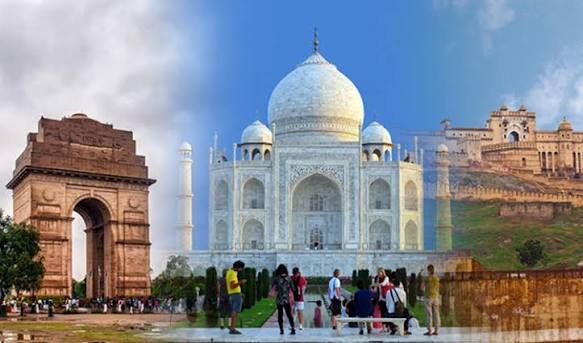
The Golden Triangle with Rajasthan is India's most rewarding travel circuit
Adding Rajasthan to the standard Delhi–Agra–Jaipur route transforms a 6-day highlight reel into a truly immersive India experience. Whether you extend to Ranthambore, Pushkar, Jodhpur, Udaipur, or Jaisalmer depends on your time and interests — but every extension is worth it. Most international visitors spend between 10 and 14 days on this combined route.
Why Add Rajasthan to the Golden Triangle?
The Golden Triangle on its own — Delhi, Agra, and Jaipur — gives you India's most iconic monuments in a compact, manageable circuit. The Taj Mahal, the Red Fort, Amber Fort, and Fatehpur Sikri cover the Mughal and Rajput highlights that define India in the world's imagination. It's a brilliant itinerary. But it only shows you one side of India.
Rajasthan adds the other side: the desert, the colour, the sheer scale of it. A morning in Jodhpur's Blue City, where the houses genuinely are painted indigo and the streets smell of spices, is unlike anything the Golden Triangle delivers. A sunset over Udaipur's Lake Pichola, with the City Palace reflected in the water, is a moment that stays with people for years. Jaisalmer's golden sandstone fort rising out of the Thar Desert has no equivalent anywhere in the world.
For visitors flying from the UK, USA, Australia, or Canada — for whom India is a long-haul, once-in-a-decade journey — extending the Golden Triangle into Rajasthan is rarely something people regret. The question isn't whether to do it, but which parts of Rajasthan to include in the time you have.
The Best Rajasthan Extensions — What to Add and Why
Jaipur is already the easternmost point of the Golden Triangle and the natural gateway into Rajasthan. From Jaipur, every Rajasthan destination can be reached by road or train, making the logistics of extending your trip straightforward. Here are the five extensions that work best for international visitors:
Ranthambore is India's most celebrated tiger reserve and the easiest wildlife extension to add to the Golden Triangle. It sits just 180 km south-east of Jaipur — roughly three hours by road — making it the most logical first stop after leaving the Pink City. Morning and evening safaris run in open jeeps through dry deciduous forest, with the ruins of a 10th-century fort rising above the tree line as a backdrop unlike any other wildlife reserve in the world. Bengal tiger sightings are not guaranteed (this is genuinely wild habitat) but Ranthambore has some of the highest sighting rates in India, and even a safari without a tiger encounter — leopard, sloth bear, mugger crocodile, a hundred species of bird — is extraordinary.
Pushkar is one of India's holiest pilgrimage towns and one of its most atmospheric. It sits around a sacred lake — one of only a handful of Brahma temples in the world overlooks it — and the ghats that descend to the water are lined with pilgrims, priests, and flower sellers from dawn until well after dark. The town itself is car-free, compact, and easy to explore on foot: narrow lanes of whitewashed houses, rooftop cafes looking out over the lake, and a famous camel fair (usually in November) that fills the desert outside town with tens of thousands of animals and traders. Pushkar is two hours west of Jaipur — easy as a day extension or an overnight stop en route to Jodhpur.
Jodhpur's Mehrangarh Fort is arguably the most impressive fort in India — more dramatic even than Amber, rising 125 metres above the old city on a sheer rock outcrop. The fort's museum is exceptional, and the views from the ramparts over the Blue City below — where thousands of houses are painted the distinctive indigo that gives the city its name — are genuinely unforgettable. The old city itself rewards slow exploration: the clock tower market, the narrow lanes of the brahmin quarter, and the remarkable collection of havelis (merchant mansions) scattered through the old walled city. Jodhpur is 320 km west of Jaipur — five hours by road, or reachable by overnight train.
Udaipur is consistently rated among India's most beautiful cities, and the reputation is entirely earned. The City Palace — a sprawling complex of maharaja's apartments, courtyards, and museums that took 400 years to build — rises above Lake Pichola in tiers of white marble, and the view from the water at sunset is one of the great visual experiences in Asia. The Lake Palace Hotel, floating on an island in the middle of the lake, is one of India's most iconic hotels (used as a James Bond villain's lair in Octopussy). Udaipur is 250 km south of Jodhpur — three to four hours by road — and works beautifully as a final destination before flying home from Udaipur Airport, which has connections to Delhi and Mumbai.
Jaisalmer is the furthest and most adventurous extension — 575 km west of Jaipur, deep into the Thar Desert — and for many international visitors it's the highlight of the entire trip. The fort here is a living citadel: people still live and work inside its 800-year-old walls, and its honey-coloured sandstone glows gold in the late-afternoon sun in a way that explains the city's nickname. The desert experience outside town — a camel safari into the dunes, an overnight camp under a sky unpolluted by city light — is something that few other places on earth can match. Jaisalmer requires commitment (it's a long drive from anywhere) but the visitors who make it almost universally say it was worth the effort.
Suggested Itineraries — How Long Do You Need?
The right itinerary length depends on which Rajasthan destinations you want to include and how fast you want to move. These three frameworks cover the most common international visitor profiles.
10 Days — Golden Triangle + Ranthambore + Pushkar
Most popular12 Days — Golden Triangle + Jodhpur + Udaipur
Best balance14 Days — Golden Triangle + Full Rajasthan Circuit
Most completeWhen building your itinerary, make sure your Agra day does not fall on a Friday — the Taj Mahal is closed every week without exception. In 2026–27, December 25 (Christmas Day) and January 1 (New Year's Day) both fall on Fridays. A good operator will flag this and schedule Agra on a different day automatically.
Plan Your Golden Triangle + Rajasthan Trip
We build private itineraries for visitors from the UK, USA, Australia, and Canada. Tell us your dates and interests — we'll send a personalised plan within a few hours.
Best Time to Visit
The extended Golden Triangle and Rajasthan circuit has a clear peak season, and timing your trip correctly makes a significant difference to the experience — particularly in Rajasthan's desert regions, which have more extreme temperatures than the GT cities.
October through February is the undisputed peak season and the right time for the vast majority of international visitors. Days are warm and sunny across the entire circuit — typically in the low-to-mid 20s Celsius — with cool nights that make outdoor dining and evening sightseeing genuinely pleasant. January brings the possibility of early-morning fog around Delhi and Agra, which can affect the Taj Mahal sunrise experience, though afternoons are reliably clear.
March and April are increasingly popular as temperatures begin climbing, prices drop, and the crowds thin out. The desert cities — Jodhpur and Jaisalmer in particular — warm up faster than the GT cities, but daytime highs in the mid-30s in April are still manageable if you plan sightseeing in the mornings and evenings and rest during the hottest hours.
The summer months from May through August bring extreme heat across the entire circuit, with Jaisalmer regularly reaching 45°C or above, and the monsoon (July–September) brings heavy rain to the GT cities while leaving Rajasthan's west relatively dry. This period is best avoided for a first-time visitor, though experienced India travellers sometimes enjoy the quiet and the dramatic monsoon skies.
Getting Around — Transport Between Cities
One of the most common questions from international visitors planning this extended circuit is how to get between the cities. The honest answer is that Indian railways are excellent value and an experience in their own right, but require a little planning — and for a touring party of two or more, a private vehicle for the Golden Triangle section often makes more sense than coordinating multiple trains.
The GT cities — Delhi, Agra, and Jaipur — are best covered by private car, which your tour operator will arrange. The journey times are Delhi to Agra around three hours on the Yamuna Expressway, and Agra to Jaipur around four to five hours via Fatehpur Sikri. Having a private vehicle means stopping at Fatehpur Sikri, the Abhaneri stepwell, or anywhere else along the way without a fixed timetable.
For the Rajasthan extensions, the distances become longer and the overnight train comes into its own. The Jaipur to Jodhpur overnight train, for example, departs in the evening and arrives the next morning — you sleep on the train and wake up in the Blue City, losing no daytime sightseeing hours. Private AC cabins (2A or 1A class) are comfortable and safe for international visitors. A good tour operator will pre-book all train tickets as part of your itinerary.
Udaipur has its own airport with connections to Delhi and Mumbai, making it a natural exit point for a Rajasthan-extended trip. Jaisalmer also has a small airport with Delhi connections, which means the 14-day full circuit can begin in Delhi and end in Jaisalmer without doubling back.
Tips for International Visitors on This Route
Ready to Book Your Golden Triangle + Rajasthan Tour?
We specialise in private tours for visitors from the UK, USA, Australia, and Canada. WhatsApp us your dates and we'll build your itinerary — usually within a few hours.