

The Golden Triangle — Delhi, Agra, and Jaipur — is India’s most visited travel circuit, and for good reason. Three cities, seven centuries of Mughal and Rajput history, one of the Seven Wonders of the World, and a road network that makes the whole thing logistically straightforward by Indian standards. When foreign visitors start planning their first trip to India, this is the route they most often land on.
The question that follows almost immediately is: what does it cost?
The honest answer is that a Golden Triangle tour can cost anywhere from $850 per person to $6,000 per person, depending on how you travel, where you sleep, and what you want included. This guide breaks down every cost component honestly — accommodation, transport, meals, entrance fees, guides, and the variable costs most people forget to budget for — so you can plan an itinerary that fits what you actually want to spend.
All prices below are in USD, with GBP, EUR, and AUD equivalents noted where relevant. Prices reflect 2026 levels and are based on double occupancy (two people sharing a room); solo travelers typically pay a single supplement of 25–40% above the per-person price.
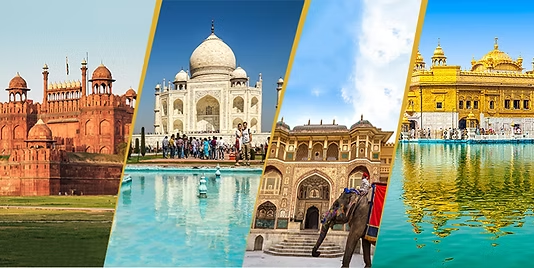
The Three Tiers of Golden Triangle Travel
Before getting into line-item costs, it helps to understand the three broad ways people do the Golden Triangle, because the cost structure differs significantly between them.
Budget independent travel means booking your own guesthouses, taking AC sleeper trains between cities, hiring local guides at monument gates, and eating at mid-range local restaurants. Done well, this can be a rich and rewarding way to see India. Total cost including flights from the UK or US typically runs $1,200–$2,000 per person for six to seven nights.
Private guided tours are what most first-time international visitors choose. A tour operator arranges everything — airport pickup, accommodation, private AC vehicle with driver for the whole trip, English-speaking guides at each monument, and breakfast daily. You travel in a comfortable vehicle with someone who knows the roads, the timings, and the best angles for photographs at the Taj Mahal at sunrise. Private tours in 2026 start from around $1,099–$1,200 per person for six nights at mid-range hotels and rise to $2,500–$3,500 per person for the same circuit with five-star palace hotels.
Luxury private tours place you in India’s finest heritage properties — the Taj Mahal Hotel in Delhi, Amarvilas in Agra (where every room faces the Taj), and Rambagh Palace in Jaipur — with butler service, private Mughal-period dinners, and experiences that are not available to walk-in visitors. Expect $4,000–$6,500 per person for six to seven nights at this level.
Accommodation Costs on the Golden Triangle
Accommodation is typically the single biggest cost variable on the Golden Triangle, and understanding what each tier delivers helps calibrate expectations.
At the budget end, guesthouses and three-star business hotels in Delhi, Agra, and Jaipur run from $35–$80 per room per night. In Delhi, this gets you a clean, air-conditioned room in areas like Paharganj or the Karol Bagh corridor. In Agra, budget hotels near the Taj East Gate offer functional rooms with rooftop restaurants that sometimes have partial Taj views. In Jaipur, the Pink City has some genuinely characterful budget guesthouses in the old city lanes.
The mid-range bracket — $100–$200 per room per night — is where the Golden Triangle starts to feel genuinely comfortable and, in some cases, memorable. Heritage hotels in this range are converted havelis, old merchant houses, or colonial-era bungalows, and they add a sense of place that a standard business hotel cannot. In Jaipur, properties like the Alsisar Haveli or the Samode Haveli sit in this bracket and deliver rooms that are distinctly Rajasthani in character. In Agra, mid-range hotels with clean pool areas and good rooftop Taj views are the norm. In Delhi, boutique hotels in South Delhi’s Hauz Khas or Safdarjung Enclave neighbourhoods offer well-designed rooms within reach of the city’s better restaurants.
The luxury tier — $250–$800+ per room per night — includes properties that are destinations in themselves. Amarvilas in Agra is the single most famous, a Moorish-style hotel where every room, every terrace, and even the pool deck is oriented toward the Taj Mahal, 600 metres away. The Taj Mahal Palace Hotel in Delhi, the Leela Palace in Jaipur, and Rambagh Palace (once the hunting lodge of the Maharaja of Jaipur) sit in this category. These hotels do not just offer rooms — they offer a specific version of India that is curated, beautiful, and a long way from anything most visitors have experienced.
A typical six-night Golden Triangle itinerary involves two nights in Delhi, one night in Agra, and two to three nights in Jaipur. At mid-range rates of $120 per night, accommodation totals approximately $720 per room, or around $360 per person for two people sharing. At luxury rates averaging $400 per night, the same itinerary runs $2,400 per room, or $1,200 per person.
Transport Costs: Getting Between Delhi, Agra, and Jaipur
Private car with driver is the standard mode of transport on organised Golden Triangle tours. A private, air-conditioned vehicle — typically a Toyota Innova or similar — with an experienced driver who knows the Agra Expressway and the Jaipur Highway is both the most comfortable and most flexible option. You stop where you want, leave when you want, and do not share the vehicle with strangers.
The Delhi–Agra leg (200 kilometres via the Yamuna Expressway) takes roughly three to four hours by car and is typically driven early in the morning to arrive at the Taj Mahal at sunrise. Agra–Jaipur (240 kilometres) takes four to five hours, often with a stop at Fatehpur Sikri, the abandoned Mughal capital, en route. Jaipur–Delhi (270 kilometres) closes the triangle in four to five hours.
For a private vehicle and driver covering the full circuit over six to seven days, costs run from approximately $350–$500 total, depending on the vehicle type and the operator. This is typically included within the per-person price of an organised tour. If you are arranging it independently, reputable taxi hire companies in Delhi charge around $60–$80 per leg for the Delhi–Agra or Jaipur–Delhi routes.
Trains are an alternative for independent travelers. The Gatimaan Express between Delhi Hazrat Nizamuddin and Agra Cantt runs in under two hours and is one of India’s fastest trains — seat prices in the air-conditioned Chair Car run approximately $8–$12 USD each way. The Shatabdi Express between Delhi and Jaipur takes around four and a half hours with AC Chair Car tickets around $10–$15 USD. The Intercity Express connects Jaipur and Agra in about four hours. For budget travelers, trains add an extra layer of logistical complexity — navigating Indian Railways booking systems, station transfers, and timing coordination — but they are efficient, comfortable, and genuinely cheap.
Flights within the Golden Triangle are technically possible (Delhi–Jaipur takes about an hour by air) but rarely worth it given airport transfer time and the relatively short driving distances. Most visitors save their flying for arriving into Delhi and departing from Delhi or Jaipur at the end of the circuit.
Monument Entrance Fees in 2026
India’s Archaeological Survey of India (ASI) operates a tiered pricing system where foreign nationals pay significantly more than Indian citizens. This is standard across South Asia and not unique to India — the fees for foreign visitors reflect the fact that international tourism is a key revenue source for conservation.
The entrance fees below are the foreign national rates applicable in 2026. Prices are in INR with approximate USD equivalents.
The Taj Mahal charges ₹1,300 per person (approximately $15 USD) for the main monument entry. An additional ₹200 (about $2.50) is required to enter the inner mausoleum. The ASI also charges a ₹50 green bus fee from the Taj gate to the monument during busy periods. Budget approximately $20 per person all in for the Taj Mahal.
Agra Fort, the Mughal imperial complex within walking distance of the Taj, charges ₹650 (about $7.50) for foreign visitors.
Fatehpur Sikri, the abandoned Mughal capital 40 kilometres from Agra, charges ₹610 (about $7) for foreign nationals.
In Delhi, the Red Fort charges ₹600 (about $7) for foreign visitors. Qutub Minar and Humayun’s Tomb each charge ₹600. The Lotus Temple is free. The India Gate lawns are free. Akshardham temple charges no entry fee but charges for the interior exhibits and fountain show.
In Jaipur, Amber Fort charges approximately ₹700 (about $8) for foreign visitors. The City Palace charges ₹700 for the main courtyard and galleries. Hawa Mahal charges ₹200 (about $2.50). Jantar Mantar charges ₹200.
Across a full Golden Triangle itinerary covering the key monuments in all three cities, budget approximately $80–$100 per person for entrance fees.
Guide Costs
A knowledgeable English-speaking guide transforms a visit to the Taj Mahal from a very beautiful building into an understanding of why Shah Jahan built it, how 20,000 craftsmen assembled it over 22 years, what the inlay work means, and why the minarets lean slightly outward. The same applies at Amber Fort in Jaipur and the Red Fort in Delhi.
Government-licensed guides at monument gates in Agra and Jaipur typically charge $25–$40 USD for a two to three hour tour of a single monument. Private tour operators include a licensed guide at each major monument within their per-person pricing.
If you are arranging guides independently, use the official Archaeological Survey of India-licensed guides rather than the unlicensed touts who approach visitors near monument entrances. The difference in knowledge and reliability is significant.
Meals and Food Costs
Food is where the Golden Triangle offers exceptional value across all budget levels.
At a good local restaurant in Delhi, Agra, or Jaipur, a full meal with dal makhani, naan, a vegetable curry, and water costs $5–$10 per person. Street food — chaat, kachori, samosas, fresh juice — is $0.50–$2 per item. The famous Karim’s restaurant near Delhi’s Jama Masjid, serving Mughal-era recipes since 1913, charges around $8–$12 per person for a full meal.
Mid-range hotel restaurants and rooftop restaurants popular with international visitors typically run $15–$25 per person for a full dinner with a soft drink or beer. Most organised tours include daily breakfast (typically a mix of Indian and continental options at the hotel); lunch and dinner are usually at the traveler’s own expense, which gives flexibility to explore local food alongside the occasional hotel dinner.
At the luxury end, the restaurants inside Amarvilas in Agra or Rambagh Palace in Jaipur are formal, beautifully designed, and price-matched to their settings — expect $60–$100 per person for dinner with drinks.
Budget approximately $25–$40 per person per day for meals at mid-range local restaurants, or $15–$20 per day if you eat primarily at street-food level.
Shopping: The Wildcard Budget Item
Rajasthani handicrafts in Jaipur, marble inlay work in Agra, and the fabric markets of Delhi are three of the best shopping environments in India, and they are genuinely difficult to resist. Jaipur’s Johari Bazaar is one of the world’s great gemstone markets. Agra’s workshops produce marble pietra dura inlay work that is the direct descendant of the technique used in the Taj Mahal itself.
Prices are negotiable in most market contexts. A hand-block-printed cotton bedspread runs $20–$60 depending on size and intricacy. A silver pendant with a semi-precious stone from Jaipur’s gem market might be $30–$150. A marble inlay jewellery box from Agra runs $25–$200. Cashmere shawls, miniature paintings, leather sandals, and blue pottery are among the most popular purchases.
It is impossible to predict what any individual will spend on shopping, but building a $100–$300 buffer into your Golden Triangle budget per person is realistic for most visitors, and some spend considerably more. If you are on a private tour, your driver and guide will typically suggest specific shops — some of these are excellent, but be aware that drivers and guides often earn a commission when you buy. The best shopping experiences on the Golden Triangle happen when you have time to wander markets without pressure.
Full Cost Breakdown by Travel Style
Budget independent traveler (per person, 7 nights, double occupancy): Flights from the US or UK are not included here — those are a separate consideration covered below. For the on-ground portion: accommodation at $50 per room per night for 7 nights comes to about $175 per person. Transport by trains between cities adds around $40–$50. Monument entrance fees total approximately $80–$100. Meals at $20 per day come to $140. Guides at monuments, approximately $60–$80. Miscellaneous including SIM card, rickshaws, tips, and incidentals: $80–$100. Total on-ground budget: approximately $575–$625 per person. Add $200–$300 for shopping and the number reaches $775–$925 per person on the ground in India.
Mid-range private tour (per person, 6 nights, double occupancy, tour-inclusive): A quality private tour for the Golden Triangle from a reputable operator, covering airport transfers, a private AC vehicle and driver for all inter-city travel, mid-range heritage hotel accommodation, breakfast daily, English-speaking guides at all major monuments, and monument entrance fees, runs approximately $1,099–$1,400 per person from operators who price competitively. Add meals (lunch and dinner at your own cost) at $30 per day = $180, shopping budget of $200, and incidentals of $80, and the total on-ground cost is approximately $1,360–$1,660 per person.
Luxury private tour (per person, 7 nights, double occupancy): The same circuit with five-star palace hotels (ITC Maurya or Taj Mahal Hotel in Delhi, Amarvilas in Agra, Rambagh Palace in Jaipur), premium vehicle, expert private guide throughout (not just at monuments), curated dining experiences, and special access — a private sunrise visit to the Taj Mahal before public opening, a rooftop dinner at a Jaipur heritage property — runs $3,500–$5,500 per person from specialist luxury tour operators. Add fine dining at $80–$120 per person per dinner and shopping at $500–$1,000, and the total can reach $4,500–$7,000 per person on the ground.
International Flights to Delhi
Round-trip flights are the largest single cost item for most international visitors and vary enormously by origin, season, and how far in advance you book.
From the United States, direct flights from New York JFK to Delhi on Air India currently run approximately $900–$1,400 round trip in economy class, depending on season and advance booking. From the West Coast (Los Angeles, San Francisco), prices are similar to slightly higher with connections. Booking three to five months in advance typically secures the best economy fares.
From the United Kingdom, direct flights from London Heathrow to Delhi on British Airways or Air India run approximately £550–£900 round trip in economy, with the best prices available on Air India. November is not peak season from the UK, so prices at the lower end of this range are achievable with advance booking.
From Europe, connecting flights from Frankfurt, Paris, Amsterdam, or Rome typically run €600–€1,100 round trip, with Gulf carriers (Emirates via Dubai, Etihad via Abu Dhabi, Qatar Airways via Doha) often the best value.
From Australia, flights from Sydney or Melbourne to Delhi connect through Southeast Asia or the Gulf and run approximately AUD 1,200–$2,000 round trip in economy.
Business class fares from the UK or US to Delhi run approximately $3,000–$6,000 round trip, and on direct services these are often available as significant upgrades over economy with advance booking or through airline loyalty programs.
What Affects the Price Most
Several variables swing the total cost of a Golden Triangle trip significantly, and understanding them helps you make deliberate choices rather than being surprised by the final number.
Time of year matters considerably. November through February is peak season on the Golden Triangle, and accommodation prices in Agra and Jaipur are at their highest. Tour operators may charge a peak-season supplement of 10–20% over shoulder-season rates. If your dates are flexible, October or early March offer nearly equivalent weather at slightly lower prices.
Solo vs. couple or group. Per-person costs on private tours drop significantly for couples compared to solo travelers. A private vehicle costs the same whether one or two people are in it, so the per-person vehicle cost halves for a couple. The same applies to many fixed costs. Solo travelers typically pay a single supplement on accommodation of $20–$60 per night over the shared room rate.
How many nights in each city. Most standard Golden Triangle tours do two nights Delhi, one night Agra, two nights Jaipur for a six-night total. Adding nights — a third night in Delhi to cover more of the city, a night at Ranthambore en route — adds accommodation and vehicle costs proportionally.
What you include in Jaipur. A day trip to Ranthambore or to the Sariska Tiger Reserve adds a safari cost of approximately $80–$150 per person for a shared jeep safari, or $200–$300 per person for a private jeep. A side trip to Pushkar from Jaipur (150 km, about 3 hours each way) adds a half-day of vehicle time.
Tipping. India has a strong tipping culture in the tourism sector and while tips are discretionary, they are expected. Budget approximately $3–$5 per day for your driver, $10–$15 per full-day guide, and $1–$2 per meal at sit-down restaurants. For a 7-day private tour this adds up to approximately $60–$100 in tips across the trip.
Is the Golden Triangle Worth the Cost?
For a first-time visitor to India, the Golden Triangle delivers an unusually high return on investment in terms of what you see and experience per day of travel. Three of India’s most significant historic sites — the Red Fort and Qutub Minar in Delhi, the Taj Mahal in Agra, and Amber Fort in Jaipur — are all on this circuit. The circuit is compact enough to be done in six to seven nights without feeling rushed, and well-travelled enough that the logistics are well-understood and reliably managed by good tour operators.
At the mid-range level, the combination of what you see and the comfort of a private tour makes the Golden Triangle one of the better-value international trips available, particularly from the UK and US, where the exchange rate in 2026 means that five-star service in India comes at three-star prices by European or American standards.
At the luxury level, properties like Amarvilas and Rambagh Palace offer experiences that are genuinely world-class — the kind of hotel stay that becomes a reference point for everything that comes after. If your budget allows it and you have always wanted to visit the Taj Mahal, the version of that visit where you watch sunrise over the Taj from your hotel window before walking over for a private early-morning tour is not a frivolous extravagance.
Frequently Asked Questions
What is the average cost of a Golden Triangle tour in 2026?
For a private tour with mid-range heritage hotels, breakfast daily, private AC vehicle, and guides at all monuments, expect approximately $1,099–$1,400 per person for 6 nights based on double occupancy. Solo travelers pay roughly $1,400–$1,750 for the same package due to the single supplement on accommodation and vehicle costs. Luxury versions of the same itinerary with palace hotels run $3,500–$5,500 per person.
Does the Golden Triangle tour price include flights?
Tour operators based in India price their packages as land-only — covering everything from your Delhi airport arrival to your departure, but not your international flight to India. International flights from the US typically add $900–$1,400 per person round trip; from the UK, £550–£900. When comparing quotes from different operators, always confirm whether the price is land-only or flight-inclusive.
Is the Taj Mahal expensive to visit?
By global standards, no. The foreign national entrance fee for the Taj Mahal is approximately $15–$20 per person all in. Given that it is one of the most extraordinary buildings on earth, this represents remarkable value. The overall Golden Triangle entrance fee budget for all monuments across three cities is approximately $80–$100 per person.
How much spending money should I bring to India?
Beyond your tour cost, budget approximately $30–$50 per day for meals (if not included), plus a shopping buffer of $150–$300 depending on your appetite for textiles, gemstones, and handicrafts. A SIM card with data costs approximately $5–$10 for a 30-day plan. Tips across a 7-day tour add another $60–$100. Total daily spending money of $50–$80 per day is comfortable for most mid-range travelers.
Is it cheaper to book a Golden Triangle tour in India or from my home country?
Tour prices from India-based operators are typically lower than packages sold by Western travel agencies, because you are cutting out the retail margin of the Western intermediary. Booking directly with a reputable India-based private tour operator like Squid Travel India gives you the local rate with the reliability and English-language communication you need to plan confidently from abroad.
What is the best season and does it affect cost?
November through February is peak season — the best weather and the highest prices. October and early March are shoulder season with nearly equivalent weather and slightly lower prices. April through September sees reduced demand and lower prices but brings extreme heat (April–June) or monsoon conditions (July–September) that make outdoor sightseeing genuinely uncomfortable.
Is a 5-day Golden Triangle tour possible?
Five days is the minimum to cover Delhi, Agra, and Jaipur without rushing — one full day in Delhi, an early morning drive to Agra for the Taj Mahal plus Agra Fort, then Fatehpur Sikri on the way to Jaipur, two days in Jaipur. It is tight but doable. Six to seven nights is the comfortable standard that allows time for Chandni Chowk and Old Delhi, a full Agra day, and both Amber Fort and the Jaipur old city without feeling rushed.
Are there any hidden costs on Golden Triangle tours?
The costs most often not included in quoted tour prices are: lunch and dinner (most tours include breakfast only), drinks with meals, personal shopping, tips for driver and guides, monument camera fees (a small charge at some sites for professional cameras), and any personal expenses such as laundry or telephone calls. A good operator will itemise what is and is not included clearly in their quotation — always ask for a full inclusions list before booking.
The Golden Triangle is India’s most compelling introduction for first-time visitors, and 2026 is an excellent year to make the trip — the exchange rate, the quality of heritage hotel accommodation, and the accessibility of e-visas all work in the foreign visitor’s favour.
Squid Travel India offers private Golden Triangle tours from $1,099 per person, fully customised to your travel dates, budget, and interests. Contact us to receive a detailed, no-obligation quotation for your 2026 trip.

Comment (0)