

The Golden Triangle is the most-traveled tourist route in India — a circuit connecting Delhi, Agra, and Jaipur across roughly 725 kilometers of northern India. For American travelers, it packs the best of the subcontinent into one manageable journey: the chaotic, electric energy of India’s capital, the world’s most recognizable monument rising from the Yamuna riverbanks, and a walled pink city where palaces and bazaars have barely changed since the Mughal era. Most Americans do the Golden Triangle in seven to ten days, which is just enough time to feel like you’ve seen something real — not just scratched the surface.
This guide covers everything you need to plan a Golden Triangle tour from the USA in 2026: the best flights, visa requirements, how much to budget, when to go, how to structure your days, and what nobody on TripAdvisor will tell you before you land.
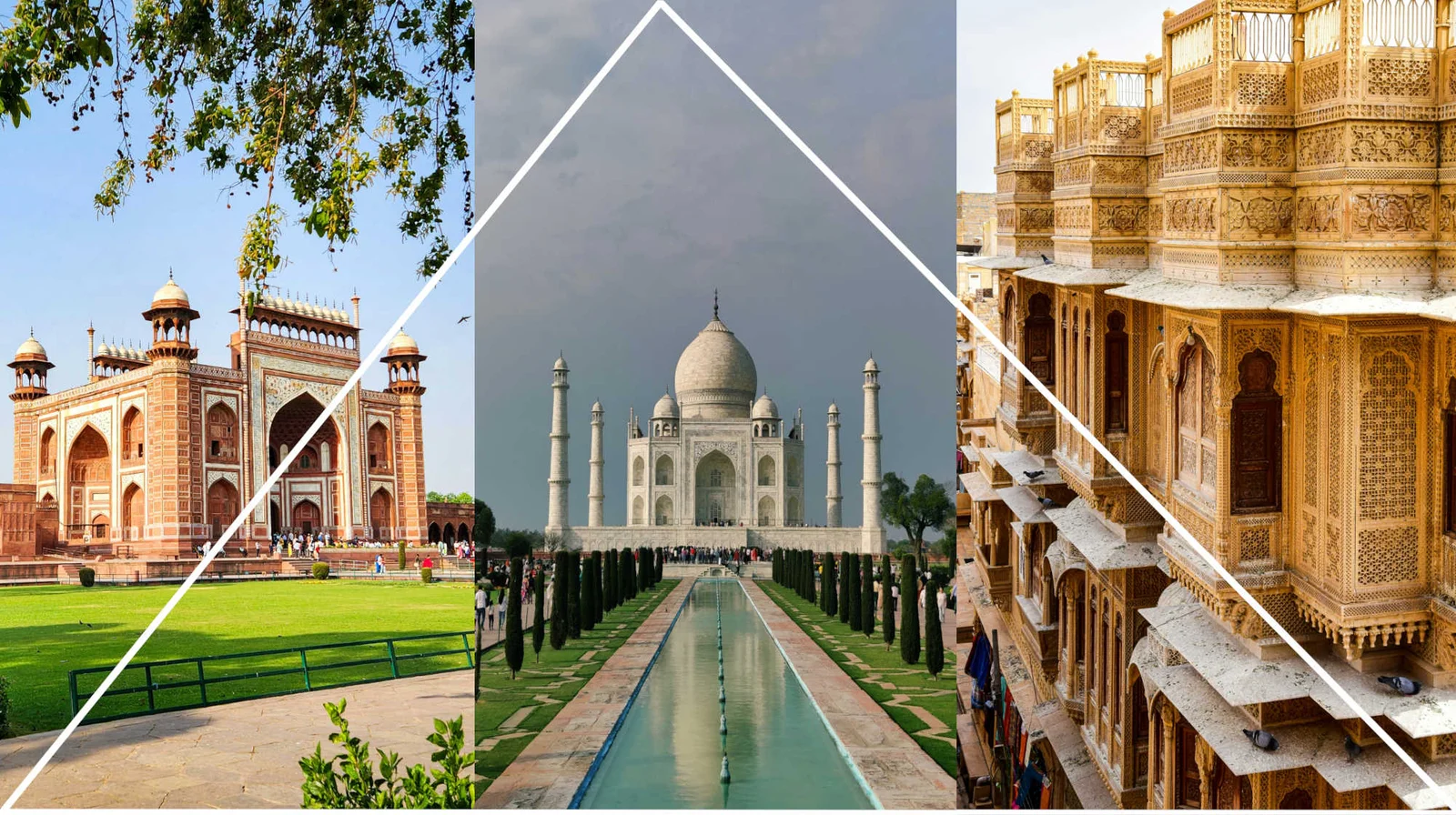
Why the Golden Triangle Works So Well for Americans
American travelers to India often face the same problem: India is vast, overwhelming, and logistically complex. You have two weeks — maybe three if you’re lucky — and you want to come home feeling like you actually experienced the country, not just survived the airports.
The Golden Triangle solves this. Delhi, Agra, and Jaipur sit within a compact triangle in northern India, all connected by fast trains, good highways, and short domestic flights. You can move efficiently between them without burning half your trip on travel days. Each city delivers a completely different experience within the same cultural region, so you’re not repeating yourself — you’re layering.
Delhi is the political and commercial capital of modern India, home to 33 million people, an extraordinary street food culture, and some of the country’s most important Mughal-era monuments. Agra is a smaller, more focused city built almost entirely around the Taj Mahal — one of those rare sites that genuinely exceeds expectations in person. And Jaipur is the gateway to Rajasthan, a pink-walled city of havelis, spice markets, and hilltop forts that feel lifted straight from a Kipling novel.
For Americans used to European travel, the Golden Triangle is a recalibration. Distances that look small on a map can still take two hours by road. Sensory input arrives faster than you expect. The food is transcendent and occasionally digestively adventurous. But the rewards are proportionally bigger. Nowhere in Europe will you stand in front of something as staggering as the Taj Mahal at 6:30 in the morning with mist rising off the reflecting pool and almost no one else around.
Flights from the USA to India: What American Travelers Need to Know
Getting from the United States to India means crossing roughly 7,500 to 8,500 miles depending on your departure city. For the Golden Triangle, you’ll fly into Indira Gandhi International Airport in Delhi (airport code: DEL). This is the closest international gateway to all three cities on the circuit.
Flying from the East Coast
Air India operates nonstop flights from John F. Kennedy Airport (JFK) in New York to Delhi, making it the only true nonstop option from the US East Coast as of 2026. Flight time is approximately 14 to 15 hours. Departures are typically overnight from New York, arriving in Delhi the following morning — a schedule that works well because you can hit the ground running with a full day in Delhi once you’ve settled in.
Other carriers including United, American, Lufthansa, British Airways, Air France, and Emirates operate connecting service through their respective hubs. A one-stop routing via London, Frankfurt, Paris, or Dubai adds three to six hours to your total travel time but often opens up more scheduling flexibility and competitive fares.
Flying from the West Coast
From Los Angeles (LAX) or San Francisco (SFO), you’re looking at connecting flights through Middle Eastern hubs — Emirates via Dubai, Etihad via Abu Dhabi, and Qatar Airways via Doha all serve Delhi with excellent business and economy class products. Total travel time from the West Coast via the Gulf runs approximately 18 to 22 hours including the connection, but Gulf airline connections are generally smooth and their hubs are efficient.
Air India also operates nonstop service from San Francisco to Delhi, cutting the route to around 16 hours in the air. This is a genuinely good option if you value simplicity over cost, though fares are typically higher than connecting routes.
From Chicago and Other Midwest Cities
Chicago O’Hare (ORD) has strong connecting options via European carriers — Lufthansa via Frankfurt, British Airways via London Heathrow, and Air France via Paris all offer solid routings to Delhi. United Airlines also operates connections through Newark (EWR) that pick up Air India’s nonstop to Delhi. Total travel time from Chicago is typically 19 to 22 hours.
What to Expect to Pay for Flights
Round-trip economy class fares from the USA to Delhi in 2026 vary significantly by season and how far in advance you book. From New York, economy fares on the nonstop Air India route typically run between $800 and $1,400 depending on travel dates and how early you book. Connecting fares on European or Gulf carriers can be competitive, sometimes dipping below $750 during off-peak windows. Premium economy runs $2,000 to $3,500 and business class starts around $4,500 from the East Coast, with West Coast fares running somewhat higher.
The best windows for booking are October through February departures (prime Golden Triangle season), booked four to six months in advance for the best economy fares. December peak and Christmas week flights fill early and command a premium — book these at least five to six months ahead.
Pro tip for American travelers: If you’re flying into Delhi on an international long-haul flight and continuing to Agra or Jaipur by train the same day, build in at least a five-hour buffer. Delhi traffic, immigration queues, baggage claim, and customs can consume two to three hours on a busy arrival morning. Arriving and immediately rushing to catch a train is a setup for stress.
Visa Requirements: US Citizens and the Indian e-Visa
American citizens need a visa to enter India. The good news is that India’s e-Visa system makes this straightforward for US passport holders.
The Indian e-Visa (officially called the eTV, or e-Tourist Visa) is applied for entirely online at the official Indian government portal — indianvisaonline.gov.in. You do not need to visit a consulate, mail your passport anywhere, or deal with a visa agency. The entire process happens online, and the approved visa arrives by email as a PDF you print and carry with you.
Cost and Processing Time
The e-Visa fee for US citizens is $25 for a 30-day single-entry visa. A 90-day multiple-entry e-Visa is also available for $40. Processing typically takes 72 hours, though applying four to five business days before travel gives you buffer for any delays. You cannot apply more than 120 days before your arrival date.
What the e-Visa Covers
Your e-Visa allows entry at 28 designated airports in India, including Delhi’s Indira Gandhi International Airport. It is valid for tourism, sightseeing, short-duration yoga programs, and casual business visits. You cannot use a tourist e-Visa for paid employment or long-term study.
At the Airport
On arrival at Delhi, US citizens with an e-Visa go through the e-Visa immigration lane, which is generally faster than the regular queue. Have your printed e-Visa approval PDF ready along with your passport, your onward or return ticket, and proof of where you’re staying in Delhi. A booking confirmation or hotel voucher is usually sufficient.
When to Go: Best Months for Americans Doing the Golden Triangle
The Golden Triangle sits in northern India’s plains, which means it experiences genuine seasons — including a summer that is genuinely brutal and a monsoon that makes outdoor sightseeing miserable. For American travelers, timing matters more than most realize.
October to March: The Prime Window
This is the ideal window for the Golden Triangle, and it is when the large majority of international visitors travel. Temperatures are comfortable for sightseeing — Delhi and Jaipur run between 15 and 28°C (59 to 82°F) through November, cooling further to 8 to 22°C (46 to 72°F) in December and January. Agra, sitting slightly east and lower, follows a similar pattern.
For Americans, this window aligns well with several natural travel breaks. Thanksgiving week (late November) is one of the best times to visit — the weather is perfect, crowds at monuments are manageable, and American travelers often find this a natural pause in their work calendar. Christmas and New Year’s week is peak season in terms of visitor numbers, and the Taj Mahal and Amber Fort get crowded, but the weather is stunning and the festive atmosphere adds energy to the cities.
February and early March are quieter than December-January, with warming days and the Holi festival arriving in late February or early March depending on the year — one of the most spectacular cultural experiences in India if your dates align.
April through June: Heat Season
Temperatures in Delhi, Agra, and Jaipur routinely exceed 40°C (104°F) from May through June, with dust storms (called “loo”) sweeping through in the afternoons. This is not the time for comfortable sightseeing. If you must travel during this window, go in April before the heat peaks, stick to early morning starts, and plan significant afternoon rest periods.
July through September: Monsoon Season
The monsoon arrives in Delhi around late June or early July and continues through September. Rainfall is heavy and irregular, humidity climbs, and monuments like the Taj Mahal and Agra Fort can appear ethereal through the mist — but you can also find yourself standing in ankle-deep water on the Taj Mahal’s marble platform. Some travelers enjoy the monsoon Golden Triangle for its dramatic skies and dramatically lower prices, but it’s not the experience most Americans picture when they plan this trip.
The Sweet Spot for American Travelers
If you have flexibility, late October through mid-December and mid-January through February are the ideal windows. You’ll get the best weather, reasonable crowds at major sites (Christmas week being the exception), and full access to everything on the circuit.
How Much Does a Golden Triangle Tour from the USA Cost?
Understanding what a Golden Triangle tour actually costs from an American’s perspective requires separating the on-the-ground tour cost from the international airfare. Both matter, and the total trip investment ranges widely depending on how you travel.
International Flights
As covered above, round-trip economy from the USA to Delhi runs approximately $800 to $1,400 from the East Coast and $900 to $1,600 from the West Coast, depending on timing and routing. These numbers represent realistic mid-range fares booked a few months in advance — not rock-bottom last-minute deals and not premium seats.
The Ground Tour Cost
Once you’re in India, a private Golden Triangle tour covering Delhi, Agra, and Jaipur — with accommodation, private car and driver between cities, guided monument visits, and all relevant entry fees — runs across three broad tiers.
At the budget end, travelers focused on cost can complete the Golden Triangle staying in clean, mid-market hotels and using a private car without a guide for around $900 to $1,200 per person based on two people sharing. This is genuine budget travel by Western standards, not backpacker dormitories.
The mid-range experience — which is where Squid Travel India’s core Golden Triangle packages sit — runs from $1,099 per person for a 6-night tour, covering comfortable three and four-star hotels, a private air-conditioned vehicle and driver for all transfers, English-speaking guides at major monuments, and entry fees. At this level, the logistics are handled, you’re not worrying about haggling for taxis or navigating the Delhi Metro with luggage, and your accommodation is reliably clean and comfortable.
Luxury travel on the Golden Triangle — five-star properties including ITC Maurya in Delhi, the Oberoi Amarvilas directly facing the Taj Mahal, and Rambagh Palace in Jaipur — starts at approximately $4,500 per person for a 7-night tour and climbs from there depending on the properties selected and additions like private cooking classes, heritage village visits, and hot air balloon flights over Jaipur.
Day-to-Day Spending
Beyond the tour cost, Americans typically spend between $30 and $80 per day on meals, incidentals, shopping, and tipping depending on their preferences. A good dinner at a reputable mid-range restaurant in Delhi or Jaipur runs $15 to $30 per person. Street food from a trusted vendor is a dollar or two. Bottled water, transportation within cities, and monument supplements add up — budget $400 to $600 for a 7-night trip in miscellaneous spending at the mid-range level.
The Complete Investment
For an American traveling to India on a 7-night Golden Triangle mid-range tour, the all-in investment including international flights, the ground tour, and daily spending typically lands between $2,100 and $2,800 per person. That covers round-trip flights from New York, a private 7-night tour package, and roughly $500 in personal spending. It is, by any measure, one of the most extraordinary travel experiences available at that price point anywhere in the world.
The Golden Triangle Route: What You’ll See
Delhi (2 to 3 nights)
Almost every Golden Triangle tour from the USA starts and ends in Delhi, both because it’s the international gateway and because it genuinely deserves two to three nights of exploration. Delhi is not one city but several layered on top of each other — Old Delhi dating from the Mughal era, British colonial New Delhi centered on Lutyens’s grand imperial boulevards, and the modern commercial city sprawling beyond.
Old Delhi is the sensory overload that most Americans either love or struggle with on day one: Chandni Chowk’s medieval lanes packed with spice traders, fabric merchants, street food vendors, and cycle rickshaws; the Red Fort’s red sandstone ramparts stretching along the main boulevard; the Jama Masjid, India’s largest mosque, where thousands gather for Friday prayers on a marble courtyard overlooking the city. This is India as most Americans imagine it from films and books — dense, ancient, utterly alive.
New Delhi offers a completely different experience. Humayun’s Tomb, the architectural precursor to the Taj Mahal, sits in formal gardens near the diplomatic quarter and is far less crowded than Agra while being architecturally extraordinary. Qutub Minar — a 73-meter minaret built in 1193 — stands surrounded by ruins of mosques and palaces in a complex that puts almost everything in medieval Europe in perspective. India Gate, the war memorial on Delhi’s ceremonial axis, is striking at dusk. The National Museum is one of Asia’s best.
Delhi’s food scene has become genuinely world-class. A dinner at a restaurant like Indian Accent or Bukhara is as compelling as anything you’d find in New York or San Francisco. More importantly, Delhi’s street food — parathas at Paranthe Wali Gali in Chandni Chowk, chaat at Bengali Market, kebabs in Nizamuddin — is the best introduction to Indian cuisine available anywhere.
Agra (1 to 2 nights)
Agra sits 230 kilometers south of Delhi, roughly a 3-hour drive or a 2-hour journey on the Gatimaan Express or Shatabdi Express trains. Most Golden Triangle itineraries spend one to two nights in Agra — enough time for the Taj Mahal, Agra Fort, and if time allows, Fatehpur Sikri.
The Taj Mahal needs no introduction, but it benefits from some honest expectation-setting. It is better in person than in photographs — more three-dimensional, more intricate, more affecting. The white marble changes color through the day, going from cool blue-white in early morning to warm gold in late afternoon. The scale is larger than most visitors expect. And the detail — 28 types of precious and semi-precious stone inlaid into marble in floral patterns visible from inches away — is extraordinary in a way photographs cannot convey.
Visiting at sunrise is strongly recommended, particularly for American travelers who tend to wake early on their first few days in India due to jet lag. The East Gate opens first, crowds are thin in the early morning, the light is extraordinary, and the experience is qualitatively different from the midday visit. For a complete guide to making the most of your Taj Mahal morning, including monthly opening times and gate strategies, read the Taj Mahal Sunrise Guide.
Critical note for all American travelers: The Taj Mahal is closed every Friday. This is a non-negotiable closure and no amount of pleading or paying extra changes it. If your Agra night falls on a Thursday, plan your Taj Mahal visit for Saturday morning, not Friday. December 25, 2026 is a Friday — the Taj Mahal will be closed on Christmas Day 2026.
Agra Fort, built in red sandstone and expanded by three successive Mughal emperors, is often rushed by travelers eager to get to the Taj Mahal — but it deserves two to three hours on its own. The apartments where Shah Jahan was imprisoned by his son Aurangzeb, with a view of the Taj Mahal visible across the river, is one of the most moving historical vignettes in India.
Jaipur (2 to 3 nights)
Jaipur sits 240 kilometers west of Agra and 270 kilometers southwest of Delhi, forming the third point of the triangle. The capital of Rajasthan, it’s known as the Pink City because its old city walls and historic buildings were painted terracotta pink in 1876 to welcome Prince Albert of Wales — and have been repainted pink ever since.
Amber Fort, built by the Rajput rulers of Jaipur before the city was established, sits on a ridge above Maota Lake 11 kilometers from the city center and is the most compelling monument on the Golden Triangle after the Taj Mahal. The fort complex sprawls across multiple courtyards, with a ganesh-pol (elephant gate) inlaid with mirrored mosaic work that catches morning light in a way that makes photography almost compulsory. Early morning visits before 9am, when tour buses arrive, make an enormous difference.
The City Palace, still partially occupied by the Jaipur royal family, is a compound of museums, courtyards, and royal apartments in the center of the old city. The Jantar Mantar — a 1728 astronomical observatory with enormous stone instruments for measuring solar time and tracking celestial events — is a UNESCO World Heritage Site that takes about an hour to explore properly and is genuinely fascinating for anyone with a scientific curiosity.
Hawa Mahal, Jaipur’s iconic five-story pink sandstone screen on the edge of the bazaar, is best photographed from the tea stalls across the road rather than from inside. The Nahargarh Fort on the ridge above the city offers the best sunset view over Jaipur — the entire pink-walled old city spread below, the desert plains stretching to the horizon.
Jaipur’s bazaars are among the best shopping in India. Johari Bazaar is where Jaipur’s famous gems and jewelry are sold — the city is a global center for gem-cutting and polishing, and the selection of precious and semi-precious stones is extraordinary. Bapu Bazaar sells textiles including block-printed fabrics, tie-dyed bandhani, and embroidered pieces. Nehru Bazaar is the place for juttis (handmade leather shoes), blue pottery, and lac bangles.
Itinerary Options for Americans
7-Night Golden Triangle (Most Popular)
The 7-night Golden Triangle is the most popular configuration for American travelers and fits comfortably into a standard two-week vacation — fly out Friday evening or Saturday from the USA, arrive in Delhi Sunday morning (India time), tour for seven nights, and fly home Sunday for a Monday return.
A typical 7-night schedule runs as follows. Days one and two cover Delhi’s highlights — Old Delhi by rickshaw in the morning, Humayun’s Tomb and Qutab Minar in the afternoon, an evening in the upscale Hauz Khas Village neighborhood. Day three, transfer to Agra by train or car; afternoon visit to Agra Fort. Day four, Taj Mahal at sunrise followed by Fatehpur Sikri (an abandoned Mughal city 40 kilometers from Agra, often skipped but genuinely worth three hours). Day five, drive from Agra to Jaipur via the Fatehpur Sikri road. Days six and seven, Amber Fort, City Palace, Jantar Mantar, Nahargarh sunset, bazaar shopping. Day eight, fly or drive back to Delhi for your international departure.
10-Night Extension: Adding Varanasi or Ranthambore
Americans with three weeks of travel time or more often extend the Golden Triangle with one additional destination. Varanasi — India’s oldest living city, on the banks of the Ganges — adds a profoundly different dimension to the trip. This is not architecture or monuments but the Hindu civilization itself: cremation ghats on the river, evening aarti ceremonies, dawn boat rides past pilgrims bathing in the sacred water. It requires two nights minimum and arrives with a strong sensory and emotional impact that many American travelers describe as the single most memorable part of their India trip.
Ranthambore National Park, 180 kilometers from Jaipur, is one of India’s best tiger reserves. A two-night Ranthambore extension gives you two or three wildlife safaris with genuine odds of spotting a Bengal tiger in the wild. The park is at its best from October through February when vegetation thins and tigers are easier to spot.
5-Night Express: For Business Travelers or Short Breaks
A 5-night Golden Triangle is achievable for travelers with limited time — typically one full day in Delhi, two days in Agra (Taj Mahal sunrise plus Agra Fort), and two days in Jaipur. This is a fast-paced itinerary that doesn’t leave much buffer for delays, and it works best for experienced travelers who can move efficiently. You’ll see the major monuments but won’t have time for the slower, more atmospheric experiences that make the Golden Triangle memorable.
Getting Around: Transport Between the Golden Triangle Cities
For American travelers on an organized private tour, the transport question is largely solved — your tour package includes a private air-conditioned car and driver for all intercity transfers and city sightseeing. This is comfortably the best way to experience the Golden Triangle. Your driver becomes a de facto travel companion over the week, handles navigation and parking (both legitimately stressful in Indian cities), and can take you to the kind of neighborhood restaurants and hidden viewpoints that aren’t in any guidebook.
For independent travelers or those looking to supplement a private tour with public transport experiences, the train system is genuinely excellent between Golden Triangle cities.
The Gatimaan Express and Shatabdi Express trains between Delhi (Hazrat Nizamuddin station) and Agra take about two hours and offer a comfortable, air-conditioned journey. First-class AC chair cars are the recommended option for foreign tourists — clean, punctual, and roughly $15 to $20 each way. Book through the IRCTC website or have your hotel or tour operator book for you, as the Indian railway booking system requires some navigation.
Delhi to Jaipur is served by several trains from Delhi’s Sarai Rohilla or Jaipur Junction, running around 5 hours in the express trains. Agra to Jaipur by road takes approximately 4 to 5 hours through pleasant Rajasthani countryside.
Practical Advice for American Travelers
Currency and Cash
India is a predominantly cash-based economy at the street level, even as digital payments have expanded rapidly. American travelers should carry Indian rupees for tips, street food, rickshaws, smaller purchases, and entry fees to some sites. ATMs are widely available in Delhi, Agra, and Jaipur, and most international debit cards work reliably — though notify your bank before traveling and confirm your card’s international withdrawal fees. Major hotels, restaurants, and large shops accept Visa and Mastercard. American Express acceptance is less consistent.
The US dollar to Indian rupee exchange rate in 2026 runs approximately 83 to 86 rupees per dollar, meaning your money stretches considerably further in India than in Europe. A meal at a good restaurant might cost $8 to $15. A three-hour private city tour with a guide might be $40 to $60. A chai at a roadside stall costs less than a dime.
Electrical Adapters
India uses Type C and Type D electrical outlets with 230V power. American devices run on 110V, so you need both a plug adapter and — for older devices without universal power supplies — a voltage converter. Most modern laptops, phones, and camera chargers are universal voltage (check for “100-240V” on the adapter brick), meaning you only need a plug adapter, not a full converter. A universal travel adapter purchased before departure is the simplest solution.
Time Zone
India Standard Time is IST, which is UTC+5:30. From Eastern Standard Time (US East Coast winter), India is 10 hours and 30 minutes ahead. From Pacific Standard Time (US West Coast winter), India is 13 hours and 30 minutes ahead. There is no daylight saving time in India, so these offsets shift slightly when the US observes DST.
The time difference creates useful jet lag for Golden Triangle travelers: most Americans wake naturally at 4am to 6am India time after flying in, which is exactly the right time to be heading to the Taj Mahal for sunrise.
Health and Water
The standard advice for American travelers in India applies: drink only bottled or filtered water, avoid ice at street-level vendors, be thoughtful about raw salads and unpeeled fruit from street stalls. At reputable hotels and restaurants, the food safety standards are good. Carry a travel-sized hand sanitizer and use it before eating street food. Bring an antibiotic prescription from your doctor (something like ciprofloxacin) for traveler’s diarrhea — it’s more common than in Europe and resolves quickly with treatment.
Vaccinations: check with your doctor or travel clinic before departure. Hepatitis A, typhoid, and tetanus are commonly recommended for India travel. Malaria risk in Delhi, Agra, and Jaipur is low, but discuss with your doctor depending on your travel dates and any extensions into rural areas.
Tipping Culture
Tipping is customary and expected at the service level in India’s tourism industry. A private driver for a full day reasonably receives 300 to 500 rupees ($3.50 to $6). A guide for a half-day monument tour typically receives 200 to 500 rupees. Restaurant tips of 10% are well-received at sit-down restaurants; street food stalls don’t expect tips. Hotel staff including bellhops and room service typically receive 50 to 100 rupees per interaction.
Choosing a Tour Operator: What to Look For
American travelers booking a Golden Triangle tour have two broad options: booking through a US-based travel agent who subcontracts to an Indian operator, or booking directly with an India-based private tour company.
Direct booking with an India-based operator typically delivers better value and more flexibility. The middleman commission paid to US travel agents and booking platforms gets eliminated, and you work directly with the people who are actually managing your trip on the ground.
The key things to look for in an Indian tour operator: clear USD pricing with no hidden fees, private vehicles (not shared transfers), English-speaking guides who are certified and experienced rather than generic fixers, hotels that are exactly as described, and responsiveness before you’ve committed your money.
Squid Travel India designs private Golden Triangle tours built specifically for international visitors, with USD pricing starting from $1,099 per person for a 6-night tour. Every tour includes a private air-conditioned vehicle and driver for all transfers, English-speaking monument guides at major sites, and carefully selected hotels at each point of the triangle. There are no hidden charges for entry fees, monument supplements, or city transfers.
To discuss a Golden Triangle tour designed around your specific travel dates, group size, and interests, get in touch with the Squid Travel India team directly.
Golden Triangle Tour from USA: Common Questions
Do I need any vaccinations before traveling to India from the USA?
No vaccinations are legally required for US citizens entering India (unless you’re arriving from a yellow fever-endemic country). That said, hepatitis A, typhoid, and tetanus boosters are commonly recommended by travel medicine doctors. Consult your physician or a travel clinic ideally six to eight weeks before departure so any necessary vaccines have time to take effect.
Can I use my US credit cards in India?
Visa and Mastercard are accepted at most hotels, higher-end restaurants, large shops, and official ticket counters. American Express acceptance is more limited. At street stalls, local restaurants, smaller shops, rickshaws, and tips, cash is the norm. Always carry some rupees for daily cash spending — ATMs are widely available in all three Golden Triangle cities.
Is India safe for American tourists?
The Golden Triangle — Delhi, Agra, and Jaipur — is among the most-visited tourist routes in the world, and millions of international visitors including hundreds of thousands of Americans travel it safely every year. Common sense precautions apply: don’t flash expensive jewelry or electronics, use pre-arranged or metered taxis rather than hailing from the street, keep copies of your passport and visa separate from the originals. Tourist areas in all three cities are generally safe, well-patrolled, and accustomed to foreign visitors.
How many days do I need for the Golden Triangle?
The minimum workable itinerary is 5 nights, but 7 nights is the recommended sweet spot for American travelers. It gives you two nights in Delhi, two nights in Agra, and three nights in Jaipur, with a comfortable pace that doesn’t feel rushed. If you can extend to 10 nights, adding Varanasi or Ranthambore Tiger Reserve makes the trip substantially richer.
What is the best time of year for Americans to visit the Golden Triangle?
November through February is the prime season — cool, clear days ideal for outdoor sightseeing, and the Taj Mahal is at its most photogenic in the golden morning light of winter. Thanksgiving week (late November) and the Christmas-New Year window are both popular with American travelers. Late October and February are slightly quieter and equally pleasant.
Can I do the Golden Triangle independently without a tour?
Yes, independent travel is possible — trains between cities are good, accommodation is widely available, and English is spoken widely enough at hotels and major sites to get by. That said, having a private vehicle and driver transforms the experience. Driving in Indian cities is genuinely chaotic by American standards, monument parking is complicated, and the distance between sights in Delhi and Jaipur means you’ll spend significant time in transit without a car waiting for you. Most American travelers who try independence wish they’d had a private driver.
Is the Taj Mahal worth the hype?
Yes — and this is not something that can be said about every famous landmark. The Taj Mahal genuinely exceeds expectations in person. The scale, the detail, the quality of the marble work, and the emotional weight of the place are all greater than photographs convey. Visit at sunrise for the most extraordinary experience.
What should I pack for a Golden Triangle trip?
Comfortable walking shoes are essential — you’ll cover significant distances on uneven surfaces. Modest clothing (covered shoulders and knees) is respectful when visiting mosques and temples and is sometimes required. A light down jacket or fleece is valuable for December and January mornings, which can drop to 8 to 10°C. Sunscreen, sunglasses, and a light scarf for dusty environments round out the practical packing list. Leave room in your bag — Jaipur’s bazaars are irresistible.
Planning your Golden Triangle tour from the USA? Squid Travel India specializes in private tours for international visitors, with USD pricing, English-speaking guides, and private vehicles for all transfers. Get in touch to design your 2026 itinerary.
For complete pricing breakdowns across budget, mid-range, and luxury tiers, read the Golden Triangle Tour Cost 2026 guide. If you’re considering the best time for your visit, the Golden Triangle in December 2026 guide covers the winter season in detail.

Comment (0)