

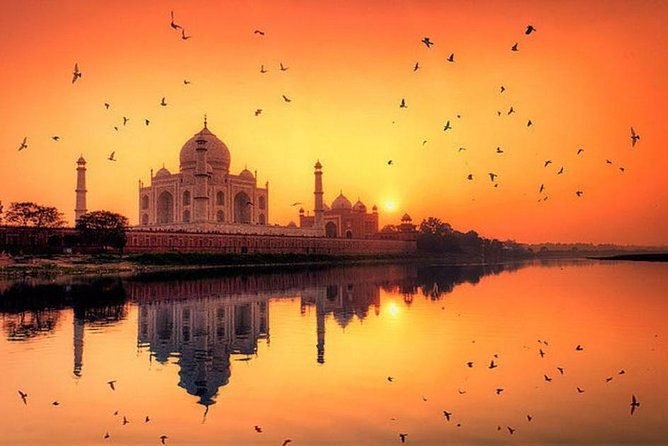
There is a reason experienced India travelers consistently rank the Taj Mahal at sunrise as one of the great travel experiences in the world — and it is not the monument alone. The Taj Mahal is extraordinary at any hour. What sunrise adds is the light, the mist, the near-silence, and the particular quality of being in front of one of the world’s most beautiful buildings before the rest of the world arrives. In that first hour after the gates open, with the early morning sun coming in at a low angle and — in October through February — sometimes a thin mist drifting across the Yamuna River behind the monument, the Taj Mahal is something different from what the midday photographs show. It is more intimate, more luminous, and more overwhelming.
This guide covers everything you need to plan and execute a Taj Mahal sunrise visit in 2026: the exact gate opening times by season, which gate to use, how to get there from your hotel, what to bring, where to stand for the best light, and the practical details that make the difference between a rushed, disorganised visit and one of the most memorable mornings of your life.
What Time Does the Taj Mahal Open at Sunrise?
The Taj Mahal opens at sunrise, which changes throughout the year as the sun rises earlier in summer and later in winter. The Archaeological Survey of India (ASI), which manages the monument, sets the opening time to coincide with sunrise and closing to thirty minutes before sunset.
In practical terms, the opening times across the key travel months are as follows. From October through November, sunrise in Agra falls around 6:15–6:30am, and the Taj opens at that time. Through December and January — peak tourist season — sunrise moves later, to around 6:45–7:00am, and the gates open accordingly. By February and March, sunrise shifts earlier again, moving back toward 6:30am. From April through June, sunrise is as early as 5:30–5:45am, and the monument opens correspondingly early — though the summer heat makes the full benefit of the early opening less felt than in the cool months.
For the purposes of a 2026 visit, the practical opening times to work with are approximately 6:00–6:15am in October, 6:15–6:30am in November, 6:45–7:00am in December and January, and 6:15–6:30am in February. Always confirm the exact time for your specific visit date before arrival — times shift by a few minutes through the month and official sources occasionally update them.
The Taj Mahal is closed every Friday. This is the single most important practical detail to check before you build your itinerary around a specific date. If your Agra day falls on a Friday, the Taj is closed and you will need to adjust. Friday closure is for prayers at the mosque on the western side of the complex, and no exceptions are made for any visitor type.
Why Sunrise Is the Best Time to Visit
The case for the sunrise visit is not simply about beating the crowds, though that matters. There are several distinct advantages that make the first hour after opening categorically different from any other time of day.
The light is exceptional. The Taj Mahal faces south, with the main gate on the south side and the river on the north. This means that from the main viewing axis — the long reflecting pool stretching from the main gate toward the plinth — you are looking roughly northward at the monument. In the early morning, with the sun rising in the east, the light comes in from the side and slightly behind you, hitting the white marble of the Taj at a low angle that brings out its texture and depth in a way that the flat overhead light of midday entirely flattens. The marble glows rather than bleaches.
The mist changes everything in winter. From October through February, Agra’s winter mornings sometimes produce a low-lying mist that drifts off the Yamuna River and settles in front of the Taj in the first forty-five minutes after sunrise. This mist — which burns off completely by 8–8:30am — gives the monument a floating quality that has been described by photographers as the most extraordinary atmospheric effect in India. It does not happen every morning, and you cannot predict it from your hotel the night before, but when it does, the combination of first light and morning river mist on the Taj Mahal is something that no amount of travel photography preparation fully prepares you for.
The crowds have not arrived. In peak season (November through February), the Taj Mahal sees thousands of visitors daily. By 9am the crowds are significant. By 10am on a busy December weekend, the main viewing axis and the plinth steps are dense with people and the meditative quality of the monument is impossible to find. In the first hour after opening, particularly on weekdays, the visitor numbers are a fraction of the midday level. You can stand at the end of the reflecting pool with no one in front of you. You can sit on the Princess Diana bench with a clear line of sight. You can walk to the sides of the plinth without navigating around tour groups. This is not guaranteed on a peak-season Saturday but it is reliably true on weekday mornings throughout the year.
The temperature is right. In the hot months — April through June — the Taj Mahal opens early and the first hour is genuinely the only comfortable outdoor period of the day. By 9am in May the temperature has already climbed to 35–38°C and the open marble platforms and gardens in direct sun are genuinely punishing. In November through February, the morning cool makes being outdoors at the Taj actively pleasant in a way that midday cannot replicate.
Which Gate to Use for Sunrise
The Taj Mahal complex has three visitor gates: the South Gate (also called the Main Gate or Great Gate), the East Gate, and the West Gate. Understanding which to use for a sunrise visit matters more than most visitors realise.
The East Gate is the standard recommendation for sunrise visitors arriving from hotels near the Taj East Gate Road. It is typically the least crowded of the three gates at opening time, queues form and move quickly, and from the East Gate the walk through the forecourt takes you to the inner gateway — the Darwaza-i Rauza — in a few minutes. The East Gate area has reliable pre-paid auto-rickshaw and tonga services from the Taj East Gate Road hotels.
The South Gate is the most famous entrance — the main gate with the calligraphic inscriptions and the first glimpse of the Taj framed through the central arch. Tour operators and larger groups often use this gate, and it tends to have longer queues at opening time during peak season. If seeing the Taj first revealed through the arched gateway is important to you (the visual effect is real and worth experiencing), the South Gate is the right choice, but arrive slightly earlier to account for the longer queue.
The West Gate is used primarily by visitors from hotels in the Tajganj area to the west of the complex and from the Shilpgram arts village parking area. It is the least commonly used of the three by international tourists on organised tours and generally has the shortest queues, though it involves a slightly longer walk to the main viewing area.
For most foreign visitors staying on the East Gate Road or arriving by private vehicle from Delhi, the East Gate is the practical recommendation for sunrise. Confirm with your tour operator or driver the night before, as they will know current traffic and queue patterns.
How to Get to the Taj Mahal for Sunrise
From hotels near the Taj East Gate: The closest hotels to the East Gate are a five to fifteen minute walk. Walking is possible in good conditions but the streets around the Taj Mahal gate area are congested even at 6am with cycle rickshaws, auto-rickshaws, and other visitor traffic. A pre-paid electric bus or cycle rickshaw for the last stretch is the standard approach.
From hotels further in Agra city: A private vehicle from your hotel to the Taj vehicle drop-off zone — the closest point cars can reach — followed by the electric green bus service (₹50 per person) or a cycle rickshaw to the gate. Alternatively, walking from the drop-off zone takes around ten to fifteen minutes.
The vehicle exclusion zone: Private vehicles cannot enter the immediate area around the Taj Mahal — there is an exclusion zone enforced to protect the monument from vehicle pollution. Battery-operated buses (green buses) and cycle rickshaws operate within this zone and are the standard last-leg transport.
From Delhi on a day trip: A very early departure from Delhi makes the Taj Mahal sunrise visit possible on a same-day trip from Delhi. The Yamuna Expressway from Delhi to Agra takes approximately three to three and a half hours in good conditions. Leaving Delhi at 3:00–3:30am gets you to Agra in time for the gate opening. This is a long day but achievable, and many visitors making a single-day Agra trip from Delhi choose the sunrise visit precisely because it allows them to see the Taj at its best before spending the rest of the day at Agra Fort and the Itmad-ud-Daulah.
The Gatimaan Express: If you are traveling by train, the Gatimaan Express departs Delhi Hazrat Nizamuddin at 8:10am and arrives Agra Cantt at 9:50am — too late for sunrise but excellent for a full day visit. There is no train service that allows a sunrise arrival unless you travel the night before and stay in Agra, which is the right approach for anyone wanting the sunrise experience properly.
Tickets and Entry: What You Need
Tickets for the Taj Mahal cannot be booked very far in advance through the ASI system — the booking window is typically limited. On an organised tour, your operator handles ticket logistics. Independent visitors can buy tickets at the gate counters, though for peak season weekends it is worth arriving early specifically to allow for the ticket queue before the gate opens.
The entry fee for foreign nationals in 2026 is ₹1,300 (approximately $15–16 USD) for the main complex. An additional ₹200 (about $2.50) is charged to enter the inner mausoleum — the building itself, where the cenotaphs of Shah Jahan and Mumtaz Mahal rest above the actual tombs. This inner chamber entry is well worth including: the inlay work, the marble screen surrounding the cenotaphs, and the understanding of the scale of the building from inside change how you see the exterior.
There is also a small ₹50 green bus fee if you use the electric transport within the exclusion zone. Shoes must be removed before stepping onto the marble plinth — shoe covers are provided at the base of the plinth steps, or you can bring your own cloth shoe covers. Wool socks in November through February are practical; the marble is cold underfoot in the early morning.
What to Bring for the Sunrise Visit
Camera or phone: The Taj Mahal sunrise is one of the great photography subjects in the world, and whatever camera you have is worth bringing. The lighting conditions — golden horizontal light, possible mist, reflected light off the marble — are excellent for almost any device. If you shoot with a DSLR or mirrorless camera, a wide-angle lens (16–24mm equivalent) handles the full scale of the monument. A zoom lets you pull in the dome and the minarets separately. Tripods are not permitted inside the complex.
Warm layers (October–February): The pre-dawn drive to the Taj gate and the first thirty minutes after opening are cold in the winter months — particularly in December and January when pre-dawn temperatures in Agra drop to 8–12°C. Bringing a jacket or fleece that you can remove as the morning warms is essential. Standing in front of the Taj Mahal in short sleeves at 6:45am in January is a cold experience that distracts from the monument.
Shoe covers or socks: You will remove your shoes at the plinth. Bare feet on cold marble in December or January is uncomfortable. Cloth shoe covers are provided but bringing your own means you do not wait for the distribution queue. Thick socks work equally well.
Water and a small snack: The sunrise visit on an empty stomach is manageable but the full morning — including time inside the mausoleum, a walk around the plinth, and the return through the garden — takes two to three hours. Water is available for purchase inside and outside the complex. No food is permitted inside.
Cash for small purchases: Postcards, cold drinks from the vendors outside the gate, tips for guides — small cash in rupees handles all of these.
Where to Stand: The Best Viewing Spots
The main viewing axis (reflecting pool): The long rectangular pool stretching south from the Taj plinth, flanked by cypress trees, is the classic composition — the one in every photograph. At sunrise, position yourself at the southern end of the pool (furthest from the Taj) for the widest angle on the full monument reflected in the water. The reflection works best when the pool surface is still, which is more likely in the first minutes after the gates open before visitor movement disturbs the water.
The Diana bench: The white marble bench on the eastern terrace, made famous by Princess Diana’s 1992 photograph, gives a slightly elevated and offset view of the Taj that differs from the head-on reflecting pool perspective. In the early morning with few other visitors, sitting on this bench with the Taj to the west and the morning light coming in from the east produces a photograph that is distinctly different from the standard view.
The plinth (the raised marble platform the Taj stands on): Walking up onto the plinth, around and behind the main mausoleum building, gives views that most visitors do not take: the Yamuna River directly behind the Taj, the Agra Fort visible downstream, and — looking back at the garden — the long axis of the reflecting pool and the main gateway framing the southern garden. The mist that sometimes drifts off the river is most visible from the back of the plinth. Sunrise from the rear of the plinth, with the river catching the first light and the dome of the Taj above you, is one of the less photographed but most atmospheric moments in the entire complex.
The mosque and guest house terraces: On either side of the main mausoleum, the red sandstone mosque (to the west) and the jawab or guest house (to the east, built only to balance the composition) have terraces that offer a three-quarter angle on the Taj that is different from any other viewpoint. Permission to access these is included in your entry ticket. The eastern guest house terrace, with the sunrise light coming directly across the face of the monument, is particularly good in October and November.
Inside the mausoleum: The interior of the Taj Mahal in the early morning, before the crowds build, has a quality of light and quiet that the midday visit cannot provide. The white marble interior with the pietra dura inlay work around the cenotaphs catches the early light from the high latticed windows, and the call to prayer from the mosque next door — audible from inside the building — adds an acoustic dimension to the experience that is specific to the morning visit.
Taj Mahal Sunrise by Month: What to Expect
October: Sunrise around 6:00–6:15am. The air is warm by the time you arrive — mornings in the mid-20s Celsius. Post-monsoon clarity means exceptional visibility and brilliant blue skies. No mist. Strong, clear early light that is beautiful but without the atmospheric drama of the winter months. This is an excellent time for colour photography.
November: Sunrise around 6:15–6:30am. Temperatures drop through the month — by late November, pre-dawn mornings are 12–15°C and a jacket is needed. The light becomes warmer and more golden as the month progresses. Early morning mist starts becoming possible in late November. Visitor numbers are building toward peak season but still manageable on weekday mornings.
December: Sunrise around 6:45–7:00am. The latest sunrises of the year. Pre-dawn mornings are cold — 8–12°C. Morning mist is a regular occurrence, particularly in the second half of the month. The Taj in December morning mist is the most atmospheric version of the sunrise visit. Peak tourist season means more visitors at the gate, but the 7am opening and the cold still thin the crowd relative to midday. Christmas week (December 20–27) is the busiest period of the year. Note: December 25, 2026 is a Friday — the Taj is closed.
January: Sunrise around 7:00–7:15am — similar to December. Delhi fog can affect early morning visibility in Agra, though less severely than in Delhi itself. Cold mornings (6–10°C) require proper layering. Still the most atmospheric month for the mist effect, and visitor numbers thin somewhat after the New Year peak.
February: Sunrise moves earlier again, around 6:30–6:45am. Temperatures rise from the January low. The mist effect becomes less reliable as the month progresses and the air dries out. Still excellent weather for the sunrise visit, with good light and manageable crowds before Holi at month’s end.
March: Sunrise around 6:15–6:30am. Holi falls in March (date varies by year). The Holi period brings a surge in domestic tourism and the Taj is busy around the festival. Otherwise, March is still good weather for the sunrise visit, though temperatures are climbing toward the April heat.
Taj Mahal Sunrise Photography Tips
The Taj Mahal is one of the most photographed buildings in the world, and the challenge is making your own images feel fresh rather than like a copy of every other photograph. A few approaches that produce distinctive results in the morning light:
Shoot toward the light rather than away from it. The standard reflecting pool image has the sun behind you and the Taj fully lit in front. Try also shooting with the early sun low on the horizon to the east, with the Taj silhouetted or side-lit — the flare and the dome outline in this direction produce a very different image.
Use the symmetry deliberately. The Taj is a symmetrical building designed to be viewed on axis, and the reflecting pool reinforces this. Centring the composition precisely — using the pool’s centre line and the dome’s apex as your alignment points — produces the image the architecture was designed for.
Look for human scale. A single person on the plinth steps, or a figure on the far bank of the reflecting pool, gives the monument a scale that is otherwise impossible to convey. In the early morning, with few other visitors, creating these compositions is possible in a way that midday crowds prevent.
Move around the complex. The main viewing axis is not the only view. The angles from beside the cypress trees, from the eastern guest house terrace, from the back of the plinth over the river, and from the mosque terrace are all underused by visitors who plant themselves at the pool and stay there.
Common Mistakes to Avoid
Arriving after 8am and expecting the quiet experience. The first hour after opening is the only time the Taj has the quality of morning calm. Once 8am passes, the crowds build quickly. If sunrise is your goal, the visit needs to start at gate opening.
Not checking the day of the week. The Friday closure is missed by a significant number of visitors every year. Check, confirm, and check again.
Leaving the tickets to the last minute. On a busy December weekend, the ticket queue at the gate can take thirty to forty minutes. Arriving at the gate area with your tickets already arranged — through your tour operator or bought in advance — means you enter at opening rather than thirty minutes after it.
Underestimating the cold in winter. The Taj Mahal’s marble plinth with the Yamuna wind coming off the river at 7am in January is cold in a way that the afternoon temperature at your Agra hotel does not prepare you for. Bring layers.
Rushing the visit. Two hours is the minimum to experience the Taj Mahal sunrise properly: the main garden and reflecting pool, the plinth exterior and both side terraces, the interior of the mausoleum, and the rear view over the river. Three hours is comfortable. Visitors who give it forty-five minutes leave having seen the building but missed the experience.
Frequently Asked Questions
What time does the Taj Mahal open for sunrise in 2026?
The Taj Mahal opens at sunrise, which varies by month. In October it is approximately 6:00–6:15am; November 6:15–6:30am; December–January 6:45–7:00am; February 6:30–6:45am; March–April 6:00–6:30am. Always verify the exact time for your specific date, as it shifts through the month.
Is the Taj Mahal worth visiting at sunrise?
Yes — unambiguously the best time of day. The combination of golden light on the white marble, possible early morning river mist from October through February, and far fewer visitors than midday makes the sunrise visit a categorically different experience from any other time. Most visitors who have been at both sunrise and midday say there is no comparison.
Which gate is best for the Taj Mahal sunrise visit?
The East Gate is the standard recommendation for sunrise visitors — typically the fastest queue at opening time and the most convenient from East Gate Road hotels. The South Gate gives you the famous framed first view of the Taj through the main arch but usually has a longer queue. Confirm with your driver or guide the night before.
What is the entry fee for the Taj Mahal in 2026?
Foreign national entry is ₹1,300 (approximately $15–16 USD) for the main complex, plus ₹200 ($2.50) for the inner mausoleum. The mausoleum entry is worth including. A ₹50 green bus fee applies if using the electric transport within the vehicle exclusion zone.
Is there morning mist at the Taj Mahal?
Morning mist drifting off the Yamuna River is possible from October through February, most likely in December and January. It is not guaranteed on any specific morning — it depends on overnight temperatures and humidity. When it occurs, it burns off by around 8:00–8:30am. If mist is one of your priorities, a mid-December or January visit gives the best probability.
Can I visit the Taj Mahal on a day trip from Delhi for sunrise?
Yes, but it requires a 3:00–3:30am departure from Delhi to arrive in time for the gate opening. The Yamuna Expressway from Delhi takes approximately three to three and a half hours in pre-dawn traffic. This makes for a very long day but is achievable. Most visitors who want the sunrise experience properly choose to spend the night in Agra and visit rested.
Is the Taj Mahal open on Sundays?
Yes. The Taj Mahal is open every day except Friday. Sundays are among the busier days, with domestic visitors joining international tourists. For the best sunrise experience, a weekday (Monday through Thursday or Saturday) gives fewer crowds at opening.
How long should I spend at the Taj Mahal at sunrise?
Allow at least two hours. Three is comfortable. The full sunrise visit covers: the garden and reflecting pool (30–40 minutes), the plinth exterior and side terraces (30–40 minutes), the interior mausoleum (20–30 minutes), the rear of the plinth over the river (15–20 minutes), and the return walk through the garden as the morning light shifts. Visitors who rush through in under an hour leave having seen the building without experiencing the monument.
The Taj Mahal at sunrise is the single experience that most visitors to India’s Golden Triangle describe as the one they remember longest. Getting there first, before the crowds and the overhead light, is the difference between a beautiful photograph and something that stays with you.
Squid Travel India arranges private Agra and Golden Triangle tours that include an expert-guided Taj Mahal sunrise visit — arriving at gate opening, guides at the monument, and the full morning spent at the complex without rushing. Contact us to plan your 2026 visit.

Comment (0)