India is three hours from Dubai. No jet lag, no long-haul fatigue — the Golden Triangle is one of the most accessible escapes in the world from the UAE, and 2027 is the right time to book it.
No other major international travel market sits as close to India as the UAE. Delhi is three hours from Dubai by air — shorter than the drive from Abu Dhabi to Ras Al Khaimah on a busy day. The time difference is just ninety minutes, so there is no meaningful jet lag to manage and no recovery day built into the itinerary. What takes British travelers a full day of travel and an adjustment period is, from the UAE, an afternoon flight and an arrival evening.
This proximity changes what the Golden Triangle can be for UAE residents. It is not only a one-week annual holiday — it is a genuinely viable long-weekend escape, a four-day trip that leaves Friday morning and returns Monday evening with the Taj Mahal, Jaipur, and Delhi all visited. Few destinations in the world offer that combination of historical depth and practical accessibility from the UAE, and the Golden Triangle offers it at a price point that makes the short trip worth every dirham.
The UAE is also home to one of the world's largest Indian diaspora communities, and for many UAE residents the Golden Triangle carries a personal dimension that is not present for most Western travelers — it is a heritage journey, a first trip back with a spouse or children who have never seen North India, or simply a long-overdue reconnection with a world that is simultaneously familiar and extraordinary. For expats of all nationalities who have built their lives in the UAE, North India is the most accessible introduction to the subcontinent and one of the most rewarding trips in the region.
The timing relationship between the UAE and India is unusually convenient. The months when the UAE becomes genuinely difficult to be outdoors — June, July, August, and much of September — are India's monsoon and tail-end summer, which are not ideal travel months in North India either. But from October onwards, as Dubai cools into its own pleasant season, India's golden travel window opens simultaneously. The two countries share the same peak period, which means UAE residents are leaving pleasant weather for equally pleasant weather, and the Golden Triangle in October, November, December, and January is simply the best version of itself.
UAE National Day (December 2–3) creates a natural long-weekend into peak India season. Combined with annual leave, it is one of the best windows for a Golden Triangle trip from the UAE.
Diwali (October/November) is a deeply meaningful time for UAE residents with Indian heritage to visit North India — Jaipur lit up for Diwali is extraordinary. It also falls in excellent travel weather.
Holi (March) is a one-day festival that transforms every city in North India into a colour celebration — a natural long-weekend trip from the UAE, arriving Thursday and returning Sunday.
The UAE has arguably the best flight connectivity to Delhi of any city in the world. From Dubai, Emirates, Air India, IndiGo, SpiceJet, and flydubai all operate multiple daily direct services to Indira Gandhi International Airport, with the total flight time sitting at around three hours. Fares are frequently competitive given the volume of traffic on this route, and multiple daily departures mean that a Thursday evening flight out and a Monday morning return is a genuinely viable long-weekend structure.
From Abu Dhabi, Etihad and Air India both operate direct services to Delhi with similar frequency and flight times. Sharjah residents have Air Arabia, which operates direct Delhi flights at typically lower fares than the full-service carriers — worth checking for value-conscious travelers who are flexible on timing.
The return routing from Jaipur to the UAE — via Delhi on a domestic connection — adds around two hours to the return journey but saves the five-hour road transfer back from Jaipur to Delhi at the end of the trip. For a seven-day tour, that extra half-day in Jaipur is genuinely worth more than the connection time saved by backtracking to Delhi by road.
Visa requirements for India depend entirely on your passport, not your UAE residency status. The UAE is home to hundreds of nationalities, and the requirements vary significantly.
Indian passport holders, including those holding OCI (Overseas Citizen of India) status, do not require a separate visa to enter India. OCI cardholders can enter India on a lifelong, multi-entry basis — no application required before each trip. This applies to a substantial proportion of UAE residents and makes India one of the easiest destinations in the world for them to visit.
All other passport holders — including holders of British, American, Australian, Pakistani, Filipino, and most other passports — require a visa to enter India. The e-Visa is the simplest and fastest route, applied for online through the official Indian government portal. Processing typically takes 72 to 96 hours, and the visa is valid for 90 days from entry with double entry permitted. Apply at least two weeks before your departure date to allow for processing during peak periods.
Indian passport / OCI card: No visa required. Enter directly.
All other passports: e-Visa required. Apply at indianvisaonline.gov.in (official portal only — avoid third-party sites charging inflated fees).
Processing time: 72–96 hours. Allow two weeks around UAE National Day and December peak period.
e-Visa cost: Approximately AED 55–75 depending on passport and exchange rate.
The three-hour flight and minimal time difference make the Golden Triangle uniquely suited to a short break from the UAE — something not possible from Australia, the UK, or the US. Both trip lengths have a logic to them, and the right one depends on how much of the Golden Triangle you want to experience.
This itinerary is built around a Friday evening departure from Dubai — a natural booking pattern for UAE residents — arriving in Delhi early Saturday morning to begin the tour immediately without losing a travel day.
Delhi is the entry point to the Golden Triangle and a city that rewards preparation. It is simultaneously the Mughal capital of the 17th century, the British colonial capital of the early 20th century, and one of the world's fastest-growing modern megacities — all visible within a few miles of each other. Old Delhi (Shahjahanabad) is the medieval city Shah Jahan built; New Delhi is the formal colonial capital Edwin Lutyens designed for the British Raj. Both deserve time.
For UAE residents with Indian heritage, Delhi has a particular resonance — the food, the sounds, the density, the colour are all versions of things that feel familiar and yet are amplified beyond what any diaspora neighbourhood in the UAE can replicate. For expats of other nationalities experiencing North India for the first time, Delhi's scale and intensity is unlike anything else in the region. Chandni Chowk, the spice market, the lanes behind Jama Masjid — give Old Delhi a full morning and it rewards you with a different understanding of what a city can be.
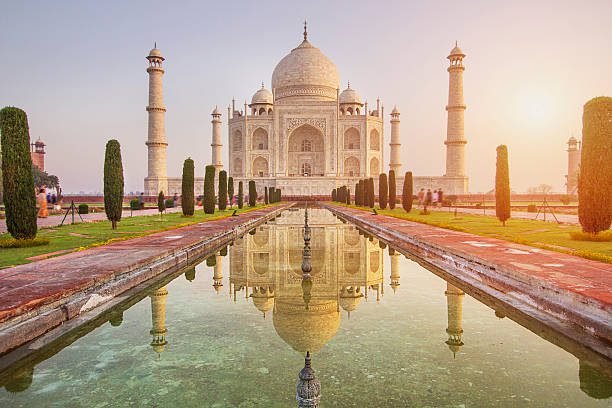
Agra is built around one monument, and that monument is the Taj Mahal. It is worth saying plainly: photographs do not prepare you for it. The scale, the symmetry, the quality of the inlaid marble, the way the structure changes colour across the morning — these are things that only make sense in person. Most visitors who have traveled widely and seen extraordinary things still count the Taj as a different category of experience.
Visit in the late afternoon on day one and return at sunrise on day two. They are genuinely different experiences — the afternoon light is warmer and the complex is quieter; the sunrise visit is the classic one, with the marble shifting from pink to white as the light builds and the reflecting pool catching the dome. Both are worth the entry fee. Beyond the Taj, Agra Fort is a substantial monument in its own right — the red sandstone fortress where the Mughal court ruled and where Shah Jahan was later imprisoned by his own son, with the view of the Taj visible across the river.
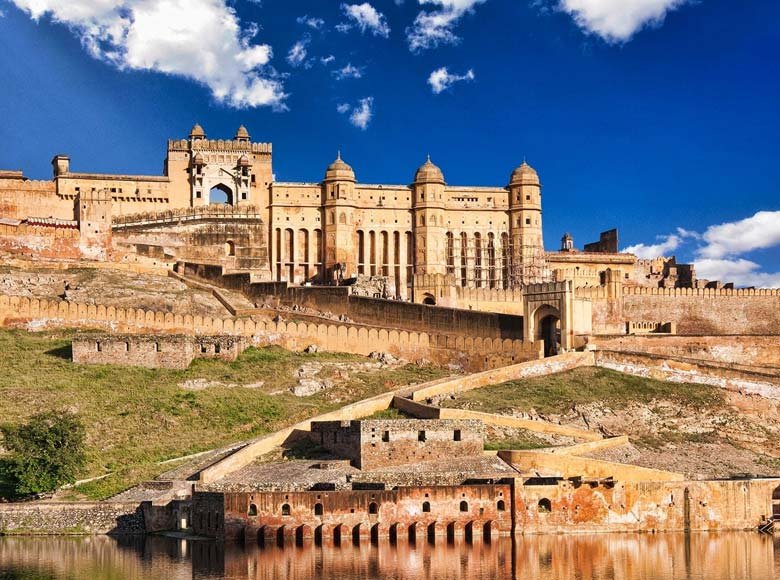
Jaipur is where the Golden Triangle reveals India at its most architecturally spectacular. The old walled city is painted terracotta-pink — a colour applied in 1876 to welcome the Prince of Wales — and the effect against the Aravalli Hills, with the Amber Fort on the ridge above and the bazaars in full swing below, is unforgettable. For UAE residents from India's west coast or south, Jaipur's Rajputana architecture and desert-palace character is a genuinely different version of the country.
Amber Fort is the crown monument — a Rajput palace-fortress built over centuries that blends Hindu and Mughal architectural styles across four extraordinary courtyards. Allow at least two and a half hours. The Johari Bazaar in the old city is one of India's great gem and jewellery markets; for UAE residents accustomed to gold souks, the quality and variety of gemstones here is worth at least a browsing afternoon. The Jantar Mantar observatory, often rushed on group tours, is quietly one of the most fascinating monuments in the city — a working astronomical instrument at an architectural scale.
The Taj Mahal closes every Friday, without exception. For UAE residents departing on a Thursday evening or Friday morning, this matters directly — a Friday arrival in Agra means you cannot visit the Taj that day.
Any reliable operator will plan the Agra visit to avoid Friday automatically. If yours hasn't mentioned it, ask the direct question: "Does our Agra visit fall on a Friday?" The fix is always simple — shift the Agra day by one — but it needs to be caught before you confirm, not after you arrive.
Given the short flight home, UAE residents often add an extension before returning. The accessibility of the UAE–India route makes this easy to arrange, and the domestic flight network within India connects Jaipur or Delhi to any of these destinations in under two hours.
Tell us your travel dates, group size, and what matters most — the Diwali atmosphere, the Taj sunrise, the Jaipur bazaars, or a tiger safari on the way. We'll put together a private 4-day or 7-day itinerary so your trip from Dubai runs without a single avoidable headache.