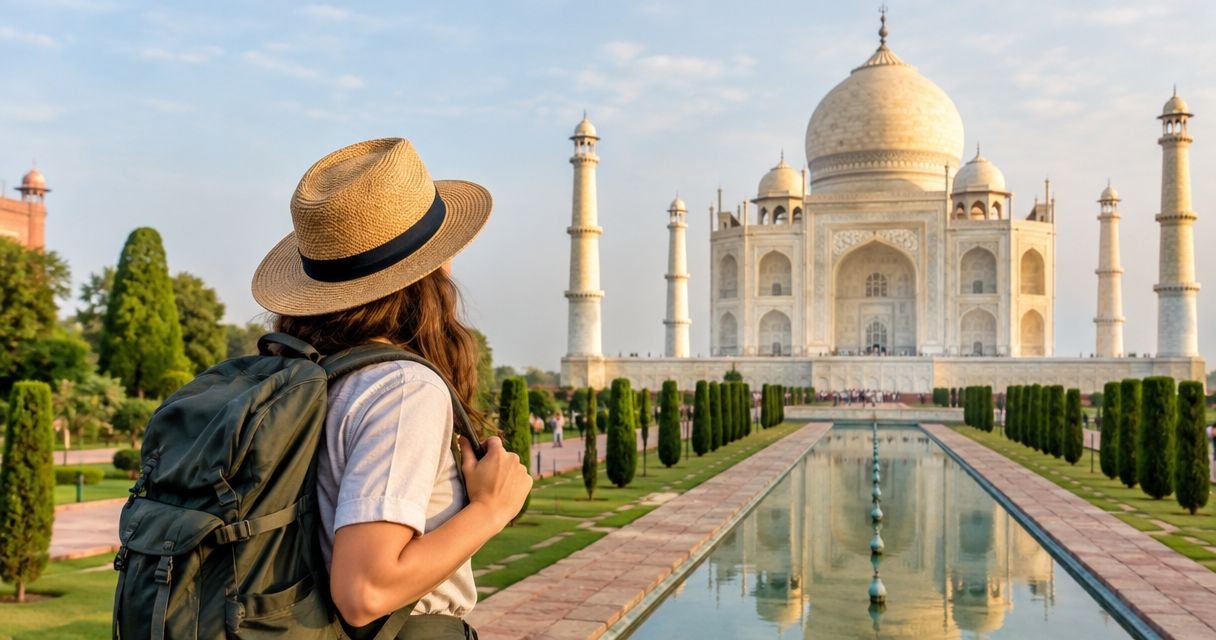
Planning a trip to India from Australia involves a quirk that travellers from the Northern Hemisphere don't face: your seasons run opposite to India's. When Australia is in the grip of summer, India is at its finest. When Australian families head off on school holidays in July, India is in full monsoon. Getting the timing right is especially important for Australians — and it turns out two of your school holiday windows are genuinely excellent for India.
This guide is written for Australian travellers — temperatures in °C (with °F for reference), pricing in AUD, and timing mapped to Australian school holiday windows across NSW, Victoria, Queensland, SA and WA. The short answer: April school holidays and September–October school holidays are Australia's best windows for India, and the December–January holidays work beautifully too (just at the highest price point).
⚠️ Critical for 2026 Christmas travellers: December 25, 2026 is a Friday. The Taj Mahal closes every Friday — no exceptions. Australian families visiting India over the Christmas–New Year break must plan Agra for Thursday 24 December or Saturday 26 December. Check any tour itinerary against this date before you book.
Why Australia's Seasons Work in Your Favour
Australia's seasonal reversal is actually a significant advantage for India travel. India's prime season (October to February) falls across Australia's spring and summer — periods that include the April school holidays, September–October school holidays, and the Christmas–January break. India's worst season (the June–August monsoon) falls precisely during Australia's winter holidays. Here's how the two countries' seasons line up:
🌏 Australia vs India Seasonal Alignment
October half-term🌸 Aus Spring✅ Post-monsoon India — excellent
Nov–Dec (early)☀️ Early summer✅ India peak season begins
Christmas–Jan🏖 Aus summer✅ India peak — ideal weather, high price
Late Jan–Feb☀️ Late summer✅ India's finest weather (no fog)
April school hols🍂 Aus Autumn✅ Warm, shoulder price — great value
July school hols❄️ Aus Winter❌ India full monsoon — avoid Golden Triangle
Sept–Oct (spring)🌸 Aus Spring✅ Post-monsoon India — great value
❄️
Peak Season
Nov · Dec · Jan · Feb
Best weather
13–26°C (55–79°F). India's finest weather — clear skies, cool mornings, warm days. Coincides with Australian summer and Christmas holidays. Highest prices of the year.
🌸
Shoulder
Oct · Mar · early Apr
Best value
20–32°C (68–90°F). Warm, clear, comfortable. October aligns with Australian spring school holidays — excellent timing at 20–30% below Christmas prices.
🌞
Hot Season
Apr · May · Jun
Early April OK
26–45°C (79–113°F). Australian April holidays land in this window. Early April (first two weeks) is warm but manageable; late April and May are too hot for the Golden Triangle.
🌧
Monsoon
Jul · Aug · Sep
Jul–Aug: Avoid
26–33°C (79–91°F). Heavy rain, flooding. Australian July winter holidays fall in full monsoon — worst overlap on the calendar. September improves as monsoon withdraws.
Month-by-Month Guide (°C)
Peak
January
13–22°C (55–72°F)
Indian winter at its most photogenic — cool mornings (7°C / 45°F in Delhi at dawn), bright clear afternoons ideal for Jaipur and Agra. Winter mist sometimes delays Taj sunrise visits. Excellent for Australians accustomed to heat. Australian summer — good timing for families already on summer break.
★★★★★
Peak
February
14–26°C (57–79°F)
The finest weather month. Delhi's winter fog has cleared, days are warm and bright, spring flowers appear. Holi (late Feb or early March) makes Jaipur spectacular. For Australians on summer break before late Feb, this is an outstanding window. Prices slightly below Christmas peak — value picks up from late January.
★★★★★
Shoulder
March
20–33°C (68–91°F)
Warming quickly but very pleasant in early March. Holi falls in March or April — one of India's most vibrant festivals, sensational in Jaipur. Prices 20–25% below Christmas peak. Australian school terms are mid-March to April, so travel is mostly adults and couples. Excellent month for India.
★★★★★
Best for AU
April
26–38°C (79–100°F)
Australian April school holidays fall here — and early April (first two weeks) is warm but very manageable with a private driver and air-conditioned hotels. Mornings are glorious. Holi sometimes falls in early April. Late April crosses 36°C+ — budget for early morning sightseeing only. Overall the best-value Australian school holiday window for India.
★★★★★
Avoid
May
32–45°C (90–113°F)
Extreme heat — the Taj Mahal marble reflects intense heat haze by 10am. Not recommended for first-time visitors or families. Cheapest month of the year. The Himalayas (Ladakh, Shimla) are at their best — a real alternative for Australians locked into this window.
★★★★★
Avoid
June
32–43°C (90–109°F)
Extreme heat and monsoon arriving mid-June. Dust storms and thunderstorms. Australian winter begins — but India's conditions make the Golden Triangle a poor choice. Ladakh (June–September) is genuinely spectacular if you must travel to India in June.
★★★★★
Monsoon
July
27–35°C (81–95°F)
Australian July school holidays hit India's worst month — full monsoon, heavy rain, flooded roads between Delhi and Agra, 90%+ humidity. The worst timing overlap for Australian families. Strongly recommend Ladakh (dry season), the Western Ghats hill stations, or postponing to September–October school holidays.
★★★★★
Monsoon
August
26–34°C (79–93°F)
Peak monsoon. India's Independence Day (15 August) is electric in Delhi — patriotic fervour, flag ceremonies, atmosphere everywhere. But rain disrupts sightseeing. Rajasthan forts look dramatically lush in the monsoon green — for adventurous travellers only, not families. Cheapest hotel prices of the year.
★★★★★
Improving
September
25–33°C (77–91°F)
Monsoon retreating by mid-September. Landscapes intensely green after the rains. Very few tourists — some Australians on spring school holidays (SA, WA). Prices low. Late September is often excellent with clear skies returning. Experienced India travellers love the empty monuments and vivid colours.
★★★★★
Best for AU
October
22–33°C (72–91°F)
Post-monsoon freshness — green landscapes, clear blue skies, comfortable temperatures. NSW, Victoria and Queensland spring school holidays land here. Diwali (Festival of Lights) often falls in October, making Jaipur and Delhi magical. Shoulder pricing is 20–30% below Christmas. The finest value window on the calendar for Australians.
★★★★★
Peak
November
17–28°C (63–82°F)
Excellent weather and low crowds relative to Christmas. Diwali atmosphere in early November. Soft winter light makes the Taj Mahal's white marble glow. No Australian school holidays — ideal for couples and adult travellers. Prices at the start of peak season — good value before Christmas premiums take hold.
★★★★★
Peak
December
13–23°C (55–73°F)
Peak season and the most popular Australian window. Ideal weather, heritage hotels beautifully festive. Australian summer holidays begin — a natural fit. Highest prices of the year. Taj closed 25 Dec 2026 (Friday). Book Sydney/Melbourne/Brisbane to Delhi flights 5–6 months ahead — they fill up.
★★★★★
Australian School Holiday Windows
🍂
April School Holidays — Best Value Aussie Window
Australian April school holidays are the best-value window for India, and the one that surprises most Australians. The first two weeks of April see comfortable 26–33°C temperatures in Delhi and Agra — warm but very manageable with a private air-conditioned vehicle and well-chosen hotels that have pools. Mornings are still cool enough for extended monument visits. Holi sometimes falls in early April, turning Jaipur into a celebration of colour. Prices are at mid-shoulder level — 25–35% below Christmas — and availability is excellent. Note: late April (the last week) pushes toward 38°C and requires adjusted early-morning-only sightseeing.
⭐ Best value school holiday window
🌸
September–October School Holidays — Post-Monsoon Hidden Gem
School holiday timing varies by state: New South Wales and Victoria have October school holidays (late September to mid-October), while Queensland, SA and WA sometimes have earlier September holidays. All of these windows land in India's post-monsoon shoulder season — arguably the most underrated time to visit. The rains have just ended, the Rajasthan landscapes are an extraordinary deep green against the sandstone forts, skies are brilliantly clear, and temperatures drop to a comfortable 22–30°C (72–86°F). Diwali often falls within or just after this window, making Jaipur evenings spectacular. Prices are 20–30% below Christmas. The best all-round timing for Australian families who don't want to pay Christmas prices.
⭐ Top pick for families — best weather-to-price ratio
🎄
Christmas & New Year — Popular but Pricey
The most popular Australian window for India — and the best weather of the year. Delhi, Agra and Jaipur are at their most photogenic (13–23°C / 55–73°F), Rajasthan's heritage hotels add festive glamour, and New Year's Eve at a palace hotel in Jaipur is genuinely unforgettable. The downsides are the highest prices of the year (flights from Sydney or Melbourne can exceed AUD $2,200+ return at Christmas), the most crowded Taj Mahal, and the need to book 5–6 months in advance. For 2026: December 25 is a Friday — Taj Mahal closed. Plan Agra for December 24 or December 26.
⚠ Book 5–6 months ahead · Taj closed 25 Dec 2026
❄️
July School Holidays — Worst Timing for Golden Triangle
Australian July winter holidays fall in India's peak monsoon. The Golden Triangle (Delhi–Agra–Jaipur) receives heavy rain, the Agra–Jaipur road can flood, humidity reaches 90%+, and 30–32°C temperatures with that humidity make prolonged sightseeing exhausting. However, if July is the only window available: Ladakh (dry season: June–September) is spectacular — high-altitude desert with clear skies and dramatic mountain scenery. Himachal Pradesh (Shimla, Manali, Kasol) is lush and beautiful in the monsoon rains. The Golden Triangle is the option to avoid; the Himalayas are not.
Not recommended for Golden Triangle
Seasonal Pricing Guide (AUD)
Australia's distance from India makes flights the biggest cost variable. Here's how pricing shifts across the seasons, in Australian dollars:
✈️ Return flights (from Sydney/Melbourne)
Christmas peakAUD $1,800–$2,600
Oct school holsAUD $1,100–$1,600
April school holsAUD $950–$1,400
Monsoon (Jul–Aug)AUD $700–$1,050
🏨 Mid-range hotel (per night)
Christmas peakAUD $130–$220
Oct school holsAUD $80–$135
April school holsAUD $65–$110
Monsoon (Jul–Aug)AUD $45–$80
🚗 Private car & driver (per day)
Christmas peakAUD $65–$95
Oct school holsAUD $50–$75
April school holsAUD $45–$68
Monsoon (Jul–Aug)AUD $38–$58
💡 The October school holiday saving: A 7-night Golden Triangle trip over October school holidays can cost AUD $1,500–$2,500 less per person than the same trip at Christmas — for nearly identical weather. A family of four saves AUD $6,000–$10,000 on the same experience.
What Australian Travellers Should Know
- 🕌
The Taj Mahal is closed every Friday. No exceptions. Plan your Agra visit on any day except Friday. In 2026, December 25 is a Friday. Review any tour itinerary specifically against this rule before paying a deposit.
- ✈️
Flight options from Australia. Singapore Airlines (via Singapore), Air India (via various hubs), Qantas codeshare, Emirates (via Dubai), and Qatar Airways (via Doha) all service the Sydney/Melbourne/Brisbane to Delhi route. Singapore Airlines is consistently rated highest for Australia–India. Direct flights are limited; most routings are 13–17 hours with one stop. Book 5–6 months ahead for Christmas; 3–4 months for school holiday shoulder periods.
- 🛂
e-Visa required for Australian passport holders. Apply at indianvisaonline.gov.in. Cost is approximately USD $25 (AUD $38). Processing takes 2–4 business days. Apply at least a week before travel. OSHC and Medicare do not cover you in India — get proper travel insurance that includes medical evacuation (Medibank International, World Nomads, and Cover-More all offer India coverage).
- ⏰
Time zone: IST is behind Australia. India Standard Time (UTC+5:30) is behind Australian Eastern time. In AEST (Oct–Apr), India is 4.5 hours behind. In AEDT (summer), India is 5.5 hours behind. This means early morning calls home are fine; calling Australia in the afternoon from India reaches people in the evening or night. Jet lag is typically mild — India's cool mornings encourage early rising, which is ideal for monument visits before crowds.
- 💳
Currency and payments. Wise and Revolut are popular with Australian travellers for fee-free AUD–INR conversion. Major Indian cities have widespread ATMs accepting international cards. Notify your bank of travel. The INR exchange rate is generally favourable for Australians — India remains excellent value against the AUD.
- 🌡
Packing for April visits. April is warm — pack light cotton clothing and sun protection. Mornings can be cool enough for a light layer before 8am. Sunglasses and a wide-brim hat are essential. For December–February visits, add a fleece or light jacket for Delhi and Agra early mornings (7–10°C / 45–50°F at dawn).
Frequently Asked Questions
What is the best time to visit India from Australia?
+
October–February is India's prime season, and two Australian school holiday windows land in it perfectly. October school holidays (NSW, Vic, QLD) deliver post-monsoon freshness at 22–30°C, with prices 20–30% below Christmas. April school holidays offer warm but manageable 26–33°C (first two weeks), at shoulder prices. Christmas–January gives the finest weather but the highest cost and crowds. July school holidays are the worst timing — full monsoon in India.
Are Australian school holidays a good time for India?
+
October school holidays (NSW, Victoria, QLD — late September to mid-October) are excellent: post-monsoon weather, Diwali possible, and 20–30% below Christmas pricing. April school holidays are the best value: early April is warm but very do-able with the right tour setup. December–January holidays are perfect weather but peak pricing and crowd levels. July school holidays are the one to avoid — full Indian monsoon.
Can Australians visit India over Christmas?
+
Absolutely — Christmas is excellent for India. Weather in Delhi, Agra and Jaipur is ideal (13–23°C), Rajasthan's heritage hotels are at their most festive, and New Year in a Jaipur palace is a bucket-list experience. The cost is the downside: flights from Sydney or Melbourne can exceed AUD $2,200 return at Christmas, and hotels are 50–70% above shoulder prices. Critical 2026 note: December 25 is a Friday — Taj Mahal closed. Plan Agra for December 24 or December 26. Book at least 5–6 months ahead.
What is the worst time to visit India from Australia?
+
July is the worst month for the Golden Triangle — and it's Australian school holidays. India is in full monsoon: heavy rain, flooding between cities, 90%+ humidity, and 30–33°C temperatures that feel far worse in the humidity. If July is your only window, consider Ladakh (July is peak season there — spectacular high-altitude desert) or Himachal Pradesh (lush monsoon valleys) instead of the Golden Triangle. May and June are also extreme heat (40–45°C) and not recommended.
What is the time difference between Australia and India?
+
India Standard Time (IST, UTC+5:30) is behind Australian Eastern time. When Australia is on AEST (UTC+10, roughly May–October), India is 4 hours 30 minutes behind. When Australia is on AEDT (UTC+11, roughly October–April), India is 5 hours 30 minutes behind. Flights from Sydney or Melbourne to Delhi take about 11–12 hours direct (Air India) or 13–17 hours with a stop (Singapore Airlines, Emirates, Qatar). Jet lag from Australia to India is generally mild and adaptation fast, since the direction of travel (westward) is easier on the body clock.
Ready to Plan Your India Trip from Australia?
Tell us your Australian school holiday window and we'll build a private Golden Triangle itinerary around your dates — Taj Friday guaranteed, AUD pricing, and no hidden charges.
WhatsApp: +91 99908 12499 · Squidtravelindia@gmail.com