Everything British travelers need to know — flights, visa, best months, a 7-day itinerary, and the one thing every UK visitor must check before booking Agra.
The Golden Triangle — the circuit connecting Delhi, Agra, and Jaipur — is one of the world's most visited travel routes, and British travelers have a particular affinity for it that goes beyond the monuments. The historical connection between Britain and India runs deep through every city on this circuit: the Raj-era architecture of Delhi's Lutyens district, the colonial-period buildings that sit alongside Mughal splendour in Agra, the British legacy woven into Jaipur's formal city plan. Traveling the Golden Triangle as a British visitor is not just sightseeing — it is traveling through a shared and complicated history that is worth understanding before you arrive.
Practically speaking, the logistics also suit British travelers well. The direct flight from London Heathrow to Delhi takes approximately eight and a half hours — short enough to manage on a one-week trip and straightforward enough that the Golden Triangle works as an annual leave itinerary rather than requiring a sabbatical. The time difference of five and a half hours is easier to adjust to than a transatlantic crossing, and most travelers find themselves comfortably oriented within 24 to 36 hours of landing.
English is widely spoken throughout the Golden Triangle, with guides, hotel staff, drivers and market vendors across Delhi, Agra, and Jaipur communicating confidently with British visitors. India has the world's largest English-speaking population and the Golden Triangle, as the country's most international tourist corridor, has the highest concentration of English fluency outside of the major cities.
The Golden Triangle has a clear seasonal rhythm. The monsoon runs from July through September, the summer heat peaks between April and June, and the genuine sweet spot — cool, dry, and brilliantly clear — runs from October through March. For British travelers, this aligns naturally with the school holiday calendar and the desire to escape the UK winter.
October half-term falls perfectly in the post-monsoon window — warm, clear, and before the peak Christmas crowds arrive. Christmas and February half-term are both excellent weather windows, though December and February hotels book out quickly. Easter catches the end of the good season — March is still comfortable, early April is manageable.
London Heathrow is the main UK departure point for India, with direct flights to Delhi operated by British Airways, Air India, and Virgin Atlantic. The direct flight time is approximately eight and a half hours, making Delhi one of the more accessible long-haul destinations from the UK — shorter than flights to Southeast Asia or Australia and without the connection complexity of North American routes.
British Airways and Air India both operate daily direct services from Heathrow to Indira Gandhi International Airport (DEL), with departures typically in the evening that land in Delhi mid-morning local time — well-timed for a smooth first day. Virgin Atlantic also serves the route with competitive fares and strong on-board service on the long-haul sector.
From Manchester, Birmingham, and Edinburgh, connecting services via Dubai (Emirates), Abu Dhabi (Etihad), or Doha (Qatar Airways) add approximately three to four hours to the journey time but can offer significantly better fares. Qatar Airways in particular is worth checking from northern UK airports — their connections through Doha are efficient and the total journey time to Delhi is typically around twelve hours.
Most travelers arrive into Delhi and depart from Jaipur, making the Golden Triangle a natural one-way route with no backtracking. Jaipur International Airport (JAI) has direct connections back to London via Delhi or via Gulf hub carriers, and routing your departure from Jaipur rather than Delhi saves the return road transfer and adds an extra half-day in Rajasthan.
British citizens require a visa to enter India. The e-Visa system is the simplest route and covers tourism visits of up to 90 days — more than sufficient for a Golden Triangle trip. The application is made online through the official Indian government e-Visa portal, requires a passport-sized photograph and a scan of your passport data page, and is typically approved within 72 to 96 hours.
Apply at least two weeks before your departure date to allow for any processing delays, particularly during peak season months when application volumes are higher. The e-Visa is linked electronically to your passport — you do not receive a sticker or stamp in advance — and is verified at the airport on arrival. Print a copy of the approval email to carry with you, as some airlines request to see it at check-in.
Apply at: indianvisaonline.gov.in (the official portal — be cautious of unofficial third-party sites charging inflated fees).
Processing time: 72–96 hours normally; allow two weeks around peak season.
Valid for: 90 days from date of entry, double entry.
Cost: Approximately £15–20 depending on exchange rate at time of application.
Seven days is the itinerary we recommend most often for British travelers. It accommodates the five-and-a-half-hour time difference without sacrificing a full day to jet-lag recovery, gives each city proper time, and includes Fatehpur Sikri — the abandoned Mughal capital just outside Agra that most shorter itineraries cut, to their loss. Here is how the seven days typically take shape.
Delhi is the starting point of every Golden Triangle tour and a city of genuine complexity. It is simultaneously the site of the Mughal empire's greatest monuments, the British colonial capital, and one of the world's fastest-growing modern megacities — all visible within a few miles of each other. Old Delhi (Shahjahanabad) is the medieval city that Mughal Emperor Shah Jahan built in the 17th century; New Delhi is the colonial capital that Edwin Lutyens designed for the British Raj in the early 20th century. Both are worth your time.
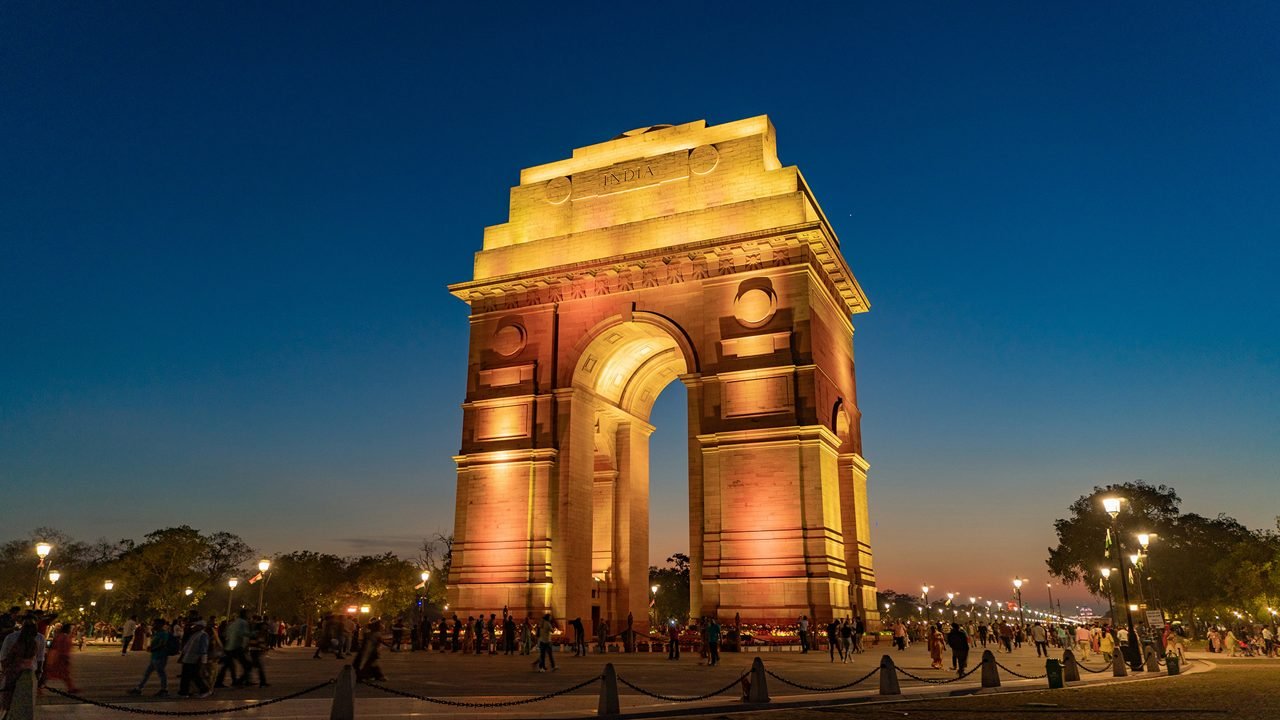
British visitors often find Delhi more familiar than expected — the administrative architecture of Lutyens' Delhi looks uncannily like Whitehall transplanted to the subcontinent, which is precisely what it was designed to do. The India Gate war memorial, built to commemorate Indian soldiers who died fighting for the British Empire in World War I, carries a particular resonance for UK visitors that it may not carry for others.
Agra is a city built around a single monument, and that monument is one of the most extraordinary things human beings have ever made. The Taj Mahal at sunrise — the white marble changing colour as the light shifts, the reflecting pool doubling the dome, the inlaid semi-precious stones catching the first rays — is an experience that photographs prepare you for and reality surpasses anyway. Most visitors have seen thousands of images before they arrive, and they are still not prepared.
Beyond the Taj, Agra Fort is a substantial monument in its own right — a red sandstone fortress that housed the Mughal emperor and later served as a British garrison. From its towers, you can see the Taj Mahal in the distance across the Yamuna River, in the same view that the imprisoned Emperor Shah Jahan is said to have gazed at the tomb he built for his wife from his room in the fort. Plan at least a full morning for the Taj and two to three hours for the fort.
Jaipur, the Pink City of Rajasthan, is where the Golden Triangle reveals India at its most visually spectacular. The old walled city is painted in a distinctive terracotta-pink — a colour applied in 1876 to welcome the Prince of Wales — and the effect on a bright December morning, with the Amber Fort rising on the ridge behind it and the bazaars in full swing below, is unlike anywhere else in the world.
Amber Fort is the crown of Jaipur. Built by the Rajput Maharajas who ruled this desert kingdom before the Mughals and later the British absorbed it, the fort combines Hindu and Islamic architectural styles in a way that reflects the complex alliances and accommodations of Rajasthan's history. Allow two to three hours here — it rewards slow exploration. The City Palace in the old city is still partly occupied by the Jaipur royal family, and the palace museum has one of the finest collections of royal textiles, weapons, and manuscripts in India.
The Taj Mahal closes every Friday, without exception. There is no early access, no special arrangement, and no workaround. If your Agra day falls on a Friday, you will not be able to visit the Taj Mahal.
When planning your itinerary, make sure the Agra night does not put the Taj visit on a Friday. Any good tour operator will check this automatically and build the itinerary around it. If yours hasn't mentioned it, ask the direct question before you confirm: "Does our Agra visit fall on a Friday?"
The fix is always simple — shift the Agra night one day in either direction. It is worth asking before you book, not after you've arrived.
British travelers on a ten-day or longer trip often add one of the following extensions to the Golden Triangle base. Each changes the character of the trip significantly and is worth considering if your time allows.
Tell us your travel dates, group size, and what matters most — the history, the wildlife, the photography, the food. We'll put together a custom 7 or 10-day itinerary with the right hotels, private guides, and transfers so your trip from the UK runs without a single avoidable headache.